

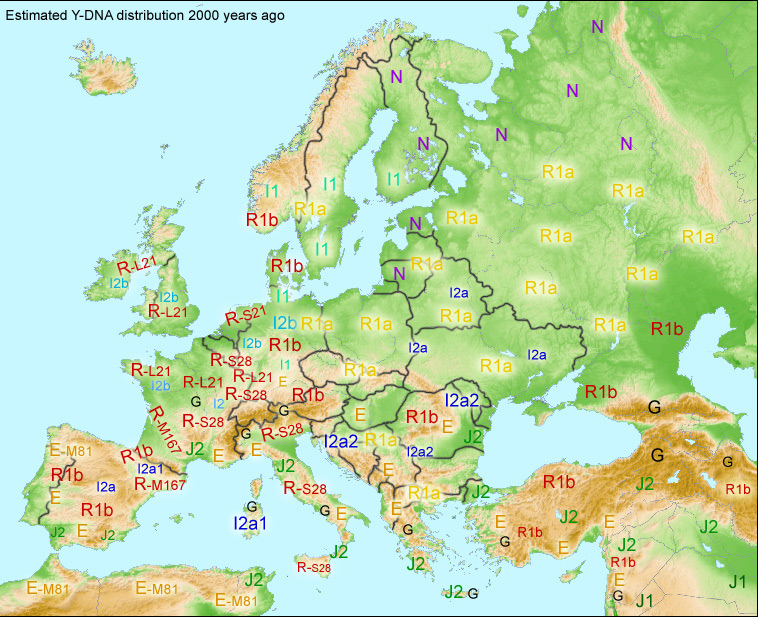
I created this map to give an idea of what Europe might have looked like genetically during the late Bronze Age or early Iron Age.
Methodology
I based myself on the modern haplogroup distribution and deducted the supposed influence of migrations that took place in the last 2000 years.
As it is a hypothetical map it didn't make sense to have pie charts with percentages for each haplogroups. It's already hard to be accurate with the data we have now.
I wanted to display all the haplogroups on a single map, so I opted out the use of a clinal map.
To avoid too much confusion, I only included the main/dominant haplogroups for each region.
Data analysis
Western and Northern Europe
Any haplogroup that does not reach at least 10% of a region's population was ignored. This means all the Near-Eastern haplogroups for northern and western Europe, except for southern Spain, thanks to the presence of the Phoenicians since the foundation of Cadiz over 3,000 years ago, and of course the Greek and Etruscan settlements in Italy and southern France.
Anyhow, it isn't sure whether the presence of haplogroups E, G , J and T in central and northern Europe is entirely due to the expansion of Neolithic farmers from the Near East, or also to later migrations, notably Roman settlements and medieval Jewish migrations.
Scandinavia & Finland
Scandinavia was certainly less mixed 2000 years ago than now. I1 is most common in southern Sweden and western Finland, and was probably even more so back then. R1b is thought to have penetrated from Germany through Denmark and continued to southern Norway. A pocket of R1a now exist in north-west Norway. We don't know why, or when these R1a arrived, so I left it this way.
Haplogroup N represents the Finno-Uralic tribes of Finland and northern Russia. Baltic people are an admixture of N and Slavic R1a.
Iceland was of course empty in the Bronze Age.
Britain & Ireland
Britain had not been colonised by the Romans, Anglo-Saxons, Vikings and Normans yet, so that left pretty much only R1b-L21+ with a frequency above 10%. Ireland still has over 80% of R1b nowadays to confirm that (despite some Viking settlements and 500 years of English colonisation).
Iberia
Most of the I1, R1a and some R1b in Iberia has Germanic origins. A lot of E and J has to be deducted as the Romans had not yet really colonised Iberia, and the Muslim invasion were still to come.
Overall ancient Iberia was a admixture of R1b and I2a. Specific subclades of R1b can be mentioned for the Basque country (M153+) as well as from Catalonia to western France (M167+).
A strong presence of E-M81 exist in Galicia. It is most likely that this presence is quite ancient - certainly over 2,000 years old.
Gaul
Germanic tribes (Goths, Saxons, Burgunds, Franks, Danes) had not yet invaded Gaul, so haplogroups I1, I2b and R1a were left out of Belgium and France. The map is supposed to represent the situation before the Roman expansion outside Italy, so the high percentage of J2 and E in some parts of France were also omitted, as France is known to have been the most Romanised part of the empire outside Italy.
Switzerland
Like for Gaul, the Germanic, as well as Near-Eastern haplogroups were cut out of Switzerland. This leaves mostly the Alpine Celtic R1b-S28. Julius Caesar mass-murdered one million Helvetians during his conquest of Gaul. The ensuing heavy Roman colonisation left little Celtic presence in Helvetia. The later Germanic invasions brought the rest of the modern haplogroups. This is probably one of the regions of Europe that has changed the most genetically in the last 2000 years.
Eastern Europe
The modern presence of Near Eastern haplogroups in Eastern Europe is considerable, and probably has its roots in the strong Jewish presence (in North-East Europe) as well as nearly 1500 years of Byzantine and Ottoman rule (in South-East Europe). Haplogroups E, G, J and T were therefore removed from the Bronze-age map. The only exception is the coast of Romania and south-west Ukraine, which the Greeks colonised (shown as J2 as they were colonised by a part of Greece now dominated by J2).
Baltic countries are now about 40% N3 and 40% R1a. I tried to place both haplogroups side-by-side with the space I had, although it obviously means that the region is mixed N3-R1a.
Likewise, Germanic haplogroups in Eastern Europe are due in big part to the Viking invasions, and especially the German expansion (Teutonic knights in Poland and Lithuania; Transylvanian Saxons in Hungary and Romania; Austrian influence in the Czechoslovakia and Hungary). This eliminated haplogroups I1, I2b and a part of the R1b from the map.
This leaves pretty much R1a all over Eastern Europe, from Bohemia to Russia, although there is a sizeable minority of I2. I2a is only dominant around Croatia and Bosnia.
The R1b shown in Austria, Romania and Bulgaria are meant to match Celtic settlements.
Austria
I hesitated to add R1b in Austria, because most of the R1b nowadays is S21, which probably came with the Ostrogoths and the Lombards, who both settled in Austria for a total of over 200 years before invading Italy. But modern data on R1b subclades in Austria is scarce and there might be more S28. If not it means that most of the Celts living there might have been massacred or displaced by the Romans. The Romans feared the Celts and suffered a lot from their raids into Italy in the in the 3rd and 2nd centuries BCE.
Near East
The Near Eastern admixture of haplogroups E1b1b, G and J is older than 2000 years. G peaks in the Caucasus, around Georgia and Armenia. A lot og J1 and J2 has been found in this region, but is likely the result of the Islamic expansion to Central Asia (especially the presence of pockets of J1). For the sake of simplicity, I preferred to assign only G to the region.
Anatolia and Greece are the most complex. Of course hapogroups R1b, J2, G and E are all mixed up nowadays and there is no way of knowing when each arrived. I placed the haplogroups in function of their highest frequency based on various modern maps of Greece and Turkey (see sources). For example, Crete and East Thrace are hotspots for J2. The border of Albania, Kosovo and Macedonia is high in E1b1b, and so in the historical region of Cilicia in Anatolia.
The Hittites were probably in high part R1b, as they were Indo-European horse-riders related to the Tocharians (known to be R1b). The stronger percentage of R1b around their old kingdom in central Anatolia seems to confirm this.
Methodology
I based myself on the modern haplogroup distribution and deducted the supposed influence of migrations that took place in the last 2000 years.
As it is a hypothetical map it didn't make sense to have pie charts with percentages for each haplogroups. It's already hard to be accurate with the data we have now.
I wanted to display all the haplogroups on a single map, so I opted out the use of a clinal map.
To avoid too much confusion, I only included the main/dominant haplogroups for each region.
Data analysis
Western and Northern Europe
Any haplogroup that does not reach at least 10% of a region's population was ignored. This means all the Near-Eastern haplogroups for northern and western Europe, except for southern Spain, thanks to the presence of the Phoenicians since the foundation of Cadiz over 3,000 years ago, and of course the Greek and Etruscan settlements in Italy and southern France.
Anyhow, it isn't sure whether the presence of haplogroups E, G , J and T in central and northern Europe is entirely due to the expansion of Neolithic farmers from the Near East, or also to later migrations, notably Roman settlements and medieval Jewish migrations.
Scandinavia & Finland
Scandinavia was certainly less mixed 2000 years ago than now. I1 is most common in southern Sweden and western Finland, and was probably even more so back then. R1b is thought to have penetrated from Germany through Denmark and continued to southern Norway. A pocket of R1a now exist in north-west Norway. We don't know why, or when these R1a arrived, so I left it this way.
Haplogroup N represents the Finno-Uralic tribes of Finland and northern Russia. Baltic people are an admixture of N and Slavic R1a.
Iceland was of course empty in the Bronze Age.
Britain & Ireland
Britain had not been colonised by the Romans, Anglo-Saxons, Vikings and Normans yet, so that left pretty much only R1b-L21+ with a frequency above 10%. Ireland still has over 80% of R1b nowadays to confirm that (despite some Viking settlements and 500 years of English colonisation).
Iberia
Most of the I1, R1a and some R1b in Iberia has Germanic origins. A lot of E and J has to be deducted as the Romans had not yet really colonised Iberia, and the Muslim invasion were still to come.
Overall ancient Iberia was a admixture of R1b and I2a. Specific subclades of R1b can be mentioned for the Basque country (M153+) as well as from Catalonia to western France (M167+).
A strong presence of E-M81 exist in Galicia. It is most likely that this presence is quite ancient - certainly over 2,000 years old.
Gaul
Germanic tribes (Goths, Saxons, Burgunds, Franks, Danes) had not yet invaded Gaul, so haplogroups I1, I2b and R1a were left out of Belgium and France. The map is supposed to represent the situation before the Roman expansion outside Italy, so the high percentage of J2 and E in some parts of France were also omitted, as France is known to have been the most Romanised part of the empire outside Italy.
Switzerland
Like for Gaul, the Germanic, as well as Near-Eastern haplogroups were cut out of Switzerland. This leaves mostly the Alpine Celtic R1b-S28. Julius Caesar mass-murdered one million Helvetians during his conquest of Gaul. The ensuing heavy Roman colonisation left little Celtic presence in Helvetia. The later Germanic invasions brought the rest of the modern haplogroups. This is probably one of the regions of Europe that has changed the most genetically in the last 2000 years.
Eastern Europe
The modern presence of Near Eastern haplogroups in Eastern Europe is considerable, and probably has its roots in the strong Jewish presence (in North-East Europe) as well as nearly 1500 years of Byzantine and Ottoman rule (in South-East Europe). Haplogroups E, G, J and T were therefore removed from the Bronze-age map. The only exception is the coast of Romania and south-west Ukraine, which the Greeks colonised (shown as J2 as they were colonised by a part of Greece now dominated by J2).
Baltic countries are now about 40% N3 and 40% R1a. I tried to place both haplogroups side-by-side with the space I had, although it obviously means that the region is mixed N3-R1a.
Likewise, Germanic haplogroups in Eastern Europe are due in big part to the Viking invasions, and especially the German expansion (Teutonic knights in Poland and Lithuania; Transylvanian Saxons in Hungary and Romania; Austrian influence in the Czechoslovakia and Hungary). This eliminated haplogroups I1, I2b and a part of the R1b from the map.
This leaves pretty much R1a all over Eastern Europe, from Bohemia to Russia, although there is a sizeable minority of I2. I2a is only dominant around Croatia and Bosnia.
The R1b shown in Austria, Romania and Bulgaria are meant to match Celtic settlements.
Austria
I hesitated to add R1b in Austria, because most of the R1b nowadays is S21, which probably came with the Ostrogoths and the Lombards, who both settled in Austria for a total of over 200 years before invading Italy. But modern data on R1b subclades in Austria is scarce and there might be more S28. If not it means that most of the Celts living there might have been massacred or displaced by the Romans. The Romans feared the Celts and suffered a lot from their raids into Italy in the in the 3rd and 2nd centuries BCE.
Near East
The Near Eastern admixture of haplogroups E1b1b, G and J is older than 2000 years. G peaks in the Caucasus, around Georgia and Armenia. A lot og J1 and J2 has been found in this region, but is likely the result of the Islamic expansion to Central Asia (especially the presence of pockets of J1). For the sake of simplicity, I preferred to assign only G to the region.
Anatolia and Greece are the most complex. Of course hapogroups R1b, J2, G and E are all mixed up nowadays and there is no way of knowing when each arrived. I placed the haplogroups in function of their highest frequency based on various modern maps of Greece and Turkey (see sources). For example, Crete and East Thrace are hotspots for J2. The border of Albania, Kosovo and Macedonia is high in E1b1b, and so in the historical region of Cilicia in Anatolia.
The Hittites were probably in high part R1b, as they were Indo-European horse-riders related to the Tocharians (known to be R1b). The stronger percentage of R1b around their old kingdom in central Anatolia seems to confirm this.
Last edited:


