Eupedia Forums
Site NavigationEupedia Top > Eupedia Forum & Japan Forum
Results 1 to 25 of 25

Thread: New R1b map of Europe

  1. #1
    Satyavrata Achievements:
    Three FriendsRecommendation First ClassVeteran50000 Experience PointsTagger First Class
    Maciamo's Avatar
    Join Date
    17-07-02
    Location
    Lothier
    Posts
    5,665
    Points
    213,692
    Level
    100
    Points: 213,692, Level: 100
    Level completed: 0%, Points required for next Level: 0
    Overall activity: 100.0%


    Ethnic group
    Celto-germanic
    Country: Belgium - Brussels


    Arrow New R1b map of Europe

    I have working on a new, more accurate map showing R1b frequencies in Europe. The one from Wikipedia really isn't good enough. I have gathered all the data I could find about each region of Europe, Anatolia and the Caucasus and came up with this.
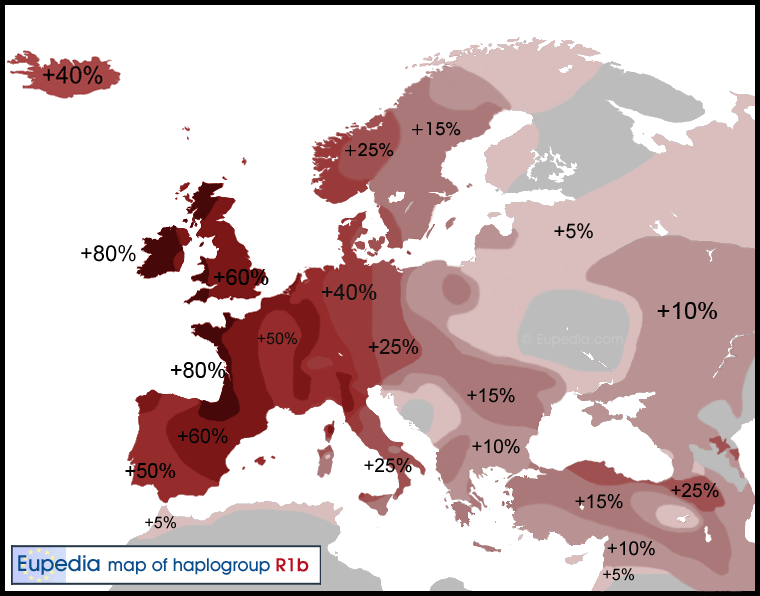


    It's not perfect, but it's as good as it can get based on the present data. I found contradictory percentages for Ukraine, Belarus and Russia. Some studies only give 2% of R1b in Ukraine, and others as much as 12%. Russia is so vast and studies so few that it's hard to be accurate.

  2. #2
    Advisor Achievements:
    Tagger Second ClassThree FriendsVeteran10000 Experience Points
    Awards:
    Discussion Ender
    LeBrok's Avatar
    Join Date
    18-11-09
    Location
    Calgary
    Posts
    2,016
    Points
    10,348
    Level
    30
    Points: 10,348, Level: 30
    Level completed: 67%, Points required for next Level: 202
    Overall activity: 76.0%

    Y-DNA haplogroup
    R1b1b2a
    MtDNA haplogroup
    H1c

    Ethnic group
    Citizen of the world
    Country: Canada-Alberta


    Sweet, gets more interesting and detailed. Now we can see pockets with or without R1bs.

  3. #3
    Regular Member Achievements:
    Three FriendsVeteran10000 Experience Points
    Cambrius (The Red)'s Avatar
    Join Date
    27-06-09
    Posts
    2,541
    Points
    11,377
    Level
    32
    Points: 11,377, Level: 32
    Level completed: 19%, Points required for next Level: 573
    Overall activity: 9.0%

    Y-DNA haplogroup
    R1b (RL-21*)
    MtDNA haplogroup
    H3

    Ethnic group
    Gallaecian Celtic
    Country: USA - Ohio


    Good that you are copyright branding these maps. The ones on eye and hair color have been plastered all over the internet and sometimes altered.

  4. #4
    Regular Member Achievements:
    Three Friends5000 Experience PointsVeteran
    Wilhelm's Avatar
    Join Date
    02-10-09
    Location
    Spain
    Posts
    1,491
    Points
    7,361
    Level
    25
    Points: 7,361, Level: 25
    Level completed: 63%, Points required for next Level: 189
    Overall activity: 9.0%

    Y-DNA haplogroup
    R1b-S26
    MtDNA haplogroup
    H1

    Ethnic group
    Celtiberians
    Country: Spain - Catalonia


    Isn't In Iberia the gradient is East/West , not South/North ??

  5. #5
    Advisor Achievements:
    Tagger Second ClassThree FriendsVeteran10000 Experience Points
    Awards:
    Discussion Ender
    LeBrok's Avatar
    Join Date
    18-11-09
    Location
    Calgary
    Posts
    2,016
    Points
    10,348
    Level
    30
    Points: 10,348, Level: 30
    Level completed: 67%, Points required for next Level: 202
    Overall activity: 76.0%

    Y-DNA haplogroup
    R1b1b2a
    MtDNA haplogroup
    H1c

    Ethnic group
    Citizen of the world
    Country: Canada-Alberta


    Isn't Czech Republic 35% R1B? Not sure, but read somewhere about this.

  6. #6
    Regular Member Achievements:
    1000 Experience PointsVeteran

    Join Date
    20-05-09
    Posts
    217
    Points
    3,568
    Level
    17
    Points: 3,568, Level: 17
    Level completed: 30%, Points required for next Level: 282
    Overall activity: 0%


    Country: Croatia


    Quote Originally Posted by LeBrok View Post
    Isn't Czech Republic 35% R1B? Not sure, but read somewhere about this.
    Yes,it is.
    http://www.unipv.eu/on-line/Home/Are...mento2986.html

  7. #7
    Regular Member Achievements:
    1 year registered1000 Experience Points

    Join Date
    06-12-09
    Posts
    51


    Country: Spain


    Quote Originally Posted by Wilhelm View Post
    Isn't In Iberia the gradient is East/West , not South/North ??

    No, porque si te fijas el mapa trabaja en intervalos puesto que habla de +60% y +80% lo que quiere decir (60,80) y (80,100), etc... Dentro de cada intervalo si habria un gradiente claro pero puesto que el mapa abarca un territorio muy amplio no seria conveniente poner mucho gradiente por sencillez visual (o al menos imagino que maciamo ha tenido en cuenta todo esto para mostarlo asi).

  8. #8
    Satyavrata Achievements:
    Three FriendsRecommendation First ClassVeteran50000 Experience PointsTagger First Class
    Maciamo's Avatar
    Join Date
    17-07-02
    Location
    Lothier
    Posts
    5,665
    Points
    213,692
    Level
    100
    Points: 213,692, Level: 100
    Level completed: 0%, Points required for next Level: 0
    Overall activity: 100.0%


    Ethnic group
    Celto-germanic
    Country: Belgium - Brussels


    Quote Originally Posted by LeBrok View Post
    Isn't Czech Republic 35% R1B? Not sure, but read somewhere about this.
    It is 35%, which is why the map shows "+25%" (meaning over 25% but under 40%, which is the next shade of red).

  9. #9
    Satyavrata Achievements:
    Three FriendsRecommendation First ClassVeteran50000 Experience PointsTagger First Class
    Maciamo's Avatar
    Join Date
    17-07-02
    Location
    Lothier
    Posts
    5,665
    Points
    213,692
    Level
    100
    Points: 213,692, Level: 100
    Level completed: 0%, Points required for next Level: 0
    Overall activity: 100.0%


    Ethnic group
    Celto-germanic
    Country: Belgium - Brussels


    Quote Originally Posted by Wilhelm View Post
    Isn't In Iberia the gradient is East/West , not South/North ??
    Based on all the studies I had on Iberia, the highest frequencies of R1b are found near the Pyrenees (Basque country to Catalonia) and the lowest in South Portugal, Extremadura and West Andalusia. Numbers for Galicia vary from 50 to 80%, but the overall average is around 60-65%.

    South-West Iberia has more Near-Eastern haplogroups (E, G, J, T) due to the early arrival of Neolithic farmers from Greece via southern Italy. Add to this the Phoenician and Arabic influence, although I now think that the Neolithic migration had the biggest impact, because the Copper-age strongholds of Portugal and Andalusia (like Zambujal or Los Millares) resisted better the Bronze-age IE invasion of R1b.

    Cantabria is a pocket of E-M81 and has therefore less R1b. E-M81 in Cantabria is certainly of Paleolithic or Mesolithic origin, as it is combined with strong frequencies of mtDNA U5 and V. Furthermore, Cantabria was the last part of Spain to adopt agriculture (around 4000 BCE) due to its isolation, so I doubt that E-M81 be of Neolithic or later origin.

  10. #10
    Regular Member Achievements:
    Three Friends5000 Experience PointsVeteran
    Wilhelm's Avatar
    Join Date
    02-10-09
    Location
    Spain
    Posts
    1,491
    Points
    7,361
    Level
    25
    Points: 7,361, Level: 25
    Level completed: 63%, Points required for next Level: 189
    Overall activity: 9.0%

    Y-DNA haplogroup
    R1b-S26
    MtDNA haplogroup
    H1

    Ethnic group
    Celtiberians
    Country: Spain - Catalonia


    Quote Originally Posted by Maciamo View Post
    Cantabria is a pocket of E1b1b and has therefore less R1b.
    No, Cantabria is not a pocket, it's only the Pasiegos, a small comarca of Cantabria. Even in Pasiegos the R1b is 61+% . For The whole Cantabria is 7.14% E1b1b and 66% R1b
    http://grupos.unican.es/acanto/aep/B...-Hum-Genet.pdf
    Last edited by Wilhelm; 21-01-10 at 23:06.

  11. #11
    Advisor Achievements:
    Tagger Second ClassThree FriendsVeteran10000 Experience Points
    Awards:
    Discussion Ender
    LeBrok's Avatar
    Join Date
    18-11-09
    Location
    Calgary
    Posts
    2,016
    Points
    10,348
    Level
    30
    Points: 10,348, Level: 30
    Level completed: 67%, Points required for next Level: 202
    Overall activity: 76.0%

    Y-DNA haplogroup
    R1b1b2a
    MtDNA haplogroup
    H1c

    Ethnic group
    Citizen of the world
    Country: Canada-Alberta


    Quote Originally Posted by Maciamo View Post
    It is 35%, which is why the map shows "+25%" (meaning over 25% but under 40%, which is the next shade of red).
    Thanks, somehow I had that reversed in my mind that +25 was the maximum.

  12. #12
    Landlord Achievements:
    3 months registered

    Join Date
    06-01-10
    Posts
    52


    Country: United States


    south-east and south-west iberians are still iberians theiy are just the least cro magnon and celtic iberians and most mediterranean/near eastern influenced! southeast iberians are the most "mediterranean" also the darkest eyes and hair are in the south of iberia this coud be due to greeks phoenicians berbers all introduced j e t g to southern iberia! southern iberia is almost on par with central italy in genes!

  13. #13
    Satyavrata Achievements:
    Three FriendsRecommendation First ClassVeteran50000 Experience PointsTagger First Class
    Maciamo's Avatar
    Join Date
    17-07-02
    Location
    Lothier
    Posts
    5,665
    Points
    213,692
    Level
    100
    Points: 213,692, Level: 100
    Level completed: 0%, Points required for next Level: 0
    Overall activity: 100.0%


    Ethnic group
    Celto-germanic
    Country: Belgium - Brussels


    Quote Originally Posted by Wilhelm View Post
    No, Cantabria is not a pocket, it's only the Pasiegos, a small comarca of Cantabria. Even in Pasiegos the R1b is 61+% . For The whole Cantabria is 7.14% E1b1b and 66% R1b
    http://grupos.unican.es/acanto/aep/B...-Hum-Genet.pdf
    Your paper actually gives 43% of R1b for the Pasiegos, 60% for the Lebaniegos, and 58% for other Cantabrians (and 60% for Asturias). The average for Cantabria is 52% (71 out of 137 samples). What's interesting is that the Pasiegos have 18% of R1a1. That's huge for Spain. The mtDNA data show that Cantabrians have a fairly unique incidence of hg I, U2, U3 and U4, which are usually found among Pontic steppe people and areas with a lot of R1a. The Pasiegos obviously have steppe ancestors, who mixed with Paleolithic people from the Maghreb (E-M81 combined with U6, L2 and M1). A very unique blend indeed.

    Flores gives 58% R1b for Cantabria, and Adams 50% for Asturias. I put both regions in between 50 and 60% on the map.

    Galicia is borderline 60%. Adams gives 58%, Flores 63%, and Balaresque's brand new study of R1b also gives 58%. Based on this new study from yesterday I think I should place Galicia in 50 to 60% like Asturias and Cantabria.

    I have just verified data for North Portugal and found 53.5% (Flores), 55% (Gonçalves et al.) and 58% (Adams). I will modify the map accordingly.

  14. #14
    Regular Member Achievements:
    Three FriendsVeteran10000 Experience Points
    Cambrius (The Red)'s Avatar
    Join Date
    27-06-09
    Posts
    2,541
    Points
    11,377
    Level
    32
    Points: 11,377, Level: 32
    Level completed: 19%, Points required for next Level: 573
    Overall activity: 9.0%

    Y-DNA haplogroup
    R1b (RL-21*)
    MtDNA haplogroup
    H3

    Ethnic group
    Gallaecian Celtic
    Country: USA - Ohio


    Quote Originally Posted by Maciamo View Post
    Your paper actually gives 43% of R1b for the Pasiegos, 60% for the Lebaniegos, and 58% for other Cantabrians (and 60% for Asturias). The average for Cantabria is 52% (71 out of 137 samples). What's interesting is that the Pasiegos have 18% of R1a1. That's huge for Spain. The mtDNA data show that Cantabrians have a fairly unique incidence of hg I, U2, U3 and U4, which are usually found among Pontic steppe people and areas with a lot of R1a. The Pasiegos obviously have steppe ancestors, who mixed with Paleolithic people from the Maghreb (E-M81 combined with U6, L2 and M1). A very unique blend indeed.

    Flores gives 58% R1b for Cantabria, and Adams 50% for Asturias. I put both regions in between 50 and 60% on the map.

    Galicia is borderline 60%. Adams gives 58%, Flores 63%, and Balaresque's brand new study of R1b also gives 58%. Based on this new study from yesterday I think I should place Galicia in 50 to 60% like Asturias and Cantabria.

    I have just verified data for North Portugal and found 53.5% (Flores), 55% (Gonçalves et al.) and 58% (Adams). I will modify the map accordingly.
    Don't forget the Beleza et al. study for Portugal.

  15. #15
    Regular Member Achievements:
    3 months registered

    Join Date
    30-01-10
    Posts
    35


    Country: Canada


    In Europe.
    Damn!
    I want to see the world map of all haplogroups, especially the map of the United States of America. Not Indians.
    Why the internet does not show this information? Europe Europe Europe!!
    What the hell!?

  16. #16
    ^ lynx ^
    Guest


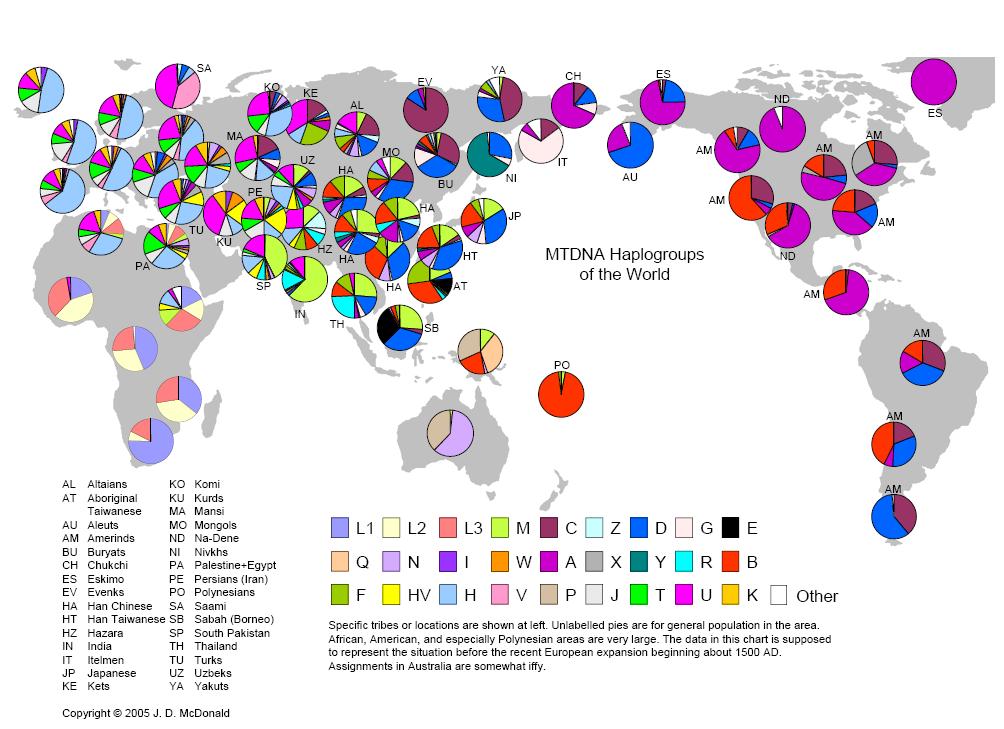
    You mean something like this but taking into acount the americans of non-native-american origins. Yes, it would be nice to see it.

  17. #17
    Satyavrata Achievements:
    Three FriendsRecommendation First ClassVeteran50000 Experience PointsTagger First Class
    Maciamo's Avatar
    Join Date
    17-07-02
    Location
    Lothier
    Posts
    5,665
    Points
    213,692
    Level
    100
    Points: 213,692, Level: 100
    Level completed: 0%, Points required for next Level: 0
    Overall activity: 100.0%


    Ethnic group
    Celto-germanic
    Country: Belgium - Brussels


    Quote Originally Posted by transmitter View Post
    In Europe.
    Damn!
    I want to see the world map of all haplogroups, especially the map of the United States of America. Not Indians.
    Why the internet does not show this information? Europe Europe Europe!!
    What the hell!?
    There is no reliable map of modern North America because the population is far too mixed and keep moving constantly. Haplogroup maps for Eurasia are supposed to show the haplogroup frequencies 500 years ago, before the rural exodus and emigration to colonies, not today.

  18. #18
    Satyavrata Achievements:
    Three FriendsRecommendation First ClassVeteran50000 Experience PointsTagger First Class
    Maciamo's Avatar
    Join Date
    17-07-02
    Location
    Lothier
    Posts
    5,665
    Points
    213,692
    Level
    100
    Points: 213,692, Level: 100
    Level completed: 0%, Points required for next Level: 0
    Overall activity: 100.0%


    Ethnic group
    Celto-germanic
    Country: Belgium - Brussels


    I have created a new thread for the genetic origin of the Cantabrians and Pasiegos.

  19. #19
    Regular Member Achievements:
    1000 Experience PointsVeteran

    Join Date
    20-05-09
    Posts
    217
    Points
    3,568
    Level
    17
    Points: 3,568, Level: 17
    Level completed: 30%, Points required for next Level: 282
    Overall activity: 0%


    Country: Croatia


    The map is very precise regarding Slovenia-Croatia-Bosnia area.From over 30% in westernmost areas of Slovenia and Croatia it falls abruptly in Bosnia to 2-3%.

  20. #20
    Regular Member Achievements:
    3 months registered

    Join Date
    30-01-10
    Posts
    35


    Country: Canada


    Quote Originally Posted by Maciamo View Post
    There is no reliable map of modern North America because the population is far too mixed and keep moving constantly. Haplogroup maps for Eurasia are supposed to show the haplogroup frequencies 500 years ago, before the rural exodus and emigration to colonies, not today.


    it is a thousand pities.

  21. #21
    Regular Member Achievements:
    3 months registered

    Join Date
    30-01-10
    Posts
    35


    Country: Canada


    Quote Originally Posted by ^ lynx ^ View Post


    You mean something like this but taking into acount the americans of non-native-american origins. Yes, it would be nice to see it.
    yes.
    but this is the map of mtDNA

  22. #22
    Regular Member Achievements:
    Three Friends5000 Experience PointsVeteran
    Wilhelm's Avatar
    Join Date
    02-10-09
    Location
    Spain
    Posts
    1,491
    Points
    7,361
    Level
    25
    Points: 7,361, Level: 25
    Level completed: 63%, Points required for next Level: 189
    Overall activity: 9.0%

    Y-DNA haplogroup
    R1b-S26
    MtDNA haplogroup
    H1

    Ethnic group
    Celtiberians
    Country: Spain - Catalonia


    I would put also Catalonia in the 80+ shade, because it is much closer to 80% than to 60% .

  23. #23
    Satyavrata Achievements:
    Three FriendsRecommendation First ClassVeteran50000 Experience PointsTagger First Class
    Maciamo's Avatar
    Join Date
    17-07-02
    Location
    Lothier
    Posts
    5,665
    Points
    213,692
    Level
    100
    Points: 213,692, Level: 100
    Level completed: 0%, Points required for next Level: 0
    Overall activity: 100.0%


    Ethnic group
    Celto-germanic
    Country: Belgium - Brussels


    I have updated the map by adding a colour zone for the 5-10% range.

  24. #24
    Regular Member Achievements:
    1000 Experience PointsOverdrive1 year registered

    Join Date
    06-06-11
    Posts
    1,080
    Points
    4,355
    Level
    19
    Points: 4,355, Level: 19
    Level completed: 27%, Points required for next Level: 295
    Overall activity: 47.0%


    Country: Netherlands


    Wow amazing, great work! Everybody on internet who is interested in DNA haplogroups knows your maps & statistics.

  25. #25
    Junior Member Achievements:
    500 Experience Points1 year registered

    Join Date
    17-10-11
    Posts
    3
    Points
    879
    Level
    7
    Points: 879, Level: 7
    Level completed: 65%, Points required for next Level: 71
    Overall activity: 0%


    Country: Portugal


    Quote Originally Posted by Maciamo View Post
    ....
    South-West Iberia has more Near-Eastern haplogroups (E, G, J, T) due to the early arrival of Neolithic farmers from Greece via southern Italy. Add to this the Phoenician and Arabic influence, although I now think that the Neolithic migration had the biggest impact, ....
    What haplogroup do you match the megalithic culture in South-West Iberia in the end of six milénia a. C at the Cromeleque de Almendres, E, G, J or T?

Posting Permissions

  • You may not post new threads
  • You may not post replies
  • You may not post attachments
  • You may not edit your posts
  •