Eupedia Forums
Site NavigationEupedia Top > Eupedia Forum & Japan Forum
Results 1 to 5 of 5

Thread: I1b M227 where is its origin

  1. #1
    Regular Member Achievements:
    1 year registered5000 Experience PointsOverdrive
    Awards:
    User with most referrers
    zanipolo's Avatar
    Join Date
    22-03-11
    Location
    Eastern Australia
    Posts
    1,680
    Points
    7,496
    Level
    25
    Points: 7,496, Level: 25
    Level completed: 90%, Points required for next Level: 54
    Overall activity: 22.0%

    Y-DNA haplogroup
    T1a2b (T-L446)
    MtDNA haplogroup
    H1c

    Ethnic group
    Venet
    Country: Australia


    I1b M227 where is its origin

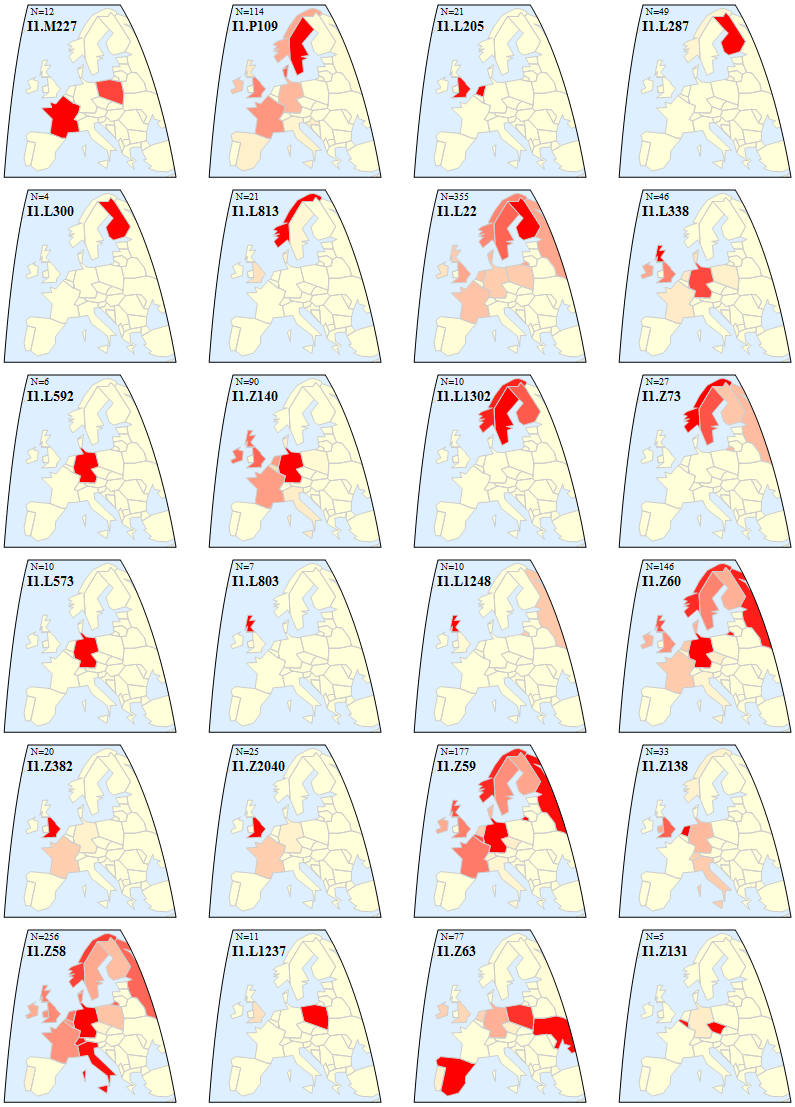
    Recently read articles by KN on rootsweb indicating the I1b M227 is as stated "purely eastern" but that less than 1% of slavs have it.
    The only eastern place i can find it is the old Prussian areas from gdansk to memel ( basically vistula delta as the core ) .
    Does this indicate the old baltic people ( prussians) or the germanic prussians.
    If germanic , then surely it came from the west.

    or do we go back further to the vistula goths

    http://varldsinbordeskriget.wordpres...ic-and-gothic/

    Any ideas or links would be helpful

  2. #2
    Great Adventurer Achievements:
    Three FriendsTagger Second Class1 year registered10000 Experience PointsOverdrive
    Awards:
    Arm of Law
    sparkey's Avatar
    Join Date
    17-02-11
    Location
    California
    Posts
    1,536
    Points
    10,906
    Level
    31
    Points: 10,906, Level: 31
    Level completed: 51%, Points required for next Level: 344
    Overall activity: 60.0%

    Y-DNA haplogroup
    I2c-A L596>PF3881
    MtDNA haplogroup
    U4

    Ethnic group
    American; or anciently Dumnonian, Silurian, Helvetian, & Anglo-Saxon
    Country: USA - California


    It's on the same branch of I1 as the unusually Pomeranian I1*-P1 and I1*-P2 branches, as well as the Welsh outlier branch called AS4, all of which are suspected of being outside the Germanic spread that is normally associated with I1, although the apparently Germanic ML branch is also there with them, indicating that they probably didn't stray too far from the Germanic core.

    I'm not sure we know enough yet about I1-M227 to be entirely sure about it, but it looks promising to have expanded from east of the Germanic core area. As with all I1, we'll need to stay geographically to the North in our analysis of where it launched from. Since it currently has a distribution from Ukraine to Sweden, and into Lithuania, my best guess right now is a connection with what is now northern Poland. Nordtvedt gives it a TMRCA of 3000 YBP. I'm not sure yet what populations match that pattern.

  3. #3
    Regular Member Achievements:
    1000 Experience Points1 year registered
    Sile's Avatar
    Join Date
    04-09-11
    Posts
    114
    Points
    1,471
    Level
    10
    Points: 1,471, Level: 10
    Level completed: 61%, Points required for next Level: 79
    Overall activity: 0%


    Country: Australia


    Quote Originally Posted by sparkey View Post
    It's on the same branch of I1 as the unusually Pomeranian I1*-P1 and I1*-P2 branches, as well as the Welsh outlier branch called AS4, all of which are suspected of being outside the Germanic spread that is normally associated with I1, although the apparently Germanic ML branch is also there with them, indicating that they probably didn't stray too far from the Germanic core.

    I'm not sure we know enough yet about I1-M227 to be entirely sure about it, but it looks promising to have expanded from east of the Germanic core area. As with all I1, we'll need to stay geographically to the North in our analysis of where it launched from. Since it currently has a distribution from Ukraine to Sweden, and into Lithuania, my best guess right now is a connection with what is now northern Poland. Nordtvedt gives it a TMRCA of 3000 YBP. I'm not sure yet what populations match that pattern.
    this is what KN said in July 2011
    The new set of FTDNA markers, 68 to 111, have proved quite productive in showing new unique marker values separating the clades and haplogroups of I

    M227+ I1b is a small haplogroup whose geographical center seems to be the eastern Baltic, although it is also found in other European places. The classic 2004 paper on haplogroup I by Rootsi et al found a decent number of M227+ because they sampled eastern Europe with unusual strength.

    It has proven difficult to recognize a haplotype of 67 markers as being a good candidate for I1b M227+ haplogroup, although there are some tendencies, such as 21 at DYS448 rather than 20, etc.

    Not everyone is going to do a M227 test to check for I1b status. Odds are probably too low of success.

    But if a few proven M227+ I1b would expand their haplotypes to 111 markers, maybe a couple new identifying marker values will show up in the 68-111 set? That would sure help us spot those in the huge I1 haplogroup who ought to test for M227 and with a higher success rate.


    The percentages from another site has in the baltic vistula area about 10%, thuringia augsburg area 5% and western slovenia 5%

  4. #4
    Regular Member Achievements:
    Overdrive1000 Experience Points1 year registered

    Join Date
    19-04-12
    Posts
    184
    Points
    1,860
    Level
    12
    Points: 1,860, Level: 12
    Level completed: 4%, Points required for next Level: 290
    Overall activity: 35.0%


    Country: Finland


    I'm interested in this HG too.

  5. #5
    Great Adventurer Achievements:
    Three FriendsTagger Second Class1 year registered10000 Experience PointsOverdrive
    Awards:
    Arm of Law
    sparkey's Avatar
    Join Date
    17-02-11
    Location
    California
    Posts
    1,536
    Points
    10,906
    Level
    31
    Points: 10,906, Level: 31
    Level completed: 51%, Points required for next Level: 344
    Overall activity: 60.0%

    Y-DNA haplogroup
    I2c-A L596>PF3881
    MtDNA haplogroup
    U4

    Ethnic group
    American; or anciently Dumnonian, Silurian, Helvetian, & Anglo-Saxon
    Country: USA - California


    Quote Originally Posted by Sile View Post
    M227+ I1b is a small haplogroup whose geographical center seems to be the eastern Baltic, although it is also found in other European places. The classic 2004 paper on haplogroup I by Rootsi et al found a decent number of M227+ because they sampled eastern Europe with unusual strength.
    I think the frequency reaches higher in the eastern Baltic, but note that Nordtvedt just calls it a "geographic center" rather than a launching point, or point of origin, or homeland, or anything like that. I don't think there's anything convincing yet to show that it spread from the eastern Baltic. Unfortunately, STR tree analyses like Robb's don't really show anything for I1b yet, AFAIK. Since its relative clades are all anchored west of it, and it extends into areas that have never had much Baltic migration into them (France, Switzerland, England), I think it's safer to assume that the higher frequency there is a result of an expansion that direction. So I'm still guessing the southern Baltic as a starting point.

Similar Threads

  1. Origin of guttural R
    By spongetaro in forum Linguistics
    Replies: 13
    Last Post: 18-01-12, 21:57
  2. Origin of G2a
    By secherbernard in forum G2a
    Replies: 21
    Last Post: 01-11-10, 08:08
  3. Columbus DNA Origin
    By Aristander in forum Y-DNA Haplogroups
    Replies: 1
    Last Post: 28-10-10, 23:43
  4. Origin of the Libyans
    By Maciamo in forum Genetic Genealogy & Haplogroups
    Replies: 31
    Last Post: 07-07-10, 10:27
  5. The Origin of L21
    By rms2 in forum R1b
    Replies: 4
    Last Post: 24-01-10, 20:13

Posting Permissions

  • You may not post new threads
  • You may not post replies
  • You may not post attachments
  • You may not edit your posts
  •