So what we have discuss today?
In post
#435 i think i explained you, cited two sources by the ancient
"..John of Amida also known as John of Ephesus records that in 581” and [Cyril Mango, BYZANTIUM: THE EMPIRE OF NEW ROME] how arrived the slavs in Balcan. They came from? You didn`t tell us. OK
In post
#431 i posted this:
1000 - 1018
Anonymous:
Fragment on the Origins of Nations
It can be seen that there are various languages on earth. Of them, there are five Orthodox languages: Bulgarian, Greek, Syrian, Iberian (Georgian) and Russian. Three of these have Orthodox alphabets: Greek, Bulgarian and Iberian. There are twelve languages of half-believers: Alamanians, Franks, Magyars (Hungarians), Indians, Jacobites, Armenians, Saxons, Lechs (Poles),
Arbanasi (Albanians),
Croatians, Hizi, Germans.
[Extract from: Radoslav Grujic: Legenda iz vremena Cara Samuila o poreklu naroda. in:
Glasnik skopskog naucnog drustva, Skopje, 13 (1934), p. 198 200. Translated from the Old Church Slavonic by Robert Elsie. First published in R. Elsie:
Early Albania, a Reader of Historical Texts, 11th - 17th Centuries, Wiesbaden 2003, p. 3.]
In this document is mentioned,among others Albanian and Croatian language, but not Serbian, Montenegrin or Fyrom. You don`t like this, OK.
In post
#436 I posted this;
1332
Anonymous:
Initiative for Making the Passage
The 'Directorium ad passagium faciendum', which can be translated as 'Initiative for making the passage', is a mediaeval Latin manuscript (also available in an early French translation) attributed alternatively to a monk called Burcard (Brocardus Monacus / Frère Brochard) or to one William Adam (Guillelmus Adam / Guillaume Adam) (1). The author was at any rate a Dominican priest and Latin prelate in the Byzantine Empire and Armenia, whose aim was to persuade the Catholic armies under Philip VI of Valois (r. 1328-1350) to embark upon a holy crusade and conquer Serbian-occupied Albania, thus restoring the Catholic Church to its former power there and taking revenge upon the Orthodox Greeks for having destroyed the Latin Empire of Constantinople. In the text, the author makes reference to the Albanians as the majority population in Albania. It is also in the 'Directorium' that a much-quoted phrase about the existence of books in Albania occurs: 'licet Albanenses aliam omnino linguam a latina habeant et diversam, tamen litteram latinam habent in usu et in omnibus suis libris' (The Albanians indeed have a language quite different from Latin, however they use Latin letters in all their books).
On the Kingdom of Rascia and how it could easily be conquered
I would like to come back to the Kingdom of Rascia to show how it could be conquered. Indeed, the desire to invade is all that is needed for the country to be taken. In order to make this clear, I would like to present a number of brief suggestions for an invasion and a number of easily fulfilled conditions for a conquest.
The said kingdom has few if any fortifications at all. All that exists are farmhouses and cottages devoid of moats and outer walls. The buildings and palaces, both of the king and of the nobles, are made of straw and wood. I have never seen a palace or home there made of stone or of brick except in the coastal towns of the Latins. The said kingdom is rich in grain, wine, oil and meat. It is a pleasant place with water from springs and rivers flowing through it, a delightful land with woods, meadows, mountains, plains and valleys full of various species of wild beasts. In short, everything that grows there is of choice quality, in particular in areas along the coast. In the said kingdom, there are indeed five gold mines and an equal number of silver mines in which expert miners toil without interruption. There are also mixed deposits of silver and gold, which have recently been discovered at various and sundry sites, and huge dense forests. Whoever owns this kingdom will have a veritable jewel in his possession, select and precious for all times.
One factor, among others, which makes this kingdom easy to conquer, is that it is inhabited by two peoples, i.e. the Albanians and the Latins who, in their beliefs, their rites and their obedience, both abide by the Roman Catholic Church. Accordingly, they have archbishops, bishops and abbots, as well as religious and secular clerics of lower rank and status.
The Latins have six towns with bishops: firstly Antibarum (Bar), the seat of the archbishop, then Chatarensis (Kotor), Dulcedinensis (Ulcinj), Suacinensis (Shas) (2), Scutarensis (Shkodra) and Drivascensis (Drisht) (3), which are inhabited by the Latins alone. Outside the town walls, the Albanians make up the population throughout the diocese. There are four Albanian towns: Polatum Maius (Greater Pult) (4), Polatum Minus (Lesser Pult), Sabatensis (Sapa) (5) and Albanensis (Albanopolis) (6) which, together with the towns of the Latins, are all legally subject to the Archbishop of Bar and his church as their metropolitan. The Albanians indeed have a language quite different from Latin. However they use Latin letters in all their books (7). The sway of the Latins is thus confined to the limits of their towns. Outside the towns, they do possess vineyards and fields, but there are no fortifications or villages actually inhabited by the Latins. The Albanians for their part, the larger of the two peoples, could assemble over fifteen thousand horsemen for warfare according to the custom and manner of the country, who would be courageous and industrious warriors.
Since the said Latins and Albanians suffer under the unbearable yoke and extremely dire bondage of their odious Slav leaders whom they detest - the people being tormented, the clergy humiliated and oppressed, the bishops and abbots often kept in chains, the nobles disinherited and held hostage, episcopal and other churches disbanded and deprived of their rights, and the monasteries in decay and ruin - they would all to a man believe that they were consecrating their hands in the blood of the aforementioned Slavs if a French prince were to appear before them whom they could make leader of their war against the said evil Slavs, the enemies of our true faith. With the help of the aforementioned Albanians and Latins, one thousand French knights and five or six thousand foot soldiers could without a doubt easily conquer the whole length and breadth of this kingdom.
Source: [Extract from:
Recueil des historiens des croisades. Documents arméniens. Tome second. Documents latins et français relatifs à l'Arménie, Paris 1906, p. 478 485.]
You started to speak about conspiracy etc. After you started the game of maps. It`s all clear, hi is speaking about Kingdom of Rascia not about Serbian Empire. Also he describe that the said kingdom was inhabitated , cities by Latins and the kingdom by Albanians:
“that it is inhabited by two peoples, i.e. the Albanians and the Latins who, in their beliefs, their rites and their obedience, both abide by the Roman Catholic Church”.
“The Latins have six towns with bishops….. Outside the town walls, the Albanians make up the population throughout the diocese”.
And:
“Since the said Latins and Albanians suffer under the unbearable yoke and extremely dire bondage of their odious Slav leaders whom they detest - the people being tormented, the clergy humiliated and oppressed, the bishops and abbots often kept in chains, the nobles disinherited and held hostage, episcopal and other churches disbanded and deprived of their rights, and the monasteries in decay and ruin”.
According to wikipedia the Kingdom of Serbia is this:
http://en.wikipedia.org/wiki/Kingdom_of_Serbia_(medieval)
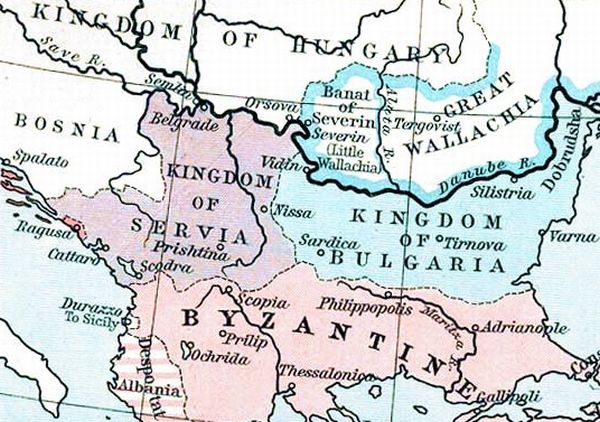
And this is the map of the said kingdom:
http://en.wikipedia.org/wiki/Kingdom_of_Serbia_(medieval)#mediaviewer/File:Balkans_1265.jpg
Again you don`t agree. OK.
In your post
#434 you said:
“There are some indications that current Slavic population of Balkan has the same anthropological (skeletal) characteristics as the ancient one, but that has to be confirmed with other research. Until then I'm supporting the official version that Slavs settled in Balkans in 6th century”.
You speak about anthropology and and i quoted the father of antropology
Carleton Stevens Coon:
“The Montenegrins, who are the tallest people in Europe, live on a barren limestone mountain upland, where they, for centuries, succeeded in maintaining their Christianity and their freedom while surrounded by the Turks. They, like the northern Albanians, preserve their old exog- amous clan organization, and their clan loyalties and feuds. They are linguistically Serbs, but there can be no question that they are to a large extent Slavicized Albanians; the cultural continuity between the two peoples is striking, the only real differences being those of language and re- ligion”. Stevens Coon Carleton The Races Of Europe page 591
Your answer was:
“I was talking about some other research, but it's of no importance today because we have DNA analysis which can prove for certainty if the hypothesis is right or wrong, so it's stupid to waste time on some 19th century methods”.
It`s not 19 century:
http://en.wikipedia.org/wiki/The_Races_of_Europe_(Coon)
About the so-called theory of Slavic settlements in Durres , I don’t want to los my time, I will make an copy paste from
Milan von Šufflay:
[h=4]
1912
Milan von Šufflay:
Mediaeval Albania[/h]
Croatian historian, Milan von Šufflay (1879-1931), was born in Lepoglava, southwest of Varaždin, and studied history and classical philology at the University of Zagreb. From 1904 to 1908, he worked for the national museum in Budapest and, from 1912 to 1918, was professor for medieval history in Zagreb. Šufflay was forced into early retirement for political reasons in 1918 and lived thereafter as a publisher in Zagreb. He was often in open political conflict with the new Kingdom of the Serbs, Croats and Slovenes and, in 1921, was sentenced to three and a half years in prison. In 1928, he was offered the chair of southeast European history at the University of Budapest, but the government in Belgrade refused to let him accept the position. He was murdered by two Serb police agents in 1931.
Among Šufflay’s publications of Albanian interest, mention may be made of “Povijest severnih Arbanasa” (History of the Northern Albanians), Belgrade 1924, “Städte und Burgen Albaniens hauptsächlich während des Mittelalters” (The Towns and Fortresses of Albania, Primarily during the Middle Ages), Vienna 1924; and “Srbi i Arbanasi: njihova simbioza u srednjem vjeku” (Serbs and Albanians: Their Symbiosis during the Middle Ages), Belgrade 1925; as well as numerous articles. Together with Ludwig von Thallóczy and Konstantin Jireček, he published the important two-volume collection of Albanian historical documents entitled “Acta et diplomata res Albaniae mediae aetatis illustrantia” (Acts and Diplomatic Affairs illustrating the Middle Ages in Albania), Vienna 1913, 1918, covering the years 344 to 1406 A.D.
The present article was first published in a Viennese newspaper in November 1912, at a time when Serb forces had conquered Kosovo and occupied much of Albania. In it, Šufflay paints a picture of Albania in the Middle Ages with a view to showing that Serbia had no historical claim to the country.
In order to justify Serb claims to Albania, in particular to the ports of Durazzo [Durrës] and Alessio [Lezha], Serb politicians bring forth primarily historical arguments. According to Pašić and Gruić, Albania has no right to autonomy, the Albanian Malissors are actually Serbs, Albania belonged solely to the Empire of Dushan, and Durrës, Lezha and San Giovanni di Medua [Shëngjin] were formerly only Serb ports. To put it briefly, all of Europe should be aware that the Serbs want only that part of Albania that they once possessed exclusively.
The purpose of these lines is to draw an objective picture of Albania in the Middle Ages (before the arrival of the Turks) so that it is obvious to everyone: that Serb politicians would have done better not to mention a historical claim to the main Albanian port of Durrës that they intend to conquer.
Firstly, the eleventh-century Byzantine Theme of Dyrrhachion, ruled over by a Dux, was transformed by the Venetians (1204) into the Ducatus Dyrrhachii and by the Angevins (around 1272) into a Regnum Albaniae was still present on Albanian soil in the 17th century. Secondly, in the 13th century an Albanian dynasty (Principes) arose in and around Kruja (1200 to 1250). It carried on for several generations (Progon, Gin, Demetrius, Golem) and, although it was submerged (perhaps only to our eyes) under pressure from foreign powers, it resurfaced immediately on the collapse of the Serb empire and took on new names (Thopias, Dukagjini etc.)
Dushan, king of Serbia, was able to conquer all of the interior of Albania and the town of Kruja in 1343, as well as Vlora and Janina in the south, but Durrës itself remained in the hands of the Angevins (at that time, Durrës was under the nominal rule of King Louis of Hungary). In 1368, Durrës fell, though not to the Serbs, but to the Albanian dynasty of Charles Thopia. Later, though only for a brief period, Durrës was in the possession of Thopia’s enemies, the Balsha family, and in 1385 Balsha II bore the title of Duke of Durrës. In 1392, however, Durrës was surrendered to Venice, not by the Balsha, but by George Thopia. In 1396, the Balsha dynasty offered to Venice the towns of Shkodra and Drivast. The republic wondered for a while whether its acceptance of these towns would violate its peace agreement with Hungary (
si intromittendo dicta loca contrafaceremus paci Hungariae). Lezha, of whose earlier fate we know little, fluctuated in the second half of the 14th century between Serb and Albanian rule, but then fell, like Durrës, to Venice, not out of the hands of the Serbs but of the Albanian dynasty of Dukagjini. Later, it was in the possession of the Castriota, who in origin and custom were certainly not Serbs. The only town that fell to the Turks (1417) directly from the Serbs, as a relic from the time of Dushan, was Vlora (Medua is little referred to in source material before the time of Scanderbeg as it was not much used as a harbour in the Middle Ages).
The only town that actually never belonged to the Serbs was Durrës, the port of which is now claimed by the Serbs for historical reasons!
[
Das mittelalterliche Albanien, first published in
Neue Freie Presse, Vienna, on 28. November 1912, p. 26 sq. and reprinted in
Illyrisch-Albanische Forschungen, edited by Ludwig von Thallóczy, Volume 1 (München & Leipzig: Düncker & Humblot, 1916), p. 282-287. Translated from the German by Robert Elsie.]
When the Slavs arrived in the Balkans they met a population, Albanians the descendants of Illyrian.
So, as you see all the evidences show that today South Slavs are an mixture of that accursed people named slav and Albanians at the beginning, and after the procces of assimilation of Albanians by slavs continued for centuries and still continue today in your country.
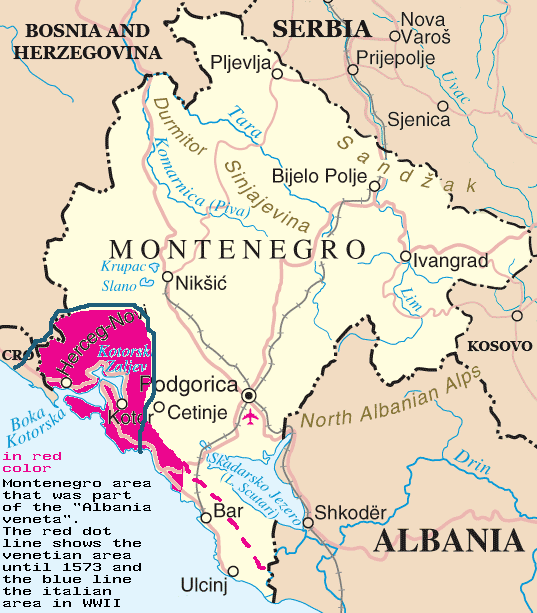
That's why the highlanders tribes in Montenegro are Albanian origine. And region inhabited by them, is named with the most tipical Albanian name: Kuç.