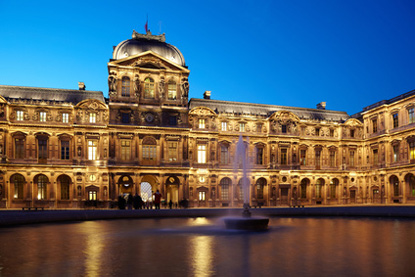
Paris
Paris is the capital of France, the second largest and most populous city in Europe (after London), as well as the fashion capital of the world. With over 30 million foreign visitors per year, it is the world's most visited city.
The population of Paris is approximately of 2,153,600 within city limits (20 arrondissements), and 9.93 million for the Greater Paris. The metropolitan area exceeds 12 million inhabitants, giving it a larger population than 36 of Europe's 45 countries.
The city contributes to a quarter of France's GDP. The district of La Défense is the largest purpose-built business district in Europe, and hosts the head offices of almost half of the major French companies, including 10 of the world's 100 largest companies*.
Paris also hosts many international organizations such as United Nations Educational, Scientific and Cultural Organization (UNESCO), the Organisation for Economic Co-operation and Development (OECD), the International Chamber of Commerce (ICC), or the Paris Club (an informal group of the 19 richest IMF members).
* namely : Total, BNP Paribas, AXA Group, Société Générale Group, Crédit Agricole, France Telecom, Sanofi-Aventis, EDF, Suez Group and Renault Group.
History
Antiquity & Middle Ages
Settled continously for at least 6000 years, Paris is one of the oldest cities in the world. A sub-tribe of the Celtic Senones, the Parisii, settled in the area from around 250 BCE, which became a Roman city in 52 BCE. The original of the city was Lutetia (also known to the Romans as Lutetia Parisiorum). Around 300 CE, the city becomes known as civitas Parisiorum, from where come the appellations "City of Paris" and Île de la Cité.
Clovis I (466-511), King of the Franks based in Tournai, conquered what was left of Roman Gaul, and established his new capital in Paris in 508. The Merovingian kings who succeeded him divided the kingdom, and Paris was often no more than a regional capital, along with cities like Reims, Soissons and Orléans.
From the 7th century, the real seat of Frankish power was in the vicinity of modern Liege, where the Carolingian dynasty originated. Charlemagne moved the capital of his newly founded empire in Aachen, 40km east of Liege.
Upon the division of the Charlemagne's Empire between his three grandsons in 843, Charles the Bald inherited of Western Francia, which would become the Kingdom of France. However, he didn't rule from Paris. It is not until 987, with the election of Hugh Capet as king, that Paris recovered its status of capital.
The early days of the Kingdom of Western Francia were deeply turmoiled. The Vikings attacked Paris repeatedly, burning and plundering its suburbs in 845 and 856, and besieging the city again in 861 and 865. In 885, an army of 35,000 Vikings on 700 ships arrived in Paris asking the local ruler the right to settle further south. Odo, Count of Paris and future King of France, refused, which led to a 4-month siege, leaving the left bank of the Seine entirely destroyed. This series of events forced his successor, King Charles the Simple, to give the region of the lower Seine as a fief to the Norse leader Rollo, thus creating the Duchy of Normandy in 911.
From 1190, King Philip Augustus enclosed Paris on both banks with a wall, the Louvre acting as its western fortress. In 1257, Robert de Sorbon founded the Sorbonne University, which quickly became a major centre of learning in Europe, bringing students to Paris from all over the continent.
Paris was occupied by the Burgundians in 1419, in the heat of the Hundred Years' War, and lost its position as seat of the French monarchy until 1435, when it was returned to Charles VII by the Treaty of Arras.
Renaissance & Revolutions
During the French Wars of Religion (1562-1598), Paris was a stronghold of the Catholic party, culminating in the St. Bartholomew's Day massacre (1572). Protestant King Henry IV re-established the royal court in Paris in 1594 after he captured the city from the Catholics. Although King of France since 1589, Henry IV was contrived to permanently renounced Protestantism to secure the allegiance of the vast majority of his subjects. On 29 July 1593, he famously declared "Paris is worth a mass".
King Louis XIV then moved the royal court permanently to Versailles in 1682. A century later, Paris was the centre stage for the French Revolution, with the Storming of the Bastille in 1789 and the overthrow of the monarchy in 1792. Paris was also the stage of the July Revolution of 1830, and the February Revolution of 1848. Cholera epidemics in hit the city shortly after each of them, in 1832 and 1849.
The Industrial Revolution, the French Second Empire, and the Belle Époque brought Paris the greatest development in its history. From the 1840s, rail transport allowed an unprecedented flow of migrants into Paris attracted by employment in the new industries in the suburbs. The city underwent a massive renovation under Napoleon III and his préfet Haussmann, who leveled entire districts of narrow-winding medieval streets to create the network of wide avenues and neo-classical façades of modern Paris.
The city suffered greatly from the siege ending the Franco-Prussian War (1870-1871), and the ensuing civil war known as the Commune of Paris (1871), which killed thousands and sent many of Paris's administrative centres (and city archives) up in flames.
Belle Epoque & 20th century
The Eiffel Tower was built for the French Revolution centennial 1889 Universal Exposition, as a "temporary" display of architectural engineering prowess but remained the world's tallest building until 1930, and is the city's best-known landmark.
The first line of the Paris Métro opened for the 1900 Universal Exposition and was an attraction in itself for visitors from the world over. Paris' World's Fair years also consolidated its position in the tourist industry and as an attractive setting for international technology and trade shows. To this day Paris remains the city that has hosted the most World Fairs in the world, 5 in total (1867, 1878, 1889, 1900 and 1937).
Paris emerged of WWI and WWII practically unscathed. During the first half of the 20th century, it acted as a magnet on artists from around the world, such as Russian composer Stravinsky, Spanish painters Picasso and Dalí, or American writer Hemingway.
Since the 1970s, many inner suburbs of Paris (especially the eastern and northern ones) have experienced deindustrialization, and these once-thriving towns have gradually turned into ghettos for immigrants, with notoriously high unemployment levels and increasingly serious safety issues.
Thanks to a successful conversion of the local economy from traditional manufacturing to high value-added services and high-tech manufacturing, the Parisian Region has the 6th highest GDPs among European cities, after Inner London, Luxembourg, Brussels, Hamburg and Vienna.
Interesting facts about Paris
Did you know ?
The Champs-Elysées were named after the Elysian Fields or Elysium, a section of the Underworld in Greco-Roman mythology, the final resting place of the souls of the heroic and the virtuous. Its better known Germanic equivalent if the Valhalla. The official residence of the French president is also called the Elysée.
The Arc de Triomphe at the end of the Champs-Élysées was located at the western gate of Paris when its construction started in 1810. At the time it was still well into the countryside, and travellers would walk under the arch as they enter the city's boundaries.
Napoleon I originally planned to build four triumphal arches in Paris. Only two were completed, and only one under his rule (the Arc de Triomphe du Carrousel in the Tuileries). The two others were supposed to be dedicated to the arts and to science.
The Column on Place Vendôme was erected by Napoleon I to celebrate the victory of Austerlitz. It was modelled after Trajan's Column in Rome, and said be made by melting the bronze of the cannons taken from the combined armies of Europe.
The sumptuous Place de la Concorde was created by Louis XV in his own honour. During the French Revolution, it was the site of the guillotine, where Louis XVI, Marie-Antoinette and 1100 other people were executed. It was renamed Place de la Révolution. To clear this bloody past, King Louis-Philippe decided to change the name to Place de la Concorde and dedicate it to all the people of France, with allegoric statues representing the largest French cities.The Egyptian Obelisk now standing in the middle of the square was built under the reign of pharaoh Ramses II, some 3,300 years ago. It was offered to France in 1831 by the viceroy of Egypt, Mehemet Ali. A ship was purposedly built to carry the 250-ton monument back to France, but the trip took two years due to storms and cholera epidemics. The missing gold-leafed pyramid cap was added by the French government in 1998.
The Eiffel Tower was the tallest building in the world upon its completion in 1889, and remained it until the completion of the Chrysler Building in New York in 1930. It is still the fourth highest man-made structure in the EU.
|
Sightseeing areas
Central Paris
Île-de-France region
Restaurants
Concise guide to the best gastronomic restaurants in Paris
How to get there
How to get around
Metro
Bus & other public transports
Bicycle
Accommodation
List of luxury hotels in Paris
Serviced apartments & offices in Paris
| |


|