• Don't want to see ads? Install an adblocker like uBlock Origin or use a Europe-based privacy-friendly browser like Vivaldi or Mullvad.

Proto-Indo-Europeans were the Highlanders, who lived near the sea.

There was huge turnover in the Baltic during the Iron age when Germanic tribes fled the Huns. I suspect that the Baltic has much more ANE than WHG, and that the current observable admixtures are a result of our lack of definition of ANE and small data set. This goes for all of Eastern Europe.

In the Baltic? I know of the South-Eastern European Goths and assorted tribes fleeing the Huns, but not the Baltic. Have a link for that?
 
Closest archeological thing distantly potentially related to Huns in Baltics (if we see Baltics wider than Baltic states) is this:
http://en.wikipedia.org/wiki/Vidivarii
"One hypothesis, based on the sudden appearance of large amounts of Roman solidi and migrations of other groups after the breakdown of the Hun empire in 453, suggest a partial re-migration of earlier emigrants to their former northern homelands."
 
It wasn't. Maikop was in the southern Caucasus.
The culture named "North Pontic Kurgan culture" or "North Pontic culture" or "North Pontic Maikop culture"("северопонтийская майкопская культура") was before Yamna in Ukraine, and was descent from Maikop culture.
And no,
Maikop culture mostly were in Northern Caucasus.
"North Pontic Maikop culture" type of Kurgans also had been found in Balkans(Northern Bulgaria)
 
The culture named "North Pontic Kurgan culture" or "North Pontic culture" or "North Pontic Maikop culture"("северопонтийская майкопская культура") was before Yamna in Ukraine, and was descent from Maikop culture.
And no,
Maikop culture mostly were in Northern Caucasus.
"North Pontic Maikop culture" type of Kurgans also had been found in Balkans(Northern Bulgaria)

Maikop was not in the Ukraine or the Balkans. it was in the Caucasus, to the south of Yamnaya, which now appears to be just as old as Maikop.
 
Maikop was not in the Ukraine or the Balkans. it was in the Caucasus, to the south of Yamnaya, which now appears to be just as old as Maikop.
In the time that Maikop was in Ukraine, the Yamna was in Volga region
There are Maikop Kurgans in Vratsa(Bulgaria) and in Kherson(Ukraine) etc
in the times that Yamna was in Volga
 
According to Gimbutas the Yamna culture was the third wave of "Kurganization" in Europe.


"""The third wave of the Kurgan culture
it is an invasion of South Russian "pit-grave"(Yamna) culture in Eastern and Central Europe """


"""Третья волна курганной культуры
вторжение южнорусской «ямной» культуры в Восточную и Центральную Европу
"""
 
The culture named "North Pontic Kurgan culture" or "North Pontic culture" or "North Pontic Maikop culture"("северопонтийская майкопская культура") was before Yamna in Ukraine, and was descent from Maikop culture.
And no,
Maikop culture mostly were in Northern Caucasus.
"North Pontic Maikop culture" type of Kurgans also had been found in Balkans(Northern Bulgaria)

Are we not mixing different things or is there a debate among archeologists (I'm not) concerning the names and extensions of old cultures?: for me Maykop is very limited in surface (N-caucasus) and the Yamanya Pit Grave culture were settled from Moldovia to East Ukraina, North the Maykop territory. I confess I'm confused by some posts, could you give some references about that?

that said, Corded were firstable well separated from BBs, but I think they merged after some time in the very interesting regions (metals hills) close to the Saale region and the Hartz - some styles of BBs seem (if i red well) influenced by Corded decorations??? and "Corded" is maybe a mystifying term: partly acculturated cultures or genuine BBs? the BB "territory" seems having been mostly a "NET" of counters with intercommunications rather than a complete homogenous continuum - the later british BBs seem showing that
 
Are we not mixing different things or is there a debate among archeologists (I'm not) concerning the names and extensions of old cultures?: for me Maykop is very limited in surface (N-caucasus) and the Yamanya Pit Grave culture were settled from Moldovia to East Ukraina, North the Maykop territory. I confess I'm confused by some posts, could you give some references about that?

that said, Corded were firstable well separated from BBs, but I think they merged after some time in the very interesting regions (metals hills) close to the Saale region and the Hartz - some styles of BBs seem (if i red well) influenced by Corded decorations??? and "Corded" is maybe a mystifying term: partly acculturated cultures or genuine BBs? the BB "territory" seems having been mostly a "NET" of counters with intercommunications rather than a complete homogenous continuum - the later british BBs seem showing that

This is pretty much how I understood BB vs CW. BB seems more like a favorite pot than anything else.
 
I was wondering why "North Pontic Kurgan" was being equated to Maykop.

Because Robert6 wants to think of them as Maykop. And, to be accurate, my previous post was poorly worded - I meant they were in the Caucasus, to the south of Yamnaya. All along the west side of the Caucasus at their greatest extent, although I believe they started in the southwestern part.
 
Well R1b would be associated with the Basque language very easily. R1a I dont know, maybe Uralic?
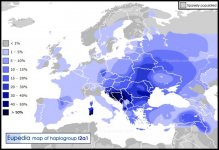
No, actually; I believe that Maciamo made a theory here earlier that R1b wasn't the original paternal haplogroup of the Basque people. It was most likely Mesolithic I2. If you look at the map of I2a you will see a small I2a1 residual; stretching from the Basque country into Western France and into Aragon:

Haplogroup_I2a.jpg

Apparently this minor subclade I2a1 originated around the Southern French Pyrenees.
 
Because Robert6 wants to think of them as Maykop. And, to be accurate, my previous post was poorly worded - I meant they were in the Caucasus, to the south of Yamnaya. All along the west side of the Caucasus at their greatest extent, although I believe they started in the southwestern part.

Yes, there's a desire to force the origin of "Kurgans" to the Caucuses or even the Southern slopes there of. I wonder why. Maykop is distinct.
 
I confess I'm confused by some posts, could you give some references about that?
Here is Gimbutas article about a North Pontic Maikop culture as a first wave of European kurganization.
Also in this article is about Yamna(Pit-Grave) the third wave of European kurganization.


But the article is in Russian
http://s155239215.onlinehome.us/turkic/btn_Archeology/GimbutasMKurgansToEuropeRu.htm
Marija Gimbutas
THE CIVILIZATION OF THE GODDESS
EDITED BY JOAN MARLER Harper, San Francisco, 1994, ISBN 978-0062508041
Глава 10
Конец древней Европы: вторжение скотоводов из Северопонтийских степей и преображение Европы


The map of early Kurgan era
http://s155239215.onlinehome.us/tur...fTheGoddess/BC3500GimbutasMKurganFig10-13.gif
 
Here is Gimbutas article about a North Pontic Maikop culture as a first wave of European kurganization.
Also in this article is about Yamna(Pit-Grave) the third wave of European kurganization.


But the article is in Russian
http://s155239215.onlinehome.us/turkic/btn_Archeology/GimbutasMKurgansToEuropeRu.htm
Marija Gimbutas
THE CIVILIZATION OF THE GODDESS
EDITED BY JOAN MARLER Harper, San Francisco, 1994, ISBN 978-0062508041
Глава 10
Конец древней Европы: вторжение скотоводов из Северопонтийских степей и преображение Европы


The map of early Kurgan era
http://s155239215.onlinehome.us/tur...fTheGoddess/BC3500GimbutasMKurganFig10-13.gif

When Gimbutas introduced her kurgan theory in the 1950s, it was an important step forward. However, it's been noted by many academics that she wasn't very good at critical analysis. I prefer the works of more modern academics, particularly David Anthony, who associates the steppe kurgans with Yamnaya.
 
Sundaland since the Ice Age.

I have issue with Ice Age it should be Snow Age as it gives a false image of blocks of ice covering Europe whereas it is really snowed under and accessible and in summer a green wonderland, maybe.

 
Last edited:
Now I was following up on Sile's Karafet Study 2014 on Haplogroup K

http://dienekes.blogspot.ca/2014/06/refined-structure-in-haplogroup-k-m526.html

http://forwhattheywereweare.blogspot.ca/2014/06/y-dna-macro-haplogroup-k-m526.html

http://en.wikipedia.org/wiki/Human_Y-chromosome_DNA_haplogroup

http://www.eastbound88.com/archive/index.php/t-27680.html

http://www.google.ca/imgres?imgurl=http%3A%2F%2F1.bp.blogspot.com%2F_yutCHs4NLCg%2FTBSDVf-
9CUI%2FAAAAAAAAACc%2F0sYmbE6j2kY%2Fs1600%2F661px-Map_of_Sunda_and_Sahul.png&imgrefurl=http%3A%2F%2Fs1.zetaboards.com%2Fanthroscape%2Ftopic%2F4742474%2F1%2F&h=599&w=661&tbnid=aC-dzheaXqq90M%3A&zoom=1&docid=3MgTsJ5PWVgJbM&ei=7D6PVIKaE4KToQTt_oCYDA&tbm=isch&ved=0CEwQMyghMCE&iact=rc&uact=3&dur=2335&page=2&start=23&ndsp=22


http://s1.zetaboards.com/anthroscape/topic/4742474/1/

It appears that the ancestors of Haplogroup R was born in Sundaland or Southeast Asia. Haplogroup R1a being a major component of Indo_Europeans along with Haplogroups J2 and E, maybe.

It gives legs to the Out of India Theory as India has R1 and R2 and the advanced stage of literature in Sanskrit. I was sketical of Out of India Theory but maybe it could be the correct one. It explains why Harappa and Indus Valley though invaded by 'Aryans' would not do so much damage as it was just foreign born 'Aryans' invading the the motherland. The Iranians may have split from the Indians rather than Indians splitting from Iranians.

The Karafet Study does turn the PIE motherland previous studies on their heads. The motherland of PIE could be India.
 
Last edited:
When Gimbutas introduced her kurgan theory in the 1950s, it was an important step forward. However, it's been noted by many academics that she wasn't very good at critical analysis. I prefer the works of more modern academics, particularly David Anthony, who associates the steppe kurgans with Yamnaya.
Translate of the word "Yamnaya" is = "Pit-Grave".
Early kurgans in Pontic steppes didn't had Pit-Graves.
Maikop culture(according to S.N.Korenevskiy Maikop culture was 4000—2900 BC)
is older than Pit-Grave(Yamna) culture.
And Leila-Tepe(4350 BC) is much older than Yamna
Both Maikop and Leila-Tepe were in Steppe regions.
 
Translate of the word "Yamnaya" is = "Pit-Grave".
Early kurgans in Pontic steppes didn't had Pit-Graves.
Maikop culture(according to S.N.Korenevskiy Maikop culture was 4000—2900 BC)
is older than Pit-Grave(Yamna) culture.
And Leila-Tepe(4350 BC) is much older than Yamna
Both Maikop and Leila-Tepe were in Steppe regions.

You obviously haven't read the paper I provided a link to, but at least read the December 9 entry on the Eurogenes Blog where he discusses the paper and gives his reasons for believing that the earliest Pit Grave kurgans on the eastern steppes are at least as old as the oldest of the Maikop kurgans in the Caucasus.
 
Now I was following up on Sile's Karafet Study 2014 on Haplogroup K

http://dienekes.blogspot.ca/2014/06/refined-structure-in-haplogroup-k-m526.html

http://forwhattheywereweare.blogspot.ca/2014/06/y-dna-macro-haplogroup-k-m526.html

http://en.wikipedia.org/wiki/Human_Y-chromosome_DNA_haplogroup

http://www.eastbound88.com/archive/index.php/t-27680.html

http://www.google.ca/imgres?imgurl=http%3A%2F%2F1.bp.blogspot.com%2F_yutCHs4NLCg%2FTBSDVf-
9CUI%2FAAAAAAAAACc%2F0sYmbE6j2kY%2Fs1600%2F661px-Map_of_Sunda_and_Sahul.png&imgrefurl=http%3A%2F%2Fs1.zetaboards.com%2Fanthroscape%2Ftopic%2F4742474%2F1%2F&h=599&w=661&tbnid=aC-dzheaXqq90M%3A&zoom=1&docid=3MgTsJ5PWVgJbM&ei=7D6PVIKaE4KToQTt_oCYDA&tbm=isch&ved=0CEwQMyghMCE&iact=rc&uact=3&dur=2335&page=2&start=23&ndsp=22


http://s1.zetaboards.com/anthroscape/topic/4742474/1/

It appears that the ancestors of Haplogroup R was born in Sundaland or Southeast Asia. Haplogroup R1a being a major component of Indo_Europeans along with Haplogroups J2 and E, maybe.

It gives legs to the Out of India Theory as India has R1 and R2 and the advanced stage of literature in Sanskrit. I was sketical of Out of India Theory but maybe it could be the correct one. It explains why Harappa and Indus Valley though invaded by 'Aryans' would not do so much damage as it was just foreign born 'Aryans' invading the the motherland. The Iranians may have split from the Indians rather than Indians splitting from Iranians.

The Karafet Study does turn the PIE motherland previous studies on their heads. The motherland of PIE could be India.

Sorry but I think you missed the point. Where Y haplogroup K was centred when haplogroups M and P diverged from it does not tell us anything about where haplogroup R was centred when R1 and R2 diverged from it. Those two events are separated by thousands of years and appear to have happened in very different places. And the origin point of R1a does not necessarily tell us where the R1a people came from to invade Europe during the Bronze Age. People move around over a period of several thousand years.
 
It appears that Haplogroup K went along the coast of India as Haplogroup LT split from it near the Arabian Sea and then kept on going to Bay of Bengal or were caught by the strong currents to the Sundaland. The seas being much lower by 120 meters offered a much smoother coastline for water flow thus stronger equatorial ocean current to loop back clock-wise in the Northern Hemisphere but having no land mass opposite India the westward equatorial current pushed into the coasts of Africa. Note: the people of Madagascar are of Indonesian descent. The westward equatorial ocean current must have carried lost fisherman and off-course early (maybe Ice Age) sailors to Madagascar, Africa. http://www.wildmadagascar.org/people/
https://www.google.ca/maps/place/Af...2!3m1!1s0x10a06c0a948cf5d5:0x108270c99e90f0b3


Probably Haplogroup P decided to go back as the Sundaland is very hot (Thailand is very hot year-round as it is very near or the Equator passes through Thailand). After backtracking instead of going back all the way to the Middle East they went north towards the Himalayas and into Central Asia. When they backtracked it was family reunion so it was quick movement across large distances. Haplogroup K and P with Q are family so they travel together. Of course, Haplogroup N and O went up north to China and N continued into Siberia and westward while O stayed in Southeast Asia, into eastern India and up the Mekong to Tibet.

Haplogroup R could have been born in the region covering Himalayas, Pamir Mountains and the Hindu Kush as well as Central Asia and Siberia.

https://pastmists.wordpress.com/2010/06/21/central-asia/
 
Last edited:
Back
Top