How do you explain the difference with peoples from Andronovo culture (blond, blue eyed, fair skins) if they were "similar" ? Because the "difference" between R1A vs R1b ? How to explain the evolution from tan skinned to very light skinned for indo-Europeans, specially with the paper of Caufield ? We have for these samples previously tested (for their skin colors) the mtdna but no Haplogroup Y, that could be an siberian group, mixed peoples etc... also these yamna have lot of WHG genes, so I guess according to you, if they have blue eyes that would not be a big surprise too; specially now that we know that these yamna folks are close to baltic peoples and the Norwegians
Corded Ware and WHG have also the same mtdna, but different haplogroup Y
Not really, previous WHG has brown eyes for what I have read; until late Neolithic (around 6000 BC), "blue eyes" seem to appear like that, so no it's not an uniform trait, and imho that could be from Karelian type peoples (EHG); that difficult to know because there were mixed (and Labrana has the haplogroup C, another WHG with light eyes has the haplogroup R etc...); now there are the problem of the "probability", according these papers they have just 50% chance to have "blue eyes" (except HERC2, I'm not sure they have the other genes for blue eyes); so I guess it's not really sure; they were also brown skinned; when light skin and light eyes seem to be exclusive to each other...I honestly think there are a problem somewhere.
Also, if they are the original sources of blue eyes, that weird because they have been invaded/mixed multiples times, with such recessive trait blue eyes shouldn't exist today; for middle easterns to have light skins; yes I guess for their genes; the problem is, unlike the Europeans, they are dark skinned to olive skins; far more rarely with fair skins (and that could be explained by invasion from Europeans).
I think we should be careful with big probability, if we have found 5 WHG with blue eyes in neolithic, that don't mean all the WHG was blue eyed, imagine we would have been just found the yamna peoples with light eyes; that would have been the same conclusion.
For your paper, there were another who claim that blue eyes peoples has the same ancestors and this gene is very young, for him it was around 8000 BC near the black sea (with the Indo-Europeans); I think you have already see it.
That just a theory (and that don't explain why that have worked just for the Europeans), sorry that don't explain how the indo-europeans have been dark skinned to very light skinned, light eyed and hairs; in a very short time during the bronze age; specially with such extremely recessive trait like light blue eyes, light hairs and white skins (and why middle eastern peoples, despite the light genes, are so "brown").
Also, according various paper, light or blue eyes don't any particular use; so that not from the natural selection.
If you wish to focus on pigmentation issues, I think you would find it helpful to read the pigmentation threads here on this site, where specific results by ancient sample are discussed, as well as the possible drivers of evolutionary natural selection. Just type "pigmentation" into the search engine. Or you may want to start a thread on pigmentation among the Yamnaya and Catacomb culture samples. This paper doesn't address pigmentation issues.
Just generally to address some of your concerns, do we have hundreds of ancient samples with pigmentation information? No, we don't. However, we have information for WHG's and they all have the snps that are used today to predict blue eyes. They
lack the derived de-pigmentation snps that are today used to predict skin color. If you have a study that shows that isn't the case, please provide it.
The fact that the WHG all had a pigmentation trait despite having different yDna lineages should indicate to you that it is unwarranted to tie pigmentation traits to one specific yDna lineage.
We also have pigmentation data for Malta (who is the model for ANE) and he was predicted to be dark haired, dark eyed and dark skinned if we use modern de-pigmentation snps as a guide.
We don't have pigmentation data for the first farmers in the Near East because we don't have an ancient sample of one of them. Once again, we do have the data for Stuttgart, an LBK early european farmer from central Europe (who had
perhaps up to 20% WHG or UHG ancestry), and she had the derived versions of SLC24A5, making her probably lighter, according to the authors of the paper, than the WHG. The derived version of that snp is now fixed in Europe and most of the Near East.
Given that pigmentation is a polygenic trait, I think it's a good bet that it requires derived snps for SLC 24A5, SLC42A5, and TYRP1 to produce "European fair" skin, plus the HERC 2 which adds the blue eyes trait. A derived version of SLC42A5 does appear in a northeastern European hunter gatherer.
We further know that the
oldest (by far) ancient samples we have where all these snps come together are the autosomally EEF (early European farmers) in central Europe. Andronovo is
much younger.
Also, we have results from Yamnaya and Catacomb culture. You can easily check the data for yourself. They were very predominantly dark haired and eyed, although it's difficult to be precise because Sandra Wilde didn't test for SLC24A5. To the best of my recollection, their levels of SLC42A5 are more in line with what is present in West Asia today than with the current levels in Europe. An early Bronze Age man from Poland has also been predicted to have a "darker" complexion. I don't
know, but perhaps that means that he also didn't have derived snps for SLC42A5.
Once again, this is the link to the Sandra Wilde et al paper where you can check the percentages:
http://www.pnas.org/content/111/13/4832.full.pdf+html
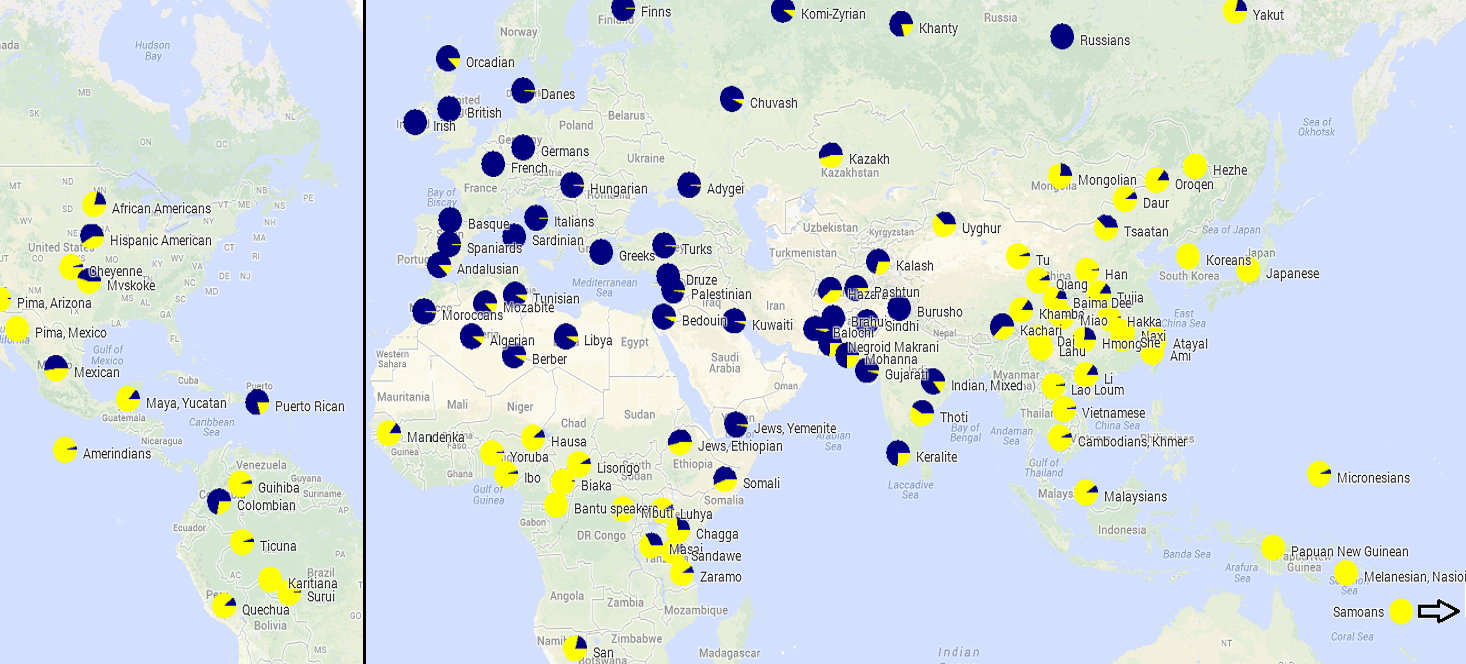
This is a map showing the presence of derived versions of SLC24A5.
This is data from Europe showing levels of SLC42A5. (Remember that all these populations are fixed for SLC24A5)
View attachment 7083
I also think someone has collated all the pigmentation data for all the ancient samples. Perhaps someone can provide a link.
That's all we know. The rest is total speculation. I don't know where any of these snps first appeared, and neither does anyone else. (The Caucasus area seems like a good bet to me for various reasons, but this is not the thread for that discussion.) What seems inescapable, however, is that these snps are under recent selection. Also keep in mind that the source of a mutation is different from its spread and its current frequencies. The possible drivers are discussed in pigmentation threads, but generally, scientists have hypothesized that it involves some interaction of latitude and changes in diet relating to the transition to a "farmer" diet, and perhaps some influence relating to the consumption of large amounts of dairy products.
Time will tell.
I will permit myself an editorial comment, which is not directed at you, of course. Other than as a matter of intellectual curiosity, who cares where it originated? Who cares where it is most frequent, or how it correlates with
present distributions of yDna lineages. This is just a biological reaction to environmental factors. Am I supposed to feel superior because I have all of the depigmentation snps except those for blue eyes? According to the ancient Greeks, they had the perfect pigmentation, while the northerners were too light and the Africans too dark. Every group, I suppose, will laud its own particular traits, but any specific combination has no higher intrinsic value than any other. Certainly, this kind of bias should not have anything to do with scientific analysis.





 We might need an alternative theory of what was in 50% like Armenians, if it wasn't neither Caucasus nor Gedrosia.