• Don't want to see ads? Install an adblocker like uBlock Origin or use a Europe-based privacy-friendly browser like Vivaldi or Mullvad.

To burn or not to burn: LBA/EIA Balkan case

Status
Not open for further replies.
Brnjica Culture is a good candidate for some of the Albanian E-V13

Until recently, our knowledge of the Brnjica
cultural group (or cultural group Donja Brnjica
– Gornja Stra`ava) was based on the research
results from fifteen or so sites, mainly necropolises.1
There were no data on settlements and habitations.2
The total archaeological collection of the Brnjica com-
munity amounted to less than three hundred objects,
mostly ceramic vessels.3This cultural group was cha-
racterized as the final phase, »… of a long evolution to be
followed with certainty through the entire Bronze Age,
while closely connected to the Balkan–Danube comp-
lex and elements the linguists mark as Dako–Moesian.
Therefore, this group’s finds could be identified with
the non-Illyrian component in the Dardanian ethno-
genesis.


researchgate(dot)net/publication/250151139_Regional_characteristics_of_the_Brnjica_cultural_group
 
Gjergj is a incoherent individual, I've seen interviews where he calls E-V13 proto-Illyrian though based on earlier comments in the interview, he clearly did not mean to. He Fs up when he types or speaks.
He says E-V13 is Pannonian, and the argument that it cannot be the linguistic ancestor groups, is that it's way too northern and likely spoke a IE language related to the northern branches(Celtic, Germanic, etc...) which is just dumb excuses, he is basically whining. I do not know why he groups R-Z2705/R-Y2337 differently from E-V13, because they clearly came into Albania together, like I said he is not very coherent, because the Moesia group if confined to E-V13, is not the largest group as he presented it. The spread of E-V13 and R-Z2705/R-Y2337 are the only coherent lineages that are reliably present in every Albanian speaking region, they are the backbone.

J2b2 only decreases in the south. the E-V13 and R1b are main hg there but they also decrease compared to the north. There are other lineages there which aren't found as much as in the north.
 
Interesting conversation in this Facebook page.

https://www.facebook.com/photo/?fbid=1340824246505282&set=a.103315046922881

I'll quote the most interesting statement from the leader of rrenjet.

There is no doubt Kruja-Komani = Latinized Illyrians and are J2b-L283 dominated, in gjergj own words, these are not the backbone of the Albanians corpus (Albanian, Arberesh, Arvanites).
If the Kruja - Komani are J2b-L283 dominated, the continuity is perfectly there. Case closed! You cannot pretend to have the continuity of all the population.
Of course it would comprise the enlargement of the continuity to include the Daco-Moesian part and the Macedonian part.
The fact that Romanians and Greeks are so reluctant to publish their results implies that all three main Albanian clades are in general the three Paleo-Balkans clades which are present mainly in Albanias.
So, there is not just one continuity. It's more a multi-faceted continuity in one modern population.
 
That was a interesting cut-off point. It looks like what was suspected, that Chaonians were J2a, is likely true after all. I think Bubanj-Hum had to have been R-PF7563, with some R-Z2103(that's a safe bet for central Balkans). The EBA samples from Kukes is dated around 2,550 BC and is about 2/3 steppe in autosomal DNA. He likely came to Albania through Kosovo which is Bubanj-Hum territory at the time(also the same timeline when this culture began). EBA Cinamak is likely is just branch of this overall migration that formed Bubanj-Hum. Armenchori which is seen as a derivative of Bubanj-Hum is likely J2a dominated along with G2 and minority R1b presence. I don't know if J2a was naturalized into IE identity locally in Macedonia or somewhere further north, I would suspect they adopted locally. It is hard to imagine Armenchori being R-PF7563 dominated and to have such a weak presence in Mycenean Greece, whoever occupied Armenchori would have supplied southern Greece with impulses of migrations. I can't see them being different from the leading Mycenean lineages.

We are confusing things here


Chaonians are a Epirote tribe in southern Albania ..........they where a huge tribe , part of 14 epirote tribes............the other main tribe where the Molossians ...............recently studies have indicated that 3 of these Epirote tribes ( chaoninas and 2 others ) spoke a different language than what the Molossians spoke

they state that when the Epirus king Phyrrhus landed in Messapic lands ( salento peninsula ) they, spoke the same language as the Chaonians did............a language he understood.
 
We are confusing things here
Chaonians are a Epirote tribe in southern Albania ..........they where a huge tribe , part of 14 epirote tribes............the other main tribe where the Molossians ...............recently studies have indicated that 3 of these Epirote tribes ( chaoninas and 2 others ) spoke a different language than what the Molossians spoke
they state that when the Epirus king Phyrrhus landed in Messapic lands ( salento peninsula ) they, spoke the same language as the Chaonians did............a language he understood.

This is utter nonsense, both Tribes were speaking North West doric dialect
IMG_20230822_050208.jpgIMG_20230822_050352.jpg
 
We are confusing things here


Chaonians are a Epirote tribe in southern Albania ..........they where a huge tribe , part of 14 epirote tribes............the other main tribe where the Molossians ...............recently studies have indicated that 3 of these Epirote tribes ( chaoninas and 2 others ) spoke a different language than what the Molossians spoke

they state that when the Epirus king Phyrrhus landed in Messapic lands ( salento peninsula ) they, spoke the same language as the Chaonians did............a language he understood.

And who says that Phyrrhus understood Messapian?


Sent from my iPhone using Tapatalk
 
The earliest evidence of writing in the local language in Puglia, conventionally termed Messapic, appears in 6th century. The high point of writing on durable materials in the local language and script is the 4th and 3rd centuries, a period to which around 70% of the total number of inscriptions can be dated. The corpus of writing from the region comprises c. 640 inscriptions in Messapic, together with a significant number of others in Greek but from local contexts or apparently written by non-Greeks, and yet others whose language cannot be securely identified. The end of the tradition of inscribing in Messapic is debatable, but it is likely to have continued until the 2nd century. Scholars now believe the numbers of late inscriptions to be small.


The alphabet has some distinctive local characters but is derived from (and closely based on) the Greek alphabet, drawing elements of letter forms from a number of Archaic Greek scripts (figure 2). It shares many features with the Laconian-Tarentine script used at Taras but there are also some significant differences. Although Tarentine influence on letter forms appears to be strong, the earliest phases of the Messapic alphabet are not solely based on this, but show similarities to other Archaic Greek scripts. The influence of the Tarentine alphabet becomes stronger from the late 5th century onwards, as literacy becomes more securely established.
 
This is utter nonsense, both Tribes were speaking North West doric dialect
View attachment 14036View attachment 14037


what did Pyrrhus and he Epirotes speak ?

we know they ruled from Durres to the Gulf of Corinth


both spoke a different form of NW Doric language as I read in the past year ..............Re you concerned the Dorians are linked with ancient proto-albanians ?
 
what did Pyrrhus and he Epirotes speak ?
we know they ruled from Durres to the Gulf of Corinth
both spoke a different form of NW Doric language as I read in the past year ..............Re you concerned che Dorians are linked with ancient proto-albanians ?

1."what did Pyrrhus and he Epirotes speak"
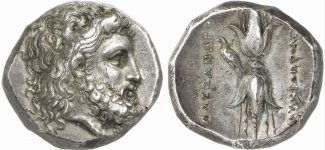
Northwestern Greek(which is a subgroup of Doric) as proven by inscriptions/coins of that era
for example a molossian coin of
the 4th Century BC
1.jpg

2."both spoke a different form of NW Doric language"

NW Doric is not even a language but a dialect.Doric Subgroup is divided in Doric proper and Northwest Greek

3."Re you concerned the Dorians are linked with ancient proto-albanians"

LOL dude are you insane?Not even the dumbest albanian nationalist spreads such hilarious claims.

Dunno where you read all this pseudohistoric nonsense but definitely you're clueless
 
Last edited:
1."what did Pyrrhus and he Epirotes speak"
Northwestern Greek(which is a subgroup of Doric) as proven by inscriptions/coins of that era
for example a molossian coin of
the 4th Century BC
View attachment 14038

2."both spoke a different form of NW Doric language"

NW Doric is not even a language but a dialect.Doric Subgroup is divided in Doric proper and Northwest Greek

3."Re you concerned the Dorians are linked with ancient proto-albanians"

LOL dude are you insane?Not even the dumbest albanian nationalist spreads such hilarious claims.

Dunno where you read all this pseudohistoric nonsense but definitely you're clueless


you clearly do not even know your own history...stop thinking nationally and you will learn history

a few of many dozen links are below

https://www.historyfiles.co.uk/KingListsEurope/GreeceEpirus.htm

https://www.amazon.com.au/Epirotes-Albanians-Antiquity-Nelson-Cabej/dp/1944788891

https://www.livius.org/articles/person/pyrrhus-of-epirus/
 

Dunno about you but i read actual data-backed history,the one that actual historians studied.I'm not the one who spreads pseudohistoric/absurd nonsense in a forum about science like the"dorian language(!)","Dorians linked to protoalbanians","Pyrrhus understanding messapic" and other utter nonsense.

I really laughed with your sources.None of them backs your nonsense that Pyrrhus understanded Messapic or that Dorians linked to Protoalbanians,on the contrary in your first source the author writes what i wrote previously:
"That (semi-legendary) early kingdom of Epirus which was formed by Mycenaeans (or even Trojans!) probably equated only to the central regions of the later Epirote kingdom, the region held by the Molossians themselves. "
"The Lyncestae of the region of Lynkestis (Lyncestis) are especially interesting in this context. Crossland and Birchall Duckworth state: 'Proto Greek... Lynkos, Lynkai, from "lunx" (gen. "lunkos"), "lynx"... in the region defined just above, roughly northern and north-western Greece... Since Greek place-names are very dense in that region and they have a very archaic appearance, one may suppose that the proto-Greeks were settled in it during many centuries and even millennia". That seems to suggest an early settlement of proto-Greeks here, but does not offer an opinion on whether they may be Mycenaeans, Dorians, or any other form of South-West Indo-European group."


the only mention about messapic in your sources is this one which obviously has nothing to do with your nonsense

"Pyrrhus conquers
Syracuse in 277 BC, and holds it for two years, with support being given by the Italian tribe, the Messapii. His hard but costly fighting against Rome on the island brings the kingdom a brief sense of importance. It is also his costly victories which inspire the term 'pyrrhic victory', as a victory with such high loses is no real victory at all. When Pyrrhus leaves Sicily, one of his former generals, Hieron, is appointed commander-in-chief of the Syracusan armed forces and is made king in 270 BC."

you should really read your own sources.

The most hilarious about your sources is the second one,the "Epirotes Albanians of Antiquity" is a history(?) book written by an albanian vet/biologist(!!!).
"Nelson R. Çabej obtained his B.A. in veterinary science in 1961, followed by B.A. in chemistry in 1976, and finally completed his doctorate degree (PhD) in biology in 1986."

Pseudohistoric "sources" like this won't help you deal with your historical insecurities my dear.
 
Last edited:
If the Kruja - Komani are J2b-L283 dominated, the continuity is perfectly there. Case closed! You cannot pretend to have the continuity of all the population.
Of course it would comprise the enlargement of the continuity to include the Daco-Moesian part and the Macedonian part.
The fact that Romanians and Greeks are so reluctant to publish their results implies that all three main Albanian clades are in general the three Paleo-Balkans clades which are present mainly in Albanias.
So, there is not just one continuity. It's more a multi-faceted continuity in one modern population.

It's interesting how Matzinger claims that Albanian is not Thracian for example but related to Messapic and Illyrian who were R1b and J2b2. Messapic and Central Balkan groups were R1b at least , if Matzingers theory is right that they were not Illyrian this means they picked up J2b2 from Illyrians. But we don't have any J2b2 in Vucedol but only R1b and which was most likely some kind of Illyrian-Neolithic culture unless Matzinger can prove some Messapic connection. Regardless, trying to delink Messapic with Illyrian is rather speculative at this point. Seems rather the Balkans was composed of different groups of cultures that met during the Bronze Age / Iron Age. You even had R-L2 Venetic tribes in parts of Croatia.

E-V13 could explain the Thracian influence in Albanian since in the central Balkans is where Thracian and Illyrian met and the E-V13 from Nish Late Antiquity has an autosomal profile influenced by Illyrian. Maybe proto-Albanians formed from different paleo-Balkan tribes which included J2b2 and R1b and E-V13

It's interesting how this guy also keeps pushing for the agenda that the J2b2 is supposed to of not come into modern Albania
when obvious factors that point out that some of it it did , some of that J2b2 could actually be Dardanian.
 
No, I definitely cannot see how the Proto-Albanians are supposed to of been an E-V13 population only. Proto-Albanians could of as well been J2b2 and R1b and picked up E-V13 on the go. Or proto-Albanians were Central Balkan R1b who picked up J2b2 and E-V13 since the Bronze Age / Iron Age.
 
If I recall correctly there is also one Romanian and Bulgarian that match one of those ancient J2b2 samples from North-Eastern Albania and there are some J2b2 shared with Romanians/Aromanians too. Of course most of the lineages aren't shared with most populations considering Romanians have good chunk of Slavic and paleo-Balkan Y-DNA were pretty much washed out
 
It's interesting how Matzinger claims that Albanian is not Thracian for example but related to Messapic and Illyrian who were R1b and J2b2. Messapic and Central Balkan groups were R1b at least , if Matzingers theory is right that they were not Illyrian this means they picked up J2b2 from Illyrians. But we don't have any J2b2 in Vucedol but only R1b and which was most likely some kind of Illyrian-Neolithic culture unless Matzinger can prove some Messapic connection. Regardless, trying to delink Messapic with Illyrian is rather speculative at this point. Seems rather the Balkans was composed of different groups of cultures that met during the Bronze Age / Iron Age. You even had R-L2 Venetic tribes in parts of Croatia.

E-V13 could explain the Thracian influence in Albanian since in the central Balkans is where Thracian and Illyrian met and the E-V13 from Nish Late Antiquity has an autosomal profile influenced by Illyrian. Maybe proto-Albanians formed from different paleo-Balkan tribes which included J2b2 and R1b and E-V13

It's interesting how this guy also keeps pushing for the agenda that the J2b2 is supposed to of not come into modern Albania
when obvious factors that point out that some of it it did , some of that J2b2 could actually be Dardanian.

You have the 2021 paper of Daunians arriving in Foggia Italy area and are known as Iapodes/Japodes .............these Iapodes/Japodes are from the modern Slovenian/croatian borde lands......they mined the Noric iron mines
There is no connection with the Messapics that I have read in the paper and also the additional paper.

apart from J2b2 and R-L2 you should also see G2a with these peoples

Messapics seem an entirely different people that arrived in the salento peninsula in Italy at least over 200 years after the Daunians arrived in late bronze age times

I will not comment on the "Thraician-Dacian" E-V13
 
FTDNA made some assignments for the Polish samples:

Koński306: E-BY68465
Masłomęcz 110: E-Z16659
Śr?dka 236: E-Y3183
Santok 400: E-FGC11451
Śr?dka 255: E-BY5219
Śr?dka 558: E-L17

Therefore we see in the North, like in earlier samples, a total dominance of E-Z5018, especially of the major branches of E-Z16659 and E-FGC11457. Just like in Hungary before and in the East as far as China.

One of the papers on Late Antiquity to Early Medieval Pannonia came out too, the samples there are:

Qrts said:
Fonyod_536 Fony?d - M?rn?ki telep Hungary Middle third of 5th century 1240K This paper E1b1b1a1b1
Hacs_21 H?cs - B?ndekpuszta Hungary Second half of 5th century WGS This paper E1b1b1a1b1a10a2h
Hacs_22 H?cs - B?ndekpuszta Hungary Second half of 5th century WGS This paper E1b1b1a1b1a1

--
E1b1b1a1b1a10a2h should be the equivalent of E-A7065

Paper: https://www.cell.com/current-biology/fulltext/S0960-9822(23)01035-7

So yet another E-Z16659/E-L241 for those which could be assigned downstream.
 
The surprises never end, despite how much we already know, like Greek J2a being a sub-branch of Hungarian neolithic clade. It's frustrating knowing that there are lots of ancient samples that have been tested but are clearly being withheld from being published, like the leak of R1b in Arta (Greece) from IA (this has been known for over 4 years now). In 2004-5, lots of samples were tested in tumulus burials of Kamenica Albania, used in someones thesis paper to get their phd, where are the bam files?
Ancient samples have already been tested to a great degree, but they are very slow to be released, Reich and co are seating on the data, picking and choosing what to publish.
There's no conspiracy theory in this case, the paper with aDNA from Amvrakia was presented as an abstract at a conference last fall so I assume will be published in the near future.

BTW, it's much easier for dishonest Greek researchers to promote continuity of modern Greeks with the northern Greek/southern Balkan (Logkas-like) samples than with Mycenaeans and classical Greeks, but you don't seem to understand this..
 
Status
Not open for further replies.
Back
Top