

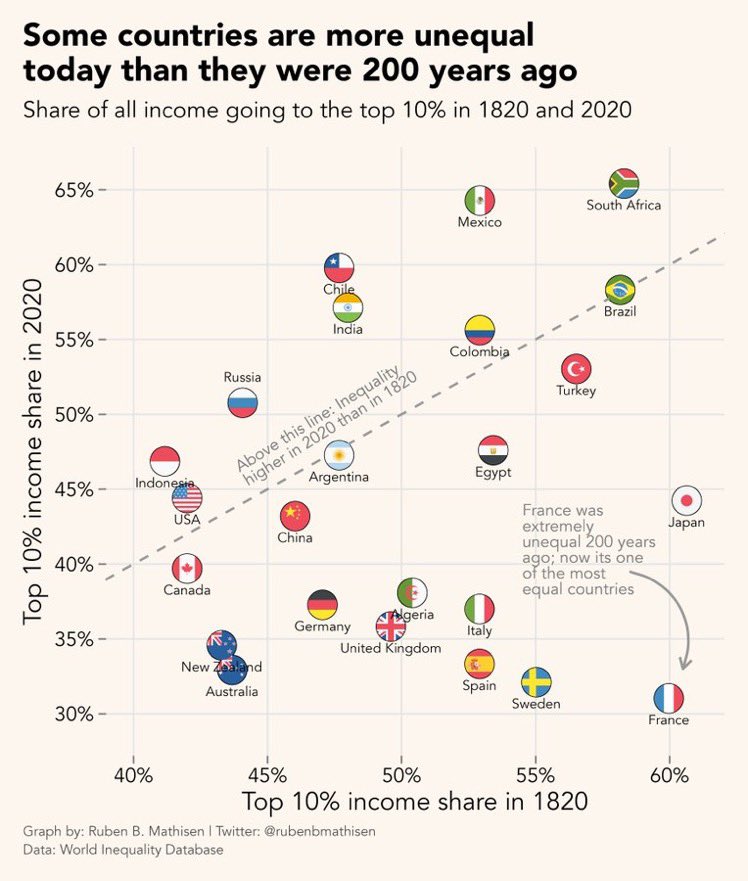
It's not a surprised to anyone that the USA is a country rife with socio-economic inequalities. It has not always been like this. The rich have been getting increasingly richer compared to the rest of the population since the early 1980's (under Ronald Reagan) and the trend has accentuated further since the early 2000's. Nowadays 40% of the wealth is owned by just 1% of Americans and nearly 80% of all the wealth belongs the top 10%. It means that 90% of Americans have very little and can indeed be considered as poor by the standards of developed countries.

Wealth vs income inequality
Income and wealth are not the same thing. Income is what people earn from their job, for example on a monthly or yearly basis. Wealth is the total money accumulated by a person or family over their lifetime and does not necessarily come from income. It can be inherited or result from capital gains from all sorts of investments.
The United States distinguishes itself by having the biggest inequalities of any rich country both for wealth and income.
If you look at the table for the income of the richest 1% on Wikipedia, you'll notice that some of the poorest countries in the world top the ranking (Malawi, Central African Republic, Mozambique), where the top 1% earn over 30% of all income. The USA are 13th worldwide, between Botswana and Iraq. The top 1% Americans earn 22.5% of all income in the country!
The EU country with the most income inequality is Romania (top 1% earn 15% of income), which is still a developing country. Among developed countries, the next after the US is Canada, where the top 1% earn 13.6% of income, then the UK (12.6%) and Germany (12.5%). Out of 116 countries listed, ranking countries from the highest income share of the top 1% to the lowest share, Northern, Western and Central European countries rank between the 71st and 116th position. That's also the case of Japan (93rd), Australia (102nd) and New Zealand (107th). The United States (13th) is ranked far outside the rest of the developed world.
Interestingly, the Netherlands, which has the second largest wealth inequality, is at the bottom of the list for income inequality (top 1% earn 6.2% of income), which shows that wealth and income inequalities are not necessarily related.
Wealth vs income inequality
Income and wealth are not the same thing. Income is what people earn from their job, for example on a monthly or yearly basis. Wealth is the total money accumulated by a person or family over their lifetime and does not necessarily come from income. It can be inherited or result from capital gains from all sorts of investments.
The United States distinguishes itself by having the biggest inequalities of any rich country both for wealth and income.
If you look at the table for the income of the richest 1% on Wikipedia, you'll notice that some of the poorest countries in the world top the ranking (Malawi, Central African Republic, Mozambique), where the top 1% earn over 30% of all income. The USA are 13th worldwide, between Botswana and Iraq. The top 1% Americans earn 22.5% of all income in the country!
The EU country with the most income inequality is Romania (top 1% earn 15% of income), which is still a developing country. Among developed countries, the next after the US is Canada, where the top 1% earn 13.6% of income, then the UK (12.6%) and Germany (12.5%). Out of 116 countries listed, ranking countries from the highest income share of the top 1% to the lowest share, Northern, Western and Central European countries rank between the 71st and 116th position. That's also the case of Japan (93rd), Australia (102nd) and New Zealand (107th). The United States (13th) is ranked far outside the rest of the developed world.
Interestingly, the Netherlands, which has the second largest wealth inequality, is at the bottom of the list for income inequality (top 1% earn 6.2% of income), which shows that wealth and income inequalities are not necessarily related.
Last edited:



 ) earns $296 million, while Glenn D. Fogel, CEO of Booking.com (based in The Netherlands) earns $30 million, just one tenth! Yet Booking.com is the bigger company of the two with a market cap of $113 billion and net profits of $3 billion in 2022. Expedia has a market cap of $15 billion (7.5 times less) and net profits of merely $352 million in 2022 (10 times less than Booking). In fact Expedia's CEO earns almost as much as the whole's company's net profits! In contrast, Booking's CEO earns only 10% of the company's profits. It's not just that American companies overpay their CEOs in comparison to the rest of their personnel, but also in relation to their net income. In other words American CEOs are taking away with them a good chunk of the money that should go to stockholders. So that's not even fair to the company's real owners (i.e. the stockholders).
