

Pax Augusta
Elite member
A couple of recent papers.
- The peopling of the last Green Sahara revealed by high-coverage resequencing of trans-Saharan patrilineages.
Eugenia D’Atanasio et al
Little is known about the peopling of the Sahara during the Holocene climatic optimum, when the desert was replaced by a fertile environment.
RESULTS:
In order to investigate the role of the last Green Sahara in the peopling of Africa, we deep-sequence the whole non-repetitive portion of the Y chromosome in 104 males selected as representative of haplogroups which are currently found to the north and to the south of the Sahara. We identify 5,966 mutations, from which we extract 142 informative markers then genotyped in about 8,000 subjects from 145 African, Eurasian and African American populations. We find that the coalescence age of the trans-Saharan haplogroups dates back to the last Green Sahara, while most northern African or sub-Saharan clades expanded locally in the subsequent arid phase.
CONCLUSIONS:
Our findings suggest that the Green Sahara promoted human movements and demographic expansions, possibly linked to the adoption of pastoralism. Comparing our results with previously reported genome-wide data, we also find evidence for a sex-biased sub-Saharan contribution to northern Africans, suggesting that historical events such as the trans-Saharan slave trade mainly contributed to the mtDNA and autosomal gene pool, whereas the northern African paternal gene pool was mainly shaped by more ancient events.
https://www.ncbi.nlm.nih.gov/pmc/articles/PMC5809971/
- A history of male migration in and out of the Green Sahara
Yali Xue
Abstract
The Sahara was once fertile; a recent study identifies human Y-chromosomal lineages that flourished in this Green Sahara and their relation to present-day populations.
Introduction
Modern humans originated in Africa at least 300 thousand years ago (kya). The migration out of Africa (~ 60 kya) was central to human history, but the subsequent migrations and demographic events within Africa, stimulated by climate changes, developments in technology and other historical factors remain under-appreciated and under-studied. A recent study [1], focusing on the consequences of climatic changes in the Saharan region over the past 12 thousand years, fills one of the gaps in our knowledge of human migration.
Y-chromosomal lineages from the Green Sahara
The transformation of the Sahara over the past 12 thousand years has been profound: a once hospitable environment with lakes, savannahs and animals 5–12 kya (referred to as the Green Sahara or the Holocene Wet Phase) has become a hostile environment that forms the largest non-Polar desert on earth. This transition is expected to have had major consequences for the human inhabitants of the region and may have left imprints in the genomes of nearby present-day populations, but can these traces be identified?
D’Atanasio et al. [1] focused on the Y chromosome to address this question. The ~ 60 Mb Y chromosome is inherited from father to son, and no recombination occurs on most of its length. Therefore, this chromosome gradually accumulates mutations and thus provides a particularly simple and detailed record of human history, at least as it has impacted men. This record is enhanced by the historical tendency of men to remain near their birthplace, leading to a strong geographical structure of Y chromosome types. For decades, dedicated researchers have distinguished Y-chromosomal lineages using genetic variants (identifying ‘haplogroups’) and have established the geographical distributions of these variants [2]. In the past few years, advances in genomic technology have made large-scale sequencing of Y chromosomes feasible, which in turn has transformed the field by enabling measurement of the mutation rate and construction of detailed, well-calibrated phylogenies. It is thus possible to use the distributions of present-day Y-chromosomal lineages to infer the historical movements of men.
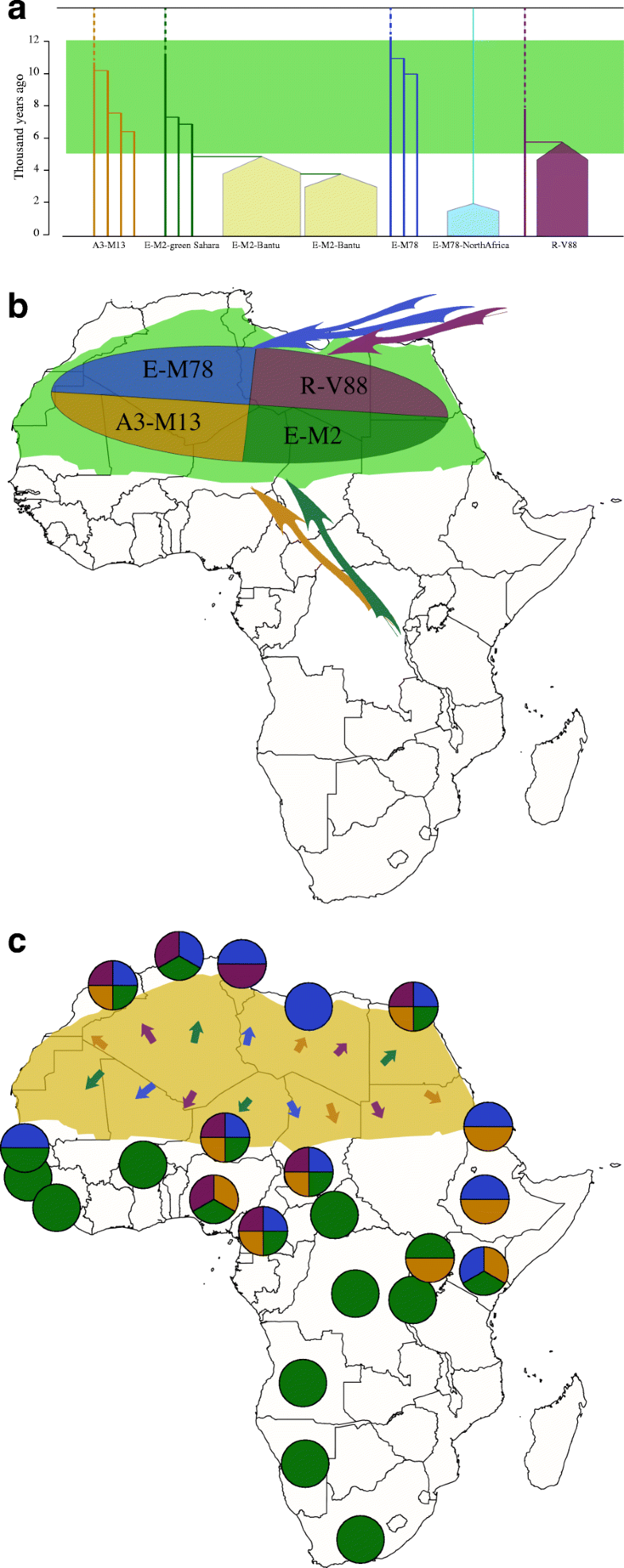
D’Atanasio et al. [1] hypothesized that, because the Sahara has been such a strong barrier to human migration for the past 5000 years, haplogroups that are found in the current populations both to the north and to the south of the Sahara must have spread during the green phase. Previous work had identified four such haplogroups: A3-M13, E-M2, E-M78 and R-V88. (The letter prefix specifies the major Y lineage, and the suffix the particular Y-SNP that defines the lineage.) Targeted sequencing of the Y chromosomes (~ 3.3 Mb) of a set of 104 men, most of whom carried one of these four lineages, allowed D’Atanasio and colleagues to construct a dated phylogenetic tree. This tree, shown in a simplified form in Fig. 1a, revealed the coalescent time of these haplogroups: that is, the period of time that has elapsed since the most recent common ancestor of the haplogroups lived. These time points mostly lay within the 5–12 kya green period, although E-M78 showed a more complex history with some older and more diverse lineages. So, for example, all of the men carrying the A3-M13 Y chromosome are descendants down the male lineage of a single ancestor who lived 10.73 (SD 0.91) kya. Although there is no direct evidence that this ancestor lived in the Green Sahara, it is a simple and reasonable inference (Fig. 1b). Notably, the R-V88 lineage shows an additional striking feature: a very rapid expansion (visualized as lineages in the phylogeny branching so closely together that no mutations occurred between the origin of the different branches) at 5.73 (SD 0.49) kya.
https://genomebiology.biomedcentral.com/articles/10.1186/s13059-018-1410-8
- The peopling of the last Green Sahara revealed by high-coverage resequencing of trans-Saharan patrilineages.
Eugenia D’Atanasio et al
Little is known about the peopling of the Sahara during the Holocene climatic optimum, when the desert was replaced by a fertile environment.
RESULTS:
In order to investigate the role of the last Green Sahara in the peopling of Africa, we deep-sequence the whole non-repetitive portion of the Y chromosome in 104 males selected as representative of haplogroups which are currently found to the north and to the south of the Sahara. We identify 5,966 mutations, from which we extract 142 informative markers then genotyped in about 8,000 subjects from 145 African, Eurasian and African American populations. We find that the coalescence age of the trans-Saharan haplogroups dates back to the last Green Sahara, while most northern African or sub-Saharan clades expanded locally in the subsequent arid phase.
CONCLUSIONS:
Our findings suggest that the Green Sahara promoted human movements and demographic expansions, possibly linked to the adoption of pastoralism. Comparing our results with previously reported genome-wide data, we also find evidence for a sex-biased sub-Saharan contribution to northern Africans, suggesting that historical events such as the trans-Saharan slave trade mainly contributed to the mtDNA and autosomal gene pool, whereas the northern African paternal gene pool was mainly shaped by more ancient events.
https://www.ncbi.nlm.nih.gov/pmc/articles/PMC5809971/
- A history of male migration in and out of the Green Sahara
Yali Xue
Abstract
The Sahara was once fertile; a recent study identifies human Y-chromosomal lineages that flourished in this Green Sahara and their relation to present-day populations.
Introduction
Modern humans originated in Africa at least 300 thousand years ago (kya). The migration out of Africa (~ 60 kya) was central to human history, but the subsequent migrations and demographic events within Africa, stimulated by climate changes, developments in technology and other historical factors remain under-appreciated and under-studied. A recent study [1], focusing on the consequences of climatic changes in the Saharan region over the past 12 thousand years, fills one of the gaps in our knowledge of human migration.
Y-chromosomal lineages from the Green Sahara
The transformation of the Sahara over the past 12 thousand years has been profound: a once hospitable environment with lakes, savannahs and animals 5–12 kya (referred to as the Green Sahara or the Holocene Wet Phase) has become a hostile environment that forms the largest non-Polar desert on earth. This transition is expected to have had major consequences for the human inhabitants of the region and may have left imprints in the genomes of nearby present-day populations, but can these traces be identified?
D’Atanasio et al. [1] focused on the Y chromosome to address this question. The ~ 60 Mb Y chromosome is inherited from father to son, and no recombination occurs on most of its length. Therefore, this chromosome gradually accumulates mutations and thus provides a particularly simple and detailed record of human history, at least as it has impacted men. This record is enhanced by the historical tendency of men to remain near their birthplace, leading to a strong geographical structure of Y chromosome types. For decades, dedicated researchers have distinguished Y-chromosomal lineages using genetic variants (identifying ‘haplogroups’) and have established the geographical distributions of these variants [2]. In the past few years, advances in genomic technology have made large-scale sequencing of Y chromosomes feasible, which in turn has transformed the field by enabling measurement of the mutation rate and construction of detailed, well-calibrated phylogenies. It is thus possible to use the distributions of present-day Y-chromosomal lineages to infer the historical movements of men.
D’Atanasio et al. [1] hypothesized that, because the Sahara has been such a strong barrier to human migration for the past 5000 years, haplogroups that are found in the current populations both to the north and to the south of the Sahara must have spread during the green phase. Previous work had identified four such haplogroups: A3-M13, E-M2, E-M78 and R-V88. (The letter prefix specifies the major Y lineage, and the suffix the particular Y-SNP that defines the lineage.) Targeted sequencing of the Y chromosomes (~ 3.3 Mb) of a set of 104 men, most of whom carried one of these four lineages, allowed D’Atanasio and colleagues to construct a dated phylogenetic tree. This tree, shown in a simplified form in Fig. 1a, revealed the coalescent time of these haplogroups: that is, the period of time that has elapsed since the most recent common ancestor of the haplogroups lived. These time points mostly lay within the 5–12 kya green period, although E-M78 showed a more complex history with some older and more diverse lineages. So, for example, all of the men carrying the A3-M13 Y chromosome are descendants down the male lineage of a single ancestor who lived 10.73 (SD 0.91) kya. Although there is no direct evidence that this ancestor lived in the Green Sahara, it is a simple and reasonable inference (Fig. 1b). Notably, the R-V88 lineage shows an additional striking feature: a very rapid expansion (visualized as lineages in the phylogeny branching so closely together that no mutations occurred between the origin of the different branches) at 5.73 (SD 0.49) kya.
https://genomebiology.biomedcentral.com/articles/10.1186/s13059-018-1410-8


