
• Don't want to see ads? Install an adblocker like uBlock Origin or use a Europe-based privacy-friendly browser like Vivaldi or Mullvad.

Hypothetical Phenotype constructions using Ancient Populations with AI

Jovialis

Advisor
Messages
9,888
Reaction score
6,794
Points
113
Ethnic group
Italian
Y-DNA haplogroup
R1b-PF7566>Y227216
mtDNA haplogroup
H6a1b7
Turns out the AI botched the blending, and continues to struggle. It did not appropiately blend according to the percentages.

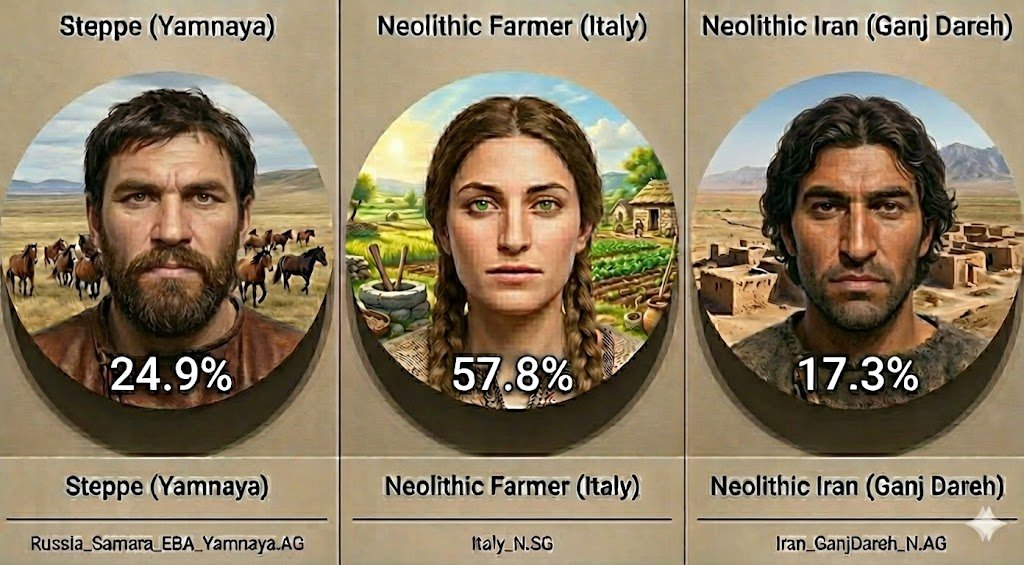
This is a far better representation of these admixture proportions:
1766608585106.png


//

This is not really an endorsement of reliability, but an exploratory endeavor into what AI is capable of. But frankly, I think this looks cooler than the vast majority of the aesthetics for most consumer-genomics test. I like these graphics, it reminds me of Civilization V.

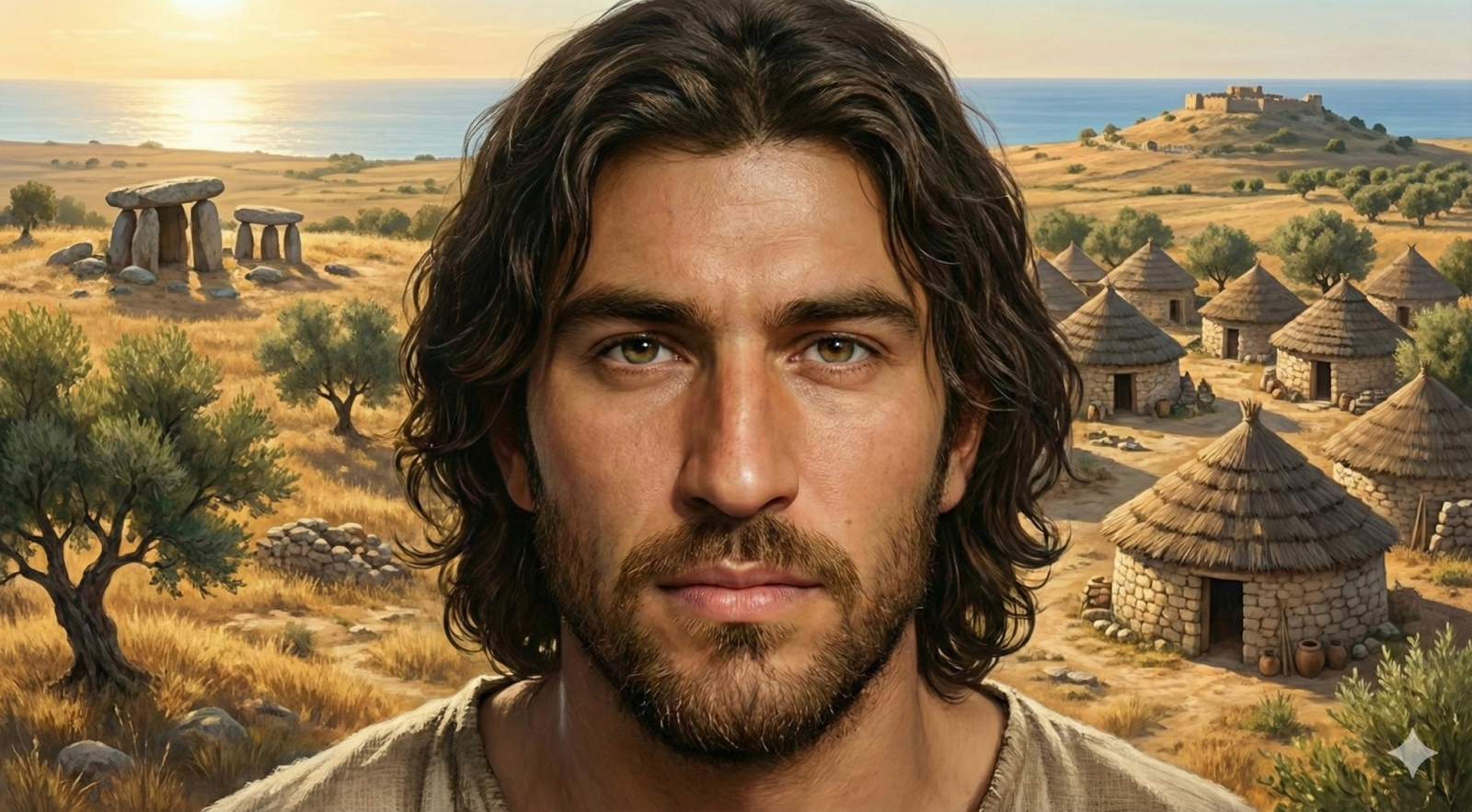
This is what a person with those ancestral components at those rates would look like, according to Gemini Nano Banana:

24.9% Steppe, 57.8% Italy_N, 17.3% Iran_N, the percentages are based on qpAdm ALLSNPS=TRUE I did on my WGS30X sample.

With and without long hair and beard. I really do not look like this person, but I think he looks Southern Italian.

1766555350854.png


1766555237465.png


1766555106186.png


1766555205534.png
 
Last edited:
With and without long hair and beard. I really do not look like this person, but I think he looks Southern Italian.
Interesting experiment, and I agree the visuals are quite striking. That said, I think the limits you point out are crucial. Even if ancestral components and proportions are accurately inferred, translating them into a plausible modern phenotype would require accounting for millennia of sexual selection and culturally mediated mate choice specific to each region. Those dynamics have shaped facial features, body types, and even perceived “regional looks” in ways that go well beyond raw admixture percentages. Without modeling that long-term, population-specific sexual selection (which is probably impossible in practice) the result is bound to be more of an artistic or exploratory rendering than a genuinely realistic reconstruction.
 
Last edited:
Interesting experiment, and I agree the visuals are quite striking. That said, I think the limits you point out are crucial. Even if ancestral components and proportions are accurately inferred, translating them into a plausible modern phenotype would require accounting for millennia of sexual selection and culturally mediated mate choice specific to each region. Those dynamics have shaped facial features, body types, and even perceived “regional looks” in ways that go well beyond raw admixture percentages. Without modeling that long-term, population-specific sexual selection (which is probably impossible in practice) the result is bound to be more of an artistic or exploratory rendering than a genuinely realistic reconstruction.
Agree.
The external phoenotypic traits can evolve more quickly than evolves the allover admixture scheme. Yet, some globally similar admixture making can hide an inegal distribution of the SNP’s inherited from every component. Except for very specific traits linked to strong selection, the admixtures (and we are all descendants of repeated admixtures sequences) produced heterogenic enough individual phoenotypes after a few generations. Some small isolated groups can see their phoenotypes variations be reduced by time before some founder effect which produces a less variated population, even more, evidently, if some of the traits are submitted to selection. It seems mating is submitted in fact to opposite forces. Even in human groups which cherish on one side some kind of ethnic stereotype, the attraction of partly « exotic » mates is at work as well for personal conscient choices as for instinctive fear of too endogamic matings*. So, even when some drastic selective conditions could give way to reduction of variability in a total hazardous context, the sexual attraction with diverse snobisms, far from producing an aesthetic consensus, produce an heteroclitous enough result. Let’s look at Askhenaze Jews : spite a relatively level global autosome DNA sketch (close enough to central and eastern Mediterraneans), they show on one extreme side caricatural external phoenotypes when at he opposite others of them are undistinguishable from people of diverse European populations. The affirmation heard around the 40-50’s « I can recognize a Jew at first sight » is laughable.
*: speaking of mating, a study showed mices choose relatively close "partners" among a pannel, but avoid mating with too close partners.

Even among Paleolythic populations of the same place the skeleton phoenotypes showed some diversity, and more during Mesolithic.
 
Interesting experiment, and I agree the visuals are quite striking. That said, I think the limits you point out are crucial. Even if ancestral components and proportions are accurately inferred, translating them into a plausible modern phenotype would require accounting for millennia of sexual selection and culturally mediated mate choice specific to each region. Those dynamics have shaped facial features, body types, and even perceived “regional looks” in ways that go well beyond raw admixture percentages. Without modeling that long-term, population-specific sexual selection (which is probably impossible in practice) the result is bound to be more of an artistic or exploratory rendering than a genuinely realistic reconstruction.
Agree.
The external phoenotypic traits can evolve more quickly than evolves the allover admixture scheme. Yet, some globally similar admixture making can hide an inegal distribution of the SNP’s inherited from every component. Except for very specific traits linked to strong selection, the admixtures (and we are all descendants of repeated admixtures sequences) produced heterogenic enough individual phoenotypes after a few generations. Some small isolated groups can see their phoenotypes variations be reduced by time before some founder effect which produces a less variated population, even more, evidently, if some of the traits are submitted to selection. It seems mating is submitted in fact to opposite forces. Even in human groups which cherish on one side some kind of ethnic stereotype, the attraction of partly « exotic » mates is at work as well for personal conscient choices as for instinctive fear of too endogamic matings*. So, even when some drastic selective conditions could give way to reduction of variability in a total hazardous context, the sexual attraction with diverse snobisms, far from producing an aesthetic consensus, produce an heteroclitous enough result. Let’s look at Askhenaze Jews : spite a relatively level global autosome DNA sketch (close enough to central and eastern Mediterraneans), they show on one extreme side caricatural external phoenotypes when at he opposite others of them are undistinguishable from people of diverse European populations. The affirmation heard around the 40-50’s « I can recognize a Jew at first sight » is laughable.
*: speaking of mating, a study showed mices choose relatively close "partners" among a pannel, but avoid mating with too close partners.

Even among Paleolythic populations of the same place the skeleton phoenotypes showed some diversity, and more during Mesolithic.
 
Turns out the AI botched the blending, and continues to struggle. It did not appropiately blend according to the percentages.

This is a far better representation of these admixture proportions:

View attachment 19008

//

This is not really an endorsement of reliability, but an exploratory endeavor into what AI is capable of. But frankly, I think this looks cooler than the vast majority of the aesthetics for most consumer-genomics test. I like these graphics, it reminds me of Civilization V.

This is what a person with those ancestral components at those rates would look like, according to Gemini Nano Banana:

24.9% Steppe, 57.8% Italy_N, 17.3% Iran_N, the percentages are based on qpAdm ALLSNPS=TRUE I did on my WGS30X sample.

With and without long hair and beard. I really do not look like this person, but I think he looks Southern Italian.

View attachment 19006

View attachment 19005

View attachment 19003

View attachment 19004
This looks fun! My lips and jaw look closer to the neolithic Iranian, then again it’s an AI sketch so take it for what it is
 
Iran_N / Zagros_N looked like "whiter" baloch / brahui people who do not show AASI (because baloch and brahui are around 8-10% AASI on average which easily showes on phenotype and pigmentation ) in their phenotype . there are baloch / brahui who have only little AASI and they would most likely be the best examples . if anybody is interested to see examples for that just tell me and i will post them . i have anaylses Iran_N a lot but i dont want to spam pics in this thread because maybe people in this thread do not care about it lol
 
Last edited:
Back
Top