

Angela
Veteran member
- Messages
- 21,783
- Reaction score
- 12,343
- Points
- 113
- Ethnic group
- Italian
See:
"Convergent evolution of lactase persistence in Europeans and Africans"
Sarah A. Tishkoff et al 2017 (She is building on prior work.)
http://www.nature.com/ng/journal/v39/n1/full/ng1946.html
"A SNP in the gene encoding lactase (LCT) (C/T-13910) is associated with the ability to digest milk as adults (lactase persistence) in Europeans, but the genetic basis of lactase persistence in Africans was previously unknown. We conducted a genotype-phenotype association study in 470 Tanzanians, Kenyans and Sudanese and identified three SNPs (G/C-14010, T/G-13915 and C/G-13907) that are associated with lactase persistence and that have derived alleles that significantly enhance transcription from the LCT promoter in vitro. These SNPs originated on different haplotype backgrounds from the European C/T-13910 SNP and from each other. Genotyping across a 3-Mb region demonstrated haplotype homozygosity extending >2.0 Mb on chromosomes carrying C-14010, consistent with a selective sweep over the past
 7,000 years. These data provide a marked example of convergent evolution due to strong selective pressure resulting from shared cultural traits—animal domestication and adult milk consumption."
"In most humans, the ability to digest lactose, the main carbohydrate present in milk, declines rapidly after weaning because of decreasing levels of the enzyme lactase-phlorizin hydrolase (LPH). LPH is predominantly expressed in the small intestine, where it hydrolyzes lactose into glucose and galactose, sugars that are easily absorbed into the bloodstream1. However, some individuals, particularly descendants from populations that have traditionally practiced cattle domestication, maintain the ability to digest milk and other dairy products into adulthood. These individuals have the 'lactase persistence' trait. The frequency of lactase persistence is high in northern European populations (>90% in Swedes and Danes), decreases in frequency across southern Europe and the Middle East (
50% in Spanish, French and pastoralist Arab populations) and is low in non-pastoralist Asian and African populations (
1% in Chinese,
5%–20% in West African agriculturalists)1, 2, 3. Notably, lactase persistence is common in pastoralist populations from Africa (
90% in Tutsi,
50% in Fulani)1, 3."
"Although the T-13910 variant is likely to be the causal variant for the lactase persistence trait in Europeans, analyses of this SNP in culturally and geographically diverse African populations indicated that it is present (and at low frequency (<14%)) in only a few West African pastoralist populations, such as the Fulani (or Fulbe) and Hausa from Cameroon15, 19, 20. It is absent in all other African populations tested, including East African pastoralist populations with a high prevalence of the lactase persistence trait19. Thus, the lactase persistence trait has evolved independently in most African populations owing to distinct genetic events15, 19, 20.Here, we examine genotype-phenotype associations in 470 East Africans, and we identify three previously undescribed variants associated with the lactase persistence trait, each of which arose independently from the European T-13910 allele and resulted in enhanced transcriptional activity in LCT promoter–driven reporter gene assays. We demonstrate that the most common variant in Kenyans and Tanzanians spread rapidly to high frequency in East Africa over the past
7,000 years owing to the strong selective force of adult milk consumption, and we show that chromosomes with these variants have one of the strongest genetic signatures of natural selection yet reported in humans."
"Frequency of lactase persistence in East African populations
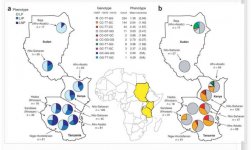
We classified individuals as having lactase persistence, lactase intermediate persistence (LIP) or lactase non-persistence (LNP) by examining the maximum rise in blood glucose levels after administration of 50 g of lactose using a lactose tolerance test (LTT)21 in 470 individuals from 43 ethnic groups originating from Tanzania, Kenya and Sudan. These populations speak languages belonging to the four major language families present in Africa (Afro-Asiatic, Nilo-Saharan, Niger-Kordofanian and Khoisan) and practice a wide range of subsistence patterns (Fig. 2 and Supplementary Table 1 online). Because genetic substructure can result in false genotype-phenotype associations22, we analyzed data from samples separated by geographic region and language family, with the exception of the Sandawe and Hadza (both click-speaking Khoisan), whom we analyzed independently (Fig. 2). We made these groupings to minimize population structure, based on a global analysis of
1,200 unlinked nuclear markers (S.A.T. and F.A.R., unpublished data). The frequency of lactase persistence was highest in the Afro-Asiatic–speaking Beja pastoralist population from Sudan (88%) and lowest in the Khoisian-speaking Sandawe hunter-gatherer population from Tanzania (26%) (Fig. 2a and Supplementary Table 1)."
The above is particularly important because there has always been the question of how do you determine actual lactase persistence versus just carrying the genes for it.
"Convergent evolution of lactase persistence in Europeans and Africans"
Sarah A. Tishkoff et al 2017 (She is building on prior work.)
http://www.nature.com/ng/journal/v39/n1/full/ng1946.html
"A SNP in the gene encoding lactase (LCT) (C/T-13910) is associated with the ability to digest milk as adults (lactase persistence) in Europeans, but the genetic basis of lactase persistence in Africans was previously unknown. We conducted a genotype-phenotype association study in 470 Tanzanians, Kenyans and Sudanese and identified three SNPs (G/C-14010, T/G-13915 and C/G-13907) that are associated with lactase persistence and that have derived alleles that significantly enhance transcription from the LCT promoter in vitro. These SNPs originated on different haplotype backgrounds from the European C/T-13910 SNP and from each other. Genotyping across a 3-Mb region demonstrated haplotype homozygosity extending >2.0 Mb on chromosomes carrying C-14010, consistent with a selective sweep over the past
"In most humans, the ability to digest lactose, the main carbohydrate present in milk, declines rapidly after weaning because of decreasing levels of the enzyme lactase-phlorizin hydrolase (LPH). LPH is predominantly expressed in the small intestine, where it hydrolyzes lactose into glucose and galactose, sugars that are easily absorbed into the bloodstream1. However, some individuals, particularly descendants from populations that have traditionally practiced cattle domestication, maintain the ability to digest milk and other dairy products into adulthood. These individuals have the 'lactase persistence' trait. The frequency of lactase persistence is high in northern European populations (>90% in Swedes and Danes), decreases in frequency across southern Europe and the Middle East (
"Although the T-13910 variant is likely to be the causal variant for the lactase persistence trait in Europeans, analyses of this SNP in culturally and geographically diverse African populations indicated that it is present (and at low frequency (<14%)) in only a few West African pastoralist populations, such as the Fulani (or Fulbe) and Hausa from Cameroon15, 19, 20. It is absent in all other African populations tested, including East African pastoralist populations with a high prevalence of the lactase persistence trait19. Thus, the lactase persistence trait has evolved independently in most African populations owing to distinct genetic events15, 19, 20.Here, we examine genotype-phenotype associations in 470 East Africans, and we identify three previously undescribed variants associated with the lactase persistence trait, each of which arose independently from the European T-13910 allele and resulted in enhanced transcriptional activity in LCT promoter–driven reporter gene assays. We demonstrate that the most common variant in Kenyans and Tanzanians spread rapidly to high frequency in East Africa over the past
"Frequency of lactase persistence in East African populations
We classified individuals as having lactase persistence, lactase intermediate persistence (LIP) or lactase non-persistence (LNP) by examining the maximum rise in blood glucose levels after administration of 50 g of lactose using a lactose tolerance test (LTT)21 in 470 individuals from 43 ethnic groups originating from Tanzania, Kenya and Sudan. These populations speak languages belonging to the four major language families present in Africa (Afro-Asiatic, Nilo-Saharan, Niger-Kordofanian and Khoisan) and practice a wide range of subsistence patterns (Fig. 2 and Supplementary Table 1 online). Because genetic substructure can result in false genotype-phenotype associations22, we analyzed data from samples separated by geographic region and language family, with the exception of the Sandawe and Hadza (both click-speaking Khoisan), whom we analyzed independently (Fig. 2). We made these groupings to minimize population structure, based on a global analysis of
The above is particularly important because there has always been the question of how do you determine actual lactase persistence versus just carrying the genes for it.
