
-
Don't want to see ads? Install an adblocker like uBlock Origin or use a Europe-based privacy-friendly browser like Vivaldi or Mullvad.
You are using an out of date browser. It may not display this or other websites correctly.
You should upgrade or use an alternative browser.
You should upgrade or use an alternative browser.
R1b spoke Proto-Basque-like language originally?
- Thread starter kmak
- Start date

Twilight
Regular Member
- Messages
- 997
- Reaction score
- 124
- Points
- 63
- Location
- Clinton, Washington
- Ethnic group
- 15/32 British, 5/32 German, 9/64 Irish, 1/8 Scots Gaelic, 5/64 French, 1/32 Welsh
- Y-DNA haplogroup
- R1b-U152-Z56-BY56073
- mtDNA haplogroup
- J1c7a36
Originally when R1B was discovered, it was thought we R1b folks came from Western Europe because of how common our YDNA is there. They Archeogenetic, we have been able to trace R1B to the Southern Yamna Culture 
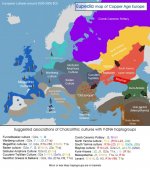
https://www.eupedia.com/europe/Haplogroup_R1b_Y-DNA.shtml
https://www.eupedia.com/europe/Haplogroup_R1b_Y-DNA.shtml
kmak
Regular Member
- Messages
- 268
- Reaction score
- 25
- Points
- 28
- Location
- İstanbul
- Ethnic group
- Unknown
- Y-DNA haplogroup
- J1-CTS1460
- mtDNA haplogroup
- I do not know
Originally when R1B was discovered, it was thought we R1b folks came from Western Europe because of how common our YDNA is there. They Archeogenetic, we have been able to trace R1B to the Southern Yamna Culture
https://www.eupedia.com/europe/Haplogroup_R1b_Y-DNA.shtml
R1b came from R1 and R1b arrived europe before proto-ındo-european. I think that R1b people spoke originally proto-basque like languages(not only proto basque but include relative or cousin of it). R1b descent from west or central asia and R1b go to west and central europe and spread own proto-basque like languages and this languages died after proto-indo-european expansion and only basque survive.
Tamakore
Regular Member
- Messages
- 187
- Reaction score
- 69
- Points
- 28
- Location
- Wellington
- Ethnic group
- Maori Irish French Scottish English
- Y-DNA haplogroup
- R1b-L21 DF5>FTA47001
- mtDNA haplogroup
- J1c3v
R1b came from R1 and R1b arrived europe before proto-ındo-european. I think that R1b people spoke originally proto-basque like languages(not only proto basque but include relative or cousin of it). R1b descent from west or central asia and R1b go to west and central europe and spread own proto-basque like languages and this languages died after proto-indo-european expansion and only basque survive.
What is your evidence that R1b arrived in Europe before Indo-European languages? Reference please.
MOESAN
Elite member
- Messages
- 6,372
- Reaction score
- 1,615
- Points
- 113
- Location
- Brittany
- Ethnic group
- more celtic
- Y-DNA haplogroup
- R1b - L21/S145*
- mtDNA haplogroup
- H3c
Y-R1b is a so numerous and forked male lineage since a so long time that we cannot ascribe all of them the same unique familiy of languages, I think. For Y-R1, it was so long ago born... The lineages as R1b-V88 could have spoken very different languages compared to the R1b-L23 descendants ones. For languages continuity or shift, we have a lot of different occurrences, depending on more than a cause (relative densities, military power and organisation, trade, founder effects for Y lineages...

Southpaw
Regular Member
- Messages
- 2,618
- Reaction score
- 1,424
- Points
- 113
- Ethnic group
- Albanian
- Y-DNA haplogroup
- E-V13
I rather think R1b-L23 is a solid candidate for Indo-Europeans. Even the Balkan IE groups like Thracians, Illyrians, Greeks were R1b-Z2103 carriers. Even the Anatolian ones. Likely the original Indo-Iranians as well before Indo-Europeanizing their distant R1a brothers.
Ygorcs
Active member
- Messages
- 2,259
- Reaction score
- 813
- Points
- 0
- Ethnic group
- Multiracial Brazilian
R1b is in Europe since the Late Paleolithic, but the R1b found in 99% of the European males who carry R1b today - subclades of R1b-M269 - certainly came from easternmost Europe after the Early Copper Age.
Now, for the umpteenth time: haplogroups are haplogroups, they are not people, and their transmission from one generation to the next generation works in a fundamentally different way from what happens to people's genome when their parents breed to make them. Read this if you want to understand what I mean: https://qr.ae/pNoQAE
Basques e.g. have >85% R1b-L23, but the people who first had it and brought it to the western parts of Europe account for no more than ~25% of their overall ancestry. And that's talking about genetic roots of people, not linguistic ancestry. If Y-DNA and genomic ancestry are often very disconnected from each other, let alone linguistic identity: one language can be replaced by other even without any major genetic replacement (e.g. notice how many Irish people shifted from Celtic Irish to Germanic English in the last ~150 years alone, or how many Basque speakers shifted to French in Southwestern France in the last ~200 years).
You can't always assume that the language spoken by a people is a descendant of the original language spoken many thousands of years ago by the first males who bore the haplogroup that is NOW (but no one can guarantee it was always) the most prevalent in that population. There is no necessary causal correlation between one thing and the other. Actually, that's very often not true for many reasons: elite dominance, genetic drift, random genetic bottlenecks and founder effects, cultural shift under foreign influence, etc. I have said that multiple times in the threads created by kmak, but it seems he/she never reflects about it and never learns.
Besides, Proto-Basque was technically spoken only 2000-2500 years ago. It's impossible that the first men carrying R1b before 20,000 years ago spoke Proto-Basque, it couldn't even be a language similar to Proto-Basque even if it were really ancestral to Proto-Basque. In 20,000 years a language changes and diverges into increasingly distinct languages so much that it'd be impossible to even recognize the linguistic connection between the earliest and the latest languages easily.
Now, for the umpteenth time: haplogroups are haplogroups, they are not people, and their transmission from one generation to the next generation works in a fundamentally different way from what happens to people's genome when their parents breed to make them. Read this if you want to understand what I mean: https://qr.ae/pNoQAE
Basques e.g. have >85% R1b-L23, but the people who first had it and brought it to the western parts of Europe account for no more than ~25% of their overall ancestry. And that's talking about genetic roots of people, not linguistic ancestry. If Y-DNA and genomic ancestry are often very disconnected from each other, let alone linguistic identity: one language can be replaced by other even without any major genetic replacement (e.g. notice how many Irish people shifted from Celtic Irish to Germanic English in the last ~150 years alone, or how many Basque speakers shifted to French in Southwestern France in the last ~200 years).
You can't always assume that the language spoken by a people is a descendant of the original language spoken many thousands of years ago by the first males who bore the haplogroup that is NOW (but no one can guarantee it was always) the most prevalent in that population. There is no necessary causal correlation between one thing and the other. Actually, that's very often not true for many reasons: elite dominance, genetic drift, random genetic bottlenecks and founder effects, cultural shift under foreign influence, etc. I have said that multiple times in the threads created by kmak, but it seems he/she never reflects about it and never learns.
Besides, Proto-Basque was technically spoken only 2000-2500 years ago. It's impossible that the first men carrying R1b before 20,000 years ago spoke Proto-Basque, it couldn't even be a language similar to Proto-Basque even if it were really ancestral to Proto-Basque. In 20,000 years a language changes and diverges into increasingly distinct languages so much that it'd be impossible to even recognize the linguistic connection between the earliest and the latest languages easily.
Ygorcs
Active member
- Messages
- 2,259
- Reaction score
- 813
- Points
- 0
- Ethnic group
- Multiracial Brazilian
I rather think R1b-L23 is a solid candidate for Indo-Europeans. Even the Balkan IE groups like Thracians, Illyrians, Greeks were R1b-Z2103 carriers. Even the Anatolian ones. Likely the original Indo-Iranians as well before Indo-Europeanizing their distant R1a brothers.
I think the PIE dialect continuum was diverse from the start in overall genetic makeup and Y-DNA distribution. Some groups had more CHG:EHG ratio than others, some had mainly R1b-L23, some mainly R1a-M417. There were also minor lineages like Q1a, I2 and perhaps even some J2b. In my opinion the Indo-Europeanization of R1a clans and tribes happened well before the Indo-Iranian linguistic stage. That was already too late. It must've happened before when Late PIE hadn't even lost its appearance of an unbroken dialect continuum, with major differences only at the peripheries. I also think PIE was originally linked to mainly R1b tribes of the steppes, but R1a groups must've been inolved in the Indo-European expansion since well before the Indo-Iranians, at least from the period immediately preceding the CWC expansion into Northern Europe.
kmak
Regular Member
- Messages
- 268
- Reaction score
- 25
- Points
- 28
- Location
- İstanbul
- Ethnic group
- Unknown
- Y-DNA haplogroup
- J1-CTS1460
- mtDNA haplogroup
- I do not know
I think the PIE dialect continuum was diverse from the start in overall genetic makeup and Y-DNA distribution. Some groups had more CHG:EHG ratio than others, some had mainly R1b-L23, some mainly R1a-M417. There were also minor lineages like Q1a, I2 and perhaps even some J2b. In my opinion the Indo-Europeanization of R1a clans and tribes happened well before the Indo-Iranian linguistic stage. That was already too late. It must've happened before when Late PIE hadn't even lost its appearance of an unbroken dialect continuum, with major differences only at the peripheries. I also think PIE was originally linked to mainly R1b tribes of the steppes, but R1a groups must've been inolved in the Indo-European expansion since well before the Indo-Iranians, at least from the period immediately preceding the CWC expansion into Northern Europe.
I wonder that R1a and R1b languages is sister or para languages of each other in the beginning? I think that R1b language is great grand father of proto basque and R1a language is great grand father of Proto-IE.
Can linguist or scientist know that what language spoken by R1 originally?
MOESAN
Elite member
- Messages
- 6,372
- Reaction score
- 1,615
- Points
- 113
- Location
- Brittany
- Ethnic group
- more celtic
- Y-DNA haplogroup
- R1b - L21/S145*
- mtDNA haplogroup
- H3c
I doubt we ever find with certainty what language was spoken by Y-R1 at first, and even what one was spoken by Y-R1b. For R1b-M269 we can suppose it was in the region envolved in PIE development, maybe early intricated with some Y-R1a clades bearers. For other Y-lineages, I have no "religion". Suppositions, because we are not sure every clade under M269 was in the PIE game. In fact our suppositions become more credible when we speak of the principal spreaders of IE, but most numerous spreaders are not always the first speakers of a language. Let's look at Romances and English languages spread into America. Nevertheless I keep R1b and R1a as very early speakers of PIE and then IE, withtout any proof helas. We have not had confirmation of the reality of a sort of pan-basque language spoken in Saami lands OR on the way of Saami towards their current home. The same for a proto-Satem one in the same conditions. I regreat it. The kind of proto-Satem one could not be to extraordinary. Battle Axe cousins of CWC east of the Baltic? All that to say we are just making suppositions in absence of writings. Personally I would rather link proto-Basque to some Y-I lineage.