I don't know much about the origin of the word Sclav or Sclavenians but there are certain anomalies when trying to draw parallels between the modern meaning of the word Slav/Sclav and some of the medieval tribes that settled in Macedonia, known as Sclavinae.
For example some of the names of the tribes known as Rhynchinoi, Strymonites or Strymonitai and some others, are derived from the names of the rivers like Strymon or Rynchina(
https://www.vlachs.gr/el/oi-olimpioi-vlahoi-kai-ta-vlahomoglena/oi-vlahorichinoi) near Chalkidiki, which according the Russian doctor of philology Oleg Trubachyov, was a name of Thracian origin.
Now, these names of the tribes do not tell us nothing about the origin of these tribes however there are some other clues.
The Russian archeologist and byzantinolgist byshop Porphyros Uspensky, found a 17-th century manuscript at Kastamoitou monastery in Athos, that mentioned the Richenoi or Vlachorichenoi (
ῥηχῑνοι or Vlachorichenoi), and Sagudates, having come from Bulgaria across Macedonia to Mounth Athos, at the time of Iconoclasm and having been christianised by the monks of the monastery.
Now, the very name Vlacho-Rynchinoi suggests some kind of Vlach people, which is clearly in contrast with the modern meaning of the word Sclav/Slav.
Moreover, in the miracles of Saint Demetrius, we find more informations about these mysterious Rynchinoi, that the name of their leader was Perboundos (
), "king of the Rynchinoi" (
), who spoke Greek fluently, had relations with Thessalonika to the point of having a residence there and even dressed in Roman style!
Now, this name Perboundos is alien to the modern Slavic speakers ears and doesn't mean anything in the modern Slavic languages.
However, recently I found out some clues in the Albanian language!
Namely, Alb. bind - "to convince" or "to make believe", Alb.
përbindësh - "monster" from the Illyrian Bindo/Bindus, an Illyrian deity from Bihac, Bosnia and Herzegovina!
Now, these are overwhelming clues that these so called Rynchinoi, although considered as Sclaviane by the Romans, were not really Slavs in the modern meaning of the name, or in other words, they were probably Thraco-Illyrians or Thraco_Illyrians mixed with Slavs, as neither the name of the tribe give us clues for their Slavic origin nor the name of their king!
Moreover, I will give you some parallels of the Slavic speaking people inhabiting the Thessalonikian plane with the modern Albanians as myself have origins from there.
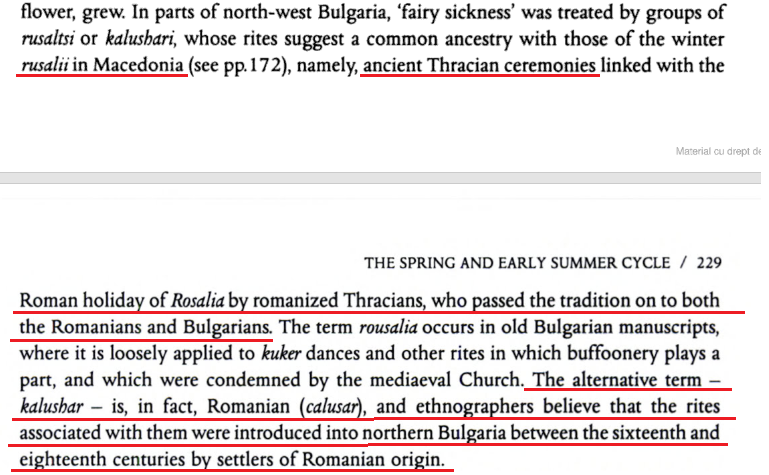
There is a very popular traditional Folk dance among the people inhabiting the plain, notably Enidze-Vardar, Kukus, Gevgeli and even Strumica, called Rusalia and the dancers who are performing it are called Rusalii!
This dance is a warrior dance, that is performed between Christmas and the 12th night and the name "Rusalia" and the dance is thought to originate from the ancient Thracian ceremonies, linked with the Roman holiday of Rosalia by the ancient Thracians!
 https://en.wikipedia.org/wiki/Rosalia_(festival)
Xenophon ( Anabasis, VI,I 5-6) describes the ancient Thracian dance of swords as such:
The Thracians started to dance, weapons in hand, on the sound of panpipes, while jumping in the air waving their daggers. At the end, after one of them overpowered another and all thought that the fallen one was dead: he fell with a great art.
These warrior dances exist only among Albanians, the Macedonians and Bulgarians from the Aegean Macedonia, South-East Rep. of Macedonia and South-West Bulgaria and nowhere else in any other Slavic country!
Now, I am asking myself, could these so called Vlacho-Rinchinoi have brought these dances or the modern Macedonians have inherited them directly from the ancient people living in Macedonia?
Other tribe that have settled in Macedonia known by the name of Sagoudatai, although considered as Sclavinae by the Romans, is also very mysterious and it doesn't give us any clues that it was really Slavic by the modern meaning of the name 'Slavic"!
The very name "Sagoudatai" is not Slavic at all, and some scholars think that it has Iranic origin!
And indeed, in the modern Macedonian and Bulgarian language, we can find some words that have no parallels with other Slavic languages, which makes Macedonian and Bulgarian truly unique.
Notably, "куче/kuche/dog" is a word of non-Slavic origin and doesn't exist in the other Slavic languages!
The closest equivalents are in Avestan "kuti", Hindu-Urdu "kuta", Ossetian "
kuжdz, kuжdzme, qжwdyn" etc.
Than we have Bg. "Хубав/Hubav/nice, beautiful", Mac. "убав/ubav", which is a word of Iranic origin, Ir. "
خوب /xub", "
hu-apah", Avestan "
huuāpah".
And words like "карпа/karpa/rock", "стопан/stopan/landlord", "голем/golem/big" and many many others!
It's quite clear that all these tribes were lumped in the same basket as "Sclavinae" although not all of them were really Slavic!



