
-
Don't want to see ads? Install an adblocker like uBlock Origin or use a Europe-based privacy-friendly browser like Vivaldi or Mullvad.
You are using an out of date browser. It may not display this or other websites correctly.
You should upgrade or use an alternative browser.
You should upgrade or use an alternative browser.
Similarities between Celtic and Romance vocabulary
- Thread starter Degredado
- Start date
MOESAN
Elite member
- Messages
- 6,372
- Reaction score
- 1,615
- Points
- 113
- Location
- Brittany
- Ethnic group
- more celtic
- Y-DNA haplogroup
- R1b - L21/S145*
- mtDNA haplogroup
- H3c
While you are most likely correct with your observations, we must also keep in mind that if we go back far enough, we can find similarities even between Irish and Hindi.
I agree, as all kinds of Man and big apes descend from a common ancestors, but I like see the subgroupings...
the italic-celtic shared traits seems to me more on the vocabulary side than on the phonetic side - liguric seems closer to celtic - what is very possible is that between the 3000 and 2500 BC a part of celtic speaking populations were absorbed by newcoming Italics, Latines before Osco-Umbrians, hard to be too affirmative -
I-E OK, but italic, celtic and germanic are close AND far one to the other according to aspects; NO recent common origin putting one closer than another, but late contacts with different dates and different ways... genetically the Germanics are farther, but for language, since when? maybe late enough... I suppose Germanics where I-Eized later or rather RE-indo-europeanized (Corded spoke surely an I-E language), if a bet is wellcome in science!
MOESAN
Elite member
- Messages
- 6,372
- Reaction score
- 1,615
- Points
- 113
- Location
- Brittany
- Ethnic group
- more celtic
- Y-DNA haplogroup
- R1b - L21/S145*
- mtDNA haplogroup
- H3c
There are absolutely undeniable similarities such as Irish Cappal italian cavallo, French cheval, Portuguese cavalo and Spanish caballo. Irish coinin is creepily similar to italian coniglio, Spanish conejo and Portuguese coelho. Also the word white: italian Bianco, French blanc, Spanish blanco and Irish and welsh ban. Again italian popolo is similar to spanish pueblo and French peuple, got to mention welsh pobl. I see how italian morto is similar to spanish muerto and French mort. I find welsh marwh and Irish marbh are most similar in my opinion to French mort with the silent ending pronunciation. Scottish Beatha is not too alien I guess from italian vita, spanish vida and French vie. Irish dia (god) is similar to Scottish dia, welsh duw, italian dio, Spanish dios, Portuguese deus and French dieu. Irish maidin and welsh madainn are similar to italian mattinata or Mattina and French matin. Oiche very similar to italian notte or Spanish noche
you did not read what I wrote to Sile: some fo your affirmations are wrong (words without any ANCIENT common origin, but recent loanwords!) ban # blanc (germanic, not italic!!!) oidhche # noct- PAY ATTENTION TO PHONETIC RULES, WE HAD ALREADY SOME PROBLEMS HERE WITH SOME FORUMERS PRACTIZING MAGIC OPERATIONS
MOESAN
Elite member
- Messages
- 6,372
- Reaction score
- 1,615
- Points
- 113
- Location
- Brittany
- Ethnic group
- more celtic
- Y-DNA haplogroup
- R1b - L21/S145*
- mtDNA haplogroup
- H3c
So we've done all the delightful things; banned Fire-Haired, made a link between ancient Celtic languages and the Celto-Italic S116/P312 linguistic branch comprising a more recent common root of words for italian, French, Spanish, Portuguese, welsh and Irish populations oddly enough.
is Fire Haired truly banned....??? why?

Ike
Regular Member
- Messages
- 1,128
- Reaction score
- 93
- Points
- 48
PIE Root/Stem: *bhel-
Meanings: white, clear; to shine
From Late Latin *blancus, from Proto-Germanic *blankaz (“bright, shining, blinding, white”), from Proto-Indo-European *bhleg- (“to shine”). Akin to Old High German blanch (“bright, white”) (German blank (“blank, white”)), Old Norse blankr (“white”) (Danish blank (“bright, shiny”)), Dutch blank (“white, shining”).
http://en.wiktionary.org/wiki/bianco
http://indoeuro.bizland.com/project/phonetics/word11.html
Meanings: white, clear; to shine
From Late Latin *blancus, from Proto-Germanic *blankaz (“bright, shining, blinding, white”), from Proto-Indo-European *bhleg- (“to shine”). Akin to Old High German blanch (“bright, white”) (German blank (“blank, white”)), Old Norse blankr (“white”) (Danish blank (“bright, shiny”)), Dutch blank (“white, shining”).
http://en.wiktionary.org/wiki/bianco
http://indoeuro.bizland.com/project/phonetics/word11.html

Eochaidh
Regular Member
- Messages
- 99
- Reaction score
- 21
- Points
- 8
- Ethnic group
- Insular Celtic
- Y-DNA haplogroup
- R-M222>A725>S679
- mtDNA haplogroup
- H4a1a4b
I have always understood the similarity between italian,French, Spanish and Portuguese but ancient Irish and welsh are strikingly similar to Latin tongues almost as if there was ancient link.....a pre-Gallic Celtic link.
Like most languages, Irish can be divided into 3 periods: Old Irish, Middle Irish, and Modern Irish, where the earliest of these was used from about 600 CE.
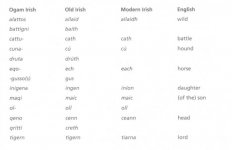
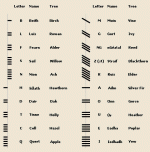
But with Irish, there is one documented earlier period called Ogham Irish after the Ogham alphabet which was used to record it on standing stones throughout Ireland (mostly in the south) and the Irish colonies in Wales. These stones date from around the start of the Common Era to the 500s.
Ogham Irish is so different from later forms, that it is considered one of the tipping points when new peoples or cultures may have entered Ireland. As adamo has said, it looks a lot like Latin especially with vowels for word endings.
This difference between Ogham and later forms of Irish have led some people to claim that it is a surviving remnant of a much earlier language which became just a sacred language in the CE, much like Sanskrit and Church Latin.
But the counter argument to this is Ptolemy's maps which use the same form of Irish. Since it is believed that Ptolemy got his information, indirectly, from common seamen who would have spoken the current language and not some sacred one, this indicates that the Ogham stones also used the common form of Irish spoken at that time.
Below are some examples from J. P. Mallory's book "The Origins of the Irish" and next to that is the Ogham language.
In Old and Modern Irish, aid(h) is pronounced like 'ah' or 'ee', and th is just pronounce as 'h'.
It is believed that the name for the ancient capital of Ulster, Eamhain Macha derived it's name from the Isamnion on Ptolemy's map where by syncopation we get I(s)AM(ni)ON to IAMON, or Eamhain. Macha was the goddess of the Ulaid (Uly).
adamo
Junior Member
- Messages
- 2,120
- Reaction score
- 76
- Points
- 0
- Y-DNA haplogroup
- T1a1a3 (T-PF7443)
- mtDNA haplogroup
- H
Membership to this group does indeed guarantee a common ancestor within a 4,000-6,000 year time frame of most Irish, welsh, many Scottish, English, Portuguese, Spanish, French, north italian, Swiss and many Belgians as well.
adamo
Junior Member
- Messages
- 2,120
- Reaction score
- 76
- Points
- 0
- Y-DNA haplogroup
- T1a1a3 (T-PF7443)
- mtDNA haplogroup
- H
On Ireland these celts are experienced as "insular celts" or western British isles celts. These particular celts (Irish) belong almost entirely to R1b L-21; the youngest branch of P312. In France, Switzerland, Italy and parts of Belgium,the celts were of a sub-category referred to as the "Gauls" (R-S28). On the Iberian peninsula (Portugal,Spain) the celts where knows as Celt-iberi, Iberian celts, among which there are many a tribe named Galli and Gallaeci, as is experienced in Spain's northwestern Galicia province. (p-312 variety, oldest italo-Celtic branch.)
adamo
Junior Member
- Messages
- 2,120
- Reaction score
- 76
- Points
- 0
- Y-DNA haplogroup
- T1a1a3 (T-PF7443)
- mtDNA haplogroup
- H
Then of course there are the GERMANIC celts which belong very predominantly to R1b U-106, spread across holland, Germany, Denmark, Austria, parts of Sweden/Norway and of course England. But I have excluded em in the. Case from my specifically Italo-Celtic (S-116) analysis.
Ike
Regular Member
- Messages
- 1,128
- Reaction score
- 93
- Points
- 48
@Adamo
Thanx. I've been researching that word stem for a long time. It's interesting because of the blond hair color. I was like, how the hell could half of Europe use a word similar to blue color for a hair that is literally yellow? There are couple of interesting stems.
1. From PIE *kweytos (briht,shine) to two branches. One Slavic swetlost (clear, bright), and the other Proto Germanic hwitaz>hwit>white.
2. From PIE *bʰel, *bʰlēw (light, brigh). In Slavic it goes directly to belo (white), in Proto-Germanic *blēwaz (blue, dark blue, gray, black), in Old English blāw (blue), and Middle Irish blá (yellow).
3.From PIE *plōw, *bhle, Old Grek φλύειν (fluein) and Latin fluentus, flux (flow). In Proto-Germanic *flōaną, *blēaną. In English blow, flow, and in Proto-Slavic *plavati (sail, swim)
Number 3. is something connected with the flow of air, water, or an object flowing in the air or in the water, and it's number 2. is connected with color of water or sky.
It's very hard to tell which of these terms went where? From PIE>Celtic>Latin>Slavic, or from PIE>Slavic and Celtic>Latin, etc....
P.S. If anyone knows different, please tell.
Some of the sources:
http://en.wiktionary.org/wiki/white#Etymology
http://en.wikipedia.org/wiki/Blond#Etymology.2C_spelling.2C_and_grammar
http://www.etymonline.com/index.php?term=blue
Thanx. I've been researching that word stem for a long time. It's interesting because of the blond hair color. I was like, how the hell could half of Europe use a word similar to blue color for a hair that is literally yellow? There are couple of interesting stems.
1. From PIE *kweytos (briht,shine) to two branches. One Slavic swetlost (clear, bright), and the other Proto Germanic hwitaz>hwit>white.
2. From PIE *bʰel, *bʰlēw (light, brigh). In Slavic it goes directly to belo (white), in Proto-Germanic *blēwaz (blue, dark blue, gray, black), in Old English blāw (blue), and Middle Irish blá (yellow).
3.From PIE *plōw, *bhle, Old Grek φλύειν (fluein) and Latin fluentus, flux (flow). In Proto-Germanic *flōaną, *blēaną. In English blow, flow, and in Proto-Slavic *plavati (sail, swim)
Number 3. is something connected with the flow of air, water, or an object flowing in the air or in the water, and it's number 2. is connected with color of water or sky.
It's very hard to tell which of these terms went where? From PIE>Celtic>Latin>Slavic, or from PIE>Slavic and Celtic>Latin, etc....
P.S. If anyone knows different, please tell.
Some of the sources:
http://en.wiktionary.org/wiki/white#Etymology
http://en.wikipedia.org/wiki/Blond#Etymology.2C_spelling.2C_and_grammar
http://www.etymonline.com/index.php?term=blue
Most of etymologic dictionaries indicate that "blanc" comes from the germanic "blank", which lead to the vulgar latin "blancus"(eliminating the classical latin words "albus" and "candidus").I don't see how "blanc" and "blanco" in French and Spanish are of Germanic loan word origin they come from Bianco; which means white in italian and originally Latin.
Degredado
Regular Member
- Messages
- 149
- Reaction score
- 40
- Points
- 28
- Y-DNA haplogroup
- R1b-DF27
- mtDNA haplogroup
- U5b1
Most of etymologic dictionaries indicate that "blanc" comes from the germanic "blank", which lead to the vulgar latin "blancus"(eliminating the classical latin words "albus" and "candidus").
That's interesting, a similar phenomenon to the switch from "bellus" to "guerra", in Romance languages. It makes me wonder when these changes occured. Maybe after the 5th/6th centuries Germanic invasions? It seems curious that each of those German tribes would have separately introduced their term for "white" (and no other colours) into the Latin dialects of Italy, Hispania and Gaul. Or maybe something earlier, during the Republic period, with the initial contacts between Romans and Teutons?