• Don't want to see ads? Install an adblocker like uBlock Origin or use a Europe-based privacy-friendly browser like Vivaldi or Mullvad.

Illyrian-Albanian Continuity

Status
Not open for further replies.
I have always hypothesized that maybe the Albanians are an indigenous Indo-European tribe of the Balkans that Greeks and Romans simply failed to document. Maybe they are a recent migration into the Balkans; and possibly were too small a tribe (at the time of the Greek and Roman civilizations) to be of any significance. It's the simplest explanation for me; and is my First theory of their origins.

^^^But if you want a more broader explanation, it is always possible though, that they could be an Illyrian tribe, that failed to assimilate/merge with the invading Yugoslavic cultures. This is also another great theory.

A third theory, I believe Albanians may also have a strong chance of being, what the Greeks called, the Phyrgians. The Phyrgians are the only tribe, besides the Illyrians; that were documented to have once lived in the territory of Albania, before Slavic migration into the Balkans. The Phyrgians were also a very small tribe; much like the Albanians. The Phyrgians originally inhabited Anatolia, and one of their tribes migrated Westward to Albania. The Phyrgians were reportedly related to the Hittites, the pre-Turkish people of Anatolia. This theory may hold some merit and scientific background, seeing as Albanians share very similar haplogroups to Turkish people, like Y-DNA J2b and a distinct E1B1B marker that is only exclusive to Kosovo Albanians. (forgive me, for I forget the specific marker). These two distinct haplogroups in the Albanians' population are almost exclusive to the Albanians; but are more rare in neighboring populations such as the Greeks, Bulgarians, Serbs and Macedonians etc. and are more abundantly found in the Turkish population.

The Fourth theory for me is, Albanians could also be a lost Thracian tribe; but I believe that this is the most unlikely; as the Thracian language is actually documented, but not fully. Even so, it shows what little we know; that the ancient language of Old Thracian does not hold much similarity to Old Albanian; and it is doubtful that they share similar Indo-European ancestry.
 
Don't you know that Vlahs of Albania are bilingual?

It could only mean that Albanians didn't manage to Albanize them all. Since there is less an less of them (and every other minority) at the end of every decade in Albania, it means the process is constant, and is consistent with my previous hypothesis.
 
If Albanians were located in Northern Romania, how did the acquired 10% of their vocabulary from old Greek language?
Have heard about it or you just litter the forum with garbage?


From what I've seen and heard about the ancient Phyrgian language; it IS very similar to the Greek language. As is Thracian. The problem with Thracian being relative to Greek, but casting doubt into being a relative of Proto-Albanian; is that Thracian shows no similarities to Albanian, and the grammar is a completely different structure from Albanian, for an Indo-European tongue. Albanian reportedly has grammar that is quite similar to the non Indo-European language Basque; but it's grammar is totally unrelated and foreign to surrounding language groups, such as Greek, Thracian or Slavic. The type of grammar that is seen in Basque is very unusual in Indo-European languages; and only Albanian seems to be the only thriving IE language that has such similar grammar structure. Many Uralic languages also share a similar grammatical structure to Basque and Albanian.

It is possible (I'm creating a fifth-theory here, that is is similar to my third-theory) is that the pre-Albanians may have been either an Anatolian or Caucasian tribe that migrated into the Balkans; as from what I have gathered, genetic markers find Albanians to be more similar to Turkic and Caucasian peoples. (excluding the Armenians) Rather than their Greek, and other Balkanic neighbors.

I advise you to do some hard studying into the linguistics between your Albanian language and the several extinct Indo-European languages of Anatolia and the Caucasus, and you may find some interesting similarities. If you ever do, find a significant similarity; please report back.

It seems likely, in my personal opinion, that Albanians are either a lost Illyrian tribe; (the original theory) or alternatively, an Anatolian tribe originating from near the Black Sea and migrating into the Balkans.
 
Last edited:
Please ignore.
 
Last edited:
; as from what I have gathered, genetic markers find Albanians to be more similar to Turkic and Caucasian peoples. (excluding the Armenians) Rather than their Greek, and other Balkanic neighbors.
you're way off on that. Genetically they're almost exactly as Northern Greeks. And the "almost" is because Northern Greeks have 3-5% East-Euro/Slavic dna.
 
you're way off on that. Genetically they're almost exactly as Northern Greeks. And the "almost" is because Northern Greeks have 3-5% East-Euro/Slavic dna.
Right; but correct me if I am wrong; but some southern Albanians are actually Greeks. And according to certain nationalists, South Albania is actually meant to be a Greek territory. While Northern Albania and Kosovo Albanians share genetics more in common with Turks and Caucasians. (Excluding Armenians.)

We must realize that Albanian is an agglutinative language also; and has a totally different grammatical structure to Greek, and Thracian. Thus rendering their language relation to Greek to be quite unlikely; and much older. This means that Albanians may be an older culture, if we talk linguistic origins and isolate genetic origin. The only Indo-European languages that are still vibrant, and possess agglutinative grammar structure; are both Albanian and Armenian; but Albanian people and their language show very little connection to the Armenians in linguistics, as well as genetics. Even though both languages are Indo-European and agglutinative; they seem to share no similarity.

Agglutinative languages are extremely rare in the Indo-European language group, and are usually found in non-IE language groups such has Uralic or Basque. Agglutinative languages are usually more ancient in origin than modern Indo-European languages. Making it very likely that the Albanian language is a very ancient branch of IE; and it may have likely originated in Anatolia, the Black Sea or around the Caucuses; when Indo-European was still a very young language group. I don't know if Illyrian was an agglutinative language; but I have never studied it and it seems the records of this language is either non-existent or very terse. Maybe these Albanian people originated somewhere around the Black Sea; or are an Anatolian people.
 
Macedonia was larger then the roman province after roman conquest.
Most important was that no union between macedonians and greek city states existed.
Greeks where conquered by macedonians. Never was and never will be same people.
993px-Map_Macedonia_200_BC-fr.svg.png


Why does all continue with nonsense discussion. Does no good in this thread.

you do know what the map is about...........its 200BC

in 202BC the roman protectorate of Albanian was under macedonian empire, it was macedonian land, but because Macedonia allied with Hannibal to support via supplies from macedonia on the adratic for his campaigns in italy and then sent 3000 troops to fight for Hannibal at zama in 202BC. The price for this alliance was the loss of macedonian lands ALL along the adriatic.

Rome then pushed Macedonia into a war with rome and a defeat at
http://en.wikipedia.org/wiki/Battle_of_Cynoscephalae


its a pity there is no 210BC map
 
Right; but correct me if I am wrong; but some southern Albanians are actually Greeks. And according to certain nationalists, South Albania is actually meant to be a Greek territory. While Northern Albania and Kosovo Albanians share genetics more in common with Turks and Caucasians. (Excluding Armenians.)
well we don't want to get our information from nationalists, do we :)
Northern Albanians and Kosovars are genetically quite far from Turks, their closest cousin are actually also Greeks, but they form a group of their own very indigenous of the Balkans, without East-Euro/Slavic or Roman influence. They're the closest you can get to the pre-Roman pre-Indo-European Balkan population. Southern Albanians are similar to Northern Greeks but that's because they're both a mix of Epirotes/Illyrians/Macedonians and because of mixing during Roman/Byzantine/Turkish times.
 
  • Like
Reactions: FBS
Which was probably Celtic tribe, and has nothing to do with Albanians of today. They were not even called Albanians but Arbanasi, and there is a legend of their origin:
http://www.albanianliterature.net/oral_lit3/OL3-11.html

Are you telling me you dont even know the names albanians were called in the middle ages? It was greek albanoi and arbanitai, slavic arbanasi, turkish arnaut, and latin albanenses.This is the first thing somebody learns when searching about albanians.
So i believe that the tribe olbonenses near Durres is the same as the illyrian albanoi (geographical and name similarity).
Remember Pliny the elder who mentioned olbonenses was roman, so he wrote in latin, meanwhile albanoi looks like the greek version of it, (see the greek version for some tribes : dardanoi, illyroi,pelasgoi, albanoi etc...) because Ptolemy who mentioned it was greek.So probably the same illyrian tribe.

^^^But if you want a more broader explanation, it is always possible though, that they could be an Illyrian tribe, that failed to assimilate/merge with the invading Yugoslavic cultures. This is also another great theory.

Yes i agree with that.

From what I've seen and heard about the ancient Phyrgian language; it IS very similar to the Greek language. As is Thracian. The problem with Thracian being relative to Greek, but casting doubt into being a relative of Proto-Albanian; is that Thracian shows no similarities to Albanian, and the grammar is a completely different structure from Albanian, for an Indo-European tongue.

It could always be illyrian as far as we know, but we dont know if albanian can or can't be thracian.However how do you know that thracian is related to greek?

Right; but correct me if I am wrong; but some southern Albanians are actually Greeks. And according to certain nationalists, South Albania is actually meant to be a Greek territory. While Northern Albania and Kosovo Albanians share genetics more in common with Turks and Caucasians. (Excluding Armenians.)

What is this you are talking about?This sounds like something you have taken from a nationalistic site who devides albanians in parts and then says who they are according to their own interests.First off there are not that many greeks in south albania and don't try to get your informations from nationalists.If we would all take information from nationalists there would not be the need for this thread.The albanians in general have got genetical haplogroups who are completely different from turks or caucasians.The one who tells you these things is messing with you. Not all E1B1 people share the same genetics, should've searched about ev-13 first.

Tha typical albanian haplogroup EV-13 has been in the balkans at least since the neolithic period, 8,500 years ago.
Most E-V13 in Europe and elsewhere descend from a common ancestor who lived in the late Mesolithic or Neolithic, possibly in the Balkans, according to the studies.The current distribution of this lineage might be the result of several demographic expansions from the Balkans, such as that associated with the Neolithic revolution, the Balkan Bronze Age, and more recently, during the Roman era during the so-called "rise of Illyrican soldiery".

You should get your info from a more reliable source and sites who actually make scholar studies.
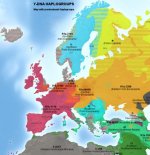
You say that albanians dont share the same genetics with greeks however the thing is that the closest people who are today genetically relative to the albanians (partialy) are the greeks.You can see here: http://en.wikipedia.org/wiki/Genetic_history_of_Italy#mediaviewer/File:Haplogroups_europe.png


640px-Haplogroups_europe.jpg
 
Um, excuse me? There was nothing "Nationalistic" about my analysis; I was taking in information from all sides. In no way am I biased or have an agenda to prove that the Greeks are superior to the Albanians, or vice versa. You see, the origin of the Albanian peoples is an issue that one needs to consider and be aware of all perspectives and theories. Kamani and Gorgonzola,you both accuse me of being biased, when in reality you both are accusing me of taking in nationalist propaganda to further my own perspective; which in turn is a bias-in-itself. Do you see the hypocrisy and contradiction in your logic? You should always take in opinions from all sides, even if it is a Nationalists' perspective.

Albanians DO have more of a connection to Eastern Anatolians and Caucasians in higher frequencies, rather than in the supposed Illyrian Urheimat, (Which is usually more situated around the Slovenian, Southwestern Croatian area and Bosnian area.) You both are indeed correct that the Greeks have similar genetic markers. But this does not indicate that Greeks are in any way relative to Albanians; as this is more than likely a recent assimilation.


Go observe the Eupedia map of J2b, which is 1 of the 2 most exclusive Albanian Y-DNA haplogroups. It showcases an unusual abundance of J2b peaking in Kosovo, then in Albania, and also a peak in the Caucuses. (Remember that in Eastern Anatolia/Caucuses there is a larger population than in the Balkans. Therefore a higher abundance. The higher percentage in the Balkans does not mean anything, as the population is lower. Please observe carefully.)


Another genetic marker, E-V13, that seems to be the second major Y-DNA in the Albanian population, seems to peak in Europe in the areas of Kosovo and Albania as well.


This particular haplogroup, E-V13, peeks in Kosovo and Albania; and is lower in other regions of Europe. But it also seems to be centered around the Black Sea. Where the first possible mutation may have occurred. It seems very widespread in Ukraine as well as Western Anatolia (Western Turkey).

So, if you are sticking to your Illyrian theory, then explain to me how Illyrians are related to Greeks? Are they related? What is your explanation for Albanians and Greeks sharing similar haplogroups? It certainly seems that you are both are theorizing and suggesting Illyrians and Greeks have a relation.

By the way, the Albanian language shows signs of agglutination, and is not just an inflected language. Greek is only a fusional language.

The Greeks are an Anatolian people. But the Albanians may very well be another tribe. So, in any case, all both of you have done is reassured my speculation. In other words, it is very possible that the Albanians may have an Anatolian/Black Sea origin.
 
Are you telling me you dont even know the names albanians were called in the middle ages? It was greek albanoi and arbanitai, slavic arbanasi, turkish arnaut, and latin albanenses.This is the first thing somebody learns when searching about albanians.
So i believe that the tribe olbonenses near Durres is the same as the illyrian albanoi (geographical and name similarity).
Remember Pliny the elder who mentioned olbonenses was roman, so he wrote in latin, meanwhile albanoi looks like the greek version of it, (see the greek version for some tribes : dardanoi, illyroi,pelasgoi, albanoi etc...) because Ptolemy who mentioned it was greek.So probably the same illyrian tribe.

your jumping to conclusions ......i said

the only historian who mentioned an illyrian tribe which remotely sounds like albanian ( prior to ptolemy ) is olbonenses tribe who lived south of Durres amongst the greek tribes. this tribe was only mentioned by pliny the elder in the 1st century AD

The olbonenses where a liburnian tribe who moved form the northern liburnian coast and settled on the coast of modern albania to create a trading post and where nearly eliminated by the the corinthian greeks and epirotes , they remained the last liburnian in the south adriatic sea after liburnian Corfu fell to the corinthians.

XXI. The race of the Liburni stretches from the Arsa to the river Tityus. Sections of it were the Mentores, Himani, Eneheleae, Buni, and the people called by Callimachus the Peucetii, all of whom are now designated collectively by the one name of Illyrians. Few of the peoples are worthy of mention, nor are their names easy to pronounce. To the jurisdiction of Scardona resort the Iapudes and the 14 communities of the Liburni, of which it may not be tedious to name the Lacinienses, Stulpini, Burnistae and Olbonenses. In this jurisdiction states having Italic rights are the Alutae, the Flanates from whom the gulf takes its name, the Lopsi, the Varvarini, the Asseriates who are exempt from tribute, and of the islands Berwitch and Karek. Moreover along the coast starting from Nesactium are Albona, Fianona, Tersaet, Segna, Lopsico, Ortoplinia, Viza, Argyruntum, Carin, Nona, the city of the Pasini and the river Zermagna, at which Iapudia terminates. The islands of the gulf with their towns are, besides the above specified, Absortium, Arba, Cherso, Gissa, Portunata. Again on the mainland is the colony of Zara, 160 miles from Pola, and 30 miles from it the island of Mortero, and 18 miles from it the mouth of the river Kerka.


BOOK III. XXI. 139-XX11. 142

14 communities of the Liburni, of which it may not
be tedious to name the Lacinienses, Stulpini,
Burnistae and Olbonenses. In this jurisdiction
states having Italic rights are the Alutae, the
Flanates from whom the gulf " takes its name, the
Lopsi, the Varvarini, the Asseriates who are exempt
from tribute, and of the islands BerAvitch and Karek.
Morcover alono: the coast startinjr from Nesactium
are Albona, Fianona, Tersact, Segna, Lopsico,
OrtopHnia, Viza, Argyruntum, Carin, Nona, the city
of the Pasini and the river Zermagna, at which
lapudia terminates. The islands of the gulf with
tiieir towns are, besides the above specified, Absor-
tium, Arba, Cherso, Gissa, Portunata. Again on
the mainhmd is the colony of Zara, IGO miles from
Pola, and 30 miles from it the island of Mortero,
and 18 miles from it the mouth of the river Kerka,
 
From what I've seen and heard about the ancient Phyrgian language; it IS very similar to the Greek language. As is Thracian. The problem with Thracian being relative to Greek, but casting doubt into being a relative of Proto-Albanian; is that Thracian shows no similarities to Albanian, and the grammar is a completely different structure from Albanian, for an Indo-European tongue. Albanian reportedly has grammar that is quite similar to the non Indo-European language Basque; but it's grammar is totally unrelated and foreign to surrounding language groups, such as Greek, Thracian or Slavic. The type of grammar that is seen in Basque is very unusual in Indo-European languages; and only Albanian seems to be the only thriving IE language that has such similar grammar structure. Many Uralic languages also share a similar grammatical structure to Basque and Albanian.

It is possible (I'm creating a fifth-theory here, that is is similar to my third-theory) is that the pre-Albanians may have been either an Anatolian or Caucasian tribe that migrated into the Balkans; as from what I have gathered, genetic markers find Albanians to be more similar to Turkic and Caucasian peoples. (excluding the Armenians) Rather than their Greek, and other Balkanic neighbors.

I advise you to do some hard studying into the linguistics between your Albanian language and the several extinct Indo-European languages of Anatolia and the Caucasus, and you may find some interesting similarities. If you ever do, find a significant similarity; please report back.

It seems likely, in my personal opinion, that Albanians are either a lost Illyrian tribe; (the original theory) or alternatively, an Anatolian tribe originating from near the Black Sea and migrating into the Balkans.
You are Coming up with fantasies that have not real life support. Albanian language shows signs of affinity with Thracian. Many scientists support dual heritage for Albanians, the Thraco-Illyrian one. But again I mentioned in one post the grammar of Albanians tend to dismiss the Thracian origin and the only one that fits the puzzle is Illyrian,
What does it mean Albanians are lost Illyrian tribe. How did they lose when yhey are where they have always been,
 
You are Coming up with fantasies that have not real life support. Albanian language shows signs of affinity with Thracian. Many scientists support dual heritage for Albanians, the Thraco-Illyrian one. But again I mentioned in one post the grammar of Albanians tend to dismiss the Thracian origin and the only one that fits the puzzle is Illyrian,
What does it mean Albanians are lost Illyrian tribe. How did they lose when yhey are where they have always been,

The Illyrian Urheimat is not just Albania; it is actually the Southwestern portion of the Balkans, stretching from Northern Greece to Slovenia...

"What does it mean Albanians are lost Illyrian tribe. How did they lose when they are where they have always been?" That doesn't make any sense. Did you even ever read my analysis? I said that the Albanians are -possibly- a -vibrant- Illyrian tribe. That means all other Illyrian tribes related to the Albanian Illyrians are extinct; and assimilated into the Yugoslav cultures. Making the Albanians the only surviving Illyrian tribe. Please read my post again. You like everyone else commenting against me seem to not have a clear understanding of what I wrote. And I am not passing them off as fantasies; as they are only theories.

I am coming up with absolutely NO fantasies. Also, there is NO proof whatsoever that Thracian has any relation to Albanian whatsoever. Look it up for yourself. Thracian language and it's words and grammar are totally different from Albanian. As I stated, before, Albanian has agglutinative grammar, while Thracian is fusional grammar like Greek. Please do not put words in my mouth.
 
Southern Albanians are similar to Northern Greeks but that's because they're both a mix of Epirotes/Illyrians/Macedonians and because of mixing during Roman/Byzantine/Turkish times.

Oh yeah, really? And just where is the evidence that you present to back up this "fact"? You cocky, ill-informed sanctimony. Or is it "just a theory". Massive hypocrisy on your part.
 
Are you telling me you dont even know the names albanians were called in the middle ages? It was greek albanoi and arbanitai, slavic arbanasi, turkish arnaut, and latin albanenses.This is the first thing somebody learns when searching about albanians.

So i believe that the tribe olbonenses near Durres is the same as the illyrian albanoi (geographical and name similarity).
Remember Pliny the elder who mentioned olbonenses was roman, so he wrote in latin, meanwhile albanoi looks like the greek version of it, (see the greek version for some tribes : dardanoi, illyroi,pelasgoi, albanoi etc...) because Ptolemy who mentioned it was greek.So probably the same illyrian tribe.

No, the problem is did they called themselves Albanians? And Latins had no reason to misspell their name, cause it's clear case in Latin:
http://en.wiktionary.org/wiki/arbos
http://www.etymonline.com/index.php?term=arbitrary

Our Greek members can confirm us if there is a logic in misspelling of ARB in ancient Greek.
 
The Illyrian Urheimat is not just Albania; it is actually the Southwestern portion of the Balk


I am coming up with absolutely NO fantasies. Also, there is NO proof whatsoever that Thracian has any relation to Albanian whatsoever. Look it up for yourself. Thracian language and it's words and grammar are totally different from Albanian. As I stated, before, Albanian has agglutinative grammar, while Thracian is fusional grammar like Greek. Please do not put words in my mouth.

You better get out of this forum! You are showing total lack of understanding the region.
I urge other forum participants to ignore the input you trying to provde!
Total nonsense!
 
Oh yeah, really? And just where is the evidence that you present to back up this "fact"? You cocky, ill-informed sanctimony. Or is it "just a theory". Massive hypocrisy on your part.
You are a total lost cause!
Stop littering!
We are not responsible for your ignorance you show in understanding, on the topic being discussed!
 
You are a total lost cause!
Stop littering!
We are not responsible for your ignorance you show in understanding, on the topic being discussed!
You can alway ignore posts if they are getting on your nerve too much. Otherwise Melancone's posts are within Eupedia's guidelines.
Welcome to Eupedia Melancone.
 
No, the problem is did they called themselves Albanians? And Latins had no reason to misspell their name, cause it's clear case in Latin:
http://en.wiktionary.org/wiki/arbos
http://www.etymonline.com/index.php?term=arbitrary

Our Greek members can confirm us if there is a logic in misspelling of ARB in ancient Greek.

We already know how they called themselfs in the middle ages : Arbër , Arbëreshë and in Gheg dialect Arban, Arbëneshë. The root is the same as the foreign ethnonym for albanians. Its just the albanian version of "albani".We are talking about the period before the 16-17 century, when they started using the name "shqiptar".
Here are some examples of those people who use these words to self identify today:

Arbëreshë http://en.wikipedia.org/wiki/Arbëreshë_people
Arbëneshë http://en.wikipedia.org/wiki/Arbanasi_people

In latin maybe they don't mispell the name, but they might pronounce it different in a brief period of time.For example they used the word arbanensis in the beggining: "In 1166, prior Arbanensis Andrea and episcopis Arbanensis Lazarus participated in a ceremony held in Kotor".

But we have it also in a different form later: "albanenses" So yes arb- can also replace alb-.
 
Go observe the Eupedia map of J2b, which is 1 of the 2 most exclusive Albanian Y-DNA haplogroups. It showcases an unusual abundance of J2b peaking in Kosovo, then in Albania, and also a peak in the Caucuses. (Remember that in Eastern Anatolia/Caucuses there is a larger population than in the Balkans. Therefore a higher abundance. The higher percentage in the Balkans does not mean anything, as the population is lower. Please observe carefully.)

You act like only your theory is right and everyone else is wrong.The J2b of albanians and greeks is different from those type of haplogroups there.You are making just supossitions here.There are people who claim that the J2 was actually spread due to the extension of roman empire, so what now should we believe them too.


Another genetic marker, E-V13, that seems to be the second major Y-DNA in the Albanian population, seems to peak in Europe in the areas of Kosovo and Albania as well.
This particular haplogroup, E-V13, peeks in Kosovo and Albania; and is lower in other regions of Europe. But it also seems to be centered around the Black Sea. Where the first possible mutation may have occurred. It seems very widespread in Ukraine as well as Western Anatolia (Western Turkey).

Ev-13 is the first major Y-dna of albanians, just to clear that. So you are saying that it peaks in this and that and in that other place, and then you decide which place it may have "muttated"?Yours is just a hyphotesis.EV-13 is considered today as one of the oldest in the balkans, which has mutated in the balkans, possibly 8500 years ago. Keep in mind im not talking about e1b1b here (which entered the balkans), just not to confuse the things.Ev-13 is its subclade and as a subgroup it has formed latter.
However this thread had nothing to do with the gentics and i dont know why we are talking about that here.
 
Status
Not open for further replies.
Back
Top