• Don't want to see ads? Install an adblocker like uBlock Origin or use a Europe-based privacy-friendly browser like Vivaldi or Mullvad.

Bones of Richard III found ?

So in essence the Plantagenet line are descendants of a French Noble men, Huges du Perche who was around in the 10th century? If I got my quick research right.
Yes, that`s correct, Maleth. However it was Henry II father, Geoffrey [the fair] of Anjou who coined the nickname Plantagenet. He was married to daughter of Henry I, Matilda--Henry II mother--. It seems he may have gotten the name by trying to impress Eleanor of Aquitaine, who afterwards, married his son, Henry II.
The House of Plantagenets is divided into three: The first Plantagenet kings were the Angevins..then Plantagenets..then the Houses of Lancaster and York..[I expect all this you know already..:) ]
 
Yes, that`s correct, Maleth. However it was Henry II father, Geoffrey [the fair] of Anjou who coined the nickname Plantagenet. He was married to daughter of Henry I, Matilda--Henry II mother--. It seems he may have gotten the name by trying to impress Eleanor of Aquitaine, who afterwards, married his son, Henry II.
The House of Plantagenets is divided into three: The first Plantagenet kings were the Angevins..then Plantagenets..then the Houses of Lancaster and York..[I expect all this you know already..:) ]

Thats interesting Hope, thanks for info. I wasn't aware of that. It just got me interested of how it was possible to have G dna since its so rare in Britian. Like R or I would be more expected. Although I was aware that Richard the lion heart did speak French if not mistaken, but often i need to go back to Royal family trees and put the dates in perspective :).
 
often i need to go back to Royal family trees and put the dates in perspective :)
I often need to go back to this tree just to recall who came from where and from whom Maleth, never mind the dates...:laughing:
 
I often need to go back to this tree just to recall who came from where and from whom Maleth, never mind the dates...:laughing:

It's the same with all the royal lines. Renaissance Italy is a mess that way too. Every prince is related five ways to the Prince who is his (or her) mortal enemy. It's all of that inbreeding, although some were worse than others...look at what happened to the poor Spanish Hapsburgs!

Basically, it's a bunch of cousins ( sometimes minimally related genetically to their subjects) all fighting one another for a bigger share of the pot. Interesting, though, in a soap opera sort of way. At least I think it's interesting. :smile:

I did watch the second video, Hope. It was very good. I'm looking forward to watching the other two.
 
It's the same with all the royal lines. Renaissance Italy is a mess that way too. Every prince is related five ways to the Prince who is his (or her) mortal enemy. It's all of that inbreeding, although some were worse than others...look at what happened to the poor Spanish Hapsburgs!

Basically, it's a bunch of cousins ( sometimes minimally related genetically to their subjects) all fighting one another for a bigger share of the pot. Interesting, though, in a soap opera sort of way. At least I think it's interesting. :smile:

I did watch the second video, Hope. It was very good. I'm looking forward to watching the other two.
Sometimes I think Angela, in the past at least, it seemed more of a case that whoever had something of a claim to the throne and could simply grab the crown first, got to call himself king...:)
Glad you are liking the videos, it`s a while since I watched them but I think I might give them a watch again over the week-end.
 
I would definitely wager that the illegitimacy is somewhere along the Somerset line at a place where it doesn't matter for anyone but the Somerset family. There are lots of generations there.


The answer lies in the body of Edward III... if only they could test his bones...

And, again, statistically, the NPE could be placed in the John Gaunt's line, but who knows? Perhaps the NPE could also be placed in the few generations that divide Edward III from Richard III. Without a proof from the Y-Haplogroup of Edward III, this is only chat.
 
Other than the fact that Richard of York had a pretty massive jaw, which Richard III inherited, it doesn't seem that they look all that different. With the Duke of Clarence, there's even more of a resemblance.

Of course, all of these people intermarried so much that who knows where certain traits actually originated.

Bottom line, I think they have to test some bones from Edward III to be sure. (John of Gaunts are gone for good, I think. )


Common phisical traits can't be taken as a proof of a parental link: all the Stuarts also were painted with a huge nose... but it was only a political choice in order to show an iconographic continuity of the genealogical line. It is a sort of ancient advertisement....

Or, again, think about the Habsburg family: obviously not all the memebers of the family had a huge jaw, but it was a political choice.
 
Common phisical traits can't be taken as a proof of a parental link: all the Stuarts also were painted with a huge nose... but it was only a political choice in order to show an iconographic continuity of the genealogical line. It is a sort of ancient advertisement....

Or, again, think about the Habsburg family: obviously not all the memebers of the family had a huge jaw, but it was a political choice.

That may be, but how on earth would we know that in any particular case? None of us were around at the time; we can't know whether the traits were there for a particular person or whether the artist took some liberties and placed them in the portraits to emphasize the descent. It's just conjecture.

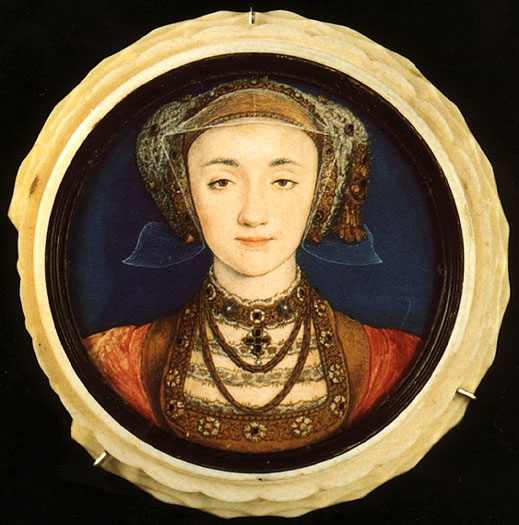
That's not to say, of course, that the artists didn't embellish, particularly in the case of royal women when marriages were being arranged. Didn't that happen with Henry VIII and Anne of Cleves? She was so unlike her portrait when she arrived that he never consummated the marriage and had it annulled immediately. It caused quite a stir. On the other hand she had the last laugh, considering how many of his wives he beheaded.:laughing:

Anne of Cleves:
Cleves,Anne02.jpg


You're right though, physical appearance is inconclusive, especially given how they were all cousins.

Ed. I wonder if Jay Leno is related to the Hapsburgs in some way?:laughing::laughing:

jay-leno.jpg
 
That may be, but how on earth would we know that in any particular case? None of us were around at the time; we can't know whether the traits were there for a particular person or whether the artist took some liberties and placed them in the portraits to emphasize the descent. It's just conjecture

A conjecture repeated by many prof. of Art at the University and Licei in Italy...

I'm sorry, but I can't find it ridiculous: cousins or not, hereditary traits are passed in many ways and it isn't sure that every generation a dominant trait can show up. For the Habsburg, they could have received that trait from the Piasts, but after two or three generation it could have easily been erased.

And, to follow your thought: none of us were around at the time; we can't know wheter the NPE happened in the John of Gaunt's line or in the Richard's one.

For me, it happened in the line of Richard only because of one reason: the greater diffusion of R-U152 in the ancestral seat of the counts of Gatinais. And, of course, also for another reason: we have really a lot of G samples around... perhaps is there any error in testing?
 
The soap opera concerning NPE's in the British royal family continues...
http://www.theguardian.com/uk-news/...nce-of-further-royal-scandal?CMP=share_btn_tw

The authors could not determine, based on the results they had, whether the NPE was on the line from Edward III leading to Richard III, or whether it was on the line from Edward III through John of Gaunt to the Beaufort family. (I think I got that right...)

BTW, here is Benedict Cumberbatch reading at the reburial...and reading beautifully, I might add...
[video]http://www.theguardian.com/uk-news/video/2015/mar/26/king-richard-iii-re-interment-benedict-cumberbatch-reads-poem-service-video[/video]

They thought maybe they could figure it out by getting the yDna of De Warren family members tracing descent further back to Geoffrey Plantangent. Surprise, surprise, it's yet a third yDna lineage...

So, was the Yorkist line illegitimate, or was it the Lancastrian line, or was it the whole Plantagenet line? Or are there other permutations?

This is one of many reasons I don't get all worked up about anyone in my family tree.
 
Last edited:
......and the coffin was made by a relative who is a carpenter living in Canada :smile:
 
The soap opera concerning NPE's in the British royal family continues...
http://www.theguardian.com/uk-news/...nce-of-further-royal-scandal?CMP=share_btn_tw

The authors could not determine, based on the results they had, whether the NPE was on the line from Edward III leading to Richard III, or whether it was on the line from Edward III through John of Gaunt to the Beaufort family. (I think I got that right...)

BTW, here is Benedict Cumberbatch reading at the reburial...and reading beautifully, I might add...
[video]http://www.theguardian.com/uk-news/video/2015/mar/26/king-richard-iii-re-interment-benedict-cumberbatch-reads-poem-service-video[/video]

They thought maybe they could figure it out by getting the yDna of De Warren family members tracing decent further back to Geoffrey Plantangent. Surprise, surprise, it's yet a third yDna lineage...

So, was the Yorkist line illegitimate, or was it the Lancastrian line, or was it the whole Plantagenet line? Or are there other permutations?

This is one of many reasons I don't get all worked up about anyone in my family tree.

All this shows that cuckolding was relatively common even among royals. After all, what man wouldn't want his progeny to inherit the throne "simply" by seducing the queen ? It's much easier that to overthrow the current dynasty and have oneself acknowledged by the population as the new sovereign. Even at the level of the aristocracy the benefits for one's child of living a wealthy life with a title has so great that more than one man must have thought about it. Then some love affairs just happen spontaneously, without any premeditation (even unconscious one).

Who knows, maybe most of the royal Y-DNA lineages have been broken since the first king of the dynasty. This would certainly bring people to reconsider the legitimacy of inherited titles. Not that it really matters nowadays.
 
Last edited:
All this shows that cuckolding was relatively common even among royals. After all, what man wouldn't want his progeny to inherit the throne "simply" by seducing the queen ? It's much easier that to overthrow the current dynasty and have oneself acknowledged by the population as the new sovereign. Even at the level of the aristocracy the benefits for one's child of living a wealthy life with a title has so great that more than one man must have thought about it. Then some love affairs just happen spontaneously, without any premeditation (even unconscious one).

Who knows, maybe most of the royal Y-DNA lineages have been broken since the first king of the dynasty. This would certainly bring people to reconsider the legitimacy of inherited titles. Not that it really matters nowadays.

In the Middle Ages, a queen who cheated on her husband was liable to be charged with treason and executed, so I'm curious about the motivation of such women. But I suspect that if we could identify the kings who were cheated on, they would have been married for a few years but hadn't yet had a son and heir. The queen of such a king might well take the risk in order to make sure she was the mother of a future king, even if it had to be by another man. Or she might have decided that she would remain alive and healthy longer if she could produce an apparent heir apparent. After all, the failure of the wife of Henry VIII to produce a healthy son had disastrous consequences for her, and changed the course of English history. One can't completely ignore the possibility of someone doing something reckless for the sake of passion, but I suspect people who grew up in the courts of Medieval Europe usually acted from mercenary motives.
 
Last edited:
In the Middle Ages, a queen who cheated on her husband was liable to be charged with treason and executed, so I'm curious about the motivation of such women. But I suspect that if we could identify the kings who were cheated on, they would have been married for a few years but hadn't yet had a son and heir. The queen of such a king might well take the risk in order to make sure she was the mother of a future king, even if it had to be by another man. Or she might have decided that she would remain alive and healthy longer if she could produce an apparent heir apparent. After all, the failure of the wife of Henry VIII had disastrous consequences for her, and changed the course of English history. One can't completely ignore the possibility of someone doing something reckless for the sake of passion, but I suspect people who grew up in the courts of Medieval Europe usually acted from mercenary motives.

I too was thinking about that. The penalties were very severe, so the motivation must have been very strong. (Not that only royals saw death as the proper punishment. In Italy, into the twentieth century, finding your wife in bed with another man was a defense if you killed her, and the man for that matter.)

I also wonder how they managed it. Queens were constantly surrounded by attendants. Then there's the fact that even in these periods people could count to nine. Monarchs were constantly absent...the infidelity had to take place at the most dangerous times, i.e. when the husband was in the vicinity. I can only think that the attendants must have been in collusion with them.

Perhaps it was indeed to get an heir. A woman who was "barren" could be put aside. It never seemed to occur to the men that the man might be at fault, although I'm sure it occurred to the women. In that vein, I've wondered whether the charges against Anne Boleyn might have had a basis in fact, although dragging all those men into it, and even including her brother, plus the whole tone of the documents has always struck me as hinting at sexual obsession and its corollary, extreme sexual jealousy.

Of course, if they had just followed a matrilineal line of descent, none of these problems would have arisen. Barring some extraordinary circumstance, you can pretty easily determine the identity of the mother. :smile:
 
In the Middle Ages, a queen who cheated on her husband was liable to be charged with treason and executed, so I'm curious about the motivation of such women. But I suspect that if we could identify the kings who were cheated on, they would have been married for a few years but hadn't yet had a son and heir. The queen of such a king might well take the risk in order to make sure she was the mother of a future king, even if it had to be by another man. Or she might have decided that she would remain alive and healthy longer if she could produce an apparent heir apparent. After all, the failure of the wife of Henry VIII to produce a healthy son had disastrous consequences for her, and changed the course of English history. One can't completely ignore the possibility of someone doing something reckless for the sake of passion, but I suspect people who grew up in the courts of Medieval Europe usually acted from mercenary motives.

Don't forget that some kings might have been homosexual, so they would not have been so paranoid about their queen cheated on them than Henry VIII.

In the Middle Ages the king still went to wage war by himself and was often away for long periods of time (think Richard Lionheart), leaving the queen to do as she pleases. There may have been people to supervise, but they can always be bribed to turn a blind eye on lovers. If the person in charge of the supervisors/guards is the one with a secret relationship with the queen, it is even easier. Monarchs never married for love, so the temptation of cheating was high. It was normal for kings to have lovers and concubines, which could make the queen jealous and wanting to get even. It's human nature.

As for the penalties, in an absolute monarchy anybody was a potential target for the kings' wrath or whim anyway, even his siblings, best friends or his wife (Henry VIII again). Anyone could end up on the scaffold for almost no reason at all, or through deceptions and plotting from enemies at the court. In such a context lives weren't very valuable and risk taking was much more common than for most people today. If you know you have a high chance of being punished or executed for things you haven't done, you might as well take your chances when you can.
 
Don't forget that some kings might have been homosexual, so they would not have been so paranoid about their queen cheated on them than Henry VIII.

In the Middle Ages the king still went to wage war by himself and was often away for long periods of time (think Richard Lionheart), leaving the queen to do as she pleases. There may have been people to supervise, but they can always be bribed to turn a blind eye on lovers. If the person in charge of the supervisors/guards is the one with a secret relationship with the queen, it is even easier. Monarchs never married for love, so the temptation of cheating was high. It was normal for kings to have lovers and concubines, which could make the queen jealous and wanting to get even. It's human nature.

As for the penalties, in an absolute monarchy anybody was a potential target for the kings' wrath or whim anyway, even his siblings, best friends or his wife (Henry VIII again). Anyone could end up on the scaffold for almost no reason at all, or through deceptions and plotting from enemies at the court. In such a context lives weren't very valuable and risk taking was much more common than for most people today. If you know you have a high chance of being punished or executed for things you haven't done, you might as well take your chances when you can.

That's very true. I suppose a king who needed a son and heir in order to quell rumours about his homosexuality might not care how his queen got pregnant as long as he didn't have to be personally involved and the queen chose a lover with the same hair and eye colour as the king. Although the queen would have no way of knowing for sure whether that was the real plan or whether the king was trying to trap her into a situation where he could say "Off with her head!" I can't imagine what it would have been like to live under a despot who behaved like the Red Queen in Alice in Wonderland. That would certainly alter a person's idea of what constitutes a reasonable risk.
 
don't belive
Please use Reply With Quote button at the bottom of a post to comment on it, otherwise we have no idea what you are referring too.
 
Back
Top