• Don't want to see ads? Install an adblocker like uBlock Origin or use a Europe-based privacy-friendly browser like Vivaldi or Mullvad.

The Wealthy in Florence Today Are the Same Families as 600 Years Ago

Tomenable

Well-known member
Messages
5,991
Reaction score
1,714
Points
113
Location
Poland
Ethnic group
Polish
Y-DNA haplogroup
R1b-L617
mtDNA haplogroup
W6a
The two economists — Guglielmo Barone and Sauro Mocetti of the Bank of Italy — compared data on Florentine taxpayers in 1427 against tax data in 2011. Because Italian surnames are highly regional and distinctive, they could compare the income of families with a certain surname today, to those with the same surname in 1427. They found that the occupations, income and wealth of those distant ancestors with the same surname can help predict the occupation, income and wealth of their descendants today.

Full article here: http://blogs.wsj.com/economics/2016...today-are-the-same-families-as-600-years-ago/

In 1427, Florence was near bankrupt from an ongoing war with Milan and so the Priors of the Republic conducted a tax census of about 10,000 citizens. They took stock of the name and surname of the head of household, their occupation and their wealth.

About 900 of those surnames are still present in Florence, with about 52,000 taxpayers having those names. The authors note that Italian surnames are especially good for this effort, because they are highly regional. While not every person with a certain surname in Florence today will be a descendant of the people with that name in 1427, it’s a good bet that most are. To see how these “families” had fared over the intervening six centuries, they compared the surnames against Florence’s 2011 tax records. (As a condition of access to this data, the authors did not publish the surnames.)

They find strong evidence that socioeconomic status is incredibly persistent. The wealthiest surnames in Florence today belong to families that, in 1429, were members of the shoemakers’ guild — at the 97th percentile of income. Descendants of members of the silk guild and descendants of attorneys — both at the 93rd percentile in 1427 — are among the wealthiest families today.

“The paper is about economic mobility (or persistence), that is whether the rich remain the rich,” the economists wrote in an e-mail from Mr. Mocetti, “But this does not necessarily imply that they are getting ever richer. Therefore there is not a direct relation with the Piketty argument (increasing inequality over time).”

The economists say their evidence suggests persistence is somewhat highest for the wealthiest, which they interpret as evidence for “the existence of a glass floor that protects descendants of the upper class from falling down the economic ladder.”

But they note their research is not focused on the super elite at the top 1% of income. Their finding is for the overall population. The entire top 33% of the income distribution in 1427 is likely to be wealthier today. This is a far broader group than Medici princes and dukes, with castles and estates to hand down through the centuries. This suggests that some 25 generations later, the hundreds of descendants of comfortable — but far-from-regal — leathermakers are likely to be doing quite well, and it’s not because they inherited great(x25)-grandpa’s shoes and belts, let alone his palaces.

There is also another study, which found this to be true not just for Florence, but for the whole world:

https://www.youtube.com/watch?v=QyIMwzHuiCU


Excerpts:

"(...) Surnames retain status information, for - in some cases - as many as 20 generations, if they start out high enough in the status disrtribution. The locational surnames from 1300 in England, did not become completely average till about 1700, which represents 400 years later. And let's say at 30 years per generation, that's a lot of time. High status surnames from 1800 in England, are still high status now. So if we know about you, for example, that you have a rare name, and that someone with that name attended Oxford or Cambridge around about 1800, then we can predict now that you have a 4 times greater than average chance of attending Oxford or Cambridge. And that's the only thing we know about you, is that you share a surname with someone 200 years ago, who happened to attend Oxford or Cambridge. (...)"

"(...) The rate of social mobility revealed by surnames varies little across societies and epochs. Social mobility rates in Britain now, are about the same as in the Middle Ages. They have not changed, they have not improved. (...) In Communist China, after the revolution of 1949 which was accompanied by the execution of a large part of the previous ruling class and the flight of many other members of that class to Hong Kong, to Taiwan, to the United States, social mobility rates have improved very very slightly. And it is still the case that names that were high status under the Qing Dynasty in China, are overrepresented amongst the Communist elite now, in modern China. (...)"
 
Hmm, either genes or family values I guess.
Very interesting topic and researches. I think similar research was done in Latvia and found that kids of top earners of Soviet times were likely to become top earners of new independent state.
 
Hmm, either genes or family values I guess.

Well, AFAIK autosomal DNA is not being transmitted very well through generations.

Because each time, a son is only ~50% genetically like his father. Example:

Random man "M" with surname "X" = 100% "M"
Son = ~50%
Grandson = ~25%
Great-grandson = ~12,5%
G-g-grandson = ~6,25%
G-g-g-grandson = just ~3% autosomally like "M"

Is this calculation correct ???

You get 100% of your dad's surname, but only ~50% of your dad's DNA.

But in reality maybe a bit more (about 60%) is inherited from dad than from mom:

http://www.eupedia.com/forum/thread...e-Your-Dad-(-)?p=477735&viewfull=1#post477735
 
It is correct arythmetically. But then the ancestors below 3-4 generations may already duplicate. What I mean is my great great great great grandfather on mom's side may be also my great great great great grandfather on dad's side.
And then there are researches showing that people tend to mate with people of their or similar upbringings.

However I do agree, it might be more to do with family values and family networking and less with genes.
 
It is correct arythmetically. But then the ancestors below 3-4 generations may already duplicate. What I mean is my great great great great grandfather on mom's side may be also my great great great great grandfather on dad's side.
And then there are researches showing that people tend to mate with people of their or similar upbringings.

However I do agree, it might be more to do with family values and family networking and less with genes.

I think you have it right. Marriages were arranged in Italy up until the 20th century, really. The mothers in families with property sought out prospective mates for their children from among other families with property or in associated professions, often families with connections to her own family, so there is tremendous pedigree collapse. It's a good thing someone else did our family trees, because I would never have had the patience. The same surnames appear over and over again. Then everyone names boys after the grandfathers and girls after the grandmothers, so you can have a lot of cousins with the exact same names. That's one reason there are so many descriptive nicknames in Italian families and towns. How else would you keep everybody straight? It reminds me of this clip from "My Big Fat Greek Wedding", one of the funniest movies ever!
https://www.youtube.com/watch?v=0JwwOkf4j0c

A girl from a "good" middle class family just didn't marry the son of the local tenant farmer or fisherman.

There were all sorts of other proscriptions, even into the 20th century: don't marry into that family, there's always a gambler or womanizer among them, some even become drunkards (cue horror!), don't marry into that family, they have a lot of TB, don't marry into that family, there's a lot of people who have nervous breakdowns in that family. They even thought harlotry ran in families. God forbid you had a daughter whose sexual morality came into question; you'd never marry off your other girls. These applied even to poor farmers. Oh, another really bad one was if the family was too free with money. For the Liguri, in particular, that was a huge no, no; don't marry any spendthrifts. my father used to say that all their money smelled of "muffa" or mold because they kept it hidden under rocks or in the wall or whatever. :)

If there were 10 children, only the healthiest and smartest inherited the farm or were apprenticed somewhere, married and had children, or became priests if they were scholarly; that was the surest way to climb the social ladder. There were always single aunts and uncles living and working on the family farm. It was a sort of self-imposed eugenics system. They were also wary of foreigners, but for a person from Parma, someone from just over the mountain range in Tuscany would remain forever "La Tosca", and her cooking, house cleaning, sewing and parenting would forever be under the microscope. "Moglie e buoi dei paesi tuoi. Women and oxen from your own village, because obviously who knows what foreigners would palm off on you. :) Even in Toscana itself, other Tuscans say, " Meglio un morto in casa che un Pisano all'uscio", or "Better a dead body in the house than a Pisan at the entrance!" How's that for harsh! I really liked the people in Pisa when I studied there, so I think it's a calumny from the Middle Ages, but there you go, it stuck to them. Then, the Sienese say terrible things about the Florentines and vice versa and on and on.

There were families who fell down the ladder socially, however: my father's mother's family were once very well to to, with the family name carved over all the gates into the village. That dates from the 1500s. It was all gone by the late 19th century. Hence, why we came to the U.S. It doesn't work quite the same way here. None of the professionals and business owners with whom I'm most familiar descend from middle or upper class families in Europe.
 
It's a real pleasure to read your posts, Angela. I think what you describe about marrying into one's social class applies to other countries too. What's different in Italy is how strong local rivalries were, and still are in some ways. It's a real wonder that a unified Italy came into existence and that it didn't dissolve. If Italy can stay united then there's no reason other Europeans can't do the same within the EU.

Sent from my LG-D620 using Eupedia Forum mobile app
 
It's a real pleasure to read your posts, Angela. I think what you describe about marrying into one's social class applies to other countries too. What's different in Italy is how strong local rivalries were, and still are in some ways. It's a real wonder that a unified Italy came into existence and that it didn't dissolve. If Italy can stay united then there's no reason other Europeans can't do the same within the EU.

Sent from my LG-D620 using Eupedia Forum mobile app

Thank you very much, Coriolan. I'm glad it was informative in some way.

These local rivalries are abating, but I don't think I need to tell you that there's still a very worrisome division between southern and northern Italy, although with the large migration of southerners into the north from around the 1950s that too isn't as bad as it once was.

Even for me, had my grandfather from Parma been alive when my husband and I decided to get married there would have been huge drama, and yes, even here in America my parents tried to "encourage" me to consider marrying someone from "home", and had high hopes I'd relent and find a nice Tuscan boy, at least, when I went to study in Pisa for a semester. Alas for their hopes, when I fall in love, I seem to fall hard. :)

I will say, though, that despite having been isolated from each other for more than a millennia, having almost separate languages, different cuisine, even different genetics to some extent, we haven't resorted to killing each other or living in armed camps as much more similar groups in Europe have done.

Oh, the rivalries were even within cities, family against family, or at least one group of families against another group of families. That's why towns in the north and center became forests of fortified towers. My nonna was born in one that was still in her family. The wealthy families were eventually forced by the comune to cut most of them down, but Gimignano still has a lot of them. It's no coincidence that the story of Romeo and Juliet is an Italian one...

San-Gimignano-italy-blog.jpg

http://italy4real.com/wp-content/uploads/2015/12/San-Gimignano-italy-blog.jpg

These little windows were great for positioning archers and the men in charge of pouring boiling oil onto the attackers below.

rs-3840x2160-slide04.jpg

http://mytours.it/upload/section1100/gallery/thumbs/rs-3840x2160-slide04.jpg
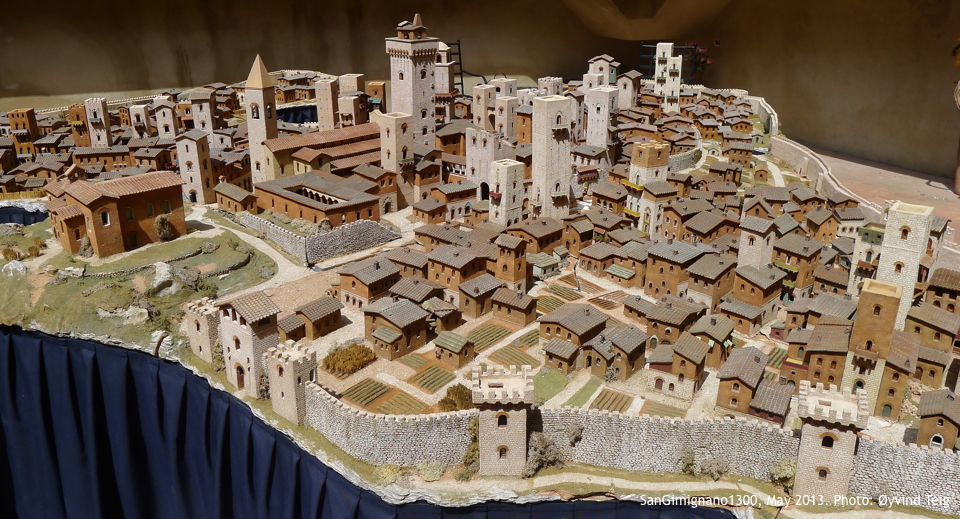
This is a model of the city as it used to exist.

069_fig01_SanGimignano1300_May2013.jpg

http://www.teigfam.net/oyvind/home/wp-content/uploads/2013/06/069_fig01_SanGimignano1300_May2013.jpg

San Gimignano was the setting for a nice movie called "Tea With Mussolini" with Joan Plowright, Judi Dench, Maggie Smith and Cher about the English expat community of Toscana who refused to leave even during the war. The English don't call Toscana "Chiantishire" for nothing. :) Anyway, it makes for a nice tourist stop: nice shops, lovely views, and great food.
https://www.youtube.com/watch?v=rSvRcd2QazA

Given all these things you can see how there is pedigree collapse in one's family trees, and how much drift there can be genetically, as well as the concentration of property over years.
.
 
Last edited:
Thanks for starting the thread, Tomenable. Some names are slipping out, of course: "I Bernardi sono piu ricchi dei Grasso". The Bernardis are richer than the Grassos, and always were.

http://www.ilsole24ore.com/art/noti...amiglie-sei-secoli--155222.shtml?uuid=ADgKR4L

This is a list of Florentine "noble" families over the years. Some of them actually didn't do as well as the haute bourgeoisie. Too many wars, no doubt, more than the normal amount of inbreeding, as with the Medici, plus disastrous marriages with even more inbred foreigners. The Medici did twice marry into the royal family of France, among others, so their blood isn't really "gone", but just so divided up by recombination with foreigners that it's meaningless.
https://it.wikipedia.org/wiki/Nobiltà_fiorentina

The Antinori are still doing remarkably well, of course, with their vineyards.
https://en.wikipedia.org/wiki/Antinori
http://www.antinori.it/

2.jpg


They are one of the few who have opened their operation up to the general public, in the American style. They invented the "Super Tuscans", bless them, so they're still not short in the brains department.

http://www.forbes.com/sites/larryol...opens-to-public-after-600-years/#68dbaef5535b

The Vespucci appear on the list (as in Amerigo Vespucci), and the Botticelli, plus the Buonapartes.
amerigo-vespucci.jpg


Botticelli is the one at the bottom. Perhaps having so little beauty himself made him appreciate it in others?
botticelli__adoration_of_the_k.jpg


Napoleone...beauty he had as a young man...
1122fa821076052c0253de16a51367ff.jpg


https://s-media-cache-ak0.pinimg.com/564x/11/22/fa/1122fa821076052c0253de16a51367ff.jpg

I had an uncle on my mother's side (far northwestern Tuscany-the Lunigiana-which was actually not Tuscan at all until the Medici took most of it) who cared about such things. We have three family names on the list: Galletti, Torrigiani, and of course the Malaspina, who once owned most of the Lungigiana. Torrigiani has to do with fortified "towers", probably, as per the above, Galletti has to do perhaps with Gauls, or relatively recent ancestry from France, and Malaspina means "Evil Thorn", and an evil bunch they were. I want absolutely nothing to do with them; blood suckers like most aristocrats. The Torrigiani and Galetti were all right, as were the Ghelfi, who were obviously followers of the Guelphs. In terms of the Malaspina, they just appear in our line, one day, and then there's constant intermarriage with other Malaspinas. I hope they were just retainers who took the name; I'd hate to be related to them.

Anyway, you can see how little has changed in Toscana over the last 600+ years.

The two Medici Queens of France:
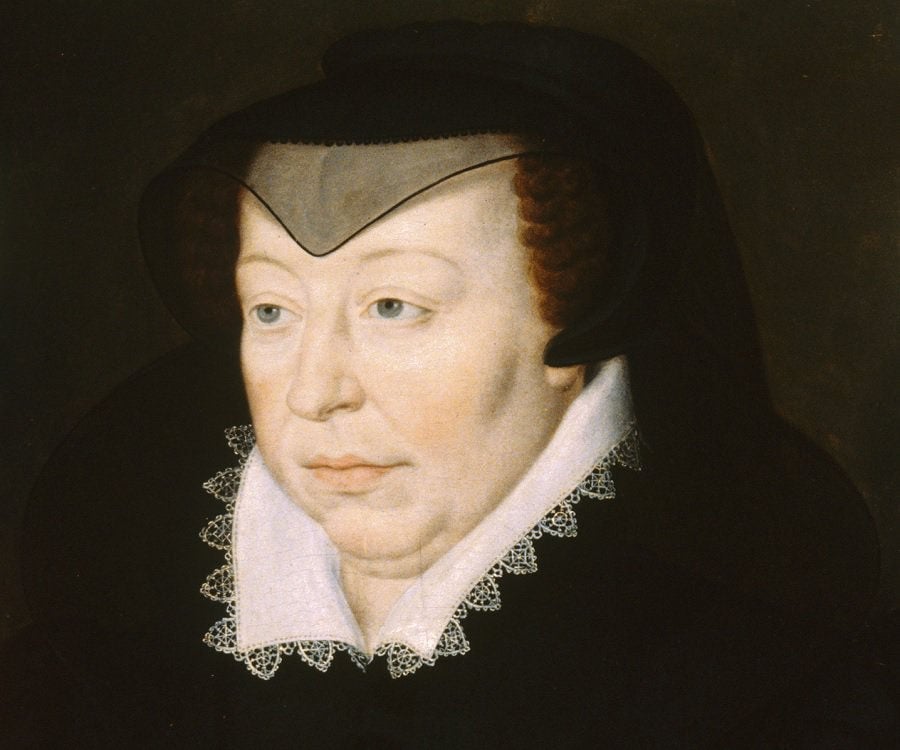
Only the pre-eminent banker in Europe would have enough money to buy a woman like this a King of France.
catherine-de-medici-1.jpg

No wonder she never dislodged Diane de Poitiers, men being men. She got her revenge, though; as soon as he died untimely young, Catherine kicked her out into the street.
739022acc6388c4f4cab332bf3cedbb8.jpg


Marie de Medici
d6e8bc90e6dd09fe9307315b51939108.jpg
 
Last edited:
Thanks for starting the thread, Tomenable. Some names are slipping out, of course: "I Bernardi sono piu ricchi dei Grasso". The Bernardis are richer than the Grassos, and always were.

http://www.ilsole24ore.com/art/noti...amiglie-sei-secoli--155222.shtml?uuid=ADgKR4L

This is a list of Florentine "noble" families over the years. Some of them actually didn't do as well as the haute bourgeoisie. Too many wars, no doubt, more than the normal amount of inbreeding, as with the Medici, plus disastrous marriages with even more inbred foreigners. The Medici did twice marry into the royal family of France, among others, so their blood isn't really "gone", but just so divided up by recombination with foreigners that it's meaningless.
https://it.wikipedia.org/wiki/Nobiltà_fiorentina

The Antinori are still doing remarkably well, of course, with their vineyards.
https://en.wikipedia.org/wiki/Antinori
http://www.antinori.it/

2.jpg


They are one of the few who have opened their operation up to the general public, in the American style. They invented the "Super Tuscans", bless them, so they're still not short in the brains department.

http://www.forbes.com/sites/larryol...opens-to-public-after-600-years/#68dbaef5535b

The Vespucci appear on the list (as in Amerigo Vespucci), and the Botticelli, plus the Buonapartes.
amerigo-vespucci.jpg


Botticelli is the one at the bottom. Perhaps having so little beauty himself made him appreciate it in others?
botticelli__adoration_of_the_k.jpg


Napoleone...beauty he had as a young man...
1122fa821076052c0253de16a51367ff.jpg


https://s-media-cache-ak0.pinimg.com/564x/11/22/fa/1122fa821076052c0253de16a51367ff.jpg

I had an uncle on my mother's side (far northwestern Tuscany-the Lunigiana-which was actually not Tuscan at all until the Medici took most of it) who cared about such things. We have three family names on the list: Galletti, Torrigiani, and of course the Malaspina, who once owned most of the Lungigiana. Torrigiani has to do with fortified "towers", probably, as per the above, Galletti has to do perhaps with Gauls, or relatively recent ancestry from France, and Malaspina means "Evil Thorn", and an evil bunch they were. I want absolutely nothing to do with them; blood suckers like most aristocrats. The Torrigiani and Galetti were all right, as were the Ghelfi, who were obviously followers of the Guelphs. In terms of the Malaspina, they just appear in our line, one day, and then there's constant intermarriage with other Malaspinas. I hope they were just retainers who took the name; I'd hate to be related to them.

Anyway, you can see how little has changed in Toscana over the last 600+ years.

The two Medici Queens of France:
Only the pre-eminent banker in Europe would have enough money to buy a woman like this a King of France.
catherine-de-medici-1.jpg

No wonder she never dislodged Diane de Poitiers, men being men. She got her revenge, though; as soon as he died untimely young, Catherine kicked her out into the street.
739022acc6388c4f4cab332bf3cedbb8.jpg


Marie de Medici
d6e8bc90e6dd09fe9307315b51939108.jpg

The famous Tuscan and Florentine director Franco Corsi Zeffirelli is a descendant of Tuscan Leonardo Da Vinci.

zeffirelli_lp.jpg


Leonardo-portrait.jpg
 
How's this for coincidence?

I just saw this article referenced by Razib Khan. His title is "Class and Status Matter More Than Performance".
http://www.unz.com/gnxp/class-statu...nce&utm_source=twitterfeed&utm_medium=twitter

The article is: "Best Paid CEOs Run Some of Worst-Performing Companies":
http://www.wsj.com/articles/best-pa...orst-performing-companies-1469419262?mod=e2tw

This is Khan's take on it. It's something to consider, as well as any genetic factors.

"And once you make it into a particular class, social connections can help prevent you from sliding back down. To a great extent the same of Yahoo to Verizon is a failure for Marissa Mayer. But she’ll be fine, and obtain another CEO position if she so chooses. If she had turned around Yahoo, always a long shot, she would have been dubbed a genius. As it is, she’ll get a golden parachute and look to future opportunities.What’s the take-home less? Social mobility is a thing in the United States. But the reality is that what you really need to do is somehow make it into a particular segment of the class structure. Once you are there, the reality is that your own competence probably matters less than chance and necessity. Even if you don’t become a superstar, the nature of the American class structure will probably make it so you’ll be shielded from the bracing consequences of creative destruction."


We really shouldn't confused modern meaning of class with old one where titles and money came with borth rights. The meaning of it is that Marissa Mayer had lots of smarts to start at the bottom of a companies to end up on the top. She did it on her own merits. However once on top she might be sheltered by "her class" of people receiving top management jobs even if she can't perform very well.

I was always for some kind of formula for CEOs salaries. They should have base salary of hundred thousands a year, not millions, and bonus for performance. And I mean performance based on percentage of company profit. If company doesn't make money they only receive basic salary and nothing more, no bonus, no shares. There should be some kind of standardise formula to keep CEOs decent, in check.
 
It is possible that some percentage of Europeans could be related to important people of Near East or Ginghis Khan. However after so many generations the amount of Muhammed's DNA in a person would be on a scale of one millionth. At this scale it is also possible to lose said person DNA completely.

Very true. Not only that, but we know there's a certain percentage of NPEs in every generation, and given what we've discovered from the analysis of Richard III and those royal lines, the "royals" weren't immune to that. So, how reliable are these aristocratic and royal family trees?

In that vein, as some of the comments made clear, parvenus have throughout history made up illustrious ancestors for themselves. In periods without clear records, how reliable are those claims?
 
Very true. Not only that, but we know there's a certain percentage of NPEs in every generation, and given what we've discovered from the analysis of Richard III and those royal lines, the "royals" weren't immune to that. So, how reliable are these aristocratic and royal family trees?

In that vein, as some of the comments made clear, parvenus have throughout history made up illustrious ancestors for themselves. In periods without clear records, how reliable are those claims?
Right on. It is even written in recent and historic records that Japanese dynasty founding father was Sun God.
 
Back
Top