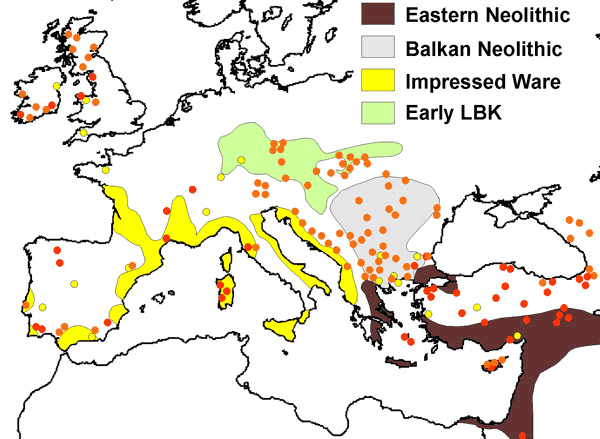
That's a map of the Early Neolithic, Berun. People fanned out from there. By the Middle to Late Neolithic the people of Europe, other than those in the most northern reaches of Europe or far to the east were 75% Anatolia Neolithic genetically, even if the men carried I2a of some sort.
I'm not saying farming didn't get there later than to some other areas, because for a long time the agricultural package wasn't adapted to grasslands, but by the early 3rd millennium BC my recollection is that there were Middle to Late Neolithic people there. Yes, Indo-European speaking people migrated there after that, people perhaps more adapted to grasslands, but they migrated to Italy too. That's why "Italians" of the Classical Era spoke either Ligurian or Italic, or other Indo-European languages. The Celtic migrations certainly affected the people there, but they also affected all of Northern Italy down into Tuscany.
There was Germanic gene flow in both areas too. The Lombards settled the Veneto pretty heavily. I think it's the Italian area that actually has the most "Lombard" ancestry.
The difference in terms of all these migrations might be because parts of Italy having been colonized so early, it was more heavily populated than areas like Slovenia, and "Indo-European" tribes might have been more adapted to grasslands.
However, the major migration wave that really impacted the two areas differently was the migration of the Slavic speaking peoples. That doesn't mean that the Slavs came into an empty landscape, no matter what some Croatians, Slovene? would like to think. There was admixture.