• Don't want to see ads? Install an adblocker like uBlock Origin or use a Europe-based privacy-friendly browser like Vivaldi or Mullvad.

Genetic borders in Europe

Tomenable

Well-known member
Messages
6,031
Reaction score
1,754
Points
113
Location
Poland
Ethnic group
Polish
Y-DNA haplogroup
R1b-L617
mtDNA haplogroup
W6a
Here is my PCA with regional averages, probably the biggest genetic border that showed up, is this between Slovenia and North-Eastern Italy. Any ideas why, how and when did this genetic border emerge? Geographically, Veneto-Friuli and Slovenia are neighbours, but in terms of DNA there is a big distance between them:

https://i.imgur.com/Z3NrUkn.png

Z3NrUkn.png
 
^^The migration history is totally different. Slovenia was heavily impacted by the invasions of the early Medieval period; Italy not so much.

They also have a totally different political history. Slovenia part of the Austro-Hungarian Empire. Venice maintained it's sovereignty until unification. Political borders acted as barriers to genetic flow to some degree. That's part of the reason for the differentiation between northern and southern Italy.

Some of the placement of the Italian regions seems "off" to me, but whatever.
 
rainfall. no, it's not a joke. rainfall is decisive in agricultural or pastoralist economies, being so determinant for cultures attached to a given economy or way of life. also demography is affected as cows can't mantain so many herders as wheat can mantain farmers.

per example the expansive Cardial culture with its agricultural techniques anf crops is not sustainable in wet Slovenia.
 
There is also a big linguistic gap (Slavic VS Romance) ...they are two ethnicities that live side by side since centuries without much interbreeding

Maybe Illyrians were more similar to ancient Veneti considering the shared Castellieri heritage
 
rainfall. no, it's not a joke. rainfall is decisive in agricultural or pastoralist economies, being so determinant for cultures attached to a given economy or way of life. also demography is affected as cows can't mantain so many herders as wheat can mantain farmers.
per example the expansive Cardial culture with its agricultural techniques anf crops is not sustainable in wet Slovenia.

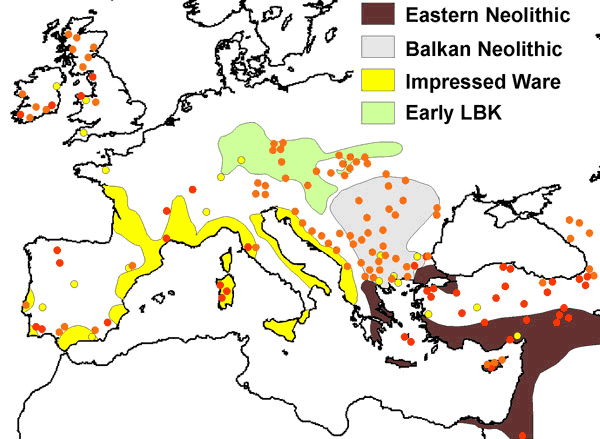
europe-map1.gif


Neolithic farmers eventually spread over all of Europe, including Slovenia, except for the far northeast. The people who used to live there were different from the people who live there now. The difference is the Early Medieval Era migrations, which did not have the same impact on Italy or Spain as they did in parts of the northern Balkans and Central Europe.

Language and politics were also barriers to gene flow.
 
Any ideas why, how and when did this genetic border emerge?

To begin with Slovenians are 2 milion, 1/30 of the Italians, basically a small Italian region, and Slovenia does show more NE components than other former Jugoslavia regions.

It's obviously due to the early Medieval Slavic migrations to Slovenia. Slavs in the Balkans are a late arrival, while the north-east Italians had already for many centuries their strong Romance and Rhaeto-Romance identities.
 
@Angela, I'm not denying historical migrations shaping the autosomal profiles, but i remark that ecosystem-economy-demography is the factor providing explanations for known and unknown human settlements. Even in the map attached Slovenia is under white colour. When it was successfully colonized and by who?... ecosystem also would justify the frontier among Veneti and Carnitian Celts, and now among Venetians and Slavs. Friulians have another history.
 
@Angela, I'm not denying historical migrations shaping the autosomal profiles, but i remark that ecosystem-economy-demography is the factor providing explanations for known and unknown human settlements. Even in the map attached Slovenia is under white colour. When it was successfully colonized and by who?... ecosystem also would justify the frontier among Veneti and Carnitian Celts, and now among Venetians and Slavs. Friulians have another history.

Furlans aren't exactly another history and they assimilated the Carni Celts.
 
@Angela, I'm not denying historical migrations shaping the autosomal profiles, but i remark that ecosystem-economy-demography is the factor providing explanations for known and unknown human settlements. Even in the map attached Slovenia is under white colour. When it was successfully colonized and by who?... ecosystem also would justify the frontier among Veneti and Carnitian Celts, and now among Venetians and Slavs. Friulians have another history.

That's a map of the Early Neolithic, Berun. People fanned out from there. By the Middle to Late Neolithic the people of Europe, other than those in the most northern reaches of Europe or far to the east were 75% Anatolia Neolithic genetically, even if the men carried I2a of some sort.

I'm not saying farming didn't get there later than to some other areas, because for a long time the agricultural package wasn't adapted to grasslands, but by the early 3rd millennium BC my recollection is that there were Middle to Late Neolithic people there. Yes, Indo-European speaking people migrated there after that, people perhaps more adapted to grasslands, but they migrated to Italy too. That's why "Italians" of the Classical Era spoke either Ligurian or Italic, or other Indo-European languages. The Celtic migrations certainly affected the people there, but they also affected all of Northern Italy down into Tuscany.

There was Germanic gene flow in both areas too. The Lombards settled the Veneto pretty heavily. I think it's the Italian area that actually has the most "Lombard" ancestry.

The difference in terms of all these migrations might be because parts of Italy having been colonized so early, it was more heavily populated than areas like Slovenia, and "Indo-European" tribes might have been more adapted to grasslands.

However, the major migration wave that really impacted the two areas differently was the migration of the Slavic speaking peoples. That doesn't mean that the Slavs came into an empty landscape, no matter what some Croatians, Slovene? would like to think. There was admixture.

 
That's a map of the Early Neolithic, Berun. People fanned out from there. By the Middle to Late Neolithic the people of Europe, other than those in the most northern reaches of Europe or far to the east were 75% Anatolia Neolithic genetically, even if the men carried I2a of some sort.

I'm not saying farming didn't get there later than to some other areas, because for a long time the agricultural package wasn't adapted to grasslands, but by the early 3rd millennium BC my recollection is that there were Middle to Late Neolithic people there. Yes, Indo-European speaking people migrated there after that, people perhaps more adapted to grasslands, but they migrated to Italy too. That's why "Italians" of the Classical Era spoke either Ligurian or Italic, or other Indo-European languages. The Celtic migrations certainly affected the people there, but they also affected all of Northern Italy down into Tuscany.

There was Germanic gene flow in both areas too. The Lombards settled the Veneto pretty heavily. I think it's the Italian area that actually has the most "Lombard" ancestry.

The difference in terms of all these migrations might be because parts of Italy having been colonized so early, it was more heavily populated than areas like Slovenia, and "Indo-European" tribes might have been more adapted to grasslands.

However, the major migration wave that really impacted the two areas differently was the migration of the Slavic speaking peoples. That doesn't mean that the Slavs came into an empty landscape, no matter what some Croatians, Slovene? would like to think. There was admixture.

This is from later in the Neolithic. Slovenia, or at least most of it was part of Cardial Impressa from what I can see.

1042px-European-late-neolithic-dutch.svg.png


800px-LocationSlovenia.svg.png


Late Bronze Age Europe:
Europe_late_bronze_age.png


Of course, this is all speculation. The only way to know is to look at ancient genomes. Does anyone know if there are any ancient sample from the area around Slovenia?
 
Furlans aren't exactly another history and they assimilated the Carni Celts.

Friulan is a dialect related to Rumansch (Rome) in Switzerland and Ladin (Latino) in the Dolomites, such patchy extension must mean a migration like that of Germans settling in south Alps: Walderer in Valle d'Aosta or Tyrolean in South Tyrol. Another case of herders traveling to poor productive regions are the Vlach in Greece, Macedonia, Bulgaria, Romanua, Serbia, etc, of course they are not the remnants of the Latin speaking population but migrations from Albania.
 
@Angela, a Paint map is not the best, betterto rely on scientific papers...
https://goo.gl/images/oh3QD4
as can be seen the Alpine ecosystem stopped the Anatolian farming as the Steppe ecosystem (the first by execessive raining, the later by lack of enough raining to sustain crops).
 
Furlans aren't exactly another history and they assimilated the Carni Celts.
Strabo and Livy claim the Carni tribe as Illyrian ............that is, always linked with the Illyrians. More recent scholars state this has changed, with a link to the Adriatic Veneti being preferred, similar to the Catali tribe to the east of the Carni.
Pliny mentions two other towns, Ocra and Segeste, as belonging to the Carni, ......."este" ending towns are 100% Illyrian

Strabo - From Tergeste, a village of the Carni, there is a pass across and through the Ocra to a marsh called Lugeum. A river, the Corcoras, flows near Nauportus, and conveys the merchandise from that place

Tergeste = Trieste .......a Illyrian town , another "este " ending name
 
@Angela, a Paint map is not the best, betterto rely on scientific papers...
https://goo.gl/images/oh3QD4
as can be seen the Alpine ecosystem stopped the Anatolian farming as the Steppe ecosystem (the first by execessive raining, the later by lack of enough raining to sustain crops).

Those maps are based on SETTLEMENTS, you know, like PEOPLE, not on terrain. Slovenia is mostly grassland, by the way, and people would have taken a nice walk up from Istria, which was ALWAYS Cardial/Impressa. Or they would have come up from the Balkans.

I guess you only like the maps of the Neolithic if they're from the very early periods. The farmers even got up to Gotland for goodness sakes.

If Otzi, a man genetically almost indistinguishable from the EEF could live and thrive on the top of the Alps, you think people couldn't live in the grasslands of Slovenia?

Why do you think there is so much Ydna E-V13 in the Austrian Tyrol and in southwestern Germany?

You know what, never mind. Slovenia was empty.

This is EARLY Neolithic. You think it stayed like that? It spread all over Spain, for example. Why do you think your EEF levels are sky-high? It got to Gotland, as I said. You think it didn't spread to all of France? Yes, there was a pause before the spread of the Neolithic into Central Europe, because their agricultural package wasn't adapted to it. It lasted almost a thousand years, but they did eventually get there.
europe-map1.gif
 
Friulan is a dialect related to Rumansch (Rome) in Switzerland and Ladin (Latino) in the Dolomites, such patchy extension must mean a migration like that of Germans settling in south Alps: Walderer in Valle d'Aosta or Tyrolean in South Tyrol. .

No, it's the opposite. It does not mean a migration, Rhaeto-Romance languages are the remnants of Romance languages spoken in the Alps in a broader area before the Germanization and Slavicization of the Alps. Vlachs are a complete different case. While Walser are indeed a migration of a Germanic-speaking population into North Italy now mostly assimilated and have nothing to do with Rhaeto-Romance people and Vlachs (and also these two are not related).
 
Angela, you are messing a good chunk, I was pointing out that ecosystem was the main reason for the divide, I'm not deniying the impact of historical migrations but by sure the ecosystem had the last answer as invaders finding more or less peopled areas and/or zones fitting better their way of life can thrive more or less. I was giving as example the lack of Cardial in Slovenia, but you come with a Paint map, Otzi Iceman (Copper Age right?), and promenades by Istrians, but even with no data about Cardial examples in Slovenia. I realy would like to have scientific debate but you are not for it today.
 
@Pax Augusta, one or two Rhaeto-Romance languages are survivals but not all, Ladin and Friulan are south of Alps but Rumansh is in the north, difficult so to imagine an ancient extended unity... broken by Venetian.
 
Back
Top