• Don't want to see ads? Install an adblocker like uBlock Origin or use a Europe-based privacy-friendly browser like Vivaldi or Mullvad.

Actual living human examples of the "Classical" phenotype?

Yea, you kind of look like one of my cousins tbh.

One Albanian guy I spoke to regarding oral history claimed the family we claim descent were originally Condottieri from the Apennines, per supposed church records. This theory seems less plausible though, as one who also claims descent was a different haplo, and the oral history most commonly accepted with Ghegs claim they were never from Italy. So idk which story is the accurate one. It certainly would explain the story, though unsubstantiated. Certainly would explain atypical central med/IT in K36.
 
One Albanian guy I spoke to regarding oral history claimed the family we claim descent were originally Condottieri from the Apennines, per supposed church records. This theory seems less plausible though, as one who also claims descent was a different haplo, and the oral history most commonly accepted with Ghegs claim they were never from Italy. So idk which story is the accurate one. It certainly would explain the story, though unsubstantiated. Certainly would explain atypical central med/IT in K36.

You're not the only Albanian who looks Italian to me, for what it's worth. Some Greeks look Italian, too, and vice versa. There was a lot of traffic, genetic and otherwise across the Adriatic, as well as shared ancient genes.

My husband's grandfather was very tall, way over six feet, light brown haired, green eyed, with a very Dinaric nose, curve and all. Now that I know who they are, :smile:he looks Gheg to me, but he's 100% Ionian Calabrian.
 
You're not the only Albanian who looks Italian to me, for what it's worth. Some Greeks look Italian, too, and vice versa. There was a lot of traffic, genetic and otherwise across the Adriatic, as well as shared ancient genes.

My husband's grandfather was very tall, way over six feet, light brown haired, green eyed, with a very Dinaric nose, curve and all. Now that I know who they are, :smile:he looks Gheg to me, but he's 100% Ionian Calabrian.

Very true. my DNA relatives are usually in this order, closest to furthest, Albanian, Greek, Italian, South Slavic, rest of Europe. Perhaps the atypical components contributes to more identifiable phenotypes within that area. Even though we are not Tuscans we usually score it in single pop before Albanian in most calcs(even with Alb references). It usually mixes me between Albanian, Tuscan, Greek and South slavic in mixed mode sharing, This probably has to do with IT in k36 being so high.
 
Very true. my DNA relatives are usually in this order, closest to furthest, Albanian, Greek, Italian, South Slavic, rest of Europe. Perhaps the atypical components contributes to more identifiable phenotypes within that area. Even though we are not Tuscans we usually score it in single pop before Albanian in most calcs(even with Alb references). It usually mixes me between Albanian, Tuscan, Greek and South slavic in mixed mode sharing, This probably has to do with IT in k36 being so high.

You mean your family, yes, not Albanians in general?

My DNA relatives is really screwed up. I don't really know why. In my top 20 matches I have Ligurians, Emilians, Tuscans, a few Piemontese, but also Americans of Danish or German or British Isles ancestry. Maybe they're false positives.

On gedmatch oracles the list is usually either Bergamo or TSI first depending on the calculator, then Tuscans, then central Italians, then either Albanians/Bulgarians in some order, or Iberians depending on the calculator, then Greeks, then southern Italians/Sicilians, then everybody else.
 
You mean your family, yes, not Albanians in general?

My DNA relatives is really screwed up. I don't really know why. In my top 20 matches I have Ligurians, Emilians, Tuscans, a few Piemontese, but also Americans of Danish or German or British Isles ancestry. Maybe they're false positives.

On gedmatch oracles the list is usually either Bergamo or TSI first depending on the calculator, then Tuscans, then central Italians, then either Albanians/Bulgarians in some order, or Iberians depending on the calculator, then Greeks, then southern Italians/Sicilians, then everybody else.

Me and my father. My mother does not. and most Albanians I see do not(if there is an Albanian reference). Given IT is highest in Tuscan, my only guess is since we are atypical it thinks we're Tuscan first.

Very interesting. I can't believe I left Bergamo out. Idk how accurate Gedmatch Gedrosia K3 is, but in pop mix, I get an exact 0 distance match which has me as 50 Albanian/50 Bergamo.

Most mixtures make me come out as Italo-Albanian or Greco-Albanian(closest distances anyways).

Italians Greeks and Albanians are ancestrally interlocked in a way, are they not? Could explain yours/my results. Maybe a Roman who got isolated in our region of Albania passed down a large chunk of that Italy shifting like ancestry. In LivingDNA I come up as 13 percent or so Italian. 4 percent of which is Tuscan. I also score like 65 percent Aegean which is also a major component in Italians. Moreso in Albanians and Greeks(per results I see).
 
Me and my father. My mother does not. and most Albanians I see do not(if there is an Albanian reference). Given IT is highest in Tuscan, my only guess is since we are atypical it thinks we're Tuscan first.

Very interesting. I can't believe I left Bergamo out. Idk how accurate Gedmatch Gedrosia K3 is, but in pop mix, I get an exact 0 distance match which has me as 50 Albanian/50 Bergamo.

Most mixtures make me come out as Italo-Albanian or Greco-Albanian(closest distances anyways).

Italians Greeks and Albanians are ancestrally interlocked in a way, are they not? Could explain yours/my results. Maybe a Roman who got isolated in our region of Albania passed down a large chunk of that Italy shifting like ancestry. In LivingDNA I come up as 13 percent or so Italian. 4 percent of which is Tuscan. I also score like 65 percent Aegean which is also a major component in Italians. Moreso in Albanians and Greeks(per results I see).

Indeed they are. In my case I'd add Bulgarians and Iberians. It all makes sense if you know your history and have some grasp of genetics.
 
Indeed they are. In my case I'd add Bulgarians and Iberians. It all makes sense if you know your history and have some grasp of genetics.

Very true. We know the last 300 years back, before that its a little hazy.
 
Very true. We know the last 300 years back, before that its a little hazy.

It depends how far back you can do your family tree. An uncle on my father's side had delusions of grandeur, the family name on the gate to the town, yada, yada, so he decided to spend years doing a family tree for my father's family. It wasn't all that hard because they all came from a handful or two of closely linked villages in the highest parts of the Apennini south of a midpoint between Parma and Reggio Emilia, the Val Cedra, to be exact. Since the Council of Trent mandated that all marriages and births, as well as other things, be registered in the parishes, I have a complete family tree for that side going back to the mid 1500s. There are scattered records, contracts, court cases in the Bishop's court etc. dating back to the 1200s. My best estimate is that they've been up there since around the 1000s.

For my mother's side, another snobby relative started doing the same for her side. I have a few lines where the records were burned during the war (La Spezia). I could go through episcopal records, but I really don't have the interest. It's pretty complete as it is.

That's why I know that 23andme goes back way more than 500 years. There are no Germans, French, or British people in my family tree in the last 500 years, although I get Northwestern European ancestry. Same for Iberian.

There's been no invasion of southern Italy/Sicily in the last 500 years either, although 23andme shows some "additional" Middle Eastern, as in more Caucasus like ancestry in them. I'd say 23andme has to go back at least 1500 if not 2000 years, although they don't claim that, because they're using the names of more or less "modern" nation states. That's the only way they could pick up British Isles and German like ancestry in me.
 
I can see it Dagne, but I'm signed in.

I agree; it looks perfect except that it's too short, which results in that "northern" long upper lip. What a very distinguished looking man; men of that era had such, I don't know, gravitas, maybe.
im signed in and I can't see it
 
There's been no invasion of southern Italy/Sicily in the last 500 years either, although 23andme shows some "additional" Middle Eastern, as in more Caucasus like ancestry in them. I'd say 23andme has to go back at least 1500 if not 2000 years, although they don't claim that, because they're using the names of more or less "modern" nation states. That's the only way they could pick up British Isles and German like ancestry in me.

However, why do Middle easterners get a small amount of "Italian", or "broadly southern European" DNA as well? I won't post other people's results without their permission, since it's unethical. But by doing a google image search, I've found several 90%+ middle easterner 23andme results where this is the case. Perhaps it has something to do with the algorithm too. Couldn't some of this have come from even further back, in late neolithic times, as shared ancestry between the two groups?
 
However, why do Middle easterners get a small amount of "Italian", or "broadly southern European" DNA as well? I won't post other people's results without their permission, since it's unethical. But by doing a google image search, I've found several 90%+ middle easterner 23andme results where this is the case. Perhaps it has something to do with the algorithm too. Couldn't some of this have come from even further back, in late neolithic times, as shared ancestry between the two groups?

I think it's absolutely plausible. I've been saying for years that Otzi with his copper ax may be part of a Late Neolithic/Copper Age movement not from the steppe as people insisted, but from Anatolia or the Aegean by way of the Balkans. I don't think that was the end of it, though. More could have come during the Bronze Age, or Iron Age, during the Roman Era or later with Moors. I just don't think we can know until we get ancient dna.

What I do know is that if Greece and the Balkans have more of it, more of the "Caucasian", if not the Southwest Asian, then some of the same processes must have affected them as well. It's not unique to Italy, and solely a product of Roman slavery, although the usual suspects always say it is.

I'm not so sure about your second statement. On the old 23andme some of my Southern Italian/Sicilian shares got, if I remember correctly, about 12-15% "Middle Eastern", which is mostly Caucasus, Iran, Anatolia. I've never seen Middle Easterners get 12% Italian, although you're right, they do get some. I honestly don't know what to make of it. Way back years ago when I was on 23andme forums, I thought perhaps it was a remnant of the farmers who went to Europe so long ago, but since then we've learned that although there's a lot less EEF type ancestry in the Near East than there is in Southern Europe, it's significant enough that I don't know why it would be picking up Italian alleles. Now, I'm wondering if perhaps it's a remnant of Sea Peoples from Italy.

It's really complicated, and again, until we get more ancient dna I just wouldn't speculate.

In terms of these calculators generally, as I've said before, I really gave up on them quite a while ago. They've all got something wrong with them. For now I'll stick to 23andme, whose scientists have a lot of experience with this. As for this new calculator of Kurd's, sorry, it's too inconsistent. There's Italians getting almost no Caucasus and central Slavs getting more than 10% of it? What will happen is that if the results match what people want to believe, they'll say it's great; if it doesn't, well, you get the idea...:)

I'll go back to ancient dna and archaeology.
 
I guess until more ancient samples are sequenced, it's hard to speculate what the case may be in regards to what these modern population tests are telling us. Until then, any speculation based on historical events, and/or what we currently know about prehistoric migrations is perfectly plausible. There's no denying events like Moorish, and Saracen invasions, and prior historical events may have contributed to these percentages to some degree. The diffusion of E-M81 is a testament to that. The question is, how much did it affect those areas, or was a large part of it there prior.

In regards to calculators, ancient DNA is a far better way to gauge ancestry than modern populations. As you said prior in another thread, Caucasus ancestry should be represented in all populations that actually have it. As should other basic early population components, before they became hybrids. This is a big part of the confusion for even people that are little more advanced into understanding population genetics as I have seen in the k29 thread.
 
I think it's absolutely plausible. I've been saying for years that Otzi with his copper ax may be part of a Late Neolithic/Copper Age movement not from the steppe as people insisted, but from Anatolia or the Aegean by way of the Balkans. I don't think that was the end of it, though. More could have come during the Bronze Age, or Iron Age, during the Roman Era or later with Moors. I just don't think we can know until we get ancient dna.

What I do know is that if Greece and the Balkans have more of it, more of the "Caucasian", if not the Southwest Asian, then some of the same processes must have affected them as well. It's not unique to Italy, and solely a product of Roman slavery, although the usual suspects always say it is.

I'm not so sure about your second statement. On the old 23andme some of my Southern Italian/Sicilian shares got, if I remember correctly, about 12-15% "Middle Eastern", which is mostly Caucasus, Iran, Anatolia. I've never seen Middle Easterners get 12% Italian, although you're right, they do get some. I honestly don't know what to make of it. Way back years ago when I was on 23andme forums, I thought perhaps it was a remnant of the farmers who went to Europe so long ago, but since then we've learned that although there's a lot less EEF type ancestry in the Near East than there is in Southern Europe, it's significant enough that I don't know why it would be picking up Italian alleles. Now, I'm wondering if perhaps it's a remnant of Sea Peoples from Italy.

It's really complicated, and again, until we get more ancient dna I just wouldn't speculate.

In terms of these calculators generally, as I've said before, I really gave up on them quite a while ago. They've all got something wrong with them. For now I'll stick to 23andme, whose scientists have a lot of experience with this. As for this new calculator of Kurd's, sorry, it's too inconsistent. There's Italians getting almost no Caucasus and central Slavs getting more than 10% of it? What will happen is that if the results match what people want to believe, they'll say it's great; if it doesn't, well, you get the idea...:)

I'll go back to ancient dna and archaeology.

good point about the sea peoples
 
I think it's absolutely plausible. I've been saying for years that Otzi with his copper ax may be part of a Late Neolithic/Copper Age movement not from the steppe as people insisted, but from Anatolia or the Aegean by way of the Balkans. I don't think that was the end of it, though. More could have come during the Bronze Age, or Iron Age, during the Roman Era or later with Moors. I just don't think we can know until we get ancient dna.

What I do know is that if Greece and the Balkans have more of it, more of the "Caucasian", if not the Southwest Asian, then some of the same processes must have affected them as well. It's not unique to Italy, and solely a product of Roman slavery, although the usual suspects always say it is.

I'm not so sure about your second statement. On the old 23andme some of my Southern Italian/Sicilian shares got, if I remember correctly, about 12-15% "Middle Eastern", which is mostly Caucasus, Iran, Anatolia. I've never seen Middle Easterners get 12% Italian, although you're right, they do get some. I honestly don't know what to make of it. Way back years ago when I was on 23andme forums, I thought perhaps it was a remnant of the farmers who went to Europe so long ago, but since then we've learned that although there's a lot less EEF type ancestry in the Near East than there is in Southern Europe, it's significant enough that I don't know why it would be picking up Italian alleles. Now, I'm wondering if perhaps it's a remnant of Sea Peoples from Italy.

It's really complicated, and again, until we get more ancient dna I just wouldn't speculate.

In terms of these calculators generally, as I've said before, I really gave up on them quite a while ago. They've all got something wrong with them. For now I'll stick to 23andme, whose scientists have a lot of experience with this. As for this new calculator of Kurd's, sorry, it's too inconsistent. There's Italians getting almost no Caucasus and central Slavs getting more than 10% of it? What will happen is that if the results match what people want to believe, they'll say it's great; if it doesn't, well, you get the idea...:)

I'll go back to ancient dna and archaeology.

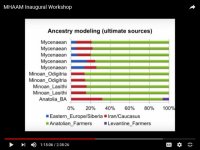
exactly that is a realistic scenario with lazaridis et al showing that there could be a further/extra non-IE dependent CHG source with anatolia_ba (2800-1800bc) in connection to the tyrrhenians historically ascribed from anatolia/(lemnos/imbros); mathieson et al qpAdm assigning anatolia_ba as much as 40-50% CHG and lazaridis et al ~30% and in this speech by j.lazaridis at MHAAM in which he also points out that anatolia_ba had levantine_n admixture so far not present in EEFs or Minoans indicating a major change/flow in anatolia itself with anatolia_ba samples being from 2800-1800bc Isparta; does not rule out any add scenarios during the roman era whether by CHG or levant_n but anatolia_ba might be a source;
https://www.youtube.com/watch?v=5OazVFNWL7I
5yjWWD7.jpg
 
I guess until more ancient samples are sequenced, it's hard to speculate what the case may be in regards to what these modern population tests are telling us. Until then, any speculation based on historical events, and/or what we currently know about prehistoric migrations is perfectly plausible. There's no denying events like Moorish, and Saracen invasions, and prior historical events may have contributed to these percentages to some degree. The diffusion of E-M81 is a testament to that. The question is, how much did it affect those areas, or was a large part of it there prior.

In regards to calculators, ancient DNA is a far better way to gauge ancestry than modern populations. As you said prior in another thread, Caucasus ancestry should be represented in all populations that actually have it. As should other basic early population components, before they became hybrids. This is a big part of the confusion for even people that are little more advanced into understanding population genetics as I have seen in the k29 thread.

Actually the diffusion of E-M81 is very low in southern Italy (from Sarno et al 2014):
At this respect, the distribution of Y-chromosome haplogroup E-M81 is widely associated in literature with recent gene flows from North-Africa [49]. Besides the low frequency (1.5%) of E-M81 lineages in general observed in our SSI dataset, the typical Maghrebin core haplotype 13-14-30-24-9-11-13 [8] has been found in only two out of the five E-M81 individuals.

Autosomally North African ancestry was measured at 4.6%, but most of that was detected only in Sicily; according to ALDER they estimate the time frame to coincide with the Moorish occupation (Sazzini et al 2015):
A similar, but even more extreme south-north gradient was observed also for the blue component highly representative of Northern African groups that was additionally detected in Middle East and, to a significant lower extent, in Southern Italy (4.6%, mainly in Sicily).
 
exactly that is a realistic scenario with lazaridis et al showing that there could be a further/extra non-IE dependent CHG source with anatolia_ba (2800-1800bc) in connection to the tyrrhenians historically ascribed from anatolia/(lemnos/imbros); mathieson et al qpAdm assigning anatolia_ba as much as 40-50% CHG and lazaridis et al ~30% and in this speech by j.lazaridis at MHAAM in which he also points out that anatolia_ba had levantine_n admixture so far not present in EEFs or Minoans indicating a major change/flow in anatolia itself with anatolia_ba samples being from 2800-1800bc Isparta; does not rule out any add scenarios during the roman era whether by CHG or levant_n but anatolia_ba might be a source;
https://www.youtube.com/watch?v=5OazVFNWL7I
View attachment 9525

Yes, I know, we've already discussed the Lazaridis paper on the Mycenaeans, including his speech, and including the small additional percentage of Levant extensively. This was a recap.

That particular visual was never posted, though, so that's good.
 
Another reference:

f5da66637af1cf5be6c75ff509effdc5.jpg


From the front:

ihGJNsj.png
 
Actual living human examples of the "Classical" phenotype?

Emperor Constantine and Cenk Uygur of the Young Turks.

ce1aa76fa6a1b9757abd0acd52bf019b.jpg
d1bac05a3d7eac2ea6317e95d6b6bd4b.jpg
 
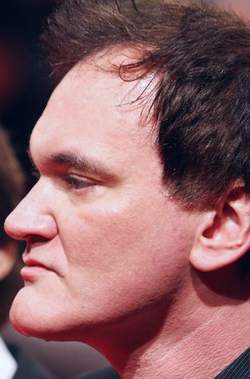
Caligula - Quentin Tarantino?

ee109efb94ca130d693753c8846d4048.jpg
 
Caligula - Quentin Tarantino?

ee109efb94ca130d693753c8846d4048.jpg

He's got a huge indentation at the root, so I don't think so. Is he only half Italian? That's decidedly not a typical Italian profile, particularly not that chin


Quentin-Tarantino.jpg


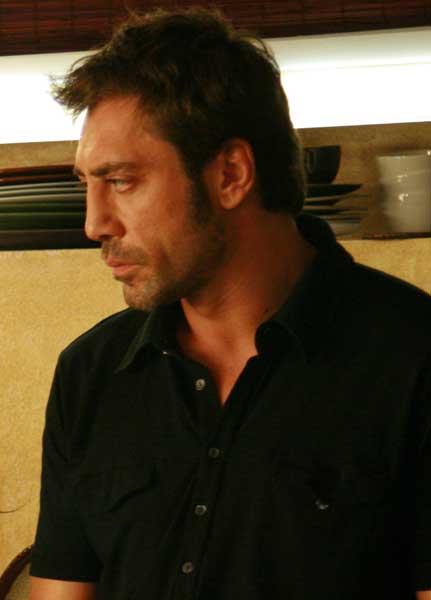
Javier Bardem?
javier_bardem.jpg


What about Daniel Auteuil? Or is that more Roman than Greek?

9e4c98f88076947220237d7b562845ed--daniel-auteuil-promis.jpg
 
Back
Top