• Don't want to see ads? Install an adblocker like uBlock Origin or use a Europe-based privacy-friendly browser like Vivaldi or Mullvad.

sea peoples

yes, because SRD root in name and because Sardinia is an island in Mediteranean...
J2b1 better explains order of conquest that included lands such as Hatti kingdom..
I think they went to Black sea coast on Hatti state and continued by land to Syria.....
through the lands of nowadays Kurds

How the could their haplogroup be known if we don't even have samples from them???

Is this something you came up with on your own, or do you actually have some reference for this?
 
How the could their haplogroup be known if we don't even have samples from them???

Is this something you came up with on your own, or do you actually have some reference for this?
its just my educated guess
 
its just my educated guess

Well actually I think the scholars who theorized they came from Sardinia are a little more educated on their guess.
 
Well actually I think the scholars who theorized they came from Sardinia are a little more educated on their guess.
Sardinia was their educated guess prior to genetics...

J2b1 theory doesnot exclude Sardinia... maybe map of J2b1 is incomplete or J2b1 disappeared from Sardinia during the times...
 
J2b1 theory doesnot exclude Sardinia... maybe map of J2b1 is incomplete or J2b1 disappeared from there during the times...

Again, we don't have sample from them. Also, look at the map legend, >5% in Cypriots, which is most likely from Greeks or earlier settlement.

Was? They still theorize they come from Sardinia.

Also, Sherden is what the Egyptians called them. What we know about them comes from their accounts.
 
Again, we don't have sample from them. Also, look at the map legend, >5% in Cypriots, which is most likely from Greeks or earlier settlement.

Was? They still theorize they come from Sardinia.

Also, Sherden is what the Egyptians called them. What we know about them comes from their accounts.

Good clue for Sardinia are horns...
Sherdana had them on Egyptian pictures and there are nuragic Sardinian figures with horns...

90px-Bronzetto_nuragico_Sulcis.jpg


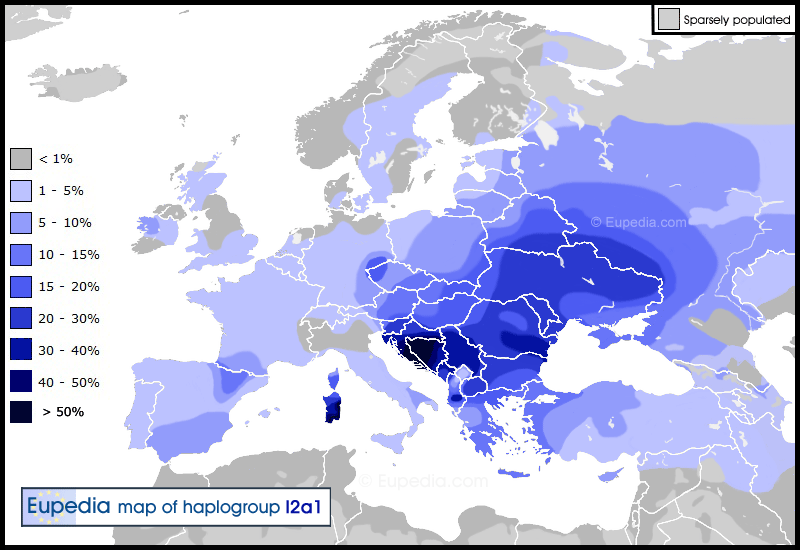
in that case I2a1 fits better...Sardis and Scordisci link is still valid

Haplogroup_I2a.gif
 
If ancient Italics, or Proto-Italics were among the sea peoples (or among some of the tribes at least. The connection to the Urnfield Culture makes this plausible at the very least) then maybe the Roman renaming of the Levant region as "Palestine" might have been motivated by a memory, perhaps remote, of the presence of their Italic kindred to some degree in the region?
 
If ancient Italics, or Proto-Italics were among the sea peoples (or among some of the tribes at least. The connection to the Urnfield Culture makes this plausible at the very least) then maybe the Roman renaming of the Levant region as "Palestine" might have been motivated by a memory, perhaps remote, of the presence of their Italic kindred to some degree in the region?
some linguists among them (B.Sergent) link Palestine to Phillistins and deeper in time to Pelasgians (for the name because the use of this name have concerned more than an hypothesis ethnically speaking. For B.Sergent the Pelasges or Pelasgians ([palashtu/pilishtu] in Assyrian sources, [Pulashati] dans d'autres sources) were principally living around the Egea and would have been speaking some kind of macro-Italic dialect. It seems some of them followed Egean Tyrsenoi into Italy. All this question seems linked in some part tho the Y-J2b-L283 question (first in East Mediterranea or in Italy and Sardigna? (do notice that the Shardana were supposed to be of Balkan origin too, among the Sea People.
 
some linguists among them (B.Sergent) link Palestine to Phillistins and deeper in time to Pelasgians (for the name because the use of this name have concerned more than an hypothesis ethnically speaking. For B.Sergent the Pelasges or Pelasgians ([palashtu/pilishtu] in Assyrian sources, [Pulashati] dans d'autres sources) were principally living around the Egea and would have been speaking some kind of macro-Italic dialect. It seems some of them followed Egean Tyrsenoi into Italy. All this question seems linked in some part tho the Y-J2b-L283 question (first in East Mediterranea or in Italy and Sardigna? (do notice that the Shardana were supposed to be of Balkan origin too, among the Sea People.


Who are the Egean Tyrsenoi? A role for J2b-L283 in the Sea Peoples? I do not think there is any evidence that J2b-L283 is first found in the eastern Mediterranean.

Br5hpSX.png


ZXC4I2Z.png
 
There's this article making a case for a 4th century bc inscription in Crete belonging to a distinct Osco-Umbrian language, and arguing that this suggests a migration to Crete (and elsewhere) by host(s) of Italics among the Sea Peoples many centuries earlier.
I only report what B. Sergent wrote. He didn't speak of Y-haplos. I was just making allusion to the quarel between "balkanists" and "italists" concerning the Y-J2b-L283 geographic origin in some threads. ATW BA in Sardigna came surely for a part from eastern Mediterranea OR southeastern Europe, an not only from N-Italy. That said the big question is: Were all the western Sea People (mid-med) speaking IE italic tongues, and before go east, were not some of them come into Italy from this east (Med or Balkans)? ancient physical anthropo (for what it's worth of) said the Chalco in Italy was principally two ways mediated: a Mediterranean one, more in south, and a Balkanic one, entered by land through north-east. I don't know what value give to this but...? Even the "autochtonal" origin of Etruscans in Italy stays questionable. Hungary (Pannonia) could have propulsed sets of common origin on diverse directions during Urnfields, westwards, then southwestwars on a side and also southwards or southeastwards. Speculations, but the question isn't completely resolved in my mind.
 
I only report what B. Sergent wrote. He didn't speak of Y-haplos. I was just making allusion to the quarel between "balkanists" and "italists" concerning the Y-J2b-L283 geographic origin in some threads. ATW BA in Sardigna came surely for a part from eastern Mediterranea OR southeastern Europe, an not only from N-Italy. That said the big question is: Were all the western Sea People (mid-med) speaking IE italic tongues, and before go east, were not some of them come into Italy from this east (Med or Balkans)? ancient physical anthropo (for what it's worth of) said the Chalco in Italy was principally two ways mediated: a Mediterranean one, more in south, and a Balkanic one, entered by land through north-east. I don't know what value give to this but...? Even the "autochtonal" origin of Etruscans in Italy stays questionable. Hungary (Pannonia) could have propulsed sets of common origin on diverse directions during Urnfields, westwards, then southwestwars on a side and also southwards or southeastwards. Speculations, but the question isn't completely resolved in my mind.

From what you write Moesan it seems that in all these years you have not read a single study of archaeogenetics based on ancient DNA. Ancient DNA has amply demonstrated that IE migrations occurred in Italy almost a thousand years before the Urnfield culture. If in 2024 we want to believe that the Etruscan autochthony thesis is still questionable let us do so, but fewer and fewer scholars believe it now. As for Bernard Sergent, I do not believe that all his theses enjoy consensus. Except that it is not even clear whether he is an archaeologist, historian, or linguist. Sergent is the author of the book "Homosexualité et initiation chez les peuples indo-européens". I tell you without any prejudice, Sergent may be very popular in France, but I rarely see him mentioned in international bibliographies.
 
ATW BA in Sardigna came surely for a part from eastern Mediterranea OR southeastern Europe, an not only from N-Italy.

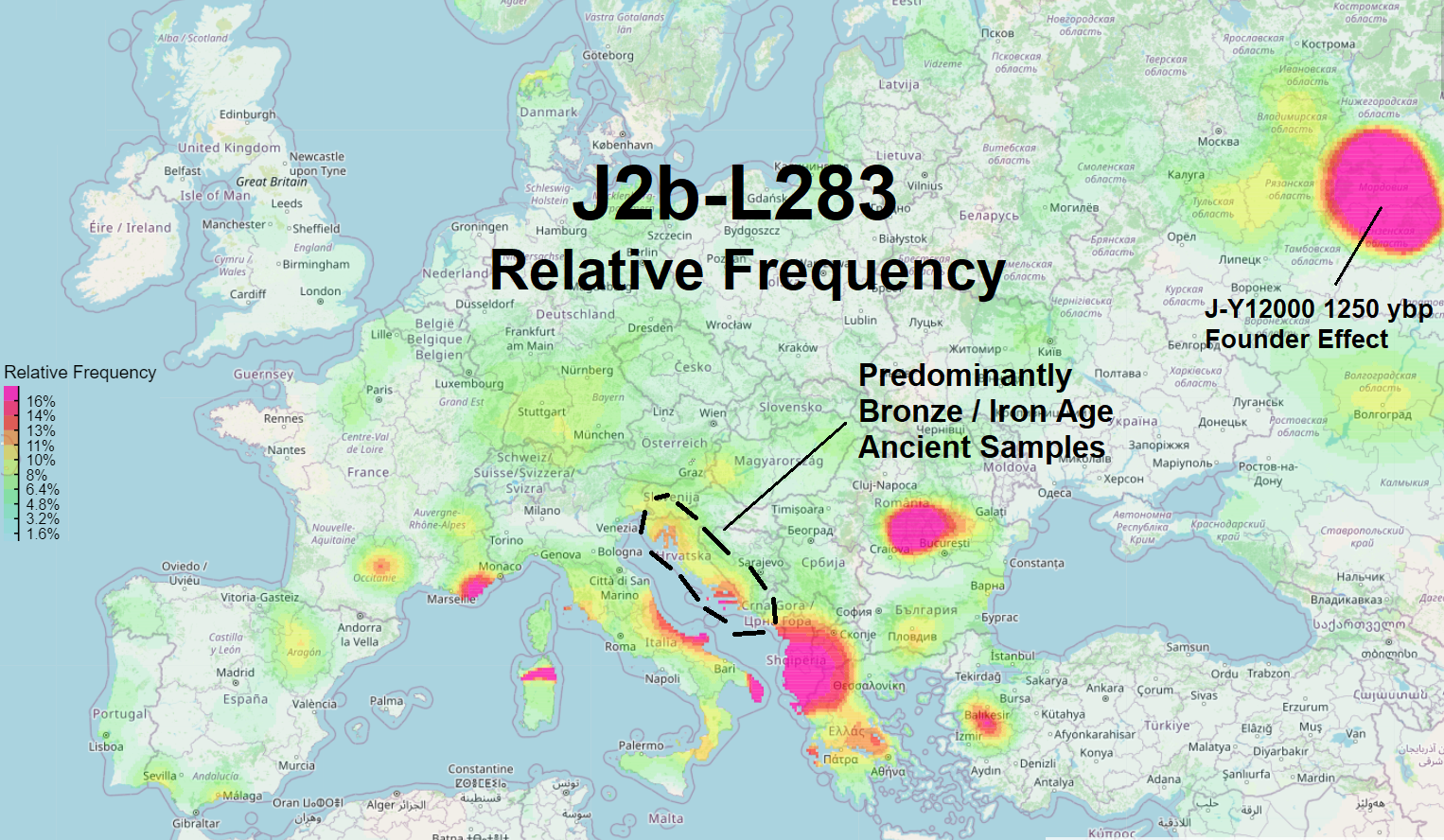
What ancient samples show that J2b-L283 is in the eastern Mediterranean before the Balkans?


J2b-L283-rel-freq.png


As I know, the only J2b-L283s found in acient samples on the other side of the Mediterranean are in Tunisia, and are dated around 500 BC, and and from an autosomal point of view they plotted in Europe, not with the Punic.


There are modern samples in the Middle East, Palestine, Jordan, and Syria, which belong to subclades of J2b-L283, but they are modern samples, and we know that during the Ottoman Empire many Balkan individuals, especially from Bosnia, migrated to the Levant.


Back
Top