• Don't want to see ads? Install an adblocker like uBlock Origin or use a Europe-based privacy-friendly browser like Vivaldi or Mullvad.

Ancient Genomics Reveals Four Prehistoric Migration Waves into Southeast Asia

bicicleur 2

Regular Member
Messages
6,442
Reaction score
1,488
Points
113
https://www.biorxiv.org/content/early/2018/03/08/278374

Two distinct population models have been put forward to explain present-day human diversity in Southeast Asia. The first model proposes long-term continuity (Regional Continuity model) while the other suggests two waves of dispersal (Two Layer model). Here, we use whole-genome capture in combination with shotgun sequencing to generate 25 ancient human genome sequences from mainland and island Southeast Asia, and directly test the two competing hypotheses. We find that early genomes from Hoabinhian hunter-gatherer contexts in Laos and Malaysia have genetic affinities with the Onge hunter-gatherers from the Andaman Islands, while Southeast Asian Neolithic farmers have a distinct East Asian genomic ancestry related to present-day Austroasiatic-speaking populations. We also identify two further migratory events, consistent with the expansion of speakers of Austronesian languages into Island Southeast Asia ca. 4 kya, and the expansion by East Asians into northern Vietnam ca. 2 kya. These findings support the Two Layer model for the early peopling of Southeast Asia and highlight the complexities of dispersal patterns from East Asia.
 
I think the migration waves of Neolithic East Asians to Southeast Asia must've been related to a gradual, milennia-old domino effect by which Central-North and Northeast Asian (including Sino-Tibetan) farmers expanded southwards and drove out the already expanding farmer groups of South China, one pushing the other out of their homelands, until the almost complete conquest of South China by Han Chinese in the beginning of the Common Era. In a way, Southeast Asia would be more or less a transplant or second home of pre-Han South China.

There is genetic and linguistic evidence that Hmong-Mien, Austroasiatic, Austronesians and Tai-Kadai came from Central and South China (Austronesian from Taiwan, but I sincerely doubt that that language family would've always been spoken just in that island, instead I think that Taiwan was simply the last refuge of those farmers as Sino-Tibetans, Hmong-Mien and Austroasiatic tribes encroached on the other peoples of South China). Other language families must've existed, too, and went extinct, but made the same clear north-to-south migration and expansion, leaving only some scattered dots of non-Sino-Tibetan speaking areas in China.

The last wave of East Asians that that study found some 2k years ago must've already included an early version of the modern South Chinese mix - that is, a much more northern-shifted people -, which is basically a genetic and cultural fusion of Han, originally from much further north, with the native Baiyue "barbarians" that they found in South China.
 
I think the migration waves of Neolithic East Asians to Southeast Asia must've been related to a gradual, milennia-old domino effect by which Central-North and Northeast Asian (including Sino-Tibetan) farmers expanded southwards and drove out the already expanding farmer groups of South China, one pushing the other out of their homelands, until the almost complete conquest of South China by Han Chinese in the beginning of the Common Era. In a way, Southeast Asia would be more or less a transplant or second home of pre-Han South China.

1. it is not that simple, b/c chinese langauge is a tonal language. looks like the migration was from south.

Tonal languages require humidity

Languages with a wide range of tone pitches have primarily developed in regions with high levels of humidity
The weather impacts not only upon our mood but also our voice. An international research team including scientists from the Max Planck Institutes for Psycholinguistics, Evolutionary Anthropology and Mathematics in the Sciences has analysed the influence of humidity on the evolution of languages. Their study has revealed that languages with a wide range of tone pitches are more prevalent in regions with high humidity levels. In contrast, languages with simpler tone pitches are mainly found in drier regions. This is explained by the fact that the vocal folds require a humid environment to produce the right tone.
original-1508157563.jpg


2. and historically, Genkiskhan did not regard northern chinese as genuine chinese, but southern chinese as genuine chinese who were suppressed like not human beings by mongol.

3. and anthropologically, I don't know what happened in china
Conclusion
The results of this study indicate that significant craniofacial variation exists between southern and northern Neolithic and Modern Chinese. For example,northern Chinese have more robust crania than southern ones. Principal component analyses show that the Neolithic-North is distinguished from the Neolithic-South in having a tall face, narrow nose andhigh eyes, while the Modern-North separate from the Modern-South in having a tall, broad face and highnose. Bivariate plots of selected measures indicate the northern Chinese are different from the southern Chinese on cranial length, upper facial height and nasal height. The Neolithic Chinese between the Qinling Mountain range and the Yangtze River are mixed withthe North and South. Statistically significant craniometrical differences exist between the Neolithic age and Modern day groups, and between the northern and southern Chinese. Temporal variation is also present.For instance, size decreased through time. However,some degree of morphological similarity exists between North and South China, and also between successive time periods. In the Neolithic sample the separation is clearer between the northern and southern samples than with the Modern arrays. During the Neolithic, the Qinling Mountain Range and theYangtze River served as a geographic boundary between North and South China.Environmental and cultural factors clearly playedimportant roles in the development of Modern Chinesecranial morphologies.
 
Last edited:
I think the migration waves of Neolithic East Asians to Southeast Asia must've been related to a gradual, milennia-old domino effect by which Central-North and Northeast Asian (including Sino-Tibetan) farmers expanded southwards and drove out the already expanding farmer groups of South China, one pushing the other out of their homelands, until the almost complete conquest of South China by Han Chinese in the beginning of the Common Era. In a way, Southeast Asia would be more or less a transplant or second home of pre-Han South China.

There is genetic and linguistic evidence that Hmong-Mien, Austroasiatic, Austronesians and Tai-Kadai came from Central and South China (Austronesian from Taiwan, but I sincerely doubt that that language family would've always been spoken just in that island, instead I think that Taiwan was simply the last refuge of those farmers as Sino-Tibetans, Hmong-Mien and Austroasiatic tribes encroached on the other peoples of South China). Other language families must've existed, too, and went extinct, but made the same clear north-to-south migration and expansion, leaving only some scattered dots of non-Sino-Tibetan speaking areas in China.

The last wave of East Asians that that study found some 2k years ago must've already included an early version of the modern South Chinese mix - that is, a much more northern-shifted people -, which is basically a genetic and cultural fusion of Han, originally from much further north, with the native Baiyue "barbarians" that they found in South China.

I share that view.
The 2 ka expansion is also a domino effect, a consequence of the Han expansion, which caused non-Han from south-China move further south.

The 4 migration waves were all haplogroup O.
They probably all came from the shores of the Yellow Sea, which drowned because of sea level rise, forcing them to inner NE China ca 9 ka.
The displaced earlier population of HG were probably haplogroup D, which is still in Negrito people, and also the link between Hoabinhan and haplogroup D Onge is intruiging.
 
1. it is not that simple, b/c chinese langauge is a tonal language. looks like the migration was from south.

Tonal languages require humidity

Languages with a wide range of tone pitches have primarily developed in regions with high levels of humidity

original-1508157563.jpg

9 ka climate was totally different in China, it was much warmer :
wild rice was growing in the Yangzi river area
 
I share that view.
The 2 ka expansion is also a domino effect, a consequence of the Han expansion, which caused non-Han from south-China move further south.
The 4 migration waves were all haplogroup O.

I think you have a good knowledge of ancient china. Can I ask two questions?

1. who were and are the Han?

As far as I know, the Ming founder created the word, " Han" to integrate chinese people, which originates in the name of "Han" dynasty. I don't think it is ethnical concept, but cultural concept. In china, they are teaching Genkiskan as Han chnese, Mongol empire/Qing as Han dynasty. So I think the Han is that kind of concept like "umbrella." like european or american:

Sun Yat-sen Main article: Sun Yat-sen
To restore our national independence, we must first restore the Chinese nation. To restore the Chinese nation, we must drive the barbarian Manchus back to the Changbai Mountains. To get rid of the barbarians, we must first overthrow the present tyrannical, dictatorial, ugly, and corrupt Qing government. Fellow countrymen, a revolution is the only means to overthrow the Qing government!

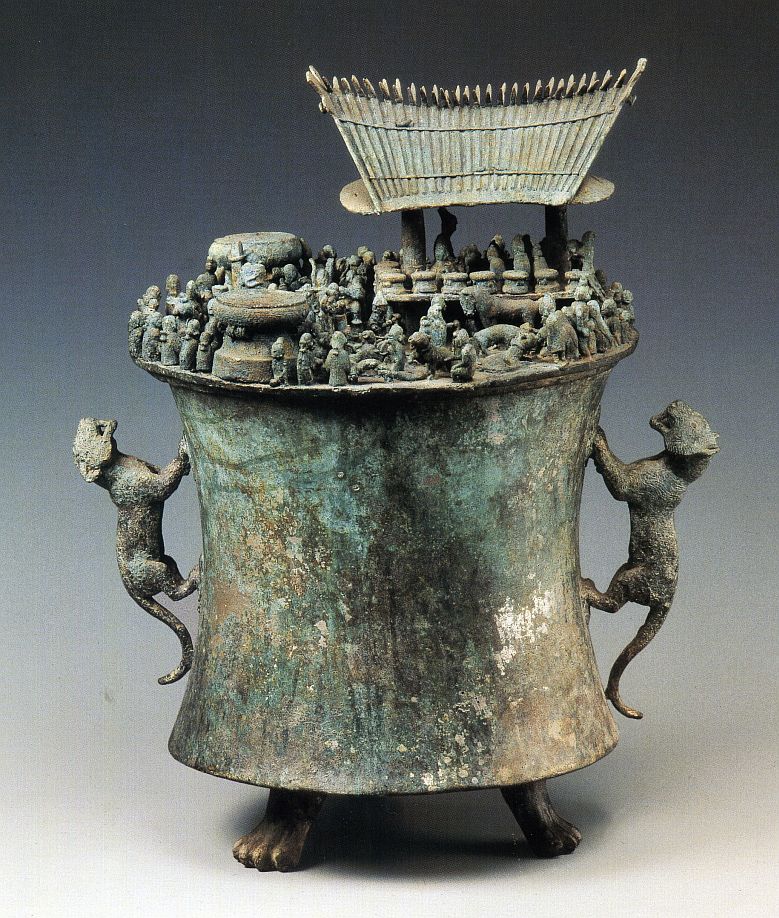
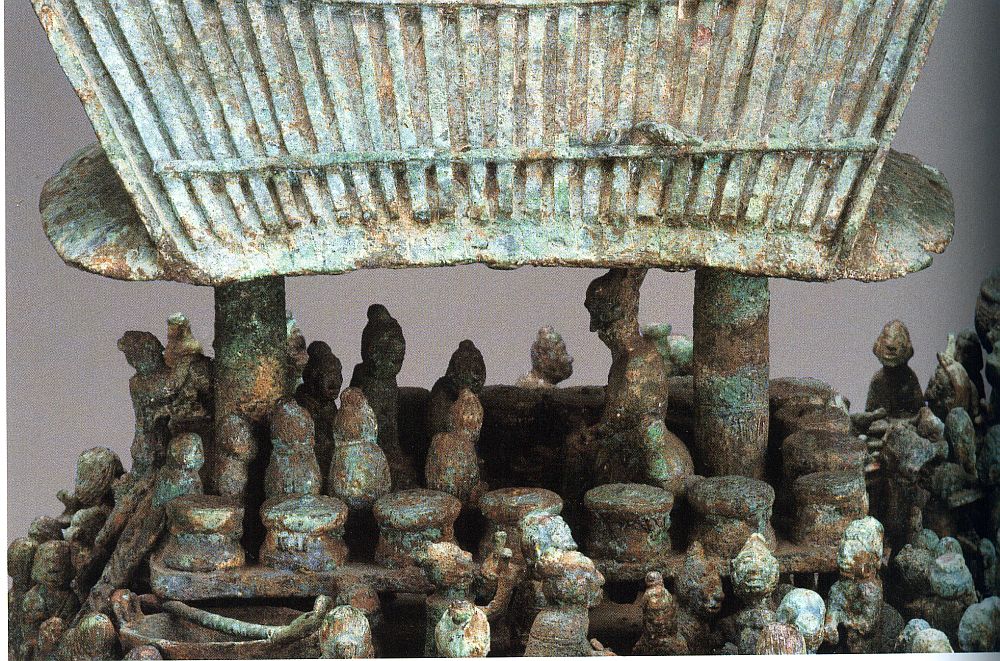
2. Who are the Han founder? They started human sacrifice again which already disappeared in Mainland China. I presume that he probably came from far north with extreme nomadic culture.

a continuation of human sacrifice in south-west China into the Western (also Former) Han Dynasty (206BCE-25CE). Already five centuries have passed since the teachings of Kong Fuzi made human sacrifice obsolete, and several centuries have elapsed without any notable evidence of human sacrifice at the state level. Confucianism, a socio-political philosophy based on etiquette, ritual know-how, and learning made human sacrifice obsolete, as the state no longer needed blood sacrifice to impose political authority and social cohesion. Animal sacrifice, however, continued as an important imperial ritual until the collapse of imperial China in 1911.
http://anthropoetics.ucla.edu/ap1401/1401plutschow/


shizhaivessel_s.jpg

1401plate1_s.jpg

In Plate 1, the king sits on top under a roof facing away from the to-be-sacrificed man. He is the only one who sits in a chair. There are eight persons who offer him food. They all sit on their heels in the dirt. The roofed area is the center of the sacrificial event.
FONT][FONT=Tahoma]


In plate 2, there are many men carrying weapons and instruments of punishment. A naked man is tied to a sculpted rock, possibly the king’s ancestral shrine.

3. And I always think that this kind of culture was never related with farmer O. looks like the Han dynasty expansion 2kyrs shows me Avar slavic expansion to Balkan area.

 
Thank you for sharing a window to a huge canvas that deserves the time and energy to expand it's horizons.
The depth of each understanding starts with the fact that a number of factors has to be considered. The historic, genetic,archaeological pieces are tied to a linguistic reality. taking a piece here and there adds a formula for further exploration.

Laurent Sagart, Roger Blench and Alicia Sanchez-Mazas

In the past ten years or so, important advances in our understanding of the
formation of East Asian populations, historical cultures and language phyla have
been made separately by geneticists, physical anthropologists, archaeologists and
linguists. In particular, the genetics of East Asian populations have become the
focus of intense scrutiny. The mapping of genetic markers, both classical and
molecular, is progressing daily: geneticists are now proposing scenarios for the
initial settlement of East Asia by modern humans, as well as for population
movements in more recent times. Chinese archaeologists have shown conclusively
that the origins of rice agriculture are to be sought in the mid-Yangzi region
around 10,000 BP and that a millet-based agriculture developed in the Huang
He Valley somewhat later.
 
1. it is not that simple, b/c chinese langauge is a tonal language. looks like the migration was from south.

This is not a good counter-argument, because we are talking about migrations thousands of years ago, and it is already a consensus among linguists of Chinese languages that Old Chinese was NOT a tonal language. So, your observation is wrong. All Sinitic languages were not tonal even when the Han Empire, the unification of China, was taking place, and tones arose only after the expansion of the Han civilization to Southern China.

It is very important to not fall into the trap of anachronism when analyzing the supposed relationship between linguistics and ancient migrations or genetic ancestry. One needs to analyze that relationship based on what we know about how the languages were milennia after our age, and not based on how they are now. Giving too much attention to the opinions of Gengis Khan is another flawed anachronism, because Gengis Khan lived more than 2,000 years or even 3,000 years after the beginning of the expansion of the North China farmers to central China and from there to south China.

Tonality developed in Chinese languages only in the last 2,000 years very gradually as a result of the simplification of consonant clusters and dropping of final consonants, so your hypothesis does not apply to the Sinitic branch of Sino-Tibetan languages. Even Middle Chinese still had many traces of that Chinese with more consonants where later tonal distinctions arose.
 
3. And I always think that this kind of culture was never related with farmer O. looks like the Han dynasty expansion 2kyrs shows me Avar slavic expansion to Balkan area.


Why? I mean, what are the evidences that you think point to an Avar expansion also in the beginning of Han dynasty?

I think there is some confusion on terminology here. When we use Han, it is in the modern sense of people carrying the language and civilization that prevailed and was a mean of unification of all the conquered peoples of unified China, which is the Sinitic one, based on the culture of speakers of Old Chinese. The term "Han" may have expanded and consolidated only with the Han dynasty, but in that sense the Han people, the people of Sinitic civilization(s), already existed even milennia earlier.
 
Why? I mean, what are the evidences that you think point to an Avar expansion also in the beginning of Han dynasty?

I think there is some confusion on terminology here. When we use Han, it is in the modern sense of people carrying the language and civilization that prevailed and was a mean of unification of all the conquered peoples of unified China, which is the Sinitic one, based on the culture of speakers of Old Chinese. The term "Han" may have expanded and consolidated only with the Han dynasty, but in that sense the Han people, the people of Sinitic civilization(s), already existed even milennia earlier.

Before answering, can I personally ask you some off topic questions?
I think you are really chinese expert.

1. In china, they are teaching students that Genkiskan is Han-Chinese, and their empire Han chinese dynasty. How do you think?
2. CCP claims that south chinses sea is their territory. How do you think?
3. I think the below CCP cannibalism as a cultural trap might be connected to bronze chinese civiliztion. How do you think?

The documents, prepared by local government offices in the 1980's, two decades after the events they describe, seem to offer a meticulous record of how Red Guards and Communist officials in one province not only tortured their victims to death but also ate their flesh. Copies of the documents have been smuggled out of China by Zheng Yi, a prominent writer wanted by the Chinese authorities for his work for the democracy movement at Tiananmen Square in 1989. After three and a half years as a fugitive, Mr. Zheng is to arrive in New York on Wednesday. Some Ugly Details At some high schools, students killed their principals in the school courtyard and then cooked and ate the bodies to celebrate a triumph over "counterrevolutionaries," the documents report. Government-run cafeterias are said to have displayed bodies dangling on meat hooks and to have served human flesh to employees. "There are many varieties of cannibalism," declares one report, "and among them are these: killing someone and making a late dinner of it, slicing off the meat and having a big party, dividing up the flesh so each person takes a large chunk home to boil, roasting the liver and eating it for its medicinal properties, and so on." The documents suggest that at least 137 people, and probably hundreds more, were eaten in Guangxi Province in southern China in the late 1960's. In most cases, many people ate the flesh of one corpse, so the number of cannibals may have numbered in the thousands. Found Only in One Province
https://www.nytimes.com/1993/01/06/world/a-tale-of-red-guards-and-cannibals.html
 
Thank you for allowing the past to breathe it's unhealthy air. I'm seeing more insights and greater focus in the daily threads than any of the tweets and false conclusions that the world's political infrastructure is willing our has the will to share.

Erich Fromm's "The Anatomy of Human Destructiveness" speaks of instances and human passions I have to wonder. In this provocative book, the distinguished author writes to break the deadlock in the struggle between the instinctivism of Konrad Lorenz and behavior psychologist B.F. Skinner.
 
IMO the formation of the Han was not ethnic, it was cultural and economic, it were people who were subject to and identified themselves with the empire.
Later when the empire expanded under the Han dynasty, it became an ethnic entity : it were people who came from the motherland of the Han empire.
The Han empire encouraged the Han people to colonize the newly conquered areas.

The empire originated in the bronze age, and IMO the bronze age was triggered by immigrations from the steppe, mainly through the Gansu corridor. They brought metallurgy and horses, and even wheat. And there was already a silk industry in China at that time.
Q-M120 probably entered China this way.

Already late neolithic China was socially stratified with elites competing each other.
The first empires (Xia - Shang ) originated when one group of elite people got the upperhand over a large area.
It happened in the Yellow River area, but there was also a bronze age empire in the Sichuan Basin.
 
Finding a point of entry

:thinking:The reality of just how many pieces of this puzzle need to be placed adds a host of challenges. Who and where belonged to the mother-lands of Han? The world's histories and stores talk also to the questions of humanity place under the totalitarian order. Yet at times those who excepted their lot survived at least for a time. Thank you for allowing the dialogue of highs and lows to facilitate another learning opportunity.

Rafe de Crespigny
Faculty of Asian Studies, Australian National University


At the end of the second century AD, all southern China was formally under the authority of the imperial government of Han. The territory was divided into three provinces, with a substructure of commanderies and counties. One function of the present chapter is to present a geography of the southern provinces, with indication of local topography, communications routes and the products of the region.

For the future, however, the important development of the Han period was the number of Chinese subjects who migrated into the lands of the south, and established themselves within those territories. As they did so, they placed increasing pressure on the non-Chinese people who had formerly inhabited the region, and brought almost endemic disturbance to the region. The physical occupation of the ground, moreover, was accompanied by a cultural aggression, generally supported by official patronage, which integrated the territory still more firmly into the Chinese cultural sphere.

The pioneer immigrants, however, had not normally come to the south in order to expand the political and administrative control of the central imperial government based in the north; on the contrary, they were often seeking to escape it, and the unit upon which they based their fortunes was the family, the extended clan, or a local system of mutual defence. By the end of the second century AD, as the authority of the central government was weakened through political conflict and turmoil in the north, the new settlers in the south maintained no particular sense of allegiance to the unified empire.
 
It happened in the Yellow River area, but there was also a bronze age empire in the Sichuan Basin.

I think the sichuan might be related with ancient greek:

Greek bronze:
Shaft tomb:
The practice of digging shaft tombs was a widespread phenomenon with prominent examples found in Mycenaean Greece; in Bronze Age China; and in Mesoamerican Western Mexico.[2]

16-1.jpg

16-3.jpg

https://www.dartmouth.edu/~prehisto...-gallery/flagframe.php?i=7&f=photo_blog&h=480

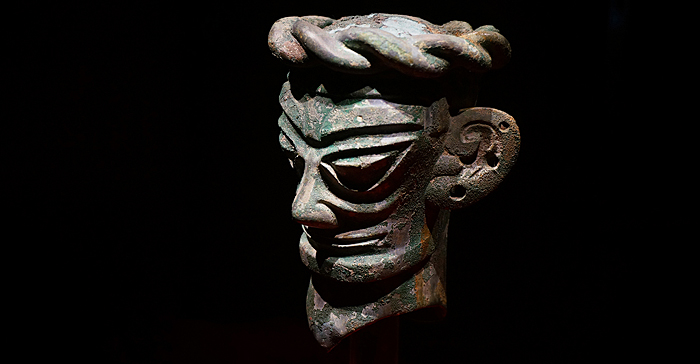
China sichuan bronze:
20150616sanxing3.jpg


http://www.kaogu.cn/en/News/New_discoveries/2015/0616/50594.html

Dinaric, Armenoid?
s-l1600.jpg


Headband & hairmode of women.

63a3da4ddaf2e5512b5b9c95e76620d0.jpg

Mycenaean-women.jpg

Dem%20Himmel%20so%20nah%2015%20Tage_4.jpg

http://www.chinareisen.de/761-Dem-Himmel-so-nah-Tibet-Nepal-Rundreise-ohne-Flug.html
https://picclick.com/Old-Chinese-Pure-Bronze-Ancient-Sanxingdui-culture-man-182934531111.html
https://philosophiaperennisetars.wordpress.com/page/3/

Unlike the Yangshao and Hemudu people, who came from southern China, the Huang Di nation came from west of China, from the western part of the Eurasian continent. They conquered the native people of the Yellow River and the Yangtze River, who possessed a developed agricultural culture. By combining their own imported cultural factors with those of the native culture,
the Huang Di people gradually developed a splendid new civilization in the Xia, Shang, and Zhou dynasties. They superseded the original native people to take the leading role on the stage of Chinese history. That the Huang Di nation was a branch of the archaic Indo-European people is one of the most remarkable facts thus far known to human history. But a large number of Indo-European words in Old Chinese language clearly attest to this fact. The relics left by the Huang Di people are related to the Longshan Culture in the archaeological chronicle, and the civilization of the Xia, Shang, Zhou, and Qin秦 dynasties were its successors.27 Evidence for this claim comes from two sources: the first uses the evidence of ancient documents to show that the Zhou people, and thus the Yellow Emperor’s nation, were originally a nomadic people, and the second is to reveal that there were a large number of Indo-European words in the Zhou language, using the evidence of historical linguistics. The third is the similarity in religion between the Huang Di people and Proto-Indo-European. As to the last point, please refer to the author’s paper “Old Chinese ‘帝*tees’ and Proto-Indo-European ‘*deus’: Similarity in Religious Ideas and a Common Source in Linguistics” (Zhou 2005).
183860331-e1389831567741.jpg


I think they are all caucasoids.
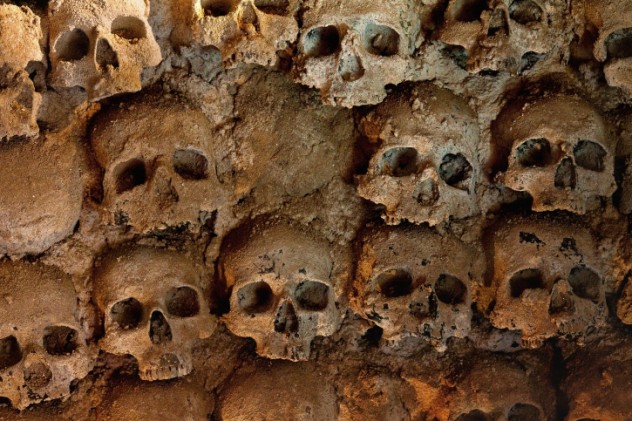
"The largest of these cities was Shimao. Founded about 4,300 years ago, Shimao was only inhabited for 300 years. In the ruins of this ancient stone town, archaeologists made a grisly discovery of over 80 human skulls—with no bodies in sight. The skulls were all of young women who died around 4,000 years ago. Further examination of the skulls showed evidence of violent deaths involving blunt objects and fire. As to why so many young women were beheaded and buried in a mass grave, researchers believe that the girls were probably from enemy groups and sacrificed as part of ceremonies to mark the founding of the city."


https://listverse.com/2014/01/18/10-...man-sacrifice/
 
What a fantastic view of a world that has been captured by your collections. Thank you for taking the time to share the pieces. Yet here we come to the reality of the value to life's existence. Capturing the article of 10 Horrifying discoveries of Human Sacrifice. looking forward to keep following this thread.
 
Back
Top