-
Don't want to see ads? Install an adblocker like uBlock Origin or use a Europe-based privacy-friendly browser like Vivaldi or Mullvad.
You are using an out of date browser. It may not display this or other websites correctly.
You should upgrade or use an alternative browser.
You should upgrade or use an alternative browser.
Ancient East, West and North Germanics had different Y-DNA lineages
- Thread starter Maciamo
- Start date
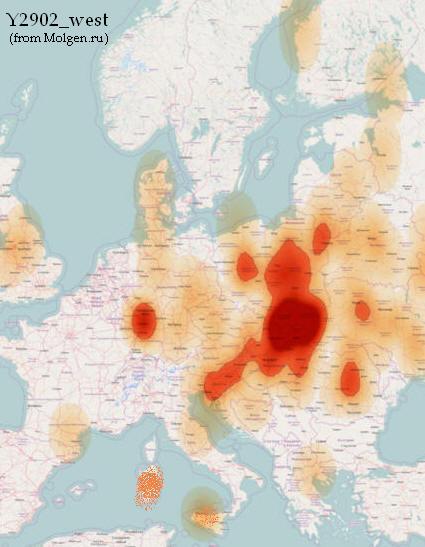


My deep clade is R-FGC10360 and this website(https://phylogeographer.com/) showed me the story of this subclade in Europe. This subclade correlates with celtic and later with germanic tribes(Przeworsk, Oksywie and Wielbark cultures) View attachment 11681
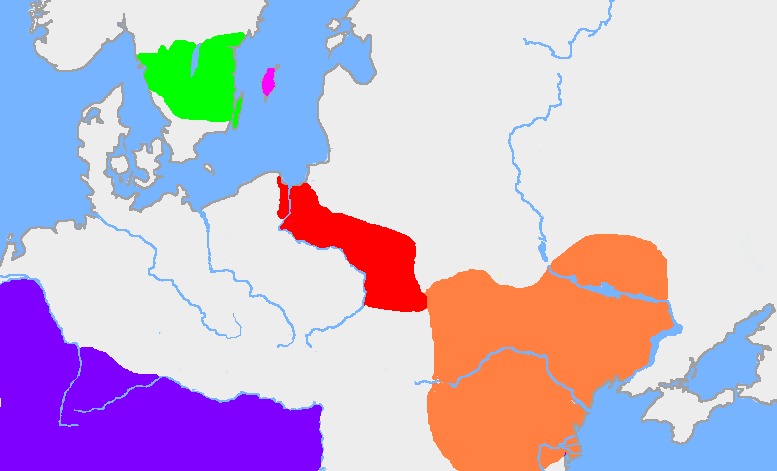
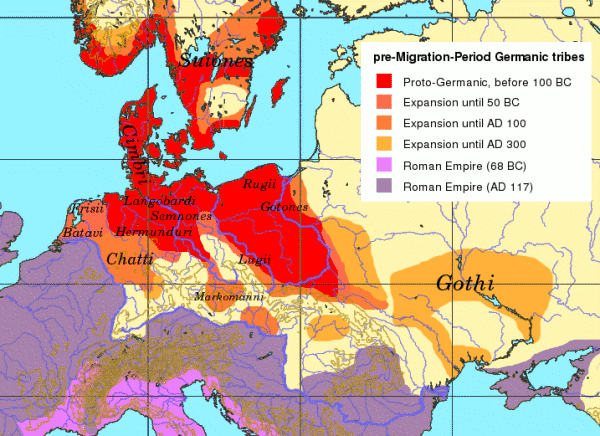
Oksywie culture chronologically and geographically coincides (according to Tacitus) with Gothic tribes of the Germanics (ancient Burgundians, vandals, Goths). Some researchers consider Rugiians as a part of oksywie culture(source: Пачкова С. П. ?Про оксивський компонент у Чаплинському могільнику зарубинецькоi культури? // Древности I тыс. н. э. на территории Украины.? Киев.?2003)
Oksywie culture chronologically and geographically coincides (according to Tacitus) with Gothic tribes of the Germanics (ancient Burgundians, vandals, Goths). Some researchers consider Rugiians as a part of oksywie culture(source: Пачкова С. П. ?Про оксивський компонент у Чаплинському могільнику зарубинецькоi культури? // Древности I тыс. н. э. на территории Украины.? Киев.?2003)


spruithean
Regular Member
- Messages
- 434
- Reaction score
- 118
- Points
- 43
I am really doubtful that E-V13 was so high among Eastern Germanics.
After their presence in Eastern Europe and Southeastern Europe? I would expect it. Especially Visigoths, Ostrogoths and Gepids spent time in these locations and would have absorbed E-V13 lineages and spread it further.
mihaitzateo
Regular Member
- Messages
- 942
- Reaction score
- 98
- Points
- 0
- Location
- Bucharest
- Ethnic group
- Romanian
- Y-DNA haplogroup
- proly R1B
Early Germanic people were related in the first place by the same mother tongue, in the second place, by being members of the same group of tribes which was expressed by close cultural/lifestyle things.
I have seen the Y DNA from most Germany on the FB group and I think that assuming "West Germanic people carried mostly I1 and R1B-U106" is not entirely correct.
Most areas of Germany do not have significant I1.
All areas of Germany have R1B-U106,raising to even 29% in Lower Saxony.
In Lower Saxony I1 is 28% and I2B is 10%.There is also I2A, at 3%.
East Frisia got 24% I1, and 14% I2B.Other areas of Germany, do not have over 20% I1 .
East Pomerania, where Goths should have been, sometimes, have 21% R1A-Z280 and 7% R1B-U106. More strange results for East Pomerania, R1B-DF27 - 10%, R1B-L21 - 10%.I2a- 6%. R1A makes most paternal lines in East Pomerania, 35%.
In regards to East Germanic people, no one can say for sure what Y DNA the Goths had. In Spain, where more Goths settled, there is a higher concentration of R1A. In Romania, where should be plenty of Y DNA that remained from Goths, no one bothered to do Y DNA testing.
To come back to the first part of the post:
I doubt that the migration of West Germanic people was a fast one.
If for example West Germanic people acquired some land near and assimilated locals, the Y DNA was changing.
The assimilated locals become West Germanic also. Now, the West Germanic tribe which consisted of the original people and the assimilated locals move to take under their rule a new land. And so forth.
Is quite clear from the East Germanic and West Germanic languages that the males of the acquired lands were not replaced.
So this is how the Y DNA of West Germanic and East Germanic people seems to have been quite diverse.
For example, in Prussia there is 24% N1 Y DNA.
Since the Ancient Prussians, which were BaltoSlavic, were assimilated, not exterminated.
Another observation, most Germany has some I2B and most Germany has some I2A, even few.
I2B seems to be a marker of West Germanic people and of Gothic people, but at low percentages.
EDIT:Sorry, East Pomerania belongs to Poland now and East Prussia, to Poland, Russia,Lithuania.
EDIT2: The Y DNA data is from the time when East Pomerania and East Prussia were part of Germany and are obtained from the DNA of the people that had male ancestors Germans from East Pomerania , East Prussia.
This is how it seems.
I have seen the Y DNA from most Germany on the FB group and I think that assuming "West Germanic people carried mostly I1 and R1B-U106" is not entirely correct.
Most areas of Germany do not have significant I1.
All areas of Germany have R1B-U106,raising to even 29% in Lower Saxony.
In Lower Saxony I1 is 28% and I2B is 10%.There is also I2A, at 3%.
East Frisia got 24% I1, and 14% I2B.Other areas of Germany, do not have over 20% I1 .
East Pomerania, where Goths should have been, sometimes, have 21% R1A-Z280 and 7% R1B-U106. More strange results for East Pomerania, R1B-DF27 - 10%, R1B-L21 - 10%.I2a- 6%. R1A makes most paternal lines in East Pomerania, 35%.
In regards to East Germanic people, no one can say for sure what Y DNA the Goths had. In Spain, where more Goths settled, there is a higher concentration of R1A. In Romania, where should be plenty of Y DNA that remained from Goths, no one bothered to do Y DNA testing.
To come back to the first part of the post:
I doubt that the migration of West Germanic people was a fast one.
If for example West Germanic people acquired some land near and assimilated locals, the Y DNA was changing.
The assimilated locals become West Germanic also. Now, the West Germanic tribe which consisted of the original people and the assimilated locals move to take under their rule a new land. And so forth.
Is quite clear from the East Germanic and West Germanic languages that the males of the acquired lands were not replaced.
So this is how the Y DNA of West Germanic and East Germanic people seems to have been quite diverse.
For example, in Prussia there is 24% N1 Y DNA.
Since the Ancient Prussians, which were BaltoSlavic, were assimilated, not exterminated.
Another observation, most Germany has some I2B and most Germany has some I2A, even few.
I2B seems to be a marker of West Germanic people and of Gothic people, but at low percentages.
EDIT:Sorry, East Pomerania belongs to Poland now and East Prussia, to Poland, Russia,Lithuania.
EDIT2: The Y DNA data is from the time when East Pomerania and East Prussia were part of Germany and are obtained from the DNA of the people that had male ancestors Germans from East Pomerania , East Prussia.
This is how it seems.
Last edited:
Gilgamesh
Regular Member
- Messages
- 63
- Reaction score
- 19
- Points
- 8
- Location
- CANADA
- Ethnic group
- North African/North East Slavic
- Y-DNA haplogroup
- E-FT420968
- mtDNA haplogroup
- T2f1b1
Hello, Your subclade looks like Slavic (Russian,Polish,...) and Uralic (Hungarian,Bachkir,Tatar...) subclade : TMRCA (2500 years) : https://www.yfull.com/tree/R-Y3226/My deep clade is R-FGC10360 and this website(https://phylogeographer.com/) showed me the story of this subclade in Europe. This subclade correlates with celtic and later with germanic tribes(Przeworsk, Oksywie and Wielbark cultures) View attachment 11681
Oksywie culture chronologically and geographically coincides (according to Tacitus) with Gothic tribes of the Germanics (ancient Burgundians, vandals, Goths). Some researchers consider Rugiians as a part of oksywie culture(source: Пачкова С. П. �Про оксивський компонент у Чаплинському могільнику зарубинецькоi культури� // Древности I тыс. н. э. на территории Украины.� Киев.�2003)
Robin64
Junior Member
- Messages
- 2
- Reaction score
- 1
- Points
- 0
- Y-DNA haplogroup
- Y65803
- mtDNA haplogroup
- T1a1b3
I1-Y11221 (TMRCA 3000 ybp) should not be here as one (see above).
According to the latest findings, it consists of two separate groups - F3312 and BY46317 (also Y186709 and BY65803).
F3312 is purely Scandinavian, while BY46317 is East German (Goths). Most likely it is the Gepids subclade, because the largest concentration is in Hungary and northwestern Romania, which were part of the Kingdom of Gepids. After the defeat of Gepids by Avar, part of Gepids moved to Italy with Lombardy and it is a reason why subclade occurs also here.
According to the latest findings, it consists of two separate groups - F3312 and BY46317 (also Y186709 and BY65803).
F3312 is purely Scandinavian, while BY46317 is East German (Goths). Most likely it is the Gepids subclade, because the largest concentration is in Hungary and northwestern Romania, which were part of the Kingdom of Gepids. After the defeat of Gepids by Avar, part of Gepids moved to Italy with Lombardy and it is a reason why subclade occurs also here.
TetaEglantina
Regular Member
- Messages
- 822
- Reaction score
- 139
- Points
- 43
- Y-DNA haplogroup
- i2a WHG
What makes you think east germanics carried so much r1a as opposed to i2a-din which sometimes has a stronger presence in south/centeal europe?

Dibran
Regular Member
- Messages
- 1,135
- Reaction score
- 323
- Points
- 83
- Ethnic group
- Albanian/Gheg/Dibran/Okshtun
- Y-DNA haplogroup
- R-L1029>Y133379
- mtDNA haplogroup
- H11a2b*
What makes you think east germanics carried so much r1a as opposed to i2a-din which sometimes has a stronger presence in south/centeal europe?
Whether they carried either is up for debate. Looking purely based on distribution and subclades, there are a larger number of Central Europeans belonging to R1a than to I-Y3120. South Europe isn't really a factor because East Germanic impact, at least in the Balkans was likely negligible in comparison to Slavic impact which is clearly represented by I-Y3120 and to some extent most R1a as well.
In the case of R1a as well, including typical Slavic branches are even found on the British Isles, in Scots and Irish. There's even R-L1029 found in Spain and Portugal and as far as I know there's literally no Y1320 In these groups that far West or North West.
Y3120 can't possibly be Dacian, East Germanic all at once.
Maybe some singletons were present same as some for R1a. But overall both were predominantly entrenched in the Slavic expansion.
Trying to remove Y3120 from having a connection to Slavs makes little sense.
TetaEglantina
Regular Member
- Messages
- 822
- Reaction score
- 139
- Points
- 43
- Y-DNA haplogroup
- i2a WHG
Whether they carried either is up for debate. Looking purely based on distribution and subclades, there are a larger number of Central Europeans belonging to R1a than to I-Y3120. South Europe isn't really a factor because East Germanic impact, at least in the Balkans was likely negligible in comparison to Slavic impact which is clearly represented by I-Y3120 and to some extent most R1a as well.
In the case of R1a as well, including typical Slavic branches are even found on the British Isles, in Scots and Irish. There's even R-L1029 found in Spain and Portugal and as far as I know there's literally no Y1320 In these groups that far West or North West.
Y3120 can't possibly be Dacian, East Germanic all at once.
Maybe some singletons were present same as some for R1a. But overall both were predominantly entrenched in the Slavic expansion.
Trying to remove Y3120 from having a connection to Slavs makes little sense.
I am not removing i2a-din from a slavic expansion connection, however i2a has been in europe for 20 thousand years whilst slavs only recently moved out of the "steppe". Proto slavs did not carry i2a, they picked it up in central/south europe
I2a having such long history in europe means not only possibly it could have been part of east germanic and dacian tribes but it could have been part of MORE tribes than even this. That is the point I am making, it is ridiculous to pin i2a-din to proto slavs. I2 has little/no history with ancient russia - look here at some old i2a samples with plenty in central/south europe (lengyel/koros etc) meanwhile with r1a all you get is steppe/russia/kazakhstan -
https://indo-european.eu/wp-content/uploads/2021/04/ftdna-y-snp-shotgun.png
This is a very nice tool - https://camayal.info/wa/treetom/?id=MHYKfqsRKHMEIOlddPdc