• Don't want to see ads? Install an adblocker like uBlock Origin or use a Europe-based privacy-friendly browser like Vivaldi or Mullvad.

Why I Can’t Stay Silent: The Narrative Around Ancient Civilizations Is Upside Down

In 1956 there was a film released starring John Wayne as Genghis Khan. Very bizarre choice. This was old Hollywood where the star was cast to attract ticket sales.
Same occurs in the movie Cleopatra from 1963. Bizarre were the ancient Egyptians portrayed in this film starry by Elizabeth Taylor and Richard Burton.
 
Last edited:
Pan-Africanism is rampant on YouTube. There's no point in arguing because you'll be massacred. Africa is treated by Afrocentrists as the black continent and Mother Africa is basically Nagô, Yoruba and Bantu, in the sense that they are all ethnically Niger-Congolese. The cultural appropriation of ancient Egypt as a nation of blacks (or sub-Saharan) relies is based on the Eurocentric view, adopted by them, that Europeans = White, Africans = Black, Asians = Yellow and Native Americans = Copper or red. For example, people who have nothing to do with sub-Saharan Africans, such as Negritos, Andamanese, Papuans, Australian Aborigines and Melanesians, were and still are considered black, leading to the false impression that they have recent African ancestry when their relationship with Africa goes back more than 60,000 years, just like that of Europeans.
Other posters have mentioned this Afrocentric phenomenon is more of an African American thing. I'd agree with that. I've witnessed it. I encountered an African American woman named after an Egyptian queen. Out of respect, I'm not going to mention her name. I've seen one man in particular wearing a mock ancient Egyptian necklace out in public as well.
Unfortunately, I feel like some of it is a loss of identity due to the transatlantic slave trade. But nowadays there is no excuse. One can take a DNA ancestry test to find out clues. There is plenty of study by them to be done within Sub Saharan Africa. African Americans can study various tribes like the Dogon, Yoruba, Masai, Hadza, Dinka, various tribes in Cameroon and the Bantu expansion.
 
Other posters have mentioned this Afrocentric phenomenon is more of an African American thing. I'd agree with that. I've witnessed it. I encountered an African American woman named after an Egyptian queen. Out of respect, I'm not going to mention her name. I've seen one man in particular wearing a mock ancient Egyptian necklace out in public as well.
Unfortunately, I feel like some of it is a loss of identity due to the transatlantic slave trade. But nowadays there is no excuse. One can take a DNA ancestry test to find out clues. There is plenty of study by them to be done within Sub Saharan Africa. African Americans can study various tribes like the Dogon, Yoruba, Masai, Hadza, Dinka, various tribes in Cameroon and the Bantu expansion.
I completely agree. This fixation on the Egyptians causes African-Americans to deny their own cultural and ethnic origins. The enslaved people brought to the Americas were mostly Niger-Congo, mainly Yoruba and Bantu from the southwest. The Bantu expansion occurred in several waves, the first of which was approximately 4,000 years ago. They initially expanded into Central Africa, reaching the east of the continent and finally reaching the South where they mixed up extensively with the Khoisan. Nelson Mandela is a great exponent of the Bantu/San ancestry. The Bantu expansion in Africa can be considered as epic as that of the Yamnaya in Eurasia. Egyptian society developed far from this reality. It is a totally exotic culture, foreign and very distant from the Bantu and West Africans in general. To better understand their own ethno-cultural origins, rather than fixating on the empty rhetoric of Afrocentrists, African-Americans should read works such as Alex Haley's book Roots: The Saga of an American Family and watch the award-winning 1977 American television series Roots, based on the book. The series eventually spawned a 1979 sequel (Roots: The Next Generations) and a Christmas special (Roots: The Gift). The Mandinka language and culture are much closer to modern African-Americans than the exotic and far away culture and history of ancient Egypt.
 
Last edited:
I completely agree. This fixation on the Egyptians causes African-Americans to deny their own cultural and ethnic origins. The enslaved people brought to the Americas were mostly Niger-Congo, mainly Yoruba and Bantu from the southwest. The Bantu expansion occurred in several waves, the first of which was approximately 4,000 years ago. They initially expanded into Central Africa, reaching the east of the continent and finally reaching the South where they mixed up extensively with the Khoisan. Nelson Mandela is a great exponent of the Bantu/San ancestry. The Bantu expansion in Africa can be considered as epic as that of the Yamnaya in Eurasia. Egyptian society developed far from this reality. It is a totally exotic culture, foreign and very distant from the Bantu and West Africans in general. To better understand their own ethno-cultural origins, rather than fixating on the empty rhetoric of Afrocentrists, African-Americans should read works such as Alex Haley's book Roots: The Saga of an American Family and watch the award-winning 1977 American television series Roots, based on the book. The series eventually spawned a 1979 sequel (Roots: The Next Generations) and a Christmas special (Roots: The Gift). The Mandinka language and culture are much closer to modern African-Americans than the exotic and far away culture and history of ancient Egypt.
To add further to this discussion, dealing with the genetics of North Africa, I'd like to shout out Tautalus' thread about the study that recently came out about some Takarkori samples from Libya ~5000 BC: https://www.eupedia.com/forum/threa...tral-north-african-lineage.45670/#post-687991

This paper complemented the 2018 study Van de Loosdrecht et al which studied the ancestry of the Iberomaurusians. The authors of the 2018 paper theorized that the ~36% SSA admixture in Iberomaurusians was actually from a distinct indigenous North African population rather than a Sub Saharan one. This new study mentioned by Tautalus models the Tafaralt Iberomaurusians as 60% Natufian/Natufian like and 40% Takarkori.
The Takarkori population itself was modeled as being 93% Native North African and 7% ancient Levantine.

Edit:
Yes, I need to look more closely into the specifics of the Bantu expansion and the broader genetic history of Sub-Saharan Africa. I'm particularly interested in whether the Sub-Saharan African (SSA) ancestry in East Africa is related to that of Central and West Africa. More specifically, I'm referring to the SSA component that existed in East Africa before the back-migration of West Eurasian ancestry into the Horn and surrounding regions.

 
Last edited:
To add further to this discussion, dealing with the genetics of North Africa, I'd like to shout out Tautalus' thread about the study that recently came out about some Takarkori samples from Libya ~7000 BC: https://www.eupedia.com/forum/threa...tral-north-african-lineage.45670/#post-687991

This paper complemented the 2018 study Van de Loosdrecht et al which studied the ancestry of the Iberomaurusians. The authors of the 2018 paper theorized that the ~36% SSA admixture in Iberomaurusians was actually from a distinct indigenous North African population rather than a Sub Saharan one. This new study mentioned by Tautalus models the Tafaralt Iberomaurusians as 60% Natufian/Natufian like and 40% Takarkori.
The Takarkori population itself was modeled as being 93% Native North African and 7% ancient Levantine.

Edit:
Yes, I need to look more closely into the specifics of the Bantu expansion and the broader genetic history of Sub-Saharan Africa. I'm particularly interested in whether the Sub-Saharan African (SSA) ancestry in East Africa is related to that of Central and West Africa. More specifically, I'm referring to the SSA component that existed in East Africa before the back-migration of West Eurasian ancestry into the Horn and surrounding regions.
We can extract from Van de Loosdrecht et al paper pointed by you interesting elements such as:
1. Present-day North Africans share a majority of their ancestry with present-day Near Easterners, but not with sub-Saharan Africans.
2. The Taforalt individuals derive one-third of their ancestry from sub-Saharan Africans, best approximated by a mixture of genetic components preserved in present-day West and East Africans.
3. None of the present-day or ancient Holocene African groups are a good proxy for the sub-Saharan genetic component.

Certainly the article highlighted by you and brought to light in this forum by Tautalus indicates that the Takarkori population represents a much better proxy for the non-Natufian component of Taforalt population than a mixture of archaic genetic components that supposedly would have remained preserved in present-day West and East Africans used as a proxy by Van de Loosdrecht et al.
 
We can extract from Van de Loosdrecht et al paper pointed by you interesting elements such as:
1. Present-day North Africans share a majority of their ancestry with present-day Near Easterners, but not with sub-Saharan Africans.
2. The Taforalt individuals derive one-third of their ancestry from sub-Saharan Africans, best approximated by a mixture of genetic components preserved in present-day West and East Africans.
3. None of the present-day or ancient Holocene African groups are a good proxy for the sub-Saharan genetic component.

Certainly the article highlighted by you and brought to light in this forum by Tautalus indicates that the Takarkori population represents a much better proxy for the non-Natufian component of Taforalt population than a mixture of archaic genetic components that supposedly would have remained preserved in present-day West and East Africans used as a proxy by Van de Loosdrecht et al.
Yes and to my understanding this population that makes up 93% Takarkori are called Ancient North Africans (ANA).

Edit: Based on the findings of the paper, ANA appear to be more closely related to Out of Africa (OoA) populations, including early West Eurasians than to Sub-Saharan Africans (SSAs).
 
Last edited:
Yes and to my understanding this population that makes up 93% Takarkori are called Ancient North Africans (ANA).

Edit: Based on the findings of the paper, ANA appear to be more closely related to Out of Africa (OoA) populations, including early West Eurasians than to Sub-Saharan Africans (SSAs).
I understand it the same way you do. Ethnically, 93% of Takarkori are ANA and the ANA are different from Sub-Saharan Africans, being closer to Out of Africa (OoA) populations - including early West Eurasians - than to Sub-Saharan Africans (SSAs)
 
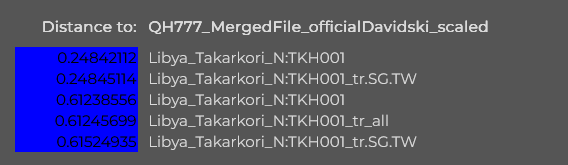
This is a brief aside. Which one of these is correct? The first two?
1744605036869.png
 
Back
Top