• Don't want to see ads? Install an adblocker like uBlock Origin or use a Europe-based privacy-friendly browser like Vivaldi or Mullvad.

Ethnic breakdown of Y-DNA in Europe

Tomenable

Well-known member
Messages
5,991
Reaction score
1,714
Points
113
Location
Poland
Ethnic group
Polish
Y-DNA haplogroup
R1b-L617
mtDNA haplogroup
W6a
Check my ethnic breakdown of Y-DNA haplogroups in Europe:


I assigned haplogroups to ethnic groups in the following way:

Mesolithic: In Western Europe I2a & I2b; in Eastern & Central Europe only I2b.*
South European:
G, J2, J1, E, T, H, L, F, R2, R1b-PF7562, R1b-Z2103, R1b-V88, etc.
Celtic-Italic-Beaker: R1b-P312 (except for R1b-L238), R1b-PF7589, R1b-S1194, etc.
Germanic: I1-M253, R1b-U106, R1b-L238, Q and also R1a in Western Europe.
Balto-Slavic: Haplogroups R1a and I2a in Eastern Europe and Central Europe.
Uralic-Baltic: Haplogroup N.

I used data about R1b subclades collected by MitchellSince1893 on Anthrogenica (and his source was the FTDNA Haplotree):

For several countries he did not publish data about R1b subclades, so I assumed frequenciies like in neighbouring countries:

Iceland - I assumed frequencies of subclades like in Norway
Moldova - I assumed frequencies of subclades like in Romania
North Macedonia - I assumed frequencies of subclades like in Bulgaria
Kosovo - I assumed frequencies of subclades like in Albania
Montenegro - I assumed frequencies of subclades like in Serbia
Croatia - I assumed frequencies of subclades like in Serbia
Bosnia - I assumed frequencies of subclades like in Serbia
Kashubians - I assumed frequencies of subclades like in Poland

=====

When it comes to overall frequencies of haplogroups, for most countries I used Eupedia:


For some Slavic countries I used frequencies which I collected from various studies here:


For Sardinians I used the data about haplogroups from the Francalacci et al. 2013 study.

=====

*Actually current designations are I2a1 and I2a2 (instead of I2a and I2b) if I'm not mistaken.
 
Last edited:
Populations with majority or plurality of Mesolithic haplogrouos:

None (but Sardinians are close)

Populations with majority or plurality of South European haplogroups:

Kosovar
Albanian
Greek
Bulgarian
Italian
Macedonian
Sardinian
Montenegrin
Austrian (but they have only 29% of such haplogroups)

Populations with majority or plurality of Celtic-Italic-Beaker haplogroups:

Irish
Welsh
Spanish
Scottish
Portuguese
French
Swiss

Populations with majority or plurality of Germanic haplogroups:

Icelandic
Norwegian
Swedish
Danish
Dutch
English
Belgian
German

Populations with majority or plurality of Balto-Slavic haplogroups:

Belarusian
Kashubian
Ukrainian
Polish
Croatian
Bosnian
Slovenian
Russian
Slovak
Serbian
Moldovan
Hungarian
Lithuanian
Romanian
Czech
Latvian
Estonian

Populations with majority or plurality of Uralic-Baltic haplogroups:

Finnish
 
It is interesting that Scotland has quite a lot of Germanic Y lineages:

- 9% of I1 (according to Eupedia)
- 8.5% of R1a (according to Eupedia)
- 0.5% of Q (according to Eupedia)
- 12% of Germanic R1b (ca. 16.83% out of 72.5% of R1b in total*)

*72.5% of R1b according to Eupedia, and Germanic subclades are U106 (16.55% of Scottish R1b) and L238 (0.28%).

In total 30% of Germanic Y-DNA. Is this figure correct in your opinion?
 
Map based on the data from my Google spreadsheet:

LINK

LyaOW1f.png
 
Last edited:
Does "plurality" mean relative majority but less than 50%?

Also, the Italian population is unevenly distributed among the North, Center, and South: 46.3% of the inhabitants reside in Northern Italy, 19.8% in Central Italy, and the remaining 33.8% in the South and on the Islands. Does the Italian average reflect this, as the difference of Y-DNA frequencies between the different areas is greater than in any other European country?
 
Last edited:
Does "plurality" mean relative majority but less than 50%?

Yes, exactly!

Also, the Italian population is unevenly distributed among the North, Center, and South: 46.3% of the inhabitants reside in Northern Italy, 19.8% in Central Italy, and the remaining 33.8% in the South and on the Islands. Does the Italian average reflect this, as the difference of Y-DNA frequencies between the different areas is greater than in any other European country?

You would need to ask Maciamo how he calculated average haplogroup frequencies for Italy.

I used his frequencies for Italy as a whole from this link:

 
Mesolithic: In Western Europe I2a & I2b; in Eastern & Central Europe only I2b.*

*
Actually current designations are I2a1 and I2a2 (instead of I2a and I2b) if I'm not mistaken.
You got it reversed.
I2a2 is from the West during the Mesolithic and the Chalcolithic.
I2a1 is the ancestor of I2a1b from the Balkans.
 
You got it reversed.
I2a2 is from the West during the Mesolithic and the Chalcolithic.
I2a1 is the ancestor of I2a1b from the Balkans.

Yes that's exactly what I wrote, I didn't get it reversed.
 
It is interesting that in Belgium Germanic Y-DNA is a bit more numerous than Celtic Y-DNA.

In terms of auDNA it is the opposite - Germanic and Gallic admixtures in northern Belgium:


KgoM3KW.png
 
Last edited:
It would make more sense to put Austria in the Balto-Slavic camp rather than "South European", a somewhat problematic category. If we're to trust Maciamo's chart, Austria still has a relative majority of Germanic haplogroups (R1b and I1). I'm taking issue with the classification of haplogroup G as "South European." As far as Europe is concerned, this HG is mostly found in the Alpine region and it's no surprise that its presence in Austria is highest in Tyrol. We know G was once much more widespread across Europe, unlike those other "South European" haplogroups.
 
^^^
Not all of R1b in Austria is Germanic, I divided R1b into subclades and assigned each subclade to an ethnic group.
 
Mesolithic: In Western Europe I2a & I2b; in Eastern & Central Europe only I2b.*
South European:
G, J2, J1, E, T, H, L, F, R2, R1b-PF7562, R1b-Z2103, R1b-V88, etc.
Celtic-Italic-Beaker: R1b-P312 (except for R1b-L238), R1b-PF7589, R1b-S1194, etc.
Germanic: I1-M253, R1b-U106, R1b-L238, Q and also R1a in Western Europe.
Balto-Slavic: Haplogroups R1a and I2a in Eastern Europe and Central Europe.
Uralic-Baltic: Haplogroup N.
But Q is not Germanic and R1b-Z2103 is not Southern European
 
Does "plurality" mean relative majority but less than 50%?

Also, the Italian population is unevenly distributed among the North, Center, and South: 46.3% of the inhabitants reside in Northern Italy, 19.8% in Central Italy, and the remaining 33.8% in the South and on the Islands. Does the Italian average reflect this, as the difference of Y-DNA frequencies between the different areas is greater than in any other European country?
After a brief check on those frequencies North Italy and Tuscany are majority Italic-celtic beaker indeed .
 
Last edited:
But Q is not Germanic and R1b-Z2103 is not Southern European

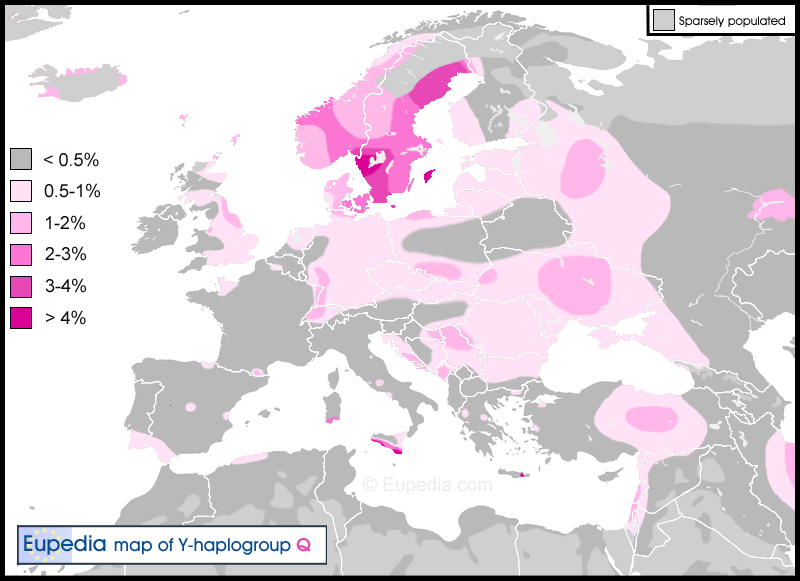
Q in Europe is strongly correlated with Germanic areas:


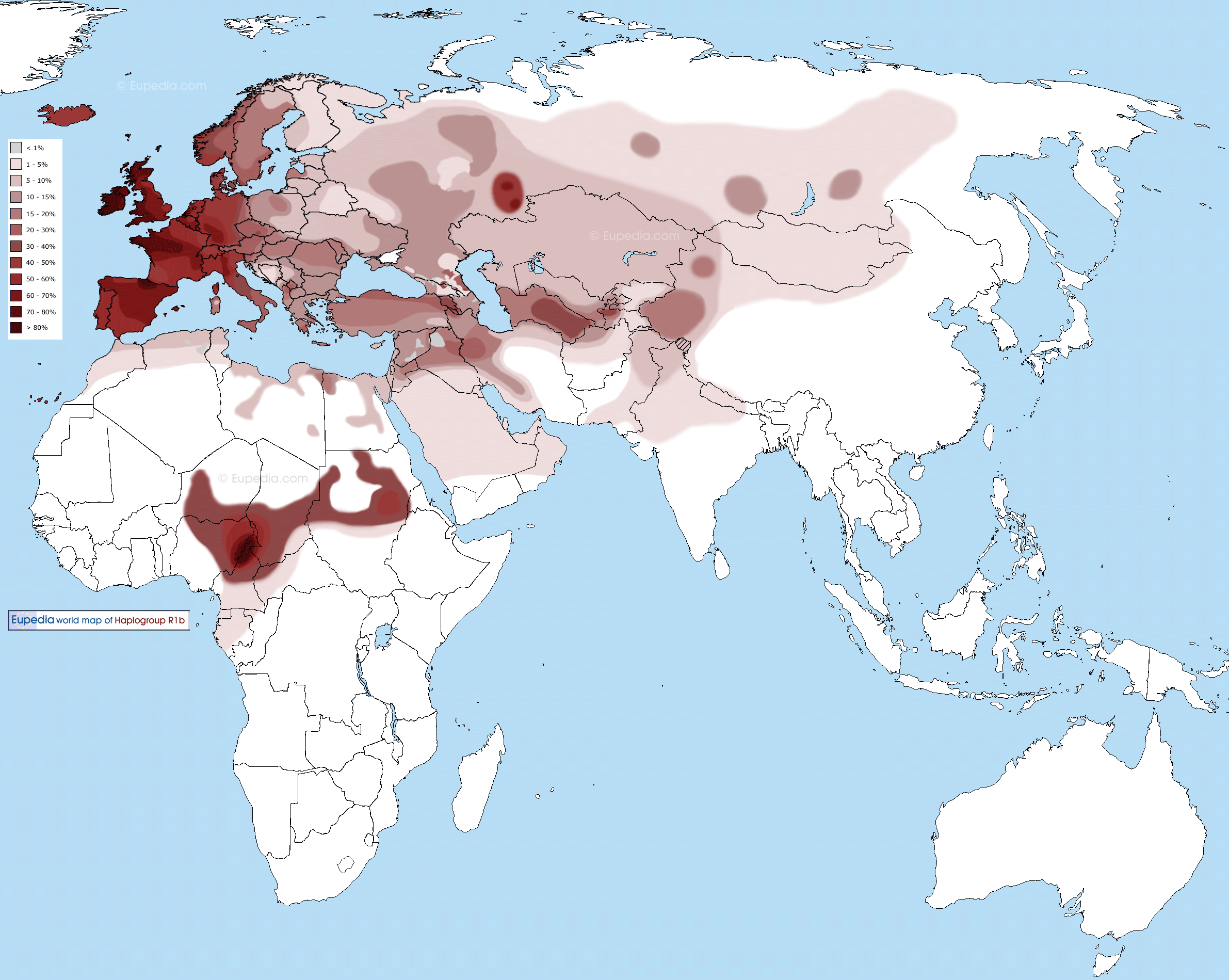
And R1b-Z2103 in Europe is also mostly South European:

 
Q in Europe is strongly correlated with Germanic areas:


And R1b-Z2103 in Europe is also mostly South European:

Scandinavia has some Q due to ancient mixture of Steppe Ancestry (probably WSH) which was already mixed with East Asians, and thus they carried it over. But Q was not spread by Germanics nor Scandinavians.
Many haplogroup Q Europeans outside of Scandinavia are either more recent Steppe Ancestry (starting with Huns), or Jewish (which also got it likely from mixing with ppl on the Steppe).

R1b-Z2103 is also indigenous in the Volga-Ural Region, where Tatars and Bashkirs live. Calling them "Southern Europeans" is just as wrong as calling ppl with Hunnic ancestry "Germanic".

Flawed and bad approach, pretty misleading.
 
Scandinavia has some Q due to ancient mixture of Steppe Ancestry (probably WSH) which was already mixed with East Asians, and thus they carried it over. But Q was not spread by Germanics nor Scandinavians.
Many haplogroup Q Europeans outside of Scandinavia are either more recent Steppe Ancestry (starting with Huns), or Jewish (which also got it likely from mixing with ppl on the Steppe).

R1b-Z2103 is also indigenous in the Volga-Ural Region, where Tatars and Bashkirs live. Calling them "Southern Europeans" is just as wrong as calling ppl with Hunnic ancestry "Germanic".

Flawed and bad approach, pretty misleading.

What you're saying here is rather flawed and misleading. First of all, let's start with your definition of "steppe ancestry." The Western Steppe Herders were a population from the Calcolithic. The Eurasian steppe was populated by West Eurasians at the time. The WSH were not "mixed with East Asians" nor is haplogroup Q East Asian. Its origins are associated with the Ancient North Eurasians just like R. It's just that the majority of Q spread eastwards where it gradually mixed with East Eurasians. Later "steppe" people like the Huns, Avars etc. are invaders from East/Central Asia and obviously to be distinguished from people that populated the steppe in the Calcolithic and Bronze Age.

If R1b-Z2103 is indigenous to the Volga-Ural region, it is because of the WSHs who were there thousands of years before the Tatars and Bashkirs or any other Turkic people. If that haplogroup is present among them, it is because they inherited it from the WSH/Indo-Europeans just as various Turkic peoples of Central Asia like the Kyrgyz inherited the Indo-Iranian haplogroup R1a-Z93, obviously from the Scythians.

Haplgroup Q among Scandinavians is not tied to Huns. It's much older than that.
 
Last edited:
What you're saying here is rather flawed and misleading. First of all, let's start with your definition of "steppe ancestry." The Western Steppe Herders were a population from the Calcolithic. The Eurasian steppe was populated by West Eurasians at the time. The WSH were not "mixed with East Asians" not is haplogroup Q East Asian. Its origins are associated with the Ancient North Eurasians just like R. It's just that the majority of Q spread eastwards where it gradually mixed with East Eurasians. Later "steppe" people like the Huns, Avars etc. are invaders from East/Central Asia and obviously to be distinguished from people that populated the steppe in the Calcolithic and Bronze Age.

If R1b-Z2103 is indigenous to the Volga-Ural region, it is because of the WSHs who were there thousands of years before the Tatars and Bashkirs or any other Turkic people. If that haplogroup is present among them, it is because they inherited it from the WSH/Indo-Europeans just as various Turkic peoples of Central Asia like the Kyrgyz inherited the Indo-Iranian haplogroup R1a-Z93, obviously from the Scythians.

Haplgroup Q among Scandinavians is not tied to Huns. It's much older than that.
Nothing I said is misleading or disproven by what you said.

Q in Scandinavians have nothing to do with the Huns? Correct, that's what I said. But I added, that many Eastern Europeans who have haplo Q has literally nothing to do with Germanics.

Tatars and Bashkirs (who are assimilated locals who got Turkified) got R1b-Z2103 from the Yamnaya ppl? Yes, won't make them *South* Europeans...

And I made a clear distinction between ancient steppe ancestry (WSH) and old/modern (starting from the Huns at least).

Tldr: Q is not Germanic. R1b-Z2103 is not South European.
 
Nothing I said is misleading or disproven by what you said.

Q in Scandinavians have nothing to do with the Huns? Correct, that's what I said. But I added, that many Eastern Europeans who have haplo Q has literally nothing to do with Germanics.

Tatars and Bashkirs (who are assimilated locals who got Turkified) got R1b-Z2103 from the Yamnaya ppl? Yes, won't make them *South* Europeans...

And I made a clear distinction between ancient steppe ancestry (WSH) and old/modern (starting from the Huns at least).

Tldr: Q is not Germanic. R1b-Z2103 is not South European.

I understand you better now. I take issue with some of the OP's classifications myself and agree that R1b-Z2103 is South European, nor is G for that matter. R1b-Z2013 is a Yamnaya haplogroup, later mostly associated with "Balkan Indo-Europeans." You might as well claim that R1b-U152 is South European. I also agree that Q isn't Germanic per se. It goes way back to the Ancient North Eurasians, who were an archaic Caucasoid people populating much of Siberia. Q has been found in "trace amounts" among WSH and this is the source of this haplogroup among Scandinavians and other Europeans. But it is not an East Asian haplogroup nor where the WSH mixed with East Asians. There were no East Asians anywhere near the Eurasian steppe during the Calcolithic. Genetically the WSH were not too dissimilar to the WHG. Their mtDNA was practically the same as that of WHG. I have often come across claims that the WSH/Yamnaya arrived in Europe as invaders when in fact they have been in Eastern Europe all along. The connection between ANE, not to mention the EHG, with the WHG goes way back to the Paleolithic.
 
Back
Top