
• Don't want to see ads? Install an adblocker like uBlock Origin or use a Europe-based privacy-friendly browser like Vivaldi or Mullvad.

Should Argentina be banned from the World Cup?

Maciamo

Veteran member
Admin
Messages
10,674
Reaction score
4,597
Points
113
Location
Lothier
Ethnic group
Italo-celto-germanic
Do you think that Argentina should be banned from the World Cup?

That banner breaks several FIFA regulations: political neutrality, discrimination, stadium code of conduct, equipment regulations.
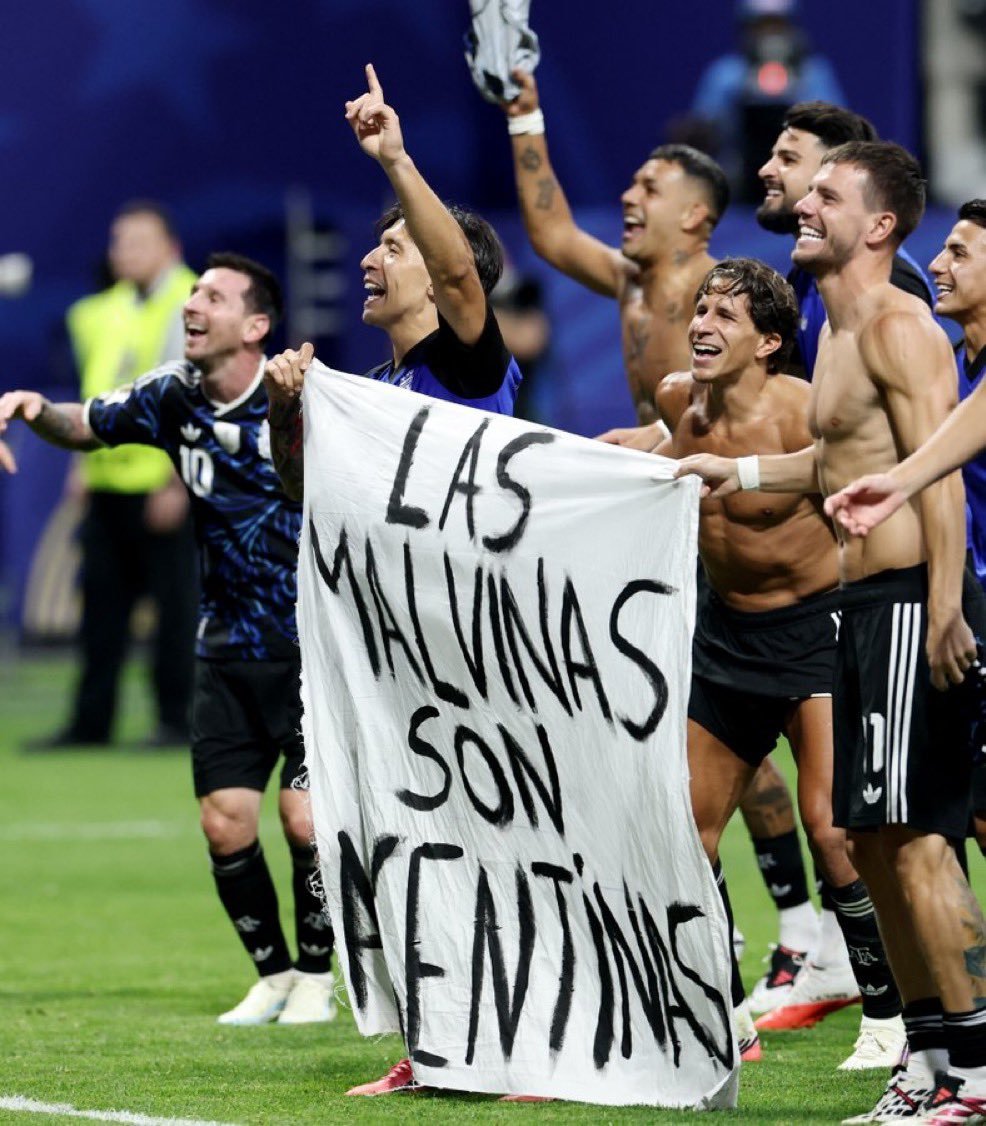
1784278884807.jpeg


What's more, it's pure nationalist propaganda without any historical basis. The Falklands were discovered by the English and never belonged once to Argentina. France briefly colonised one of the islands of the archipelago in 1764 (East Falkland), which it ceded to Spain in 1767. Spain lost that lone island to Britain four years later. Argentina became independent from Spain in 1816.
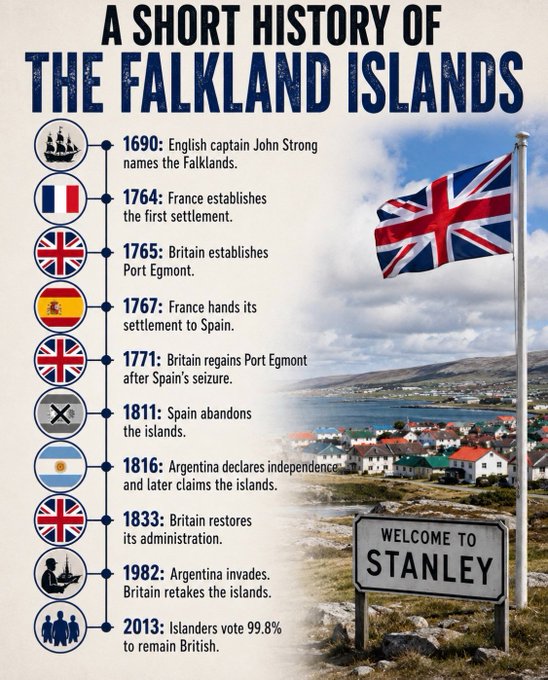
1784278793604.jpeg


When a South Korean player held up a political sign about his country's territorial dispute with Japan at the 2012 Olympics, FIFA decided to suspend him for two matches.

1784278928965.png


French players were not even allowed by FIFA to wear a black armband as a sign of respect for their manager Didier Deschamp’s mum dying.

Argentine players have just been brainwashed by Milei's nationalist propaganda and are doing his bidding on the world stage in front of billions of people. They are essentially promoting another war with the United Kingdom. They already declared war on the UK over the Falklands in 1982 without casus belli and lost that war.

It's no better than Trump claiming that Greenland should belong to the US. It's the same level of nonsense. Imagine the international reaction if the US team had brandished banners saying 'Greenland belongs to the United States'.

Football teams who use the World Cup as a stage to promote hatred and try to trigger wars should be banned from FIFA. I also think that each player should be held individually responsible and sued in front of an international court for their behaviour. An example needs to be set.

Argentina itself should be banned from the FIFA, which means this World Cup and all future World Cups, until they publicly apologise and promise never to behave in this manner again.
 
Last edited:
In December 2016, FIFA officially fined England, Wales, Scotland, and Northern Ireland 100,000 CHF (Swiss Francs). The penalties were issued after the teams displayed poppies to commemorate Armistice Day during World Cup qualifying matches played in November 2016.

FIFA justified the fines by stating that the poppy constituted a political symbol. Under Law 4 of FIFA's Equipment Regulations at the time, players were strictly prohibited from wearing equipment that featured any "political, religious or personal slogans, statements or images". England and Scotland players wore the poppy emblem on black armbands during their match against each other at Wembley Stadium on 11 November 2016. Wales and Northern Ireland were penalized for displaying poppies on the pitch and in the stands during their respective matches.

To put this in context, plenty of people wear puppies on Armistice Day in the UK. It's a national tradition. In this case, they were playing against each other inside the UK. All British people thought it was perfectly fine.
 
The real question to me is why do they even care of some rocks lost in the southern Atlantic inhabited by a handful of Britons who don't want to be Argentines.

By the way Spain did the same when they won the Euros in 2024 with chants about Gibraltar being Spanish...

If I were British I don't think I would be so offended anyway.
 
There are significant oil reserves in the waters of the Falkland Islands. Commercial exploration of the Sea Lion field, located 220 km north of the archipelago, is underway, with the first extraction scheduled for March 2028.
Peak production is estimated to reach 50,000 barrels per day by 2032. The project is being developed by the Israeli oil company Navitas Petroleum and the British firm Rockhopper. This multi-billion-dollar discovery has the potential to triple the islands' Gross Domestic Product (GDP) but has reignited long-standing geopolitical tensions, as Argentina views the exploration as a unilateral and illegitimate activity, given the country's claim to sovereignty over the archipelago.
 
There are significant oil reserves in the waters of the Falkland Islands. Commercial exploration of the Sea Lion field, located 220 km north of the archipelago, is underway, with the first extraction scheduled for March 2028.
Peak production is estimated to reach 50,000 barrels per day by 2032. The project is being developed by the Israeli oil company Navitas Petroleum and the British firm Rockhopper. This multi-billion-dollar discovery has the potential to triple the islands' Gross Domestic Product (GDP) but has reignited long-standing geopolitical tensions, as Argentina views the exploration as a unilateral and illegitimate activity, given the country's claim to sovereignty over the archipelago.

There are half a million sheep in the Falklands. Because the human population of the territory is only around 3,500 people, the Falklands boast one of the highest sheep-to-human ratios in the world. Sheep farming and fishing are the two main economic activities for the locals.

Obviously, President Milei doesn't care about sheep or fish. When a country is ready to invade a sparsely populated territory, even if it means war with a major power, it's usually about petrol or other mineral resources. The sad thing is that the Argentinian football players probably don't even realize that. They're just doing what they are told.
 
UEFA banned Spain players for Gibraltar chants after the Euros final - not even in the stadium but the next day in Madrid.

Apparently, FIFA is not going to do anything about Argentina's display about the Falklands. Not even a fine. Double standards.
 
UEFA banned Spain players for Gibraltar chants after the Euros final - not even in the stadium but the next day in Madrid.
I didn't know that. In fact you are right they banned two players for starting the chant (one of whom was Morata which was in fact a favour made to Spain j/k) for one international match.
 
In my opinion, there are three major problems with the Argentinian team displaying the banners, "The Falklands belong to Argentina".

1. The geopolitical context​


Only a few months ago, President Trump attempted to annex Greenland, which could have started a war with Europe and Canada. President Milei is not only a close friend of Donald Trump but was elected in great part thanks to Trump's support. Both share the same nationalist and fascist views.

Greenland and Falkland are remarkingly similar in many ways. Both are cold, inhospitable islands that were uninhabited before the Europeans settled them (the Inuits only came to Greenland centuries after the Scandinavians). Both remained in the possession of the first settlers (Danish- Norwegians for Greenland, and British for the Falklands). Both are very sparsely populated. If the US is interested in Greenland it is for its mineral resources (petroleum and rare earths). Ditto for Argentina with the Falklands.

So Milei, a wannabe Trump, is just copying his mentor. Is there an actual risk that Argentina is going to invade the Falklands? Yes. They have already done it in living memory and under a president who wasn't as vociferously patriotic as Milei.

2. Unfair to other football teams who were sanctioned in the past​


FIFA's decision not to sanction the Argentinian team in any way (fine, ban, or even just a warning) is unfair to the other teams that were sanctioned in the past for mixing sports and politics. It's especially unfair to the English, Scottish, Welsh and Northern Irish teams who were fined for wearing poppies to commemorate Armistice Day in remembrance of the victims of the First World War. Poppies are a symbol of peace. What's more they were playing at home and just following a national tradition.

It's especially ironic that FIFA would decide not to sanction Argentina for provoking the English team with threats of annexation if the Falklands. This is not a peace protest, but an aggressive stance with a real history of conflict between the two nations, in an already tensed political context (see point 1 above).

3. Trump meddling with FIFA​


Donald Trump has shown very little interest in football in his life apart from his political role in backing the US bid to host the current World Cup. When it comes to sports, his real passion is golf, but he has also historically gravitated toward sports like American football, boxing, wrestling, and later MMA. Never really football (soccer). Yet during this World Cup it only took one phone call from him to the FIFA president Infantino to have the red card of US striker Balogun lifted for the match against Belgium.

I did a bit of research and the only other cases when heads of state meddled with a FIFA World Cup include:

- Benito Mussolini’s influence over refereeing in Italy’s 1934 and 1938 World Cup campaign.

- Argentina’s military junta in 1978 amid long‑standing suspicions around Argentina’s 6–0 win over Peru that sent them to the final.

Two dictatorships. But the last time was 48 years ago.

What's interesting in this case is that Trump and Milei are closely aligned politically. There has been widespread reports of favoritism toward the Argentinian team, and especially Lionel Messi, during the current World Cup.

For example, after Argentina’s dramatic 3–2 comeback win over Egypt in the round of 16, when Egypt’s coach Hossam Hassan said his team had been “treated unfairly” and hinted that “they wanted to keep the champion in.”

It's not just opinions. The FBI and U.S. Department of Justice have opened an investigation into the Argentine Football Association (AFA) over alleged money laundering, bank fraud and suspicious financial flows through U.S. banks.
 
Last edited:
There’s no evidence Mussolini interfered with the 1938 World Cup. Italy was playing in France, outside any Fascist political leverage, and the team was already the strongest side of the era. They had just dominated the 1936 Berlin Olympics, winning the football tournament outright, no politics, no manipulation, just a superior squad. “The ‘win or die" line in 1938 wasn’t a threat and had nothing to do with match interference. It was just Fascist-era propaganda rhetoric, a slogan Mussolini’s regime used everywhere. There’s no evidence he influenced referees, organizers, or results in 1938. Italy played in France, outside any political control.
 
Last edited:
There’s no evidence Mussolini interfered with the 1938 World Cup. Italy was playing in France, outside any Fascist political leverage, and the team was already the strongest side of the era. They had just dominated the 1936 Berlin Olympics, winning the football tournament outright, no politics, no manipulation, just a superior squad. “The ‘win or die" line in 1938 wasn’t a threat and had nothing to do with match interference. It was just Fascist-era propaganda rhetoric, a slogan Mussolini’s regime used everywhere. There’s no evidence he influenced referees, organizers, or results in 1938. Italy played in France, outside any political control.

I don't know football history very well, so I asked the AI, if there had been any other cases of heads of state interfering in a FIFA World Cup before President Trump this year. The examples I mentioned are those that the AI could find. If some of them are wrong it makes Trump's intervention this year or the more unique.

The most interesting the historical case of a government, meddling directly in a World Cup was the 1978 World Cup in Argentina, which the Argentinian military dictatorship used as a propaganda showcase. It was the same military dictatorship, although under a different president, that invaded the Falklands in 1982. That's why it is concerning to see the Argentinian team now breaching the FIFA rules with impunity while claiming to the world that the Falklands should belong to Argentina, most probably at the behest of President Milei. We could be witnessing the case of history repeating itself.

The very fact that the Argentinian team was not sanctioned by FIFA when it should have been points to political intervention, either by President Milei or President Trump.
 
Last edited:
I was wondering if Argentina were to invade the Falklands again now would NATO countries be bound to protect it as it is part of the UK, or does NATO not apply to overseas territories of the UK? Here is what the AI replied.

---

NATO countries would not be automatically bound to defend the Falklands in the way they would be for an attack on the UK mainland, because the islands lie outside NATO’s formal treaty area.

What NATO’s treaty actually covers

- Article 5 (the “attack on one is an attack on all” clause) is limited by Article 6, which defines the geographic area: Europe, North America, and territories or islands in the North Atlantic area north of the Tropic of Cancer.
- The Falkland Islands are in the South Atlantic, well south of the Tropic of Cancer, so they are explicitly outside the area covered by NATO’s collective-defence obligations.
- This is the same reason NATO did not intervene collectively in the 1982 Falklands War, even though the territory is sovereign British soil; support from allies was voluntary and bilateral, not under NATO.

---

Considering that President Milei is a close friend (and some would say a puppet) of President Trump, Trump could decide to side with Argentina in case of conflict. The way I see it, Trump would most likely act as "peacemaker" to broker a deal between two countries in which the UK would be forced to sell the Falklands to Argentina while he gets a "generous donation" (at least a billion dollars) to help the two countries find a deal.
 
Last edited:
As a Uruguayan- and therefore , a very close neighbor of Argentina- I consider an Argentine invasion of the Falkland Islands ( or Islas Malvinas , to us South Americans) absolutely unthinkable. All Argentines, regardless of their political views, believe the islands belong to them, because ever since they were invaded by the United Kingdom in 1833, they never stopped claiming them as their own.But this doesn´t make them irrational idiots.

While they remember the 1982 war as a heroic feat marked by the sacrifice of their young soldiers, they know that the conflict was the desperate, flailing act of a dying dictatorship. I do not think one can compare the drunken leader of a sinister dictatorship, like General Galtieri, to someone like Milei—who, while having questionable aspects, is the democratically elected president of a functioning democracy. Furthermore, after twenty years of left-wing populist governments, the Argentine armed forces have lacked significant investment and possess outdated weaponry that is only now beginning to be modernized; above all, they use it to patrol their unprotected territorial waters, which have long been plundered by Chinese fishing vessels, many of them operating illegally.
I eas wondering if Argentina were to invade the Falklands again now would NATO countries be bound to protect it as it is part of the UK, or does NATO not apply to overseas territories of the UK? Here is what the AI replied.

---

NATO countries would not be automatically bound to defend the Falklands in the way they would be for an attack on the UK mainland, because the islands lie outside NATO’s formal treaty area.

What NATO’s treaty actually covers

- Article 5 (the “attack on one is an attack on all” clause) is limited by Article 6, which defines the geographic area: Europe, North America, and territories or islands in the North Atlantic area north of the Tropic of Cancer.
- The Falkland Islands are in the South Atlantic, well south of the Tropic of Cancer, so they are explicitly outside the area covered by NATO’s collective-defence obligations.
- This is the same reason NATO did not intervene collectively in the 1982 Falklands War, even though the territory is sovereign British soil; support from allies was voluntary and bilateral, not under NATO.

---

Considering that President Milei is a close friend (and some would say a puppet) of President Trump, Trump could decide to side with Argentina in case of conflict. The way I see it, Trump would most likely act as "peacemaker" to broker a deal between two countries in which the UK would be forced to sell the Falklands to Argentina while he gets a "generous donation" (at least a billion dollars) to help the two countries find a deal.
 
As a Uruguayan- and therefore , a very close neighbor of Argentina- I consider an Argentine invasion of the Falkland Islands ( or Islas Malvinas , to us South Americans) absolutely unthinkable. All Argentines, regardless of their political views, believe the islands belong to them, because ever since they were invaded by the United Kingdom in 1833, they never stopped claiming them as their own.But this doesn´t make them irrational idiots.

Indeed, several surveys conducted since 2012 have consistently shown that a large majority of Argentinians support their country’s claim to the Falklands – typically something in the 70–80% range. More recently, an Argentine survey reported that over 81% of respondents believed the country should continue to press its sovereignty claim, with only 10% saying it should stop.

You mentioned the British invasion of the Falklands in 1833, but they were only reclaiming what was theirs in the first place.

When the United Provinces of the Río de la Plata (the predecessor to modern Argentina) declared independence from Spain in 1816, they claimed to inherit all former Spanish territories in the region, including the Falklands, based on the principle of uti possidetis juris. This was a legal/diplomatic assertion rather than physical occupation — no Argentine government representative or settler was actually on the islands in 1816. What's more, the claim was tenuous at best since Spain had abandoned the Falklands five years before the independence of Argentina.

In 1828, the Argentine government granted German-born merchant Louis Vernet (a Huguenot of French origin) rights to colonize and govern the islands. Vernet actually sought approval to settle in the Falklands from both Argentina and Britain. He established a cattle farm there, but there were only a handful of Argentinian people, and no Argentinian government building or administration.

In 1831, after Vernet seized American sealing vessels for violating his restrictions, the US warship USS Lexington retaliated by destroying the Argentine settlement at Port Louis, leaving the colony devastated and largely leaderless.

By early 1833, when the British warship HMS Clio arrived, only a token Argentine garrison remained, which departed without resistance when asked to leave.

While they remember the 1982 war as a heroic feat marked by the sacrifice of their young soldiers, they know that the conflict was the desperate, flailing act of a dying dictatorship. I do not think one can compare the drunken leader of a sinister dictatorship, like General Galtieri, to someone like Milei—who, while having questionable aspects, is the democratically elected president of a functioning democracy. Furthermore, after twenty years of left-wing populist governments, the Argentine armed forces have lacked significant investment and possess outdated weaponry that is only now beginning to be modernized; above all, they use it to patrol their unprotected territorial waters, which have long been plundered by Chinese fishing vessels, many of them operating illegally.

I agree. There is no doubt that the Argentine armed force cannot are no match for the British Navy and Air Force. That was already the case in 1982, and they did not prevent them from invading the Falklands. This only happened because of unrestrained nationalism, which often needs two stupid political and military decisions. That's why I'm concerned about the situation now, as I do not think that Milei is any better. The real danger is that Milei feels strong thanks to the support of President Trump, and because he knows that the Falklands are not protected by NATO. If Trump were only to suggest that he agrees with him that the Falklands should be Argentinian and that he had his support, Milei would probably not hesitate to invade, even if only to please his electorate, given the overwhelming support of the Argentinian population for an annexation of the Falklands,

In fact, Trump has said that if Argentina were to invade the Falklands, he would reconsider US backing for the UK’s claim over the Falklands. So far, Trump hasn't clearly said that the Falklands should belong to Argentina. But he has stated that in case of conflict, he would rather side with Argentina then with Britain. If the US should back Argentina, I doubt that the UK would go to war with the US over the Falklands.

The more likely outcome would be that several European countries or maybe even four NATO countries apart from the U.S. would show their support to the U.K. which could lead to the war of NATO countries against the US and Argentina, or the dissolution of NATO in case of serious disagreement between member states. There is a good chance that this latter possibility is what Trump wishes for. Trump has shown times and again his dislike of NATO, and his pretensions over Greenland were probably a test to see if it could lead to enough disagreement between member states to weaken or dissolve NATO.

So there is nothing innocuous about the Argentinian football team carrying the banner claiming that the Falklands belong to Argentina. There is a real a risk of conflict which Trump probably hopes to use as a way to weaken the UK and NATO. The lack of FIFA sanction against Argentina is also probably thanks to the influence of Trump as the World Cup was mainly hosted in the United States. Only Trump and Milei had the political motivation and enough influence over FIFA to prevent sanctions. And among the two of them, it's clear that Trump carries the more weight.
 
Last edited:
I did a bit more research on Louis Vernet, the guy whose farming settlement on the Falklands from 1828 to 1833 is the only claim Argentina has over the archipelago. It turns out that from his own biography, Vernet was a French citizen who first arrived in Argentina in 1818. He wrote in 1856 that he had never taken out Argentine citizenship. Therefore, during the five years he was in the Falklands, he was not an Argentinian citizen, but a French one. There is no evidence that he later obtained Argentine citizenship, but even if he did, it would have been decades after he left the Falklands. This shows just how tenuous the Argentinian claim over the Falklands really is.
 
Back
Top