
-
Don't want to see ads? Install an adblocker like uBlock Origin or use a Europe-based privacy-friendly browser like Vivaldi or Mullvad.
You are using an out of date browser. It may not display this or other websites correctly.
You should upgrade or use an alternative browser.
You should upgrade or use an alternative browser.
101 Ancient Eurasian Genomes Available Online
- Thread starter Fire Haired14
- Start date
Tomenable
Well-known member
- Messages
- 6,031
- Reaction score
- 1,754
- Points
- 113
- Location
- Poland
- Ethnic group
- Polish
- Y-DNA haplogroup
- R1b-L617
- mtDNA haplogroup
- W6a
IMO Britons, Picts and Gaels were Goidels who spoke Goidelic
Britons spoke Brythonic languages, similar to modern Welsh and (already extinct) Cornish, but not to Goidelic Scottish and Irish languages. Pictish was rather Celtic, but not Goidelic - it was probably either Brythonic or a branch of its own. Gauls spoke Gaulish, one of continental Celtic languages.
Belgians most probably spoke a continental Celtic, but a distinct language than Gauls.
https://en.wikipedia.org/wiki/Pictish_language
https://en.wikipedia.org/wiki/Brittonic_languages
https://en.wikipedia.org/wiki/Goidelic_languages
https://en.wikipedia.org/wiki/Gaulish_language
https://en.wikipedia.org/wiki/Ancient_Belgian_language

Angela
Veteran member
- Messages
- 21,783
- Reaction score
- 12,343
- Points
- 113
- Ethnic group
- Italian
Fire Haired:
Where are you getting this information? Allentoft's ADMIXTURE and PCA? If so, that isn't enough. No one has thoroughly analysed the Allentoft genomes.
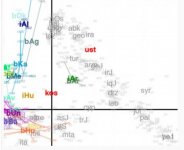
I would second that. If I were to go just by the PCA it would seem that Tuscans are very close to Bronze Age Hungarians (who may have changed only minimally since perhaps the Middle Neolithic). However, I'm not going to make that leap right now; those ancient samples are projected onto the modern populations. When a better PCA is provided, we'll see.
As for the yDna calls, I wouldn't go to the bank with any of this yet. Allentoft says they weren't very interested in the Ydna! Their calls are very general. The calls are being made by bloggers on sometimes very poor samples, and there's still a lot of confusion from what I can see.
Plus, people should be aware that the statistical analysis is providing slightly different results from those in the ADMIXTURE program run, and when the latest tools are used, which it appears weren't used by the authors of Allentoft et al it may be different yet.
We've waited a long time for more ancient samples. I think it's prudent to not rush into conclusions on some of these issues.
Angela
Veteran member
- Messages
- 21,783
- Reaction score
- 12,343
- Points
- 113
- Ethnic group
- Italian
I see that Dienekes has provided some analysis of the paper:
http://www.dienekes.blogspot.com/2015/06/into-out-of-and-across-eurasian-steppe.html
It bears close reading, I think.
"The first conclusion of the new study is the detection of the migration from the steppe to Europe that was the title piece of the earlier study. The authors do not present quantitative estimates of the amount of demographic replacement effected by the Yamnaya-to-Corded Ware migration, so it will be interesting to see if there are any minor significant differences in these. But, the two papers have different Yamnaya and Corded Ware samples, and yet arrive at qualitatively similar conclusions, so at least this part of the story should be considered firmly "settled"."
"The second conclusion is the migration from the European steppe to the Afanasievo culture of the Altai... This confirms movement #2 of the Anthony/Ringe model, although I doubt that this migration had anything to do with Tocharians as detailed below. But, it did happen."
"The third conclusion is that the later steppe cultures of the Sintashta and Andronovo (putative Indo-Iranians according to some), were not a continuation of the Yamnaya-Afanasievo people, but had extra Neolithic farmer ancestry. So, it seems that Neolithic farmers entered the steppe, and the development of steppe cultures did not happen in isolation.
Whether this involved migration of Corded Ware people (as the authors prefer), who were already a mixture of Yamnaya and Neolithic farmers, or some other mixture of Neolithic farmers with steppe populations (e.g., Tripolye plus Yamnaya) remains to be seen."
"As for the Yamnaya, the authors do not find a very strong signal of admixture (as did the earlier study), which they attribute quite plausibly to the lack of eastern hunter-gatherers in their dataset. On the other hand, they claim that the "Caucasus" genetic component in the steppe populations was of steppe ancestry rather than Near Eastern/Caucasian origin as was claimed in the earlier paper. This is based on the statistic D(Yoruba, Armenia BA; Yamnaya, Corded Ware) that is not significantly different from zero. However, Corded Ware is a mixture of Yamnaya and European Neolithic, so the sign of this statistic is determined by the sign of the statistic D(Yoruba, Armenia BA; Yamnaya, European Neolithic). If Yamnaya was simply a steppe population, descendants of local people without ancestry from the Middle East/Caucasus, then this statistic would be positive because of the shared Middle Eastern ancestry of Armenia BA and European Neolithic. Whereas, if Yamnaya is a mixture of a steppe population and a Middle Eastern/Caucasian one, then the statistic would be positive/negative for the respective parts, which would be consistent with an average not different from zero. I am sure that when the new data is re-analyzed together with the eastern hunter-gatherers it will be clear that the Yamnaya are not a pure steppe population."
 "Speaking of the Caucasus/Middle East, it seems clear as a first approximation that the Bronze Age Armenians are quite similar to modern Armenians. Whether the genetic continuity of Armenians extends beyond the Bronze Age, or Armenians were formed by mixture in the Bronze Age remains to be seen. The question of Armenian linguistic origins is of course separate as it is commonly understood that the Armenian language is unrelated to Anatolian languages and may have arrived in Armenia from the Balkans at around the Bronze Age-Iron Age transition."
"The story of the Y-chromosomes seems very interesting, although these are not resolved to fine detail. The most interesting aspect of this part of the work is the appearance of haplogroup J in Iron Age samples from Russia, Armenia, and the Altai. This may tie in to the question of the Tocharian origins, which I have claimed were associated with R1b, rather than R1a (as the Indo-Iranians were). The modern Uygurs (who are partially of Tocharian origin) have both J2 and R1b, so were the recipients of West Eurasian elements other than the R1a that so seem to have dominated the eastern steppe, including the Afanasievo. I continue to think there's no evidence that the Afanasievo is Proto-Tocharian, as it's in the wrong place and 3,000 years before the attestation of Tocharian. "
So, there is no necessary conflict between the findings of Haak et al and Allentoft et al. Allentoft just didn't have the EHG genomes (and had different Yamnaya samples...there was some variation from site to site, afterall), nor did they have the latest statistical tool.
http://www.dienekes.blogspot.com/2015/06/into-out-of-and-across-eurasian-steppe.html
It bears close reading, I think.
"The first conclusion of the new study is the detection of the migration from the steppe to Europe that was the title piece of the earlier study. The authors do not present quantitative estimates of the amount of demographic replacement effected by the Yamnaya-to-Corded Ware migration, so it will be interesting to see if there are any minor significant differences in these. But, the two papers have different Yamnaya and Corded Ware samples, and yet arrive at qualitatively similar conclusions, so at least this part of the story should be considered firmly "settled"."
"The second conclusion is the migration from the European steppe to the Afanasievo culture of the Altai... This confirms movement #2 of the Anthony/Ringe model, although I doubt that this migration had anything to do with Tocharians as detailed below. But, it did happen."
"The third conclusion is that the later steppe cultures of the Sintashta and Andronovo (putative Indo-Iranians according to some), were not a continuation of the Yamnaya-Afanasievo people, but had extra Neolithic farmer ancestry. So, it seems that Neolithic farmers entered the steppe, and the development of steppe cultures did not happen in isolation.
Whether this involved migration of Corded Ware people (as the authors prefer), who were already a mixture of Yamnaya and Neolithic farmers, or some other mixture of Neolithic farmers with steppe populations (e.g., Tripolye plus Yamnaya) remains to be seen."
"As for the Yamnaya, the authors do not find a very strong signal of admixture (as did the earlier study), which they attribute quite plausibly to the lack of eastern hunter-gatherers in their dataset. On the other hand, they claim that the "Caucasus" genetic component in the steppe populations was of steppe ancestry rather than Near Eastern/Caucasian origin as was claimed in the earlier paper. This is based on the statistic D(Yoruba, Armenia BA; Yamnaya, Corded Ware) that is not significantly different from zero. However, Corded Ware is a mixture of Yamnaya and European Neolithic, so the sign of this statistic is determined by the sign of the statistic D(Yoruba, Armenia BA; Yamnaya, European Neolithic). If Yamnaya was simply a steppe population, descendants of local people without ancestry from the Middle East/Caucasus, then this statistic would be positive because of the shared Middle Eastern ancestry of Armenia BA and European Neolithic. Whereas, if Yamnaya is a mixture of a steppe population and a Middle Eastern/Caucasian one, then the statistic would be positive/negative for the respective parts, which would be consistent with an average not different from zero. I am sure that when the new data is re-analyzed together with the eastern hunter-gatherers it will be clear that the Yamnaya are not a pure steppe population."

"The story of the Y-chromosomes seems very interesting, although these are not resolved to fine detail. The most interesting aspect of this part of the work is the appearance of haplogroup J in Iron Age samples from Russia, Armenia, and the Altai. This may tie in to the question of the Tocharian origins, which I have claimed were associated with R1b, rather than R1a (as the Indo-Iranians were). The modern Uygurs (who are partially of Tocharian origin) have both J2 and R1b, so were the recipients of West Eurasian elements other than the R1a that so seem to have dominated the eastern steppe, including the Afanasievo. I continue to think there's no evidence that the Afanasievo is Proto-Tocharian, as it's in the wrong place and 3,000 years before the attestation of Tocharian. "
So, there is no necessary conflict between the findings of Haak et al and Allentoft et al. Allentoft just didn't have the EHG genomes (and had different Yamnaya samples...there was some variation from site to site, afterall), nor did they have the latest statistical tool.

LeBrok
Elite member
- Messages
- 10,231
- Reaction score
- 1,620
- Points
- 0
- Location
- Calgary
- Ethnic group
- Citizen of the world
- Y-DNA haplogroup
- R1b Z2109
- mtDNA haplogroup
- H1c
I really like this, and it fits with population movements of Cucuteni and Corded described by Anthony, which theories I'm a big fan of. I was expecting, as mentioned in other threads, to find differences in population admixtures between West and East Yamnaya. West being more EEF farmers and East more HG/Nomadic horse breeding. What is interesting and surprising that both groups took part in eastern expansion, and that they stayed distinct, not mixing. Though Tarim mummies, more of farmers than horse herders was kind of giveaway. Well, we knew there was some movement from West Yamna/Corded into the far East, but not on a scale of Sintashta/Andronovo. I'm yet to find time to go through new data. At the end of a day we need to accommodate not 2 but 3 distinct groups/sub cultures of Yamnaya, R1a Z93 and Z282, and R1b.I see that Dienekes has provided some analysis of the paper:
http://www.dienekes.blogspot.com/2015/06/into-out-of-and-across-eurasian-steppe.html
It bears close reading, I think.
"The first conclusion of the new study is the detection of the migration from the steppe to Europe that was the title piece of the earlier study. The authors do not present quantitative estimates of the amount of demographic replacement effected by the Yamnaya-to-Corded Ware migration, so it will be interesting to see if there are any minor significant differences in these. But, the two papers have different Yamnaya and Corded Ware samples, and yet arrive at qualitatively similar conclusions, so at least this part of the story should be considered firmly "settled"."
"The second conclusion is the migration from the European steppe to the Afanasievo culture of the Altai... This confirms movement #2 of the Anthony/Ringe model, although I doubt that this migration had anything to do with Tocharians as detailed below. But, it did happen."
"The third conclusion is that the later steppe cultures of the Sintashta and Andronovo (putative Indo-Iranians according to some), were not a continuation of the Yamnaya-Afanasievo people, but had extra Neolithic farmer ancestry. So, it seems that Neolithic farmers entered the steppe, and the development of steppe cultures did not happen in isolation.
Whether this involved migration of Corded Ware people (as the authors prefer), who were already a mixture of Yamnaya and Neolithic farmers, or some other mixture of Neolithic farmers with steppe populations (e.g., Tripolye plus Yamnaya) remains to be seen."
Edit:
I just had a look at Y haplogroups of these cultures. So Afanasievo is R1b, with sbuclades looking so far very IndoEuropean indeed. I think it is a great news to finally find them. I thought they were stationed, before migration to Europe and Near East, closer to East Side of Caspian Sea. However it was 500 to 1,000 years before Andronovo (R1a Z 93) culture, so at this time they might have had Central Asia completely to themselves.
Andronovo is Z93, and contains more farmer admixture than R1b. I wonder what part of Yamnaya they come from? How were they positioned in relation to Z283 so they didn't mix together. If East Yamnaya was full of of R1b, this doesn't leave much room in West Yamnaya for both of them. Unless the split from mother clade Z645 is younger than expected. Younger than 3,000 BC?
Edit:
I'm too fast on a trigger. Now I can see that Afanasievo were just females, no R1b discovered. Though if there is great affinity to Yamnaya R1b, they should turn out the same. Will see.
Last edited:

Fire Haired14
Banned
- Messages
- 2,182
- Reaction score
- 585
- Points
- 0
- Y-DNA haplogroup
- R1b DF27*
- mtDNA haplogroup
- U5b2a2b1
RISE00: M913021: Corded Ware Estonia.
ANE K7.
ANE: 19.34
WHG: 74.48
ENF: 5.61
East African: 0.57
M966366: Corded Ware Germany. Haak 2015.
ANE K7.
ANE: 24.68
WHG: 59.61
ENF: 12.55
There was variation in Corded Ware.
ANE K7.
ANE: 19.34
WHG: 74.48
ENF: 5.61
East African: 0.57
M966366: Corded Ware Germany. Haak 2015.
ANE K7.
ANE: 24.68
WHG: 59.61
ENF: 12.55
There was variation in Corded Ware.
Alan
Elite member
- Messages
- 2,521
- Reaction score
- 462
- Points
- 83
- Ethnic group
- Kurdish
- Y-DNA haplogroup
- R1a1a1
- mtDNA haplogroup
- HV2a1 +G13708A
RISE00: M913021: Corded Ware Estonia.
ANE K7.
ANE: 19.34
WHG: 74.48
ENF: 5.61
East African: 0.57
M966366: Corded Ware Germany. Haak 2015.
ANE K7.
ANE: 24.68
WHG: 59.61
ENF: 12.55
There was variation in Corded Ware.
In ANE K7 the component is called for a reason WHG-UHG, because it is not exclusively WHG but also eats up the UHG portion of ENF

Tomenable
Well-known member
- Messages
- 6,031
- Reaction score
- 1,754
- Points
- 113
- Location
- Poland
- Ethnic group
- Polish
- Y-DNA haplogroup
- R1b-L617
- mtDNA haplogroup
- W6a
RISE00: M913021: Corded Ware Estonia.
ANE K7.
ANE: 19.34
WHG: 74.48
ENF: 5.61
East African: 0.57
M966366: Corded Ware Germany. Haak 2015.
ANE K7.
ANE: 24.68
WHG: 59.61
ENF: 12.55
There was variation in Corded Ware.
Nice! Where did you get this from? Can you check admixtures for CW samples from Poland and Germany?
BTW - I've heard that Davidski has published Y-DNA results but I can't find where.
Anyway, this one sample of R1b from Corded Ware seems to be RISE1 (Genetiker has it only as P so far).
Fire Haired14
Banned
- Messages
- 2,182
- Reaction score
- 585
- Points
- 0
- Y-DNA haplogroup
- R1b DF27*
- mtDNA haplogroup
- U5b2a2b1
Nice! Where did you get this from? Can you check admixtures for CW samples from Poland and Germany?
BTW - I've heard that Davidski has published Y-DNA results but I can't find where.
Anyway, this one sample of R1b from Corded Ware seems to be RISE1 (Genetiker has it only as P so far).
Both Corded Ware dudes are uploaded to GEDmatch. Find their IDs, here(Allentoft) and here(Haak)
Here's Ancient West Eurasian Y DNA(Including Allentoft data). I don't know about the Corded Ware R1b. Geneticker says he doesn't think it's R1b, and says it's of very low coverage. I don't think anyone has uploaded the Polish CWCs to GEDmatch or analyzed them in anyway yet. BTW, Sintashta/Andronovo are more EEF than German Corded Ware. Basically they were immigrants from Late Neolithic Europe. So, maybe R1a1a1b-S224 originated in Ukriane or something.
https://docs.google.com/spreadsheets/d/12G2cfjG0wHWarsl5bB99ridFmvUWzqlZfZ6_e_R6oIA/edit#gid=0
bicicleur 2
Regular Member
- Messages
- 6,442
- Reaction score
- 1,488
- Points
- 113
RISE504 is J2a2-L581
together with RISE602 that makes 2 x J2a2 in Iron age Russia
together with RISE602 that makes 2 x J2a2 in Iron age Russia

arvistro
Elite member
- Messages
- 1,004
- Reaction score
- 188
- Points
- 0
How those J2 look autosomally?RISE504 is J2a2-L581
together with RISE602 that makes 2 x J2a2 in Iron age Russia
Tomenable
Well-known member
- Messages
- 6,031
- Reaction score
- 1,754
- Points
- 113
- Location
- Poland
- Ethnic group
- Polish
- Y-DNA haplogroup
- R1b-L617
- mtDNA haplogroup
- W6a
^ Here it is:
"Davidski said...
I've just updated the post with a link to the official (from the lead author) Y-HG list for the samples from the study. Here it is again...
https://drive.google.com/file/d/0B9o3EYTdM8lQaU54RWc0eEV2WUU/view
June 14, 2015 at 6:05 AM"
"Davidski said...
I've just updated the post with a link to the official (from the lead author) Y-HG list for the samples from the study. Here it is again...
https://drive.google.com/file/d/0B9o3EYTdM8lQaU54RWc0eEV2WUU/view
June 14, 2015 at 6:05 AM"
Alan
Elite member
- Messages
- 2,521
- Reaction score
- 462
- Points
- 83
- Ethnic group
- Kurdish
- Y-DNA haplogroup
- R1a1a1
- mtDNA haplogroup
- HV2a1 +G13708A
David said:Yeah, these Bronze Age Armenians look like they had recent ancestors from the steppe and/or northeast Caucasus. This is a pretty good fit for them using qpAdm (chisq 2.140, tail prob 0.543766).
baArm
Yamnaya 0.312
LBK_EN 0.688
But then again this is an awesome fit for Yamnaya (chisq 0.573, tail prob 0.902514).
Yamnaya
EHG 0.427
baArm 0.573
So working out the precise details of the nature of gene flow between Yamnaya and the Bronze Age Caucasus is gonna be tricky.
I gave at least 3! reasonings on Eurogenes comment section itself why is this blatanly wrong. He didn't bother to tackle it.
Yamna did not have Atlantic_Med type ancestry and had only 5% of Caucasus. This is the major difference to modern West Asians and what causes the "European" shift not freakn Yamna type ancestry.
The major "European" shift in this samples is the much smaller frequency of Southwest Asian and the significantly higher Atlantic_Med ancestry (over 30% vs modern populations with ~10%) and Caucasus (30%).
He is like trying to explain the blueness of the sky with greenhouse effect. Ancient Armenia was populated by Northeast Caucasian type people and every freakn linguist believed that Northeast Caucasians arrived from further South and not the opposite. My god sometimes his agenda makes him lose totally common sense.
How can a population (Yamna) be a source for something (EEF) in another population (BaArmenia) which they lack themselves(Yamna) I will never understand this logic.
Fortunately I am not the only one who realized that.
Alberto said:Thanks for that Admixture run. Very interesting.
Regarding the BA Armenian, the oldest one (ca. 1800 BC):
baArm (RISE413)
Amerindian: 2.5%
EEF: 14.2%
Euro_HG: 6.5%
BA_Cauc: 74.5%
Karelia_HG
Amerindian: 12%
EEF: 0%
Euro_HG: 88%
BA_CAUC: 0%
baYam (RISE552)
Amerindian: 2.8%
EEF: 0%
Euro:HG: 49%
BA_Cauc: 46%
The BA Armenian, apart from getting some EEF admixture during the 1500-2000 years they must have been on the area, it doesn't look to me it has any steppe admixture.
On the other hand, it looks like a great fit for Yamnaya with the EHGs. The fact that he's the oldest one we have (though not old enough), and that he's R1b, shouldn't it be giving a strong clue as to what really happened? Sure, we'll need an older sample for 100% confirmation, but the odds are that we found the direct descendants of the "Armenian-like" population from Haak et al.
Last edited:
bicicleur 2
Regular Member
- Messages
- 6,442
- Reaction score
- 1,488
- Points
- 113
How those J2 look autosomally?
sorry, only this
https://www.facebook.com/photo.php?fbid=10153383262614324&set=pcb.10153358223627769&type=1&theater
it's confirmed by Chris Rottensteiner
Tomenable
Well-known member
- Messages
- 6,031
- Reaction score
- 1,754
- Points
- 113
- Location
- Poland
- Ethnic group
- Polish
- Y-DNA haplogroup
- R1b-L617
- mtDNA haplogroup
- W6a
Thanks for the info Fire Haired, but at the moment... :
http://gedmatch.com/
"GEDmatch is down while we deal with a major data loss caused by a recently introduced software bug. We are working to restore data. We apologize for the inconvenience, and ask for your understanding."
http://gedmatch.com/
"GEDmatch is down while we deal with a major data loss caused by a recently introduced software bug. We are working to restore data. We apologize for the inconvenience, and ask for your understanding."

Johannes
Regular Member
- Messages
- 435
- Reaction score
- 33
- Points
- 0
- Ethnic group
- Celtic/Germanic/Basque
- Y-DNA haplogroup
- I2a1
Exactly.
According to Julius Caesar Britain was a hodge-podge of Britons, Gauls (don't confuse with Gaels), Belgians, and Picts.
Of course most of Gauls and Belgians were in what is now England, Picts in Scotland, Britons in England and Wales.
There were also those mysterious swarthy-pigmented Silures in one part of Wales, who were the strongest of Welsh tribes. That was a Celtic-speaking tribe but probably immigrants from Iberia, or with high local Neolithic ancestry.
The Silures were not Celtic. They could not be. They had woolly hair and dark complexions. Had to have been Neolithic people -- possibly Berbers. They just adopted Celtic language. Iberia was heavily populated by Celts and Iberians. They were not woolly-haired and swarthy. Anyways I have seen Spaniards and the majority are light skinned.

sparkey
Great Adventurer
- Messages
- 2,238
- Reaction score
- 358
- Points
- 83
- Location
- California
- Ethnic group
- 3/4 Colonial American, 1/8 Cornish, 1/8 Welsh
- Y-DNA haplogroup
- I2c1 PF3892+ (Swiss)
- mtDNA haplogroup
- U4a (Cornish)
The Silures were not Celtic. They could not be. They had woolly hair and dark complexions. Had to have been Neolithic people -- possibly Berbers. They just adopted Celtic language. Iberia was heavily populated by Celts and Iberians. They were not woolly-haired and swarthy. Anyways I have seen Spaniards and the majority are light skinned.
The idea that the Silures were Iberians is based on one piece of speculation by Tacitus. Placing them as another dark-complexioned people, like the Berbers as you do, doesn't have any precedence as far as I know.
My opinion is that the Silures were definitely Celts. Archaeology in the area settled by the Silures points to very similar patterns to other Brythonic Celts, like the use of British-style roundhouses. Modern Southeastern Welsh are genetically about as we would expect. They may be a local maximum for dark complexion, but IMO don't share many other phenotypic traits with non-British populations. There are also no notes, in Tacitus or otherwise, of the Silures speaking an unusual language, or having unusual cultural patterns (other than being warlike).
Angela
Veteran member
- Messages
- 21,783
- Reaction score
- 12,343
- Points
- 113
- Ethnic group
- Italian
Alan: Fortunately I am not the only one who realized that.
Originally Posted by Alberto
Thanks for that Admixture run. Very interesting.
Regarding the BA Armenian, the oldest one (ca. 1800 BC):
baArm (RISE413)
Amerindian: 2.5%
EEF: 14.2%
Euro_HG: 6.5%
BA_Cauc: 74.5%
Karelia_HG
Amerindian: 12%
EEF: 0%
Euro_HG: 88%
BA_CAUC: 0%
baYam (RISE552)
Amerindian: 2.8%
EEF: 0%
Euro:HG: 49%
BA_Cauc: 46%
The BA Armenian, apart from getting some EEF admixture during the 1500-2000 years they must have been on the area, it doesn't look to me it has any steppe admixture.
On the other hand, it looks like a great fit for Yamnaya with the EHGs. The fact that he's the oldest one we have (though not old enough), and that he's R1b, shouldn't it be giving a strong clue as to what really happened? Sure, we'll need an older sample for 100% confirmation, but the odds are that we found the direct descendants of the "Armenian-like" population from Haak et al.

That certainly seems suggestive to me. If we get similar or even better fits with dna from Maykop or perhaps from older Neolithic era dna from Armenia (which we should be getting soon,yes?) then it will seal the deal, as we say. If that earlier dna or Maykop dna is also an upstream form of R1b then it would validate hypotheses proposed on this site for a very long time.
I suppose that would mean the end of the saga of the overwhelmingly attractive south Caucasus women and the incredible allure that drove steppe men to either steal them or madly round up every horse in sight in order to buy them.
I guess we'll soon know the answer. Btw, what is the closest modern population to the earliest ancient Armenian samples?
Silesian
Junior Member
- Messages
- 738
- Reaction score
- 104
- Points
- 43
- Ethnic group
- Citizen of Earth.
- Y-DNA haplogroup
- R1b-BY593
- mtDNA haplogroup
- U5b2a2
Zoomed in Armenian sample. Plots near modern Ossetian/Georgian region.
RISE397 Armenia LBA R1b1a2a2-Y4371/Z8128


| SAMEA3325367 | RISE397 | Kapan | LBA | Armenia | Male | 1048 BC | 855 BC | R1b1a2a2 | R1b |
RISE397 Armenia LBA R1b1a2a2-Y4371/Z8128