• Don't want to see ads? Install an adblocker like uBlock Origin or use a Europe-based privacy-friendly browser like Vivaldi or Mullvad.

Immigration Ethnic groups in Italy

A Famous albanian televison dancer of italy, tells about his integration in italy

 
it depends, if the population grow, theorically the work grow in tha same manner, because more people demand more goods, so more production and more workers involved.. the GPD per Capita, doesn't depend on population grow.

The problems lye more on Multiculturalism, if there will persist more cultures in italy;.. if the immigrants take our mentality, there would be only one culture, so this problem wouldn't exist.

A problem that would exist is multiethnicity, and the genepool changed, or the people who don't accept immigrants, if this is percieved as a problem, if the people become more tolerant or wil start to mix heavily, than this problem wouldn't exhist.

this does not solve the issue of work, infrastructure, utilities ................every country has a limit on the people it can have . Italy has already reached its maximum.
There is not enough power in Italy now, we do not expect people to live under candle light do we ?
 
this does not solve the issue of work, infrastructure, utilities ................every country has a limit on the people it can have . Italy has already reached its maximum.
There is not enough power in Italy now, we do not expect people to live under candle light do we ?

Indeed i didn't have thought about energy power, in this case you are right, but since babies born to pure ethnic italian are becoming less, immigrants will replace them, and the population will be like those of taoday in quanttity, well this if new immigration doesn't enter in italy...

if we talk about a racial point, if that's matter, than romenians and albanians are very similar to us.. (the two majour ethnic groups in italy).. expecially albania, think of the geographical position, and only 80 km distant from the shore's of Apulia.
Albania is also near greece, and has an ethnic composition similar to most of italy (egeo stock plus illirians).
Also Romenians are similar with us, and they have a romance language
 
Indeed i didn't have thought about energy power, in this case you are right, but since babies born to pure ethnic italian are becoming less, immigrants will replace them, and the population will be like those of taoday in quanttity, well this if new immigration doesn't enter in italy...

if we talk about a racial point, if that's matter, than romenians and albanians are very similar to us.. (the two majour ethnic groups in italy).. expecially albania, think of the geographical position, and only 80 km distant from the shore's of Apulia.
Albania is also near greece, and has an ethnic composition similar to most of italy (egeo stock plus illirians).
Also Romenians are similar with us, and they have a romance language

Concluding from your statements I suppose you prefer an immigration policiy which is based on genetic proximity, rather than cultural similiarity (--> Ok, at this point most members in this forum would probably argue that genetic proximity EQUALS cultural similiarity as all culture is based on genes.)
That is for Italy, rather open doors to Albania, Greece or Romania than for instance Poland, Ukraine or even Spain. Or am I wrong?
 
Also Romenians are similar with us, and they have a romance language

Yes they have a romance language .....an eastern romance language like south Italy.
 
Concluding from your statements I suppose you prefer an immigration policiy which is based on genetic proximity, rather than cultural similiarity (--> Ok, at this point most members in this forum would probably argue that genetic proximity EQUALS cultural similiarity as all culture is based on genes.)
That is for Italy, rather open doors to Albania, Greece or Romania than for instance Poland, Ukraine or even Spain. Or am I wrong?

I prefer this, if i could choose the immigrants i wanted, i'll chose those more genetically similar with italians.
The culture can be adopted later by them, still if they are quantity manageble and integrable.

I've already had this experience: i met some young people of albanian and romanian descendance (which i didn't know their origin, obviously), and still untill they told me their names, i would have said they were of italian origin like me, when they told me their names i was shocked they weren't of italian origins, since their accent was the local one, and even their mannerism local, of my region.
phisycally they were like the locals.

but than i have mixed feelings, i feel that moving is a people right, and if africans or chinses, wants to live there it's their right since people have always mooved since pre-history.
 
.................
 
Last edited:
very brutal images
racism in italy on immigrants from subsaharian africa
in this case the confilct is among poor people the immigrants, and the locals that are also of lower economic status

than it talks about the life of other immigrants, the ukrainians

 
what are the latest trends on immigration?
Here is the incresing percentage, of immigrants in 2005-2010... which are those rapidly growing?

Romanians 256,7
Bulgarians 199,4
Moldovans 178,1
Poles 107,9

You can see that Estern Europeans are rapidly growing, mostly south-eastern europeans, but also north-eastern europeans like the Poles.

Grouping immigrants in area of origins:


South East europe
Romanians 968.576 + Albanians 482.627 + Moldovans 130.948 + Macedonians 89.900 + Serbians 52.954 + Bulgarians 51.134 + Bosnians 31.972 + Kosovo 22.778 + Croatians 21.079 + Slovaks 9.150+ Greeks 7.250 + Montenegrins 4.588 = 1.872.956

Nort East europe
Ukrainians 200.730 + Poles 109.018 + (Russians 30.504) + Hungarians 7.404 + Belorussians 6.975 + Czechs 6.134 + Slovenians 3.201 = 333.462
 
a multicultural street in Milan Via Padova
 
Dinner toghether Calabrians have dinner with Moldavians immigrants in Calabria, to know eachothers

Campanians have dinners with Ukrainians in Campania
 
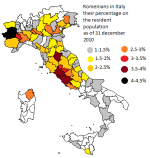
2010 Percentage of people with Romenian citizenship on total resident poulation an the areas of italy (italians plus all immigrants)
rouit.png

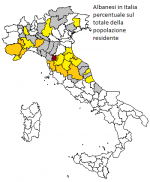
2010, This is the same but about Albanians
albit.png
From this maps we can see that both romenians and albanians prefer to settle in north and central italy but not in southern italy.
Romanians like to settle in the Turinese Laziale and Aretino area
i think there could be a draw to Rome for what it represents, romance language Latin, and tyes between Rome and Romania, (also in the name)
Albanians like to settle in the Pistoiese areas and in central italy (tuscany umbria Marche Romagna), as well as around Cuneese Astigiano Alessandrino, i bet they works in the wine regions of Asti, Barlo wine, Langhe area.

Also both romenians and alabnians seem not so favourable to set around the Alps area of italy, probably because the culture there is more distant to standard italian one

However that maps show the percentage of those immigrants on total residents, so it's just their impact number (%); not numbers of settlement
 
Last edited:
an interesting thing is that migrants tend to stabilize themselves in place like colonies, for example the first one arrives than he brings all his family than cousins, than firends etcc.. remebre the greek colonies in southern italy.
I would safetly say that all immigrants settle in colonies, so you have places with higher concentration of people originally from a single city, town or area of his home country.

someone who disagrees or agrees with me?
 
It seams to be the case. It is easier for emigrants to come to the city where their native community is already established. Many reasons play role here: family, sponsors, friends, language/communication/jobs, food.
I was in refugee camp in Castel Fusano near Ostia close to Rome. I remember the fastest integration was for young, single, blond girls. They were sort of "fast tracked" into the Italian community, lol.
I hope to show up in Italy in few years. I have Italian friends and Roma and Milano.
 
It seams to be the case. It is easier for emigrants to come to the city where their native community is already established. Many reasons play role here: family, sponsors, friends, language/communication/jobs, food.
I was in refugee camp in Castel Fusano near Ostia close to Rome. I remember the fastest integration was for young, single, blond girls. They were sort of "fast tracked" into the Italian community, lol.
I hope to show up in Italy in few years. I have Italian friends and Roma and Milano.

i hope you will feel well there, if you want to come as travel go to rome.. if you want to work, for business is better milan
 
if we look at genetic maps we can see that the two majour european ethnic group emigrating into italy are gentically quite close to italians
genmap1.jpg


Romenians are to the east of italians and regerding southern vs northern admixture they have the same level as northern italians (maybe a bit more).
Albanians are to the east of italians and regarding southern vs north admixture they are at the same level of the most northern genetically southern italians (between tuscans and southern italians)

ukrainians are one of the most europeans with eastern europe admixture obviously, and they are in the northern european range as for example Uk Denmark Cechs etc..
Poles are similar to ukrainians but a bit more northerners and a bit more westerners

Bulagarians are as northern italians and a bit more eastern than all italians
Makedonians are like tuscans more so but a bit more easterns than all italians
Kosovars are like tuscans and very easterns almost like poles
 
some infos of forign european communities in italy

Romanians
Romanians in Italy became a notable presence mostly after 1999, due to a large wave of emigration known in Romania as Fenomenul către UE. 80% of the emigrants went to Spain or Italy. They were followed by a further wave beginning in 2002, when Romanian citizens obtained the right to leave their country and go to any Schengen Zone country without having a visa. As of 1 January 2011, there were 968,576 Romanian citizens living in Italy, representing 21.2% of all foreign citizens in that country.[1] Unofficial estimates put the actual number of Romanians in Italy at well over one million people.
On 4 November 2007, Italy started expelling Romanians with criminal records, after a wave of violent crime blamed on swelling numbers of immigrants from Romania.

Albanians
The Albani were an aristocratic Roman family, members of which attained the highest dignities in the Roman Catholic Church, one, Clement XI, having been Pope. They were ethnic Albanians who originally moved to Urbino from the region of Malësi e Madhe in Albania.[9] and had been soldiers of Scanderbeg against the Ottoman Empire. Though eventually assimilated in their Italian environment, Clement XI's Albanian antecedents were evident in his having commissioned, during his reign as a Pope, the famous Illyricum Sacrum. Today it is one of the main sources of the field of Albanology, with over 5000 pages divided in several volumes written by Daniele Farlati and Dom. Coletti.
There is an Albanian community in southern Italy, known as Arbëreshë, who had settled in the country in the 15th and the 16th century, displaced by the changes brought about by the expansion of the Ottoman Empire. Some managed to escape and were offered refuge from the repression by the Kingdom of Naples and Kingdom of Sicily (both under Aragonese rule), where the Arbëreshë were given their own villages and protected. The Arbëreshë were estimated as numbering at a quarter million in the 1970s.[better source needed]
After the breakdown of the communist regime in Albania in 1990, Italy had been the main immigration target for Albanians leaving their country. This was because Italy had been a symbol of the West for many Albanians during the communist period, because of its geographic proximity. Italy reacted to the migration pressure by introducing the "Martelli" law, stipulating that any immigrant who could prove that he or she had come into the country before the end of 1989 be granted a two year residency permit. From March 1997, Italy instituted a strict patrol of the Adriatic in an attempt to curb Albanian immigration. As a result, many Albanian immigrants in Italy do not have a legal status. Out of an estimated 450,000 Albanian immigrants in Italy in 1998, only some 82,000 were registered with authorities. In total there are 800,000 Albanians in Italy.[10]
The Italian Government has housed significant numbers of Albanians from Kosovo in the Arbëresh settlements, most notably in Piana degli Albanesi in Sicily.


Ukrainians
North Italy, Naples, Sicily

Poles
The majority of Polish residents are recently arrived immigrants in the late 20th century drawn to the stellar economy of Italy in need for imported labor. Large Polish immigrant sections/communities are found such as Rome, Milan, Venice, Naples and Palermo. Polish immigration to Italy might continue while the EU contract labor program between the two countries remains in place.

Makedonians
The largest population of Macedonian Muslims in the Macedonian diaspora can be found Italy. Many of them are from the Debar, Gostivar,Struga and Mavrovo regions of Macedonia. Among the Macedonian Muslims are a large population of Maceodonian Christians.

Serbians
In Arzignano there are non-autochtonous thousands of Serbians living with Serbs from all over former Yugoslavia.[1]
In Trieste, about 12,000 Serbs live in the city. In 1782 the first Serbian school opened, and in the 19th century the Serbian Orthodox "Saint Spyridon church" was built at the Ponte Roso square.

When the Serbs claimed protection by Emperor Heraclius (r. 610-640), they were exposed to the Christian faith immediately by "Roman elders".[3]
After an Arab (Saracen) raid and subsequent sieges along the coast of Dalmatia in the late 860s, Emperor Basil I (r. 867–886), who had put the Slavs of Dalmatia under his suzerainty, sent the Serbs along other tribes into Lombardy, where the Slavs would besiege Saracen Bari in 871.[4][5]
According to Graziadio Isaia Ascoli, the first Serbs who settled in Molise were brought by Skanderbeg during his Italian expedition in 1460—1462, together with Albanians.

Bulgarians
ccording to data from Italian sources presented by the Ministry of Foreign Affairs of Bulgaria, the Bulgarian diaspora in Italy numbers around 70,000; of those, 50,000 reportedly reside in Northern Italy.
Besides
Rome, major centres of Bulgarian migration are Milan, Bologna, Florence and Torino. There are Bulgarian Orthodox parishes in Rome and Milan.

Germans
There exist smaller, unique populations of Germans who arrived so long ago that their dialect retains many archaic features heard nowhere else:
Smaller German-speaking communities exist also in the Friuli Venezia Giulia region: the Carinthians in the Canale Valley (municipalities ofTarvisio, Malborghetto Valbruna and Pontebba) and the Zahren and Timau Germans in Carnia.
Contrarily to the before-mentioned minorities, the German speaking population of the province of South Tyrol cannot be categorized as “ethnic German” according to the definition of this article, but as Austrian minority.[11] The province formerly was part of the Austrian County of Tyrol before the 1919 dissolution of the Austro-Hungarian Empire. South Tyrolians were part of the over 3-million German speaking Austrians who in 1918 found themselves living outside of the newborn Austrian Republic as minorities in the newly formed or enlarged respective states of Czechoslovakia, Yugoslavia, Hungary and Italy. Their dialect of South Tyrolians is Austro-Bavarian German. Both standard German and dialect are used in schooling and media. German enjoys co-official status with the national language of Italian throughout this region.


if we look at genetic maps we can see that the two majour european ethnic group emigrating into italy are gentically quite close to italians
genmap1.jpg


Romenians are to the east of italians and regerding southern vs northern admixture they have the same level as northern italians (maybe a bit more).
Albanians are to the east of italians and regarding southern vs north admixture they are at the same level of the most northern genetically southern italians (between tuscans and southern italians)

ukrainians are one of the most europeans with eastern europe admixture obviously, and they are in the northern european range as for example Uk Denmark Cechs etc..
Poles are similar to ukrainians but a bit more northerners and a bit more westerners

Bulagarians are as northern italians and a bit more eastern than all italians
Makedonians are like tuscans more so but a bit more easterns than all italians
Kosovars are like tuscans and very easterns almost like poles

i find these genetic maps useless when you bracket genetics within nations as one.
Take france as an example, would normandy people be identical to provence people....no
so using this circle of france representing genetics of france is silly.

In regards to your topic, its been discussed many times, greek, albanian romanian is closer to central and southern italy and france, swiss and german with northern italy.
can we ever say the french are similar to southern italy!

On your map norway is closer to swiss than Italy , is it correct
 
Back
Top