• Don't want to see ads? Install an adblocker like uBlock Origin or use a Europe-based privacy-friendly browser like Vivaldi or Mullvad.

23andMe Got my first results today

This is from Eurogenes K15 mixed mode.

# Primary Population (source) Secondary Population (source) Distance
1 59.2% Iranian + 40.8% Armenian @ 3.19
2 74.6% Kurdish + 25.4% Armenian @ 3.59
3 85.8% Kurdish + 14.2% Assyrian @ 3.96
4 98.9% Kurdish + 1.1% Mayan @ 4.06
5 99% Kurdish + 1% Pima @ 4.07
6 99% Kurdish + 1% North_Amerindian @ 4.12
7 96% Kurdish + 4% Lebanese_Christian @ 4.13
8 99.3% Kurdish + 0.7% Yoruban @ 4.14
9 95.4% Kurdish + 4.6% Syrian @ 4.14
10 99.3% Kurdish + 0.7% Mandenka @ 4.15
11 96.6% Kurdish + 3.4% Samaritan @ 4.15
12 96.1% Kurdish + 3.9% Cyprian @ 4.15
13 99.3% Kurdish + 0.7% Bantu_S.W. @ 4.15
14 99.3% Kurdish + 0.7% Bantu_S.E. @ 4.15
15 99.3% Kurdish + 0.7% Biaka_Pygmy @ 4.16
16 96.5% Kurdish + 3.5% Georgian @ 4.16
17 97.2% Kurdish + 2.8% Ashkenazi @ 4.17
18 99.3% Kurdish + 0.7% Luhya @ 4.17
19 99.3% Kurdish + 0.7% Bantu_N.E. @ 4.17
20 98.3% Kurdish + 1.7% Algerian @ 4.17


Unlike most other Kurds I have some real Sub Saharan African admixture (0.5% noise but there) while if most other Kurds have some, it is East or North African related.It could (doesn't need) have to do with Levantine admixture, but than it could also be ancient gene flow from Africa to Near East Bantu

What is also interesting I seem to have some additional Northern Amerindian/Mayan admixture. and additional EastMed admixture compared to the average is also visible.

I wasn't exactly right about me being between Anatolian/Syrian and Iraqi/Iranian Kurds. I am mostly Northern Kurdish according to my results but with more tendency to Iraqi and Iranian Kurds than the average Northern Kurd. And I also have more affinities to Atlanntic_Med as the average of the 23andme tested Kurds. I appear mostly as Northern and Western Kurd (Anatolian) but with more tendency towards Eastern and Southern Kurds.
 
Last edited:
Alan, it's not because 23andMe didn't find your deep subclade of R1a1a that it hasn't been identified yet. 23andMe has updated the defining SNP's for haplogroups in over two years. You might be able to determine it yourself by looking at the ISOGG list of SNP's. Open your raw data with a text editor, then search for the SNP by rsid or position. Not many new SNP's are tested by 23andMe, but there might be a few downstream R1a1a. I haven't checked though. Note that the position used by 23andMe aren't the same as in ISOGG, but you can get the 23andMe position by searching for the SNP in the NCBI database. 23andMe uses the NCBI36 position, while ISOGG uses the GRCh37.p10. For example, the M417 mutation (rs17316771) has the position 8533735 at ISOGG but 8593735 at 23andMe. In this case they are very similar, but they can also be completely different.

I am not that knowledgeable in this area. I tried to search for "rs17316771", 8533735 and 8593735 in the txt. data but couldn't find these mutations.
 
Last edited:
Alan, it's not because 23andMe didn't find your deep subclade of R1a1a that it hasn't been identified yet. 23andMe has updated the defining SNP's for haplogroups in over two years. You might be able to determine it yourself by looking at the ISOGG list of SNP's. Open your raw data with a text editor, then search for the SNP by rsid or position. Not many new SNP's are tested by 23andMe, but there might be a few downstream R1a1a. I haven't checked though. Note that the position used by 23andMe aren't the same as in ISOGG, but you can get the 23andMe position by searching for the SNP in the NCBI database. 23andMe uses the NCBI36 position, while ISOGG uses the GRCh37.p10. For example, the M417 mutation (rs17316771) has the position 8533735 at ISOGG but 8593735 at 23andMe. In this case they are very similar, but they can also be completely different.

Maciamo I went through the ISOGG list of SNP's. I tried to search the specific mutations in my raw data. Expect these few I couldn't find any of the other listed mutations in my data.

These are the one I found.

[TABLE="width: 300"]
[TR]
[/TR]
[TR]
[/TR]
[TR]
[/TR]
[TR]
[/TR]
[TR]
[/TR]
[TR]
[/TR]
[TR]
[TD][/TD]
[/TR]
[/TABLE]

[TABLE="width: 500"]
[TR]
[TD]Y-position (GRCh37)[/TD]
[TD]SNP/Other Names[/TD]
[TD]Haplogroup[/TD]
[TD]Mutation in ISOOG list[/TD]
[TD]Mutation in my raw data[/TD]
[/TR]
[TR]
[TD]15030752[/TD]
[TD]M198[/TD]
[TD]R1a1a[/TD]
[TD]C -> T[/TD]
[TD]T[/TD]
[/TR]
[TR]
[TD][/TD]
[TD][/TD]
[TD][/TD]
[TD][/TD]
[TD][/TD]
[/TR]
[TR]
[TD]19375294[/TD]
[TD]M514[/TD]
[TD]R1a1a[/TD]
[TD]C -> T[/TD]
[TD]T[/TD]
[/TR]
[TR]
[TD][/TD]
[TD][/TD]
[TD][/TD]
[TD][/TD]
[TD][/TD]
[/TR]
[/TABLE]


Couldn't find any of the other listed R1a1a* SNP's/mutations.
 
Last edited:
Alan, it's not because 23andMe didn't find your deep subclade of R1a1a that it hasn't been identified yet. 23andMe has updated the defining SNP's for haplogroups in over two years. You might be able to determine it yourself by looking at the ISOGG list of SNP's. Open your raw data with a text editor, then search for the SNP by rsid or position. Not many new SNP's are tested by 23andMe, but there might be a few downstream R1a1a. I haven't checked though. Note that the position used by 23andMe aren't the same as in ISOGG, but you can get the 23andMe position by searching for the SNP in the NCBI database. 23andMe uses the NCBI36 position, while ISOGG uses the GRCh37.p10. For example, the M417 mutation (rs17316771) has the position 8533735 at ISOGG but 8593735 at 23andMe. In this case they are very similar, but they can also be completely different.

Maciamo I was told that 23andMe already uses Build 37 since 2012 and that the ISOOG list of 2014 is basically build 37. https://www.23andme.com/you/download/revisions/
 
Last edited:
Someone on 23andme gave me this information.
Hi,
You can check your Y-DNA Haplogroup R1a1a* more deeply by use your 23&me raw data. If your rs34297606 Y 14498990 T, you are R1a1a1. Maybe it's only for person who have recent analysis with a new chip V4. No sure about.
My current Y-DNA haplogroup - R1a1a1.
Good luck!

M198 R1a1a 15030752 i3000048 C->T
M514 R1a1a 19375294 rs17315926 C->T
M515 R1a1a 14054623 rs17221601 T->A
PF6238 R1a1a 15030752 i3000048 C->T
Page7 R1a1a1 14498990 rs34297606 C->T

All the way down to rs34297606 I am positive but downstream I am not. So I must be R1a1a1
 
Last edited:
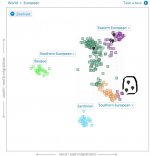
You're not the only Kurd who's neither in European nor in the Near Easter box. There's no box for the Kurds, we need our own box, hahaha. I've got 7 other Kurds in my list and none of them are in the European or in the Near Eastern box. I see only myself and other Kurd in the European box, but not in the Near Easter box if I zoom in. I'm green dot, and other Kurd (Alevi Kurmanji) from Dersim is black dot.
b2ob.jpg

Goga I added another Kurd yesterday. He is also originally Southeast Anatolian Kurd like me, He also falls close to the (South)East European cluster. but contrary to you and the other Kurd he tends more towards North.
He is also R1a1a.

attachment.php
 

Attachments

  • Similarity.jpg
    Similarity.jpg
    40.2 KB · Views: 431
I just found out that according to 23andMe DNA Relatives you're my '4th to Distant Cousin'. We share the same distant ancestor (by same blood), hahaha! At least one of your ancestors was a Kurd Ezdi in the recent past!
 
I just found out that according to 23andMe DNA Relatives you're my '4th to Distant Cousin'. We share the same distant ancestor (by same blood), hahaha! At least one of your ancestors was a Kurd Ezdi in the recent past!


There is a Yezidi Kurdish Girl also from Georgia. Her name is Marina she added me and said that according to 23andme she is my close cousin.
 
There is a Yezidi Kurdish Girl also from Georgia. Her name is Marina she added me and said that according to 23andme she is my close cousin.
Well, she's not my relative. I don't have her in my 'DNA Relatives' list. So you have then more than just 1 recent Kurd Ezdi ancestor! If you go to 'family & friends' -> 'family traits' you can see that we share DNA in the second chromosome. BTW, there're a lot Kurdish Ezdi women in Georgia with the name 'Marina', 'Roza' etc.
 
Well, she's not my relative. I don't have her in my 'DNA Relatives' list. So you have then more than just 1 recent Kurd Ezdi ancestor! If you go to 'family & friends' -> 'family traits' you can see that we share DNA in the second chromosome. BTW, there're a lot Kurdish Ezdi women in Georgia with the name 'Marina', 'Roza' etc.

You might be right. All Kurds were at the end of the day either, Yezidi or Yarsan.
 
Last edited:
using interpretome ..........I wonder which is best from my chromosome ethnicity

interpretome below

Uploaded with ImageShack.us
 
In regards to Italian data in 23andme............they (23andme) noted to me that between 80 to 90 % of their Italian data for ancestry composition comes from Sicilian-Americans from USA ( east coast area mainly )
 
In regards to Italian data in 23andme............they (23andme) noted to me that between 80 to 90 % of their Italian data for ancestry composition comes from Sicilian-Americans from USA ( east coast area mainly )

We've had this discussion before...in fact, I think I've asked you before if you kept a copy of this communication. Have you located it in the interim?

I ask, because as I have explained before, I have shared with many Italian users at 23andme, and they are nowhere near 80% Sicilian Americans. True, Italian-Italians, other than some Padania racists, are notoriously not interested in these kinds of genetic tests, especially for ancestry. The biggest interest is in Italian Americans trying to find relatives in Italy or just generally trying to find out more about their ancestry. However, even among them, I have found that a great many of them are from Calabria, Naples, and Puglia, in addition to Sicily, or they are a combination of all of those groups.

In addition, that statement would only apply to the reference population formed from 23andme customers. That does not take into account the many samples that they have from published academic sources.

This is a page from 23andme that describes the various academic sources they use, which include the Human Genome Diversity Project, HapMap, and the 1000 Genomes project.
https://customercare.23andme.com/entries/22584878-Reference-populations-in-Ancestry-Composition

More recently, I was informed that they also use the Popres data, and other data from Tuscany, but I have yet to see a statement to that effect from them.

Many other programs do not use all of these academic sources, and even if, like Dienekes, they do, they don't have as many privately tested individuals. 23andme has even more of them than does Dienekes. I personally share on 23andme with far more than 5 individuals from Northern Italy.

As I also suggested before, you might find it helpful to read the "White Paper" on their method. The precision and recall numbers are particularly interesting. The link is below.
https://www.23andme.com/ancestry_composition_guide/

Just generally I would also say that you need far fewer samples to do a reputable autosomal analysis than you need for uniparental markers, which are so volatile.

Also, as can be seen on the many PCA's of autosomal variation in Europe, Italians, north, south and center, northeast and northwest, while encompassing more variation than much of the rest of Europe put together, still only cluster with other Italians. The Alps, and to a lesser extent the Mediterranean, were formidable barriers to gene flow, as I'm sure you know if you've read Ralph and Coop et al or looked at all those PCAs. The number of Italians who place in France and Switzerland is very small. (or vice versa) A few drift in the direction of Spain (but land in the Mediterranean) and a few drift a little toward the Balkans, but none land there to my knowledge. (A few Romanians do, however, plot very near us.) Then, there are the southern Italian/Sicilian samples that overlap or are very close to the Ashkenazim. There is none of the kind of overlap that one sees, for example, between Britain and the low countries.
 
We've had this discussion before...in fact, I think I've asked you before if you kept a copy of this communication. Have you located it in the interim?
I never saw it

I ask, because as I have explained before, I have shared with many Italian users at 23andme, and they are nowhere near 80% Sicilian Americans. True, Italian-Italians, other than some Padania racists, are notoriously not interested in these kinds of genetic tests, especially for ancestry. The biggest interest is in Italian Americans trying to find relatives in Italy or just generally trying to find out more about their ancestry. However, even among them, I have found that a great many of them are from Calabria, Naples, and Puglia, in addition to Sicily, or they are a combination of all of those groups.

In addition, that statement would only apply to the reference population formed from 23andme customers. That does not take into account the many samples that they have from published academic sources.

correct, from the 23andme customers...........known as Italian in the ancestry composition, from sicialin-americans ( which 23andme also place southern italians form USA in same bracket)

Basically, if you have over 40% italian in your composition ( not speculative), your ancestors are southern Italian, between 20% to 40% thay are central Italian and below 20% you are north-italian ( write to 23andme and they will write to you. Currently I am writing about the Southern European setup and placement ( I do not know why they have Tuscan north of northern-Italian.))

This is a page from 23andme that describes the various academic sources they use, which include the Human Genome Diversity Project, HapMap, and the 1000 Genomes project.
https://customercare.23andme.com/entries/22584878-Reference-populations-in-Ancestry-Composition

More recently, I was informed that they also use the Popres data, and other data from Tuscany, but I have yet to see a statement to that effect from them.

I will check it out

Many other programs do not use all of these academic sources, and even if, like Dienekes, they do, they don't have as many privately tested individuals. 23andme has even more of them than does Dienekes. I personally share on 23andme with far more than 5 individuals from Northern Italy.

As I also suggested before, you might find it helpful to read the "White Paper" on their method. The precision and recall numbers are particularly interesting. The link is below.
https://www.23andme.com/ancestry_composition_guide/

I stated, Diekes, which is dodecad has only 5 samples of North-italian and does not allow any more.
23andme IIRC has 12 samples, but you can check them yourself today....it might be more

Just generally I would also say that you need far fewer samples to do a reputable autosomal analysis than you need for uniparental markers, which are so volatile.

why do you make this statement?

Also, as can be seen on the many PCA's of autosomal variation in Europe, Italians, north, south and center, northeast and northwest, while encompassing more variation than much of the rest of Europe put together, still only cluster with other Italians. The Alps, and to a lesser extent the Mediterranean, were formidable barriers to gene flow, as I'm sure you know if you've read Ralph and Coop et al or looked at all those PCAs. The number of Italians who place in France and Switzerland is very small. (or vice versa) A few drift in the direction of Spain (but land in the Mediterranean) and a few drift a little toward the Balkans, but none land there to my knowledge. (A few Romanians do, however, plot very near us.) Then, there are the southern Italian/Sicilian samples that overlap or are very close to the Ashkenazim. There is none of the kind of overlap that one sees, for example, between Britain and the low countries.

Read this and agree with it , but PCA's change depending on what tests you do.............if you do interpretome from Stanford Univ. you use PCA1 and PCA 4 if you are European, other places have other numbers
 
Last edited:
23andme

How to interpret Sicilians, since Sicilians are part of 23andme's "Italian" population, each score you see is how well the individual stacks up to the reference population average. I.e. 20% "MENA" means that individual is 20% more MENA than the "Italian" reference population's average.

Keep in mind that the "Italian" reference population consists of Sicilian-Americans as well as other Italians.
For separating Greeks:
1) If their Italian score is higher than their Balkan score, they are NOT from the mainland. The reverse can happen with an islander having higher Balkan than Italian, but never the other way around.
2) If their MENA exceeds 18%, they are at least partially Anatolian Greek.
3) Ionian islanders are indistinguishable from the mainland.


I don't know what MENA means

.............................

ON another matter
Interpretome message from konrad from stanford Univ.
Chromosone split

Hello!

The letter codes correspond to the populations from which the samples derived (below). At the moment, only the Hapmap 2 (which includes CEU, CHB/JPT, and YRI, or European, Asian, and African, respectively) are particularly reliable.

The Y-DNA is a fairly separate calculation that can be wildly different from autosomal for a number of reasons (it has a different inheritance pattern, and so, the population genetics are very different).


At this time, there is no way of knowing which half is maternal and paternal, and the painting of which side is which will not actually be consistent across chromosomes or even in a single chromosome.

-Konrad

ASW African ancestry in Southwest USA
CEU Utah residents with Northern and Western European ancestry from the CEPH collection
CHB Han Chinese in Beijing, China
CHD Chinese in Metropolitan Denver, Colorado
GIH Gujarati Indians in Houston, Texas
JPT Japanese in Tokyo, Japan
LWK Luhya in Webuye, Kenya
MEX Mexican ancestry in Los Angeles, California
MKK Maasai in Kinyawa, Kenya
TSI Toscani in Italia
YRI Yoruba in Ibadan, Nigeria
 
Maciamo. Very handy. My rawdata from ancestry for M417 has rs17316771 at
8633545. I believe ancestry is using a newer Illumina chip than 23and me.
 
Sile;428118]

correct, from the 23andme customers...........known as Italian in the ancestry composition, from sicialin-americans ( which 23andme also place southern italians form USA in same bracket)

First of all, I have been on 23andme practically since they went into business. I highly doubt that 23andme scientists do not know that southern Italians and Sicilians are two different groups, close as they may be. If they don't, they are seriously uninformed. That's why I doubt that they said that 80% of the 23andme customers who claim 100% Italian ancestry are Sicilians. I also doubt it given the company's well known paranoia about maintaining customer privacy.'

Regardless, the most important fact is that 23andme does not only rely on their own customer base for reference populations, as you implied in your post.

Basically, if you have over 40% italian in your composition ( not speculative), your ancestors are southern Italian, between 20% to 40% thay are central Italian and below 20% you are north-italian ( write to 23andme and they will write to you. Currently I am writing about the Southern European setup and placement ( I do not know why they have Tuscan north of northern-Italian.))

Just generally, who told you that the speculative setting is less reliable? Yes, I know it's called speculative and the statistics are lower in terms of recall and precision. I'm very familiar with their White Paper. However, after years of comparing scores on 23andme, it became crystal clear that the speculative setting in effect provides an analysis that comports more accurately with known genealogy. Remember that 23andme makes no claims about providing deep ancestry a la Lazaridis et al, or even one similar to what Dienekes has done in the past.

Second of all, I'm sorry to disappoint you, but the only difference as you go from the Speculative to the Standard as far as Italians are concerned is that some of the "Italian" will become non-specific Southern European; very little if any at all of it becomes northern European or German or whatever.

I also don't know where you got these kinds of figures. I just checked all my shares plus my folder of people whose results I've seen...pure, 100% Tuscans are about 70% "Italian" on the graphic, plus another 13% or more non-specific Southern European, which was probably on the Italian peninsula since the Neolithic or before, and the rest is a blend of French/German and some non-specific European. None of them have any minority ancestry, i.e. Middle Eastern, North African, East Asian or SSA, although some trace amounts might show up in some Tuscans, of course. One pure Tuscan is 76% Italian, higher than all but one or two southern Italians. In fact, many of my shares from southern Italy and Sicily come in ten points lower or more.

As to people from north of Toscana, 100% Ligurians can score 65% Italian, plus about 19% non-specific southern European. One of my Emilians comes in at 60% Italian, plus 18% non-specific Southern European. People from Piemonte come in at about the same levels, at least the ones I've seen. One of my Lombards, who plots further north on the 23andme PCA plot than any other Italian I've seen, comes in at 48% Italian plus a whopping 22% non-specific Southern European. Even a Friulan with whom I share, (and I don't consider the Friulani really Italian), comes in at 32% Italian, plus more than 25% non-specific Southern European.

It's clear that Toscana is the center of gravity for Italianita', in terms of the 23andme analysis, which makes some Tuscans of my acquaintance extremely happy. :) Both extreme southerners and extreme northerners deviate from it.

Perhaps you are looking at the scores of the people who form part of the Other Italians/OT's on Dodecad? I think you mentioned them when discussing your own results. I find this group's scores rather out of the ordinary, not least because of the SSA score, which while, of course, very small, is much higher than that of the Northern Italians and Tuscans I've seen.

why do you make this statement?

Because I've seen hundreds of 23andme results and read umpteen hundred papers. Think back to all the papers on Italian uniparental markers discussed on this site. The variety in a given area can be dizzying. Yet, autosomally, all the people from that area are very similar. It got to the point, when looking at all the Dodecad calculator results, that I could tell what the first predicted population would be for certain people just by looking at their values...you didn't even need to run the program.

Read this and agree with it , but PCA's change depending on what tests you do.............if you do interpretome from Stanford Univ. you use PCA1 and PCA 4 if you are European, other places have other number

Indeed they can, even the ones that are honestly done, but as to this particular point, all the PCA's of Italians show that they cluster autosomally only with each other, and they occupy their own space, even if it is a very LARGE space.

Edit: Those are the speculative scores as, through experience, I consider them to be the most accurate.
 
Sile;428118]


First of all, I have been on 23andme practically since they went into business. I highly doubt that 23andme scientists do not know that southern Italians and Sicilians are two different groups, close as they may be. If they don't, they are seriously uninformed. That's why I doubt that they said that 80% of the 23andme customers who claim 100% Italian ancestry are Sicilians. I also doubt it given the company's well known paranoia about maintaining customer privacy.'

Regardless, the most important fact is that 23andme does not only rely on their own customer base for reference populations, as you implied in your post.

they refer to sicilians as southern italians and southern italians as sicilians

the non 23andme NON reference populations are noted differently as seen in the show details link...........23andme have no defining tuscan and north-italian, they rely on other customer bases and as of a few hours ago, the tuscan was 8 samples and north-italian 13 samples ................IF 23andme defined tuscan and north-italian seperatley from their italian component, they would have noted it on their show more details link

Just generally, who told you that the speculative setting is less reliable? Yes, I know it's called speculative and the statistics are lower in terms of recall and precision. I'm very familiar with their White Paper. However, after years of comparing scores on 23andme, it became crystal clear that the speculative setting in effect provides an analysis that comports more accurately with known genealogy. Remember that 23andme makes no claims about providing deep ancestry a la Lazaridis et al, or even one similar to what Dienekes has done in the past. Second of all, I'm sorry to disappoint you, but the only difference as you go from the Speculative to the Standard as far as Italians are concerned is that some of the "Italian" will become non-specific Southern European; very little if any at all become northern European or German or whatever.
speculative is as it says.............basically, they do not seperate their Italian sample in detail, so that's the speculative.

I also don't know where you got these kinds of figures. I just checked all my shares plus my folder of people whose results I've seen...pure, 100% Tuscans are about 70% "Italian" on the graphic, plus another 13% or more non-specific Southern European, which was probably on the Italian peninsula since the Neolithic or before, and the rest is a blend of French/German and some non-specific European. None of them have any minority ancestry, i.e. Middle Eastern, North African, East Asian or SSA, although some trace amounts might show up in some Tuscans, of course. One pure Tuscan is 76% Italian, higher than all but one or two southern Italians. In fact, many of my shares from southern Italy and Sicily come in ten points lower or more.

you checked only in 23andme or are you throwing in other sites?

As to people from north of Toscana, 100% Ligurians can score 65% Italian, plus about 19% non-specific southern European. One of my Emilians comes in at 60% Italian, plus 18% non-specific Southern European. People from Piemonte come in at about the same levels, at least the ones I've seen. One of my Lombards, who plots further north on the 23andme PCA plot than any other Italian I've seen, comes in at 48% Italian plus a whopping 22% non-specific Southern European. Even a Friulan with whom I share, (and I don't consider the Friulani really Italian), comes in at 32% Italian, plus more than 25% non-specific Southern European.

It's clear that Toscana is the center of gravity for Italianita', in terms of the 23andme analysis, which makes some Tuscans of my acquaintance extremely happy. :) Both extreme southerners and extreme northerners deviate from it.

where do you get these figures?...only from 23andme?

Perhaps you are looking at the scores of the people who form part of the Other Italians/OT's on Dodecad? I think you mentioned them when discussing your own results. I find this group's scores rather out of the ordinary, not least because of the SSA score, which while, of course, very small, is much higher than that of the Northern Italians and Tuscans I've seen.

more likely I see scores of southern italians over 30% and anything north of Le Marche/tuscan as greatly less ( i do not use speculative )

If I use speculative I am 21% southern european and 23% north european.
If I use standard , I am 9% southern and 2% northern

1% balkan
0.4% ashkenazi
0.5% north african-middleEast
1.2% iberian

Basically the ONLY three areas I get are Italain, france and germany ( and you will know france and germany are noted as 1 group ( go figure that)
 
R1a is considered Aryan haplogroup and some kurds I've met in the past
don't loo like Aryans at all. They look more Arabic
 
Back
Top