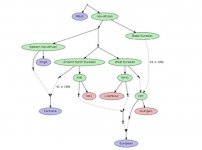
Why can populations be modeled exactly on older populations? Even if a population stayed genetically isolated, it wouldn’t look the same as it did in the past. I don’t imagine all Eurasian humans (without African admixture) can be modeled as 100% “the first migrants out of Africa.” Is it just the case that modern humans are just extremely similar to ancient humans 20k-40k years ago? To be honest with you, I don’t understand how humans can be modeled purely as populations from the ice age, like ANE or Basal Eurasian. Surely there must be a small percentage that’s unique to the modern population.If you don’t get what I’m saying, let’s say a population is genetically isolated for 20,000 years. Let’s call the population at year 0 population A, and at year 20,000 population B. Can population B be modeled as 100% population A? This gets to my question about how modern populations can be modeled as a mix of ancient populations like ANE and Basal Eurasian, or even more modern (but still ancient) populations like Yamnaya and EEF.
Last edited: