• Don't want to see ads? Install an adblocker like uBlock Origin or use a Europe-based privacy-friendly browser like Vivaldi or Mullvad.

Europe New Euro Banknotes: Why the ECB Is Redesigning Our Money

Maciamo

Veteran member
Admin
Messages
10,688
Reaction score
4,616
Points
113
Location
Lothier
Ethnic group
Italo-celto-germanic
The European Central Bank (ECB) has launched a public survey where we can vote on the new euro banknote designs, and it’s actually a pretty significant change for anyone using cash in the euro area.

Below is a quick overview of why the ECB is doing this, what the new designs are about, and how this survey works.

Why redesign the euro banknotes at all?

This is the first full redesign of euro banknotes since they were introduced in 2002. The ECB’s main reasons are:

– Improving security features to stay ahead of counterfeiters.
– Reducing the environmental impact of banknote production and circulation.
– Making the notes feel more relatable and better reflect European identity and values.

In short, they want new, more secure and more sustainable banknotes that people feel represent Europe today.

How did we get here?

This redesign is the result of a multi-year process rather than a quick cosmetic update. Key steps:

– The ECB first consulted a representative sample of euro area citizens on possible themes for future banknotes.
– A panel of experts (including historians, scientists and designers) shortlisted themes based on that input.
– In 2023, hundreds of thousands of Europeans gave feedback through public surveys and focus groups.
– Based on all that, the ECB selected two overarching themes for the future banknotes:
– “European culture: shared cultural spaces”
– “Rivers and birds: resilience in diversity”

Then, the ECB ran a Europe-wide design contest. More than a thousand designers applied, and a smaller group was invited to create full sets of banknote proposals. An independent jury reviewed these and narrowed them down to 10 final design proposals.

What is in the current survey?

The public survey that is now online asks us to react to those 10 shortlisted design proposals – five based on “European culture” and five based on “Rivers and birds”.

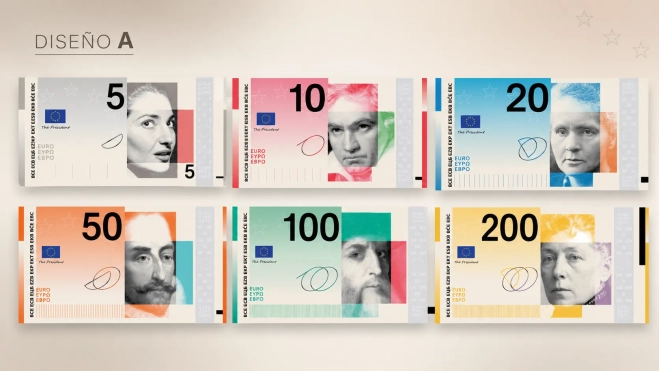
For the European culture theme, the proposals feature well-known cultural and scientific figures on different denominations, combined with everyday cultural scenes.

Here's what's actually on the table for each denomination (5, 10, 20, 50, 100, 200 euros):
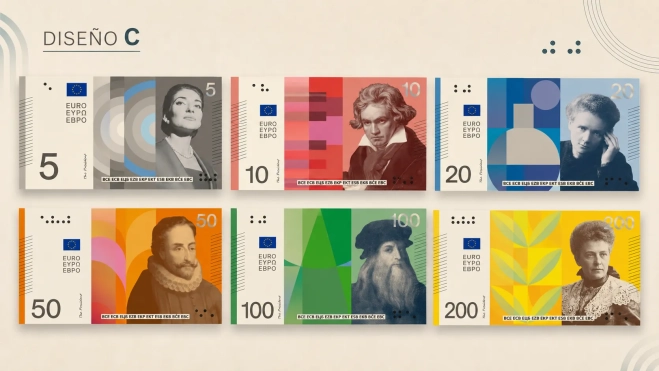
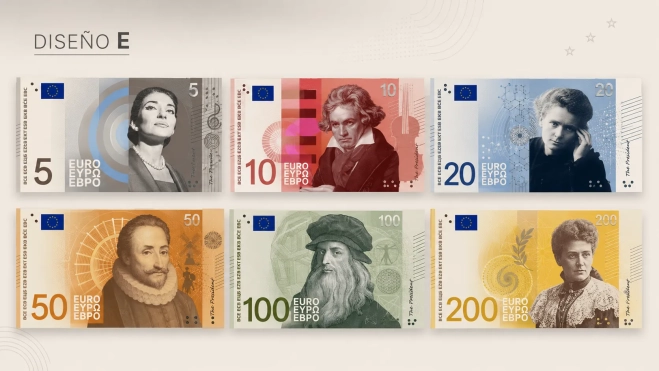
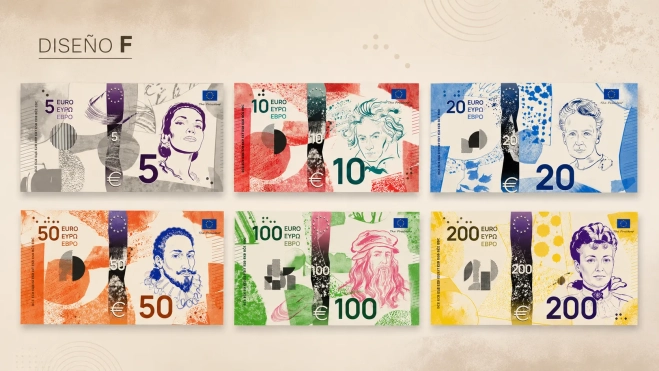
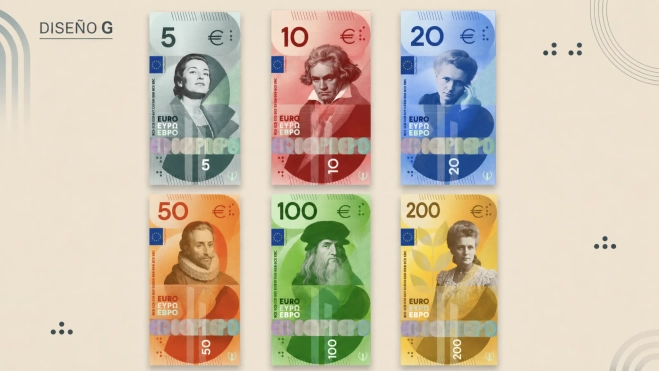
  • European culture theme: Maria Callas (5), Ludwig van Beethoven (10), Marie Curie (20), Miguel de Cervantes (50), Leonardo da Vinci (100), Bertha von Suttner (200), paired with scenes like street performances, choirs, schools, libraries, museums, and public squares.
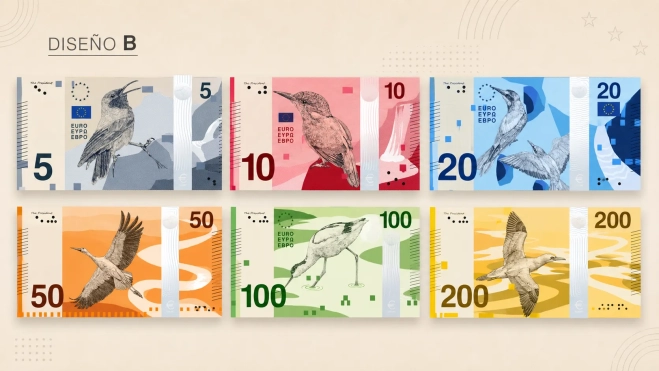
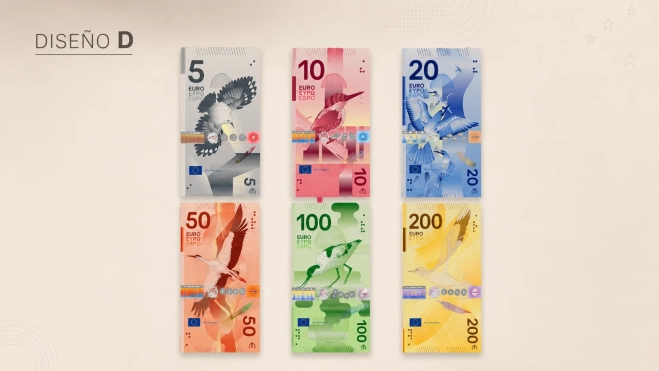
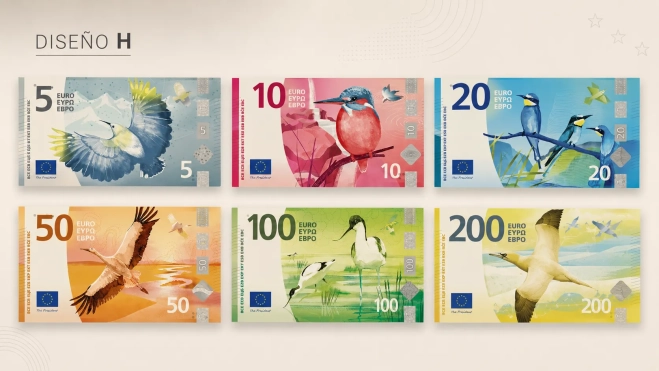
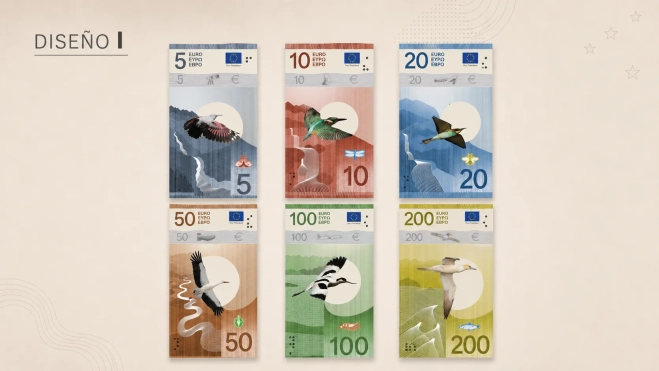
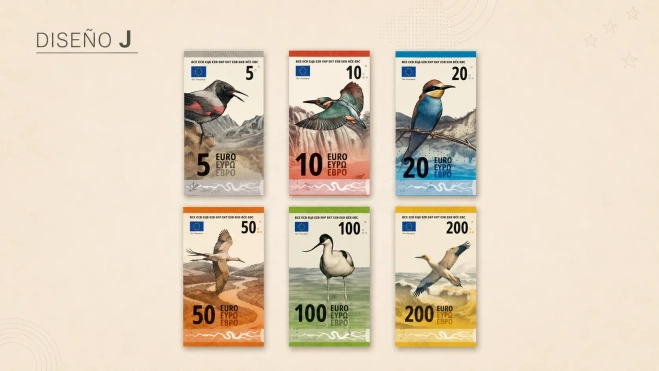
  • Rivers and birds theme: wallcreeper (5), kingfisher (10), bee-eater (20), white stork (50), pied avocet (100), northern gannet (200), each tied to European river and coastal landscapes.
For the Rivers and birds theme, each denomination shows a different bird strongly associated with European rivers, wetlands or coasts (such as kingfisher, stork, bee-eater, gannet, etc.), placed in natural landscapes. The idea is to highlight Europe’s nature, biodiversity and the role of rivers as connecting lifelines.

Here are the proposed designs for the front side :
1784876733993.png


1784876955005.png


1784876722645.png


1784876694177.png


1784876980800.png


1784877109131.png


1784877122304.png


1784877131385.png


1784877141368.png


1784877154281.png


You can see all the designs here.

How the survey works

In the online survey, you can:

– View all 10 shortlisted design proposals.
– Give your preferences and opinions on the two themes and the specific designs.
– Comment on what you like or dislike about the look and the ideas behind them.

In parallel, the ECB is also running a similar survey through an independent research company with a representative sample of citizens. That means the final decision won’t rely only on self-selected online votes from the public; both sets of results will be combined and analysed.

What happens after the survey?

After the survey closes, the ECB’s Governing Council will:

– Examine the jury’s recommendations.
– Review the technical assessment of the designs (security, durability, production, etc.).
– Consider the feedback from the public survey and the representative sample.

Based on all this, they will choose the final design concept for the next series of euro banknotes. Then comes a technical development phase, testing and preparation for production. So even once the design is selected, it will still take several years before the new notes are actually printed and start circulating.

How to participate

If you want to have a say in what our future euro banknotes look like, you can take the survey here:

https://surveys.ecb.europa.eu/10b/banknotes/share/

It only takes a few minutes, and it’s one of those rare cases where ordinary citizens can directly influence something we literally use every day: the money in our pockets.
 
Last edited:
Personally, I find the bird designs H and J, particularly beautiful. However, like many people, I believe that it would be better to have famous people on the bank notes instead of birds as they represent our shared cultural identity. But I really don't like designs A, C and F, which are too modernist. For famous people, I prefer designs E.

1784905131161.jpeg


Regarding the choice of people, I understand that they had to find a balance between countries, choose three men and three women, and select people from a variety of backgrounds.

Beethoven is a very good choice. He is half Belgian, half German and worked for a long time in the Austrian Empire.

Leonardo da Vinci is also an excellent choice as he is a multifaceted genius who combines artist and scientist, representing perfectly the Renaissance man.

Mary Curie is Polish but worked mostly in France with her French husband. She's the most famous female scientist and the only woman who ever obtained two noble prices in different disciplines (physics and chemistry).

I suppose that they chose Cervantes because the UK is no longer in the EU (and wasn't in the Eurozone anyway), otherwise Shakespeare would have been a better choice.

Maria Callas is an odd choice, though, as she was born in New York and was an American and Greek citizen. Why of the thousands of famous people in European history did they have to choose one who was born an American?

I understand that Bertha von Suttner was a reasonable choice for a famous European woman as she was the second woman in history (after Marie Curie) to obtain a Nobel Prize (Peace Prize). She was Austrian, but also with Czech ancestry. However, in my opinion, she's not famous enough.
 
Last edited:
The "European Culture" theme has the advantage of celebrating Europe's cultural and scientific heritage. However, as soon as you choose individuals, some questions arise. Why Beethoven and not Bach or Mozart? Why Leonardo and not Rembrandt or Velásquez ? Why Cervantes and not Dante or Goethe? With only six personalities for a Union of 27 member states, and a continent with over millenia of recorded history, many Europeans will inevitably feel that their country's contribution is underrepresented or absent.

By contrast, the "Rivers and Birds" theme avoids almost all of these problems. Rivers and migratory birds belong to no single nation, they naturally cross borders, reflecting European interconnectedness, they represent Europe's biodiversity and shared environment, are politically and historically neutral, and are unlikely to become controversial as the Union evolves.

The current euro banknotes (bridges and architectural styles) have been successful for much the same reason, they symbolize a common European heritage without privileging one nation over another.

One could even argue that the birds theme has an additional symbolic meaning. Many of the selected species migrate across Europe without regard for national frontiers, while rivers physically connect countries from source to sea. Those are fitting metaphors for a common currency used across many sovereign states.

In my view, if the objective is to create banknotes that Europeans will use for several decades, the "Rivers and Birds" series is likely to age better. Cultural tastes and historical reputations can change, and debates over who should be represented may intensify as new countries join the euro area. Native wildlife and landscapes, by contrast, are much less likely to become divisive and can be appreciated by Europeans regardless of their nationality or political views.

My favorite design is the proposal H. And the backs retain an architectural dimension by depicting European public buildings which creates a nice balance. It combines nature, architecture, and European institutions in a coherent way.

yH2Rwt2.png
 
Last edited:
I completely understand your point about birds being more neutral and less likely to be controversial.

Let's also not forget the backside of the bank notes. in the historical figure series, it depicts cultural activities in relation with the person on the front side of the note (e.g. Classical music for Beethoven and people in a library for Cervantes). But the back side of the bird design shows buildings of the European Union (European Parliament, European Commission, European Central Bank, European Court of Justice, etc.), which are important symbols of the European Union and its values. Unlike historical figures, they are not controversial, as there are a few of these EU institutions, and they are shared between all member states.

In terms of pure aesthetics, I also think that these two bird/buildings designs are better than any of the designs in the historical figures series.

This one is my favorite (design H).

1784924430100.png

I like the colorful birds here, but they don't really like the buildings on the other side.

1784924929828.png
 
Since the creation of the *real* on July 1, 1994, Brazil has definitively abandoned the tradition of honoring historical figures on banknotes. Animals from our native fauna represent a shared heritage and are the ones deserving of recognition on our currency.
Historical figures are often controversial; the reputations of political leaders, military figures, or statesmen shift over time. Furthermore, animals offer several advantages: they highlight biodiversity and promote environmental education by helping millions of people recognize native species; they allow for visually rich designs—featuring plumage, coat patterns, and natural landscapes—that are difficult to counterfeit due to their intricate graphic details; and they lend longevity to the design. While historical figures can become politically sensitive, wildlife species remain relatively stable symbols.
IMG_0858.png
 
To solve the problem of reasonably widespread national representation, notes could easily add several figureheads from multiple European nationalities of a common discipline onto a single note and this would perhaps represent the pancontinental nature of the EU broadly. While I think some portrayals of European wildlife are reasonable the broader focus should be on European civilization since the EU is not a wildlife committee, but a political and economic organization whose actions affect its citizens first and foremost. Europe has a plethora of beautiful historic architecture to utilize for such imagery.


Better yet, one could have nationally representative figureheads on notes distributed specific to their respective countries. In this sense currency returns to (mostly) matching the representative nation outside of a minority of circulating foreign notes. As foreign notes come in, banks can exchange foreign notes for domestic ones as they are deposited.
 
I've seen several users on X posting their own suggestions for the banknotes, the best one I've seen is the one below.

The series presents a chronological journey through European civilization:
The €5 note represents Classical Greece: the Parthenon, a Greek statue, a black-figure vase.
The €10 note represents Ancient Rome: aqueducts, a Roman emperor, a triumphal arch, a mosaic.
The €20 note represents Christian Europe / Byzantine and Romanesque: Hagia Sophia, Christ Pantocrator, an illuminated manuscript, a cathedral.
The €50 note represents Gothic Europe: a cathedral and rose window.
The €100 note represents the Renaissance: Leonardo's Vitruvian Man, Brunelleschi's dome, Botticelli's Birth of Venus.
The €200 note represents modern art and architecture: Kandinsky-inspired abstract art, a modern sculpture and the Guggenheim Museum Bilbao.

Instead of six unrelated historical figures, every note represents an era that contributed to European civilization, almost a visual history of Europe
The problem is that this series is less neutral than the current notes or the birds theme. The €20 note prominently depicts Christ. While this undeniably reflects a central part of European history and art, some might object that euro banknotes should not feature religious imagery.
And several countries have no monuments represented directly.

That said, because the focus is on eras rather than individual nations, these debates would probably be less intense than with portraits of famous people.

Regarding the €20 note, we cannot forget that Byzantium preserved Roman law, Greek knowledge, and much of classical literature, transmitted knowledge to later generations, and influenced southeastern and eastern Europe for centuries. These are genuine European contributions that are sometimes overlooked.

The last note is the weakest thematically. Modern abstract art is certainly part of European culture, but Europe's influence on the modern world also came through science, industry, democracy and technology. A composition including figures such as the telescope, a steam engine, a particle accelerator, or iconic scientific instruments alongside modern architecture might better convey Europe's later contributions.

This design celebrates Europe's shared heritage through periods rather than personalities and gives the notes a coherent narrative. While the current euro banknotes already represent successive periods of European civilisation through architectural styles, this design makes those periods far more recognisable by depicting their most iconic monuments, works of art and cultural achievements.
It has something the official "European Culture" proposals lack: a unifying historical narrative. Rather than asking Europeans to agree on six individuals, it invites them to recognize the major epochs that collectively shaped European civilization.

G61BXWk.jpg
 
Last edited:
i don't think any hisorical figures or themes will be good as there is always a problem with inclusion/representation. it is less depicting modern european culture and more some specific countries histories. if they want to do this with culture, they should first of all try to define what is the real modern european culture or the values, then try to depict those things on a more abstract level. the birds theme evades all of this and birds are always nice to look at, so if those are the two only options, then birds are better.
 
I've seen several users on X posting their own suggestions for the banknotes, the best one I've seen is the one below.

The series presents a chronological journey through European civilization:
The €5 note represents Classical Greece: the Parthenon, a Greek statue, a black-figure vase.
The €10 note represents Ancient Rome: aqueducts, a Roman emperor, a triumphal arch, a mosaic.
The €20 note represents Christian Europe / Byzantine and Romanesque: Hagia Sophia, Christ Pantocrator, an illuminated manuscript, a cathedral.
The €50 note represents Gothic Europe: a cathedral and rose window.
The €100 note represents the Renaissance: Leonardo's Vitruvian Man, Brunelleschi's dome, Botticelli's Birth of Venus.
The €200 note represents modern art and architecture: Kandinsky-inspired abstract art, a modern sculpture and the Guggenheim Museum Bilbao.

Instead of six unrelated historical figures, every note represents an era that contributed to European civilization, almost a visual history of Europe
The problem is that this series is less neutral than the current notes or the birds theme. The €20 note prominently depicts Christ. While this undeniably reflects a central part of European history and art, some might object that euro banknotes should not feature religious imagery.
And several countries have no monuments represented directly.

That said, because the focus is on eras rather than individual nations, these debates would probably be less intense than with portraits of famous people.

Regarding the €20 note, we cannot forget that Byzantium preserved Roman law, Greek knowledge, and much of classical literature, transmitted knowledge to later generations, and influenced southeastern and eastern Europe for centuries. These are genuine European contributions that are sometimes overlooked.

The last note is the weakest thematically. Modern abstract art is certainly part of European culture, but Europe's influence on the modern world also came through science, industry, democracy and technology. A composition including figures such as the telescope, a steam engine, a particle accelerator, or iconic scientific instruments alongside modern architecture might better convey Europe's later contributions.

This design celebrates Europe's shared heritage through periods rather than personalities and gives the notes a coherent narrative. While the current euro banknotes already represent successive periods of European civilisation through architectural styles, this design makes those periods far more recognisable by depicting their most iconic monuments, works of art and cultural achievements.
It has something the official "European Culture" proposals lack: a unifying historical narrative. Rather than asking Europeans to agree on six individuals, it invites them to recognize the major epochs that collectively shaped European civilization.

G61BXWk.jpg

These bank notes are nice, but the point is not to retrace European art history. What's more these designs focus almost exclusively on southern Europe. The Byzantine Empire was mostly outside the boundaries of the modern EU (centred around Turkey). Some will argue that even the Roman Empire was more of a Mediterranean Empire, including North Africa and Near East, but not including most of central and northern Europe, which are part of the EU today (ireland, Denmark, Sweden, Finland, Estonia, Latvia, Lithuania, Poland, half of Germany and the Netherlands, etc.). Nearly half of ancient Greece was also outside the boundaries of the modern EU. It included western Turkey, the Black Sea coast of Ukraine, parts of Albania... Most modern Europeans do not identify with it.

It's better to focus on modern EU institutions, in my opinion.
 
Back
Top