• Don't want to see ads? Install an adblocker like uBlock Origin or use a Europe-based privacy-friendly browser like Vivaldi or Mullvad.

origin of brachycephaly

That afalou skull doesnt look like something that i know. the rectangular orbits are clearly a negroid or archaic human caracteristic, is cranium look like a total melting pot of early humans and he's got a very robust chin with an long face... he must have some different origins ( africa, south europe, mediterranea in general... ).
 
Are you talking about "swaddling"? It was indeed done in Europe and very recently too. I still have my own swaddling cloths as a keep sake. My head wasn't swaddled, however.

See:
https://en.wikipedia.org/wiki/Swaddling

As a teenager I teased my mother about abusing me as an infant, but lo and behold, my pediatrician recommended it for colicky babies. He said it soothes them, helps them sleep, and helps prevent Infant Death Syndrome, and so I wound up swaddling my own infants. What goes around comes around.

Are you guys saying that the head shape was deliberately deformed until recently?
 
Come on ! for the deformation of cranium we strip the head with a bandage ( maybe the term does not exist in english, so the case, my apologies ). In french the concept of of elongated skull is called Deformation Volontaire Crânienne, so yes, it means that it is deliberate, there is no, hyperbrachycephalic elvens in nature in ancient times.
 
Andronovo 's were not homogenous, but they shew (according to what I red) some global robusticity, and a tendancy to more mesocephalic less dolichocephalic heads compared to 'cromagnoid' people of the Mesolithic steppes

No, they were not homogenous, but dominant people were close to Afanasievo, as far as I know.
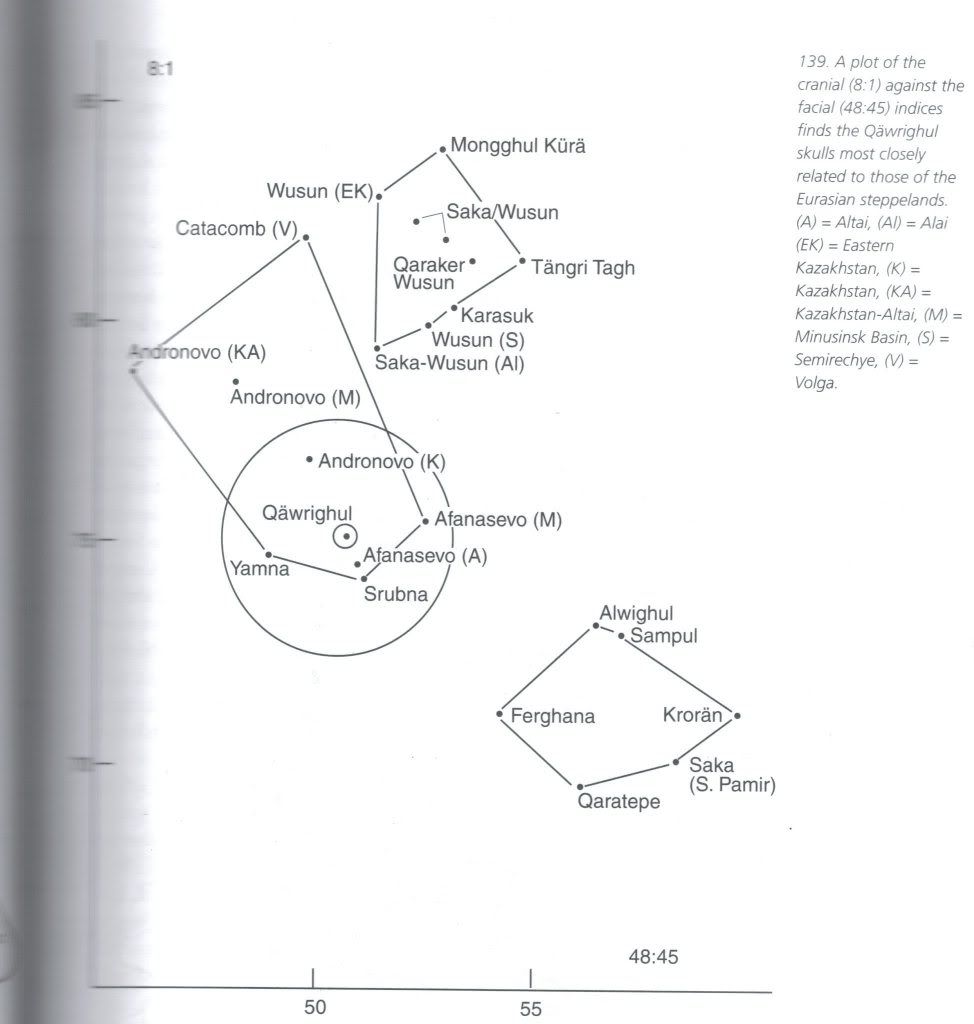
4-2.jpg

From "The Tarim Mummies" by J.P. Mallory and Victor H. Mair, 2000

In the map, Yamna is close to Afanasievo, which I really don't understand. I don't think yamna,sredni stog and khvalynsk people could become Afanasievo people, but opposite is possible. Moreover, seems like the paleo european type people, especially Afanasievo people, spread Indoeuropean language. Afanasievo R1b is close to srubna R1a-z93(Aryan people) and Qawrighul(2,000bc tarim) related with tocharian.

Gimbutas (1985: 191) has suggested that the Srednij Stog II culture in the DnieperDonets region which she identifies as her Kurgan I and II cultures (ca. 4500–3500BCE) was not the result of local evolution in that region but had its source in an
intrusion from an earlier culture farther east with connections to the earliest Neoli-
thic in the Middle Urals and Soviet Central Asia. The archaeological record of the regions still farther east before that time is unfortunately still largely blank.:Edwin G. PulleyblankUniversity of British [email protected] PEOPLES OF THE STEPPE FRONTIER IN EARLYCHINESE SOURCES*
 
Sredni Stog is called Kurgan I and II, what it means that the first kurgans sepulturs were on sredni stog or Kurgan is just a generic term for the Kurgan Hypothesis ? By the way, with the environnmental context of tarim basin, i think we should not take conclusion about them, they could be anything, to a fusion with tocharians and iranians, to rejected peoples.
 
That afalou skull doesnt look like something that i know. the rectangular orbits are clearly a negroid or archaic human caracteristic, is cranium look like a total melting pot of early humans and he's got a very robust chin with an long face... he must have some different origins ( africa, south europe, mediterranea in general... ).

NO, nothing negroidlike in Afalou - archaic orbits, surely, but not particularly african, and the remnant is very very non-negroid - some Qafzeh/Skhul skulls, even more primitive (true they were more ancient), had very more proto-negroidlike tendancies, I think
 
@Johen, friendly:
I add the Afalou Mongolia Bronze proximity is sufficient to prove the unaccuracy of this kind of plottings!
 
The rectangular orbits are an negroid influence, in archaic humans the proximity with the out of africa, explain this, in afalou, the geography explain this. Other than the rectangular orbits, he's seems pretty much a melting-pot of humans features.
 
The rectangular orbits are an negroid influence, in archaic humans the proximity with the out of africa, explain this, in afalou, the geography explain this. Other than the rectangular orbits, he's seems pretty much a melting-pot of humans features.

It's your opinion, it seems withtout any basis to me - Could you provide me ancient (but "modern") skulls of plain Africa? I saw only one, but it was very very far from Afalou indeed.
 
good reading - not too evident, only an abstract

contour was generally asymmetrical. Taking into account the rounded and symmetrical inferior portion, the orbit contour of the Asian sample resembles a quadrilateral shape with a slight inclination; it has a narrower superior portion and a broader inferior portion. This contradicts the assumption proposed by Lahr (1994, 1996) that a particular orbit shape associated with East Asian populations was unidentifiable. These results also do not support claims that modern Chinese have square or elliptical orbital shape (Liu et al, 2006; Lu, 2007). Lahr (1996) proposed that the orbital contour of Europeans were characterized by their moderate to pronounced inclination, which was also demonstrated in the present study. Additionally, the lower and upper margins of the European orbital contour remained parallel in a large number of specimens. Considering the straight lateral margin, the orbit shape of European specimens was almost an inclined square or rectangle. However, the orbits of some European specimens involved an obvious inclined inferior contour and a horizontal superior contour. Therefore, the degree of inclination for the inferior portion especially on the internal aspect of the lower margin is a more stable and a typical characteristic of the European orbital contour. Cameron’s (1920) suggestion that orbital contours of people from Eurasia have more rounded corners was undermined here. As proposed by Villiers (1968), the means and distribution of the orbit index categories showed that hypsiconch orbits may be a Bantu-speaking South African specific characteristic. However, the characterization of Africans as having a much taller orbit was not supported by the results of the present study or those by Masters (2008). The typical features for the African superior and inferior contour of the orbit concentrate on its shortness, although parts of African specimens were still relatively high. Villiers (1968) proposed that the orbital contour of Bantu-speaking South Africans was characteristically rectangular in shape. However, as shown in the present study, the orbit shape in the African sample resembled that of Asians and Europeans to a large degree. Therefore, it is difficult to describe it as being either rectangular or round. Generally speaking, the African orbit
is not as rectangular or as square as Europeans and was less rounded than Asians. Masters (2008) placed Asian and African orbit shape on two opposite positions and proposed that the orbit shape of Europeans fell between them, with slight affinity towards the African group. However, based on the results of the present study, in the superior contour of the orbit, Europeans had a closer affinity to Africans than to Asians. The inferior contour of Africans showed approximate affinity to both Asians and Europeans. When lines were used to connect any two populations, with the line length representing the difference of average orbit shape, then a triangle was formed to represent the relationship among these three populations. In this triangle, the line between Asians and Africans was always the shortest. This means that, in terms of overall orbital shape, the contour of Asians and Africans show closer affinity, than that between Europeans and either Asians or Africans. The most variable areas of the superior contour concentrate on the internal aspect of the upper margin and the contour near the fmo, with the contour between them being relatively stable. The portion of the frontal bone forming the upper margin of the orbital aperture in relation to the horizontal plane of the cranium varies in its inclination, which probably involves the whole orbital roof. Additionally, there was a disproportionate increase in the internal aspect of the upper margin for the Asian sample, which increases the variability of the superior contour. As in the superior contour, rather than overall change, the majority of the variation in the inferior contour comes from the partial and disproportionate transformations. The internal aspect of the inferior contour was the most variable area, especially for the European and African samples. These areas along the lower margin extend more laterally than Asians, which could explain why more specimens in the Asian sample were correctly discriminated. The variation of the contour near the fmo was relevant to change of the superior-lateral corner, and plays a significant role in determining whether the orbit was rectangular or rounded. This indicates that orbit shape should be treated as a metric feature based on its nature of being continuously
 
Ahah ! funny response ! the rectangular orbits are definitly negroid or archaic ( archaic humans are negroid by definition ). What do you mean by ancient and modern ? Afalou is 20'000 B.C. He's gonna be nothing else than a cro-magnoid from north africa. He's skin color is not important. So yeah, by negroid, i surely being misunderstood, i should say, Archaic Anatomicaly Modern Human Who Obviousely Look Like Modern African People, some way or another, it can be Khoisan, or something else, but definitely for a modern human eyes, he had to look more african, than modern european.
 
From above: "Generally speaking, the African orbit is not as rectangular or as square as Europeans and was less rounded than Asians.
I began to wonder if your are not a bit blockheaded??? (LOL) - Excuse this rude word, but I don't understand your way of thinking - and have you ever seen a Khoisan man? He is the farthest possible you can find from Afalou, he is paedomorphic what Afalou is not at all!
and modern Africans (except SOME OF the Northern Africans from Maghreb) are all far enough to very far from Afalou; except in Maghreb the closest to Afalou would be some RARE Arabs of Yemen (not the typical Yemenite Bedwin, himself very gracile 'mediter' and light jawed, contrary to Afalou) - Afalou came FROM EAST (so Eurasia) or very close places, not from SOUTH -
today Negoids are not by force closer to ancient Humanity than Mongoloids or Europoids are: all of our ancestors evolved through different paths, just Africans stayed in a climatic region more akin to the ancient conditions - I even think that the externally colsest people to ancient Humans are Papoos and Australoids...
I think you have to look and read more about this stuff, and if possible not on the too numerous sites dedied to physical anthropology where old sagas are repeated ad nauseum.
No offense.
 
Apparently European Jews (both Ashkenazi and Sephardi ones) were/are brachycephalic (C.I. between 81.5 and 83.0):
Maurice Fishberg, "Physical Anthropology of the Jews. I. The Cephalic Index", published in: "American Anthropologist", Vol. 4, No. 4, 1902.
The "Jewish nose" is in fact Armenoid nose, and it is actually most common among ethnic Armenians.
Data on percentage of convex noses by country / ethnicity:

Armenians: 62%
Albania (Ghegs): "over 50%"
Montenegro: 52%
Jews (Ashkenazi): "below 50%"
Ireland: 45%
Basques: 43% (Spanish); 49% (French)
Netherlands (Frisians): 35%
Italy (North): 32%
Greece: 30%
Switzerland: 25%
Serbia: 25%
Ukraine (Volhynians): 17%
Spain: 15%
Bulgaria: "rare"

And how do you explain the connection between Armenians, Ashkenazi, Irish, Basques, French and Frisians (Northern Dutch)?

Italy (North) is 23,8% (31,70% males and 16,01% females = 23,8%)

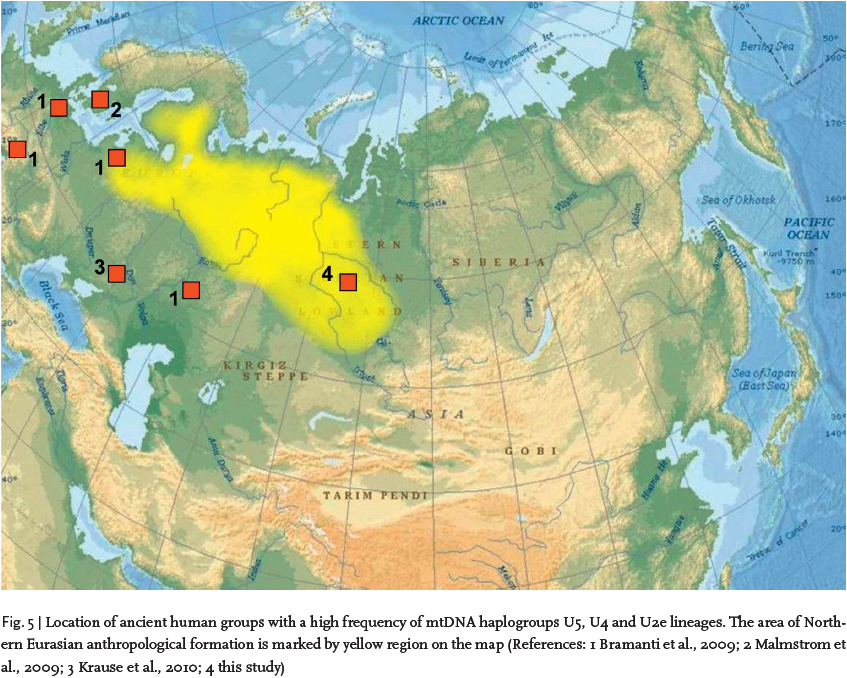
I think the convex nose might be related with mesolithic-neolithic people, who lived in the yellow zone of Northern Eurasian Anthropological Formation , karzakstan, south western siberia and altai area
This people’s facial traits are low, wide and convex nose with upper facial flateness. The traits gave us a great impression of being mixed with caucasoid and mongoloid. So I agree the opinions that this people is just intermediate between caucasoid and mongoloid and that the convex nose was created in cold area. As I remembered, yamna people had that nose too.
Pretty interesting thing is that only yamna R1b was europoid and kitoi R1a mongoloid at that time, who resided at the end of the intermediate people’s huge territory.
Another mistery is, without any anthro or archaeological footprints on the huge territory, afanasisevo caucasoid popped up in altai, and mongoloid in pit-comb culture area.

U2e-U4-U5region.png


Karzakstan:
All Botai skulls are large, have a characteristic horizontal Flatness in the front part, which is also noted in some ancient Finds of Western Siberia (Protoka & Sopka-2), the steppe Urals (Gladunino-3), Western Kazakhstan (Shoktybai, Kumsai, Zhirenkopa, Ishkinovka), the Eastern Kazakhstan (Shiderty, Zhelezinka, Ust-Narymsky, Rough II), and the Northern Turkmenistan (Tumek-Kichidzhik / Priaralye). Thus the Botany skulls Represent a separate anthropological type, formed in the steppe Parts of Asia during the Eneolithic period - "Kazakh steppe type"

Southern Siberia (which is sometimes viewed as a region that includes the Russian part of the Altai-Sayan highland) and Western Siberia (which is often believed to include
Gorny Altai, the Kuznetsk Alatau, Kuznetsk Basin, and the Salair range)
are geographically intermediate between the distribution areas of Caucasoids and Mongoloids.
In Russian physical anthropology, Western Siberia is described as a northern intermediate zone, and Southern Siberia as a southern intermediate zone. Morphological intermediacy is commonly believed to result from hybridization. Most physical anthropologists studying the prehistoric populations of Gorny Altai, too, believe that the key evolutionary factor was hybridization
between Caucasoids and Mongoloids. However, human remains recently excavated in that territory suggest that at least in certain cases, intermediacy might have been caused by evolutionary conservatism, leading to unusual combinations of diagnostic traits. Thus,
certain prehistoric cranial series from Gorny Altai are characterized by a broad face, equally flattened at the nasomalar and zygo-maxillary levels, convex nasal bones combined with a small nasal prominence angle, medium wide nasal aperture, and broad and low orbits. This combination, which is rather unusual since it cannot be described as either Caucasoid or Mongoloid, shows a remarkable persistence in Gorny Altai over several millennia. The entire complex of these traits was observed in several skeletal populations of that territory,
from the Neolithic to the Early Iron Age, strongly implying biological continuity.

Karelians display a rather unusual trait combination, characterized by mesobrachycrany and a relatively short, wide, robust and extremely high braincase. The face is medium high and medium wide (it is wide in northern Karelia). The upper horizontal facial profile is flattened by European standards, but the midfacial profile is sharp. The nose is sharply protruding and convex. This trait combination opposes the Karelians to all modern and recent groups of Eurasia including the closest linguistic relatives of Karelians, the Baltic Finns, specifically the Suomi Finns and Estonians (Khartanovich, 1986, 1990). Among the prehistoric series, the same trait
combination is observed in the Meso-Neolithic sample from Zvejnieki, Latvia (Khartanovich, 1991b).
A significant contribution to the study of the early population history of Eastern Europe and of the origins of the contradictory trait combinations distributed on that territory was made by T.I. Alekseyeva. In a joint monograph describing the Neolithic cranial series from Sakhtysh in the Upper Volga area, she notes that certain European Mesolithic groups were characterized by large dimensions of the braincase and especially by its conspicuous height. The face was wide and relatively low and a flattened upper facial profile co-occurred with a sharp midfacial profile and sharply protruding nasal bones (Alekseyeva, 1997). In Alekseyeva’s words, this
unusual trait combination, which was more than once revealed by multivariate statistics, was widely distributed and was typical of Mesolithic Caucasoids of the forest and forest-steppe zones of Eastern Europe as evidenced by groups such as Zvejnieki, Popovo, Southern Oleniy (Reindeer) Island, and Vasilievka I and III. In her words, there is no doubt that robustness and upper facial flatness were inherited from earlier Caucasoid populations of Eastern Europe (Ibid.: 26). In the joint monograph integrating the anthropological studies of the Eastern Slavs, Alekseyeva formulated her conclusions regarding the origin of this trait combination: “Judging by the concentration of these unusual features in Scandinavia, the Baltic and the Onega area, people displaying them had migrated to Eastern Europe from the northwest and were possibly associated with the Mesolithic cultures of the circum-Baltic region. Revisiting the long-standing issue of admixture versus evolutionary conservatism in the Mesolithic population of Eastern Europe in the light of new data, we must reject the admixture hypothesis.
The location of this peculiar type and its expansion from the west to the east suggest that it should be regarded as an independent ancient type which originated in northwestern Europe” (Alekseyeva, 1999: 254–255). In the Neolithic, biological continuity with the Mesolithic population was preserved but the diversity increased.
Importantly, according to Alekseyeva (Ibid.: 255), the population which in the Mesolithic had been quite Caucasoid despite the unusual combination of the two 7 facial profiles flattened in the upper part and sharp in the middle part; one might add that the face was very broad and the braincase was very high) began to assume a somewhat “Mongoloid” appearance.After the Neolithic, groups marked by the trait combination noted by Alekseyeva and others seem to have disappeared from Eastern Europe. This may have been partly due to the scarcity of cranial remains from the Bronze Age, Early Iron Age, and medieval burials in the Eastern Baltic area and to the complete absence of such remains from Karelia.

 
The nose shape is a very unsteady ground, the old states were oversimplifications with simplistic categories -
it exists more than a shape that would be classified 'convex' (dame for concave), spite they have no common genetic origin nor same profile - some are convex only in their lowest 2/3, and have a "hole" between glabella and higher nose, other are less convex, more regular, and have an higher nose root under glabella and so on...
to go back to the very thread, to complete the Coon statement reproduced here (thanks to the one who send it) about apparition of brachycephaly in Anatolia, a survey of 3 Japaneses (2009) "found" that the Himrin pop was dolichocephalic like the pop of South-Mesopotamia, but more heterogeneity arose during and after the Parthians period; among Persians, mix of dolicho's and brachy's after the Achemenides (they said) - but they and others think there were already brachy's among people in the Zagros mountains (Gouteans and Kassites) just after Sumer and the Akkadians - an other one wrote "above all it is clear as a result of anthropologic researches that brachycephalisation increased in Anatolia in a very clear way after the Hittites" what can be the result of diverse factors, Hittites or the populations they submitted and/or displaced/centralized...
as a whole in Anatolia the brachycephaly as a common phenomenon seem appearing only around the 2250 BC - the problem is it is unclear yet where it came from, and brachycephaly doesn't mean ONE kind of shape nor ONE folk -
 
I dont think we should refer as brachycephaly in the case of metrics but more in the case of flat occiput. Flat occiput definitevly cant have multiple origins, but only one, in an ancestral population with a certain phenotypes who after expended in a large part of the world. The only legit place that thoses mutation can occurs are the eurasian steppe. If only we had the skull of ust ishim and not just a leg bone... About convexe nose, its also a non-sens to try to explain it with a multiregional mutation who occurs in different populations around the world...
 
Brachycephaly is brachycephaly, and planoccipitaly is planoccipitlay, associated to some brachycephals, not all of them - specific mutation or new mix of pre-existant genes? for both I favour mutation(s) but noboby seems sure of the origin - some old anthropologists suggered the 'dinaric' so called type found birth in mountains ecosystem close to sea, on a phylum tied to 'brünn'-'capelloid', and 'dinaric' is typified by flat headback; I avow I'm short here; Coon thought in a specific crossing, so more a mix result than an unique specific mutation - he even proposed it was a condition involving brachy's and dolicho's of any sort, so producing in the details more than ONE 'dinaroid' type, according to "parents races"; nobody seems having the right answer todate, even if Coon's hypothesis doesn't seem so stupid - ATW the typical balkanic/carpathian 'dinaric' complex could be linked to a limited (in number) special result of crossing between high statured dolichomorphic/dolichocephalic type with an high-statured robust brachycephalic type, creating a rather stable type where were selected diverse homozygotous pairs of biallelics from donors, pairs which were not associated together in any of the parents type, but become associated in the new "type", and numerically dominant in the new population; so an unbalanced result of crossing (usually the result is rather a numerically dominant type of heterozygotous pairs) - maybe the lambdoid flattening among the brachycpehalic "parents" could help to create the allover flat occiput? We know very few and this matter is no more the focus of today scientists; but genetic dominance too can create curious results in crossings, I think -
 
The thing is, with melting of different population the result that planoccipitaly become a dominant gene is near 0, in terms of metrics brachycephaly with flat occiput or without, is not the same, because brachycephaly without flat occiput, can be charachterised by melting between a brachycephalic and dolichocephalic type of people, create a continnum between mesocephaly and brachycephaly. But flat occiput mever can be the result of a melting between dolichocephalic and brachycephalic people, so flat occiput has to be somehow a " pur " phenotype, born somewhere and expand in all part of the world.
 
Or you know more than me (possible) or you don't have the smallest idea of what crossings can do at the individual level after some generations;
what doesn't exclude a specific mutation creating this so typical flattened occiput, I made only suppositions, gratis; but a crossing involving an already partly flattened lambdoid (what seems frequent among some 'borreby's') could be the beginning of a track. I don't know. How could I? But it seems the first typical 'dinaric' types were found in Europe, and they appeared relativey lately (3000 BC? or a bit before?); but new discoveries could ruin my statement. I give it up, for the moment because I've no new clue -
 
It's not important, because planoccipital faces are found for exemples in a south-east asia north east asia gradiant and in a continuum from armenia-anatolia-balkans. The phenotype of the face are very different on these two contexts, but the skulls are slightly the same.
 
Back
Top