• Don't want to see ads? Install an adblocker like uBlock Origin or use a Europe-based privacy-friendly browser like Vivaldi or Mullvad.

Origin of the basques (revisit)

You would never wind up with 50% EEF levels in northern Europeans in that way. When Lazaridis et al says 50% of the genome of the Germans is EEF, to take one example, they mean that the computer scanned the total genome of the three ancient samples and the total genome of modern samples, and in terms of the total autosomal make up of a population like the Germans, not just a few percentage points that could be attributable to certain beneficial alleles or to the mtDNA, it turns out that there is a 50% overlap between this modern population and the Stuttgart woman.

Even assuming that the Bronze Age populations were very large in number, and without taking into consideration the fact that even, as just one example, a slight increase of the ability to father males of the R1b and R1a lines might over thousands of years result in a dramatic shift in frequency of certain yDNA lines, the only way that such high levels of EEF could appear in northern Europeans is if these Bronze Age migrations were mostly male mediated. I think that's also a conclusion that can be drawn from the ancient mtDNA paper to which I linked upthread. A very small percentage of "new" mtDNA appears in the cultures most likely to have experienced gene flow from the east.

This would mean that if new ancient samples where discovered then the numbers would change by a greater degree ......ATM my EEF stands at 69.21 ...it could move 10 points by a new find(s) if I understood what you meant.
 
This would mean that if new ancient samples where discovered then the numbers would change by a greater degree ......ATM my EEF stands at 69.21 ...it could move 10 points by a new find(s) if I understood what you meant.

That's virtually identical to the 70% level found for northern Italians in general.

That isn't precisely what I meant. I think that when whole genomes of "Mesolithic" peoples from the Balkans, Greece, perhaps Italy, are sequenced and subjected to the kind of analysis done by Lazaridis et al, it's *possible* that they were already EEF like. This is pure speculation, of course. I only think that it might be a possibility because of the mtDNA results released about Greek mesolithic samples in which not a single "U" mtDNA was found, and instead, there was a high preponderance of what we are accustomed to think of as "Neolithic" lineages. I've also often wondered how likely it is that Mesolithic peoples in the southeastern Balkans were substantially different from the "farmer" peoples of adjacent Anatolia. Every "farmer" culture was first a hunter-gatherer culture after all, and the distance between those two areas is miniscule in the grand scheme of things.

Alternatively, the hunter gatherers of the Balkans and Italy might turn out to not be EEF, but to be at the same time substantially different from both WHG and ANE. In that case, since you'd be dividing the "pie" into four instead of three pieces, the EEF component might go down for all Europeans.

I don't know if that makes sense.
 
That's virtually identical to the 70% level found for northern Italians in general.

That isn't precisely what I meant. I think that when whole genomes of "Mesolithic" peoples from the Balkans, Greece, perhaps Italy, are sequenced and subjected to the kind of analysis done by Lazaridis et al, it's *possible* that they were already EEF like. This is pure speculation, of course. I only think that it might be a possibility because of the mtDNA results released about Greek mesolithic samples in which not a single "U" mtDNA was found, and instead, there was a high preponderance of what we are accustomed to think of as "Neolithic" lineages. I've also often wondered how likely it is that Mesolithic peoples in the southeastern Balkans were substantially different from the "farmer" peoples of adjacent Anatolia. Every "farmer" culture was first a hunter-gatherer culture after all, and the distance between those two areas is miniscule in the grand scheme of things.

Alternatively, the hunter gatherers of the Balkans and Italy might turn out to not be EEF, but to be at the same time substantially different from both WHG and ANE. In that case, since you'd be dividing the "pie" into four instead of three pieces, the EEF component might go down for all Europeans.

I don't know if that makes sense.

it makes sense!
I think you are right when you suppose like me the cultural-economical new finds (agriculture) could occur in a place which is only a peace of a greater human group territory:
the newly agricultors are not obliged to be different from their still hunter-gatherer neighbours, not EVERYWHERE
I confess I would be very glad if things were so simple as different/same culture - different/same genes - different/same language: helas! too easy: it is the ineterest and the boring aspect of History... but we keep on "working" (or "musing")...
 
That's virtually identical to the 70% level found for northern Italians in general.

That isn't precisely what I meant. I think that when whole genomes of "Mesolithic" peoples from the Balkans, Greece, perhaps Italy, are sequenced and subjected to the kind of analysis done by Lazaridis et al, it's *possible* that they were already EEF like. This is pure speculation, of course. I only think that it might be a possibility because of the mtDNA results released about Greek mesolithic samples in which not a single "U" mtDNA was found, and instead, there was a high preponderance of what we are accustomed to think of as "Neolithic" lineages. I've also often wondered how likely it is that Mesolithic peoples in the southeastern Balkans were substantially different from the "farmer" peoples of adjacent Anatolia. Every "farmer" culture was first a hunter-gatherer culture after all, and the distance between those two areas is miniscule in the grand scheme of things.

Alternatively, the hunter gatherers of the Balkans and Italy might turn out to not be EEF, but to be at the same time substantially different from both WHG and ANE. In that case, since you'd be dividing the "pie" into four instead of three pieces, the EEF component might go down for all Europeans.

I don't know if that makes sense.

thanks, understood

BTW , with my WHG and ANE , I sit between Bergamo ( north Italians ) and South France:rolleyes2:
 
thanks, understood

BTW , with my WHG and ANE , I sit between Bergamo ( north Italians ) and South France:rolleyes2:

Yes, precisely between.
Southwest French-Gascons?-67.5
Northern Italians-Bergamo-71.5
Sile-69.5

A lot of places in southern Europe seem to hover around that 70% number, just like a lot of central Europe hovers around the 50-55% number. (and England for example)


I wonder if the SE French would have a similar 68% or even higher level? I would guess it would be at least the same, but there might be slight differences even within the region.

In terms of all of Europe south of the Alps and the Carpathians, the only areas with a more "northern" swing are northern? France at 55, and Crotia with a similar number.

The Spanish swing the other way, with a score of 81, surpassing the Greek 79% level. Of course, Sicily, along with Malta, comes in even higher.

Interesting also how the French Basque come in at 59%, but Pais Vasco is 71%.
 
there are some differences between the two basque communauties, the northern ones (France) being supposed to be "purer" as a whole - the spanish part is slightly heterogenous according to regions but also to industrial towns opposed to rural places - I would say that for the outside look, Basques of some regions of S-Basque cpuntry seem showing a stronger 'megalithic people' impact than the France ones -
the France Basques (the old ethnic ones) were supposed by the past scholars to present too some endogamic drifts and deviations, even concerning physical aspect
 
I still take them into account, yes.


You mean the Thracian sample? The Balkans is not the Near-East and I don't think he resembles Sardinians in particular. I think the authors concluded that because the Thracian was mostly south-european and Sardinians are the most south-european-like today. And I think it's because in many admixtures the 'Caucasus' component gets subjugated by 'mediterranean'. And regarding Ötzi, he in fact showed some hints of 'Caucasus' admixture (10-20% in some runs) when compared to Gök4 who had none in the same runs, so there must have been some difference already.

I never said he resembles Sardinians nor did I said Sardinians are representative for the Neolithic people. I said the Thracian man (Thracia is the closest you can get to Western Asia) was fully Ötzi like while he should actually show more traces of "West Asian" or "Caucasus" if the Neolithic farmers were Caucasus like but he didn't, he was almost exactly like Ötzi with no additional "West Asian" admixture.

So my point is if individuals from Iron Age! Thracia were fully Mediterranean like while modern Balkanians even have more Caucasus admixture, why should we expect the Near East to have been Caucasus_Gedrosia dominated during the Neolithic. This is something I already wrote in Dienekes blog spot.

Sorry you again have a major mistake in your thinking. NOT Caucasus gets subjugated by Mediterranean BUT Mediterranean gets subjugated by Caucasus these kind of things are clear from Dienekes own articles. This is why Ötzi shows some "Caucasus" in K12, These genes are in fact Southern which got subjugated by Caucasus. But taken out the Southern from Caucasus. Ötzi shows no traces of the West Asian like genes as we see in the lower K's

Mediterranean/Southern appears in the lower K's (lower K's = more ancient/ more ancestral) while Caucasus only appears in the higher K's (K12).

Also we see from Dienekes's own break up of K12 and K7 components that it is Caucasus which subjugates parts of Mediterranean and I already explained this in my previous post.

Caucasus is basically Gedrosia with additional "Farmer" (Mediterranean) component. Please see here. -> http://1.bp.blogspot.com/-v80ztSRUM9E/UE3JklSVh5I/AAAAAAAAGUg/cUR5Ps2TBA8/s1600/_7.png

Gedrosia is basically "Proto West Asian" + 8% ANI in modern components or defined in ancient components 60% ANE and 40% farmer (my estimation).

Caucasus is basically "Proto West Asian" + additional Southern (Mediterranean) and few North European or in ancient components 40% ANE and 60% farmer.


I think 'Caucasus' started to spread in the near-east while the yet non-'Caucasus' farmers spread to europe - yes, during the neolithic. Otherwise I find it hard to explain how the whole near-east including Arabia is flooded by 'Caucasus' today. Even assuming that you are right, 'Caucasus' eventually made it into the near-east and Basques must have escaped before 'Caucasus' arrival (under assumption of this one particular theory that Basques have a possible Caucasus link, which I don't really believe). Else, Kartvelian language (again assuming a basque link) must have developed in a 0% 'Caucasus' population, which I find not plausible given that 'Caucasus' is modal in Georgians today.


Friend you still make the mistake that you think in modern components which causes flaws in this theory. The "whole" Near East was not "flooded" by Caucasus like people which replaced Mediterranean entirely. The Caucasus+Gedrosia components themselves ARE the modern results of the ANE admixing INTO the wider Near East. This is exactly what I tried to explain you in my first post. Mediterranean component is not to 100% the component of farmers. Mediterranean component itself is made up of an more ancient component (early farmers) with additional (~15%) WHG admixture. WHILE Caucasus itself is made up of 60% farmer + 40% ANE. In other words Caucasus did not replace farmer component. Back than it likely didn't even exist. But it first appeared as result of farmers crossing with ANE people. So around 50% of the genes in the Caucasus which have merged into "West Asian" are in fact descend from an older farmer like people while the other 50% is descend from an ANE like people. But since these components like "Caucasus", "Mediterranean" etc were taken as granted to be ancestral, we thought Caucasus was an entirely different component from Mediterranean just showing close affinities to each other. But nowadays we know that allot of the genes which made the Caucasus and Mediterranean components appear had one related ancestors (farmer component).

Also the Caucasus mountains provide the environment for isolation and development of specific autosomal components in small pockets. Also north-east europe is more 'Caucasus' admixed today, while north-west europe is more 'Gedrosia' admixed, despite NE europe has less farmer admixture. It is one of the reasons why I don't think that 'Caucasus' is just 'Gedrosia' plus a little more farmer admixture.

The Neolithic farmers reached Northwest Europe when there wasn't anything called Gedrosia nor Caucasus. These few percentages more of "Gedrosia" which we see in Northwest Europe are the remnants of the Indo Europeans which brought it with them as part of an older and bigger component. It all appears more complicated because we still think and try to explain these things with modern components.


In my understanding Mal'ta was directly ancestral to 'Gedrosia' and Kalash only, but not to 'Caucasus'. 'Caucasus' is certainly related, but it is not clear at all how.

Right Gedrosia and Kalash appear more to be descend from Mal'ta but the genes among Caucasus which are descend from Mal'ta got eaten up mostly by European in the Mal'ta paper.
 
I never said he resembles Sardinians nor did I said Sardinians are representative for the Neolithic people. I said the Thracian man (Thracia is the closest you can get to Western Asia) was fully Ötzi like while he should actually show more traces of "West Asian" or "Caucasus" if the Neolithic farmers were Caucasus like but he didn't, he was almost exactly like Ötzi with no additional "West Asian" admixture.

So my point is if individuals from Iron Age! Thracia were fully Mediterranean like while modern Balkanians even have more Caucasus admixture, why should we expect the Near East to have been Caucasus_Gedrosia dominated during the Neolithic. This is something I already wrote in Dienekes blog spot.

I see your point, but I did not claim that the near-east already was dominated by 'Cacuasus' during the neolithic. Read again more carefully please, I said that it started to spread during the neolithic and there are places where it eventually dominates like today in Georgia. If you disagree then no problem, because I'm doing bets only, the problem I have is that you present your bets as facts.
I find it not plausible that the whole near-east was purely southern/mediterranean during the whole neolithic, because ANE likely was strong already in neighbouring Iran and for sure in BMAC and Harrappan culture. It is off to assume they were mediterranean/southern, even Ötzi-like. See here, this can not all (except NW-europe) be the result of post-neolithic migrations only:
ya7s.png


Sorry you again have a major mistake in your thinking. NOT Caucasus gets subjugated by Mediterranean BUT Mediterranean gets subjugated by Caucasus these kind of things are clear from Dienekes own articles. This is why Ötzi shows some "Caucasus" in K12, These genes are in fact Southern which got subjugated by Caucasus. But taken out the Southern from Caucasus. Ötzi shows no traces of the West Asian like genes as we see in the lower K's

I think your mistakes are to ignore that
1. the same ancestral autosomal can split-up.
2. isolation and genetic drift can happen.
3. you confuse the meaning of ancestry and calculator subjugation.

You can be perfectly right that the 'Caucasus' signal in Ötzi comes from the old southern/mediterranean (or whichever) component, but at the same time it still can be unique such that it leads some calculators to create an own component like 'Caucasus'. This would make 'Caucasus' not obsolete as an independent migrational signal. And then why does Gok4 not show any 'Caucasus' in any run, while Ötzi in some does?

Mediterranean/Southern appears in the lower K's (lower K's = more ancient/ more ancestral) while Caucasus only appears in the higher K's (K12).
Also we see from Dienekes's own break up of K12 and K7 components that it is Caucasus which subjugates parts of Mediterranean and I already explained this in my previous post.


Caucasus is basically Gedrosia with additional "Farmer" (Mediterranean) component. Please see here. -> http://1.bp.blogspot.com/-v80ztSRUM9E/UE3JklSVh5I/AAAAAAAAGUg/cUR5Ps2TBA8/s1600/_7.png

Gedrosia is basically "Proto West Asian" + 8% ANI in modern components or defined in ancient components 60% ANE and 40% farmer (my estimation).

Caucasus is basically "Proto West Asian" + additional Southern (Mediterranean) and few North European or in ancient components 40% ANE and 60% farmer.

That might actually be true and it looks already different from what you posted before, no objection. We disagree about the timing. Yet I would not take the image too literally. Mind the misinterpretations of the Mat'ta genome where some erroneously believed to see an admixed individual.

...
In other words Caucasus did not replace farmer component.
...

Again, this was not what I claimed.

...
Back than it likely didn't even exist.
...

This is what I question.

But it first appeared as result of farmers crossing with ANE people. So around 50% of the genes in the Caucasus which have merged into "West Asian" are in fact descend from an older farmer like people while the other 50% is descend from an ANE like people. But since these components like "Caucasus", "Mediterranean" etc were taken as granted to be ancestral, we thought Caucasus was an entirely different component from Mediterranean just showing close affinities to each other. But nowadays we know that allot of the genes which made the Caucasus and Mediterranean components appear had one related ancestors (farmer component).

Whatever, it's the timing where we disagree.
You might want to dig in the forum and find out that actually I was the first one here who questioned the ancientness of 'Caucasus' compared to 'Southern/Mediterranean' by using the same Dieneke's image you mention now. I still don't understand how you conclude that any slight 'Caucasus' signal is obsolete when it shows. Even if it originates from a more ancestral 'Southern' or whatever, it still can have meaning.

The Neolithic farmers reached Northwest Europe when there wasn't anything called Gedrosia nor Caucasus. These few percentages more of "Gedrosia" which we see in Northwest Europe are the remnants of the Indo Europeans which brought it with them as part of an older and bigger component. It all appears more complicated because we still think and try to explain these things with modern components.

Strawman. I kept saying this all over long ago, this is not my point. I know that no Gedrosia has been found so far in mesolithic and neolithic europe. Only Ötzi showed some inconsistency regarding 'Caucasus', so I wonder why not all farmers? I find it not very probable that coincidentally only the 'souther' part which is part of the 'caucasus' component was erased by WHG admixture.
 
Strawman. I kept saying this all over long ago, this is not my point. I know that no Gedrosia has been found so far in mesolithic and neolithic europe. Only Ötzi showed some inconsistency regarding 'Caucasus', so I wonder why not all farmers? I find it not very probable that coincidentally only the 'souther' part which is part of the 'caucasus' component was erased by WHG admixture.

I do not recall otzi ever being branded a farmer.....a hunter yes
 
Yes, precisely between.
Southwest French-Gascons?-67.5
Northern Italians-Bergamo-71.5
Sile-69.5

A lot of places in southern Europe seem to hover around that 70% number, just like a lot of central Europe hovers around the 50-55% number. (and England for example)


I wonder if the SE French would have a similar 68% or even higher level? I would guess it would be at least the same, but there might be slight differences even within the region.

In terms of all of Europe south of the Alps and the Carpathians, the only areas with a more "northern" swing are northern? France at 55, and Crotia with a similar number.

The Spanish swing the other way, with a score of 81, surpassing the Greek 79% level. Of course, Sicily, along with Malta, comes in even higher.

Interesting also how the French Basque come in at 59%, but Pais Vasco is 71%.

thanks , i found the breakup

http://img24.imageshack.us/img24/2240/q1is.png

I am
EEF 69.21
WHG 20.20
ANE 10.59

so if I read it correctly, I am
EEF = 50% south franch and 50% bergamo ( bulgarian ?)
WHG = south french
ANE = Bergamo
 
Its surprising that apart from the WHG, the spanish and albanians are nearly identical. And as you say croatians are the most northern of the balkan people....a lot of difference.

In regards to Bergamo....if we use it as others do, then there is a swiss and tyrolese component added in

Basques - if there is a difference , as noted, which is so great between french and spanish basques, then are they the same ethnicity or is the term basque purely linguistic for these two ?
 
I am amazed at the difference between Basque, I have not seen, but I do not know those who live in Spanish Basque country because I live in France and I contacted him, as Basque, through my family who did not speak with the Spanish Basque country.
It is true that to destroy the Basque many Spaniards are introduced by Franco.
Perhaps this is what explains the difference between Basque under Spanish rule, and basque in French domination. Is that there has been no import esqpagnols or French in the Basque country under French domination.
the Basque country nobody talks about Caucasian language, or like, this is a fact!

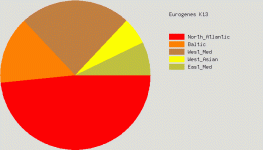
my parents are spanish Basque k13.gif

Population

[TD="bgcolor: #ffffff, align: right"][/TD]

[TD="bgcolor: #ffffff"]North_Atlantic[/TD]
[TD="bgcolor: #C0C0FF, align: right"]49.01%[/TD]

[TD="bgcolor: #ffffff"]Baltic[/TD]
[TD="bgcolor: #ECECFF, align: right"]14.85%[/TD]

[TD="bgcolor: #ffffff"]West_Med[/TD]
[TD="bgcolor: #E0E0FF, align: right"]23.87%[/TD]

[TD="bgcolor: #ffffff"]West_Asian[/TD]
[TD="bgcolor: #F7F7FF, align: right"]5.72%[/TD]

[TD="bgcolor: #ffffff"]East_Med[/TD]
[TD="bgcolor: #F7F7FF, align: right"]5.50%[/TD]

[TD="bgcolor: #ffffff"][/TD]
[TD="bgcolor: #ffffff, align: right"][/TD]

[TD="bgcolor: #ffffff"][/TD]
[TD="bgcolor: #ffffff, align: right"][/TD]

[TD="bgcolor: #ffffff"]East_Asian[/TD]
[TD="bgcolor: #FEFEFF, align: right"]0.46%[/TD]

[TD="bgcolor: #ffffff, align: right"][/TD]

[TD="bgcolor: #ffffff"]Amerindian[/TD]
[TD="bgcolor: #FEFEFF, align: right"]0.60%[/TD]

[TD="bgcolor: #ffffff, align: right"][/TD]

[TD="bgcolor: #FEFEFF, align: right"][/TD]

[TD="bgcolor: #FEFEFF, align: right"][/TD]

West Med 23.87+East Med 5.5+West Asian 5.72= 30.09 Mediterranean

http://www.youtube.com/watch?v=Y0eqw4oE2u0
Hegazti txikiak izan nintzen
Esan zidaten,
kaiola
Jaio nintzen,
Orduan nuen arrano bat bihurtu zen
Hautsitako kaiola euli
Beldur naiz,
Dut uste liburua
Atsegin izan dut,
Dut ireki
hegan egin zidan,
baina laster konturatu nintzen
harkaitz baten hanka
da lotutako
kate motz eta astun.


Translation and explanation of the song Txori Ttikia:
When I was little bird they told me I was born to live in a cage.
Later, when an eagle I turned, dreading to see me flee by breaking the cage, they made me believe that I was free.

Then they opened the doors for me to fly, but I realized very quickly that my leg was tied to a rock by a short and heavy chain.
 
Last edited:
El Horsto

you are right, it seems we are getting closer with our thoughts just a few differences in timing and explanation.

Unfortunately I don't have the time to give another detailed answer.

My only point was that the "Caucasus or Gedrosia " components which nowadays dominate the Near East didn't exist back than so Ötzi or the "proto Basques" don't need to show any sign of Caucasus like component (since Caucasus is a relatively knew evolved component) to be from somewhere in the Caucasus. Note I am not claiming that they are from the Caucasus but it is possible that they are from a place where the Caucasian languages might have originated from too. (fertile crescent).
 
El Horsto

you are right, it seems we are getting closer with our thoughts just a few differences in timing and explanation.

Unfortunately I don't have the time to give another detailed answer.

My only point was that the "Caucasus or Gedrosia " components which nowadays dominate the Near East didn't exist back than so Ötzi or the "proto Basques" don't need to show any sign of Caucasus like component (since Caucasus is a relatively knew evolved component) to be from somewhere in the Caucasus. Note I am not claiming that they are from the Caucasus but it is possible that they are from a place where the Caucasian languages might have originated from too. (fertile crescent).

Sure it is possible, I just meant that there are many other than basque populations living today who are much closer genetically to Georgians despite they don't speak Basque nor Kartvelian. This is no killer argument, just a blemish for this theory.
 

I'm afraid that isn't how it works. All European populations have all three elements, just in different proportions, although, as I said, the proportions by region are strikingly similar. Bergamo has WHG and EEF as well.
Bergamo:
EEF: 71.5
WHG: 17.7
ANE: 10.8

I don't see how your levels have anything to do with the southwest French. You have the levels typical for someone from your area. Your levels show a basically northern Italian signature, with perhaps a slight Balkan input.

Take a look at all three columns for each population at the link I provided above.
http://biorxiv.org/content/biorxiv/suppl/2013/12/23/001552.DC1/001552-1.pdf


And Oetzi wasn't a hunter-gatherer. His people were way beyond that...past the Neolithic and into the metal ages. He not only carried a copper tool, he had high arsenic levels in his blood, an indication that he may have been a metal smith. These people just hunted to supplement their diet.
 
I am amazed at the difference between Basque, I have not seen, but I do not know those who live in Spanish Basque country because I live in France and I contacted him, as Basque, through my family who did not speak with the Spanish Basque country.
It is true that to destroy the Basque many Spaniards are introduced by Franco.
Perhaps this is what explains the difference between Basque under Spanish rule, and basque in French domination. Is that there has been no import esqpagnols or French in the Basque country under French domination.
the Basque country nobody talks about Caucasian language, or like, this is a fact!

my parents are spanish Basque View attachment 6280

Population

[TD="bgcolor: #ffffff, align: right"][/TD]

[TD="bgcolor: #ffffff"]North_Atlantic[/TD]
[TD="bgcolor: #C0C0FF, align: right"]49.01%[/TD]

[TD="bgcolor: #ffffff"]Baltic[/TD]
[TD="bgcolor: #ECECFF, align: right"]14.85%[/TD]

[TD="bgcolor: #ffffff"]West_Med[/TD]
[TD="bgcolor: #E0E0FF, align: right"]23.87%[/TD]

[TD="bgcolor: #ffffff"]West_Asian[/TD]
[TD="bgcolor: #F7F7FF, align: right"]5.72%[/TD]

[TD="bgcolor: #ffffff"]East_Med[/TD]
[TD="bgcolor: #F7F7FF, align: right"]5.50%[/TD]

[TD="bgcolor: #ffffff"][/TD]
[TD="bgcolor: #ffffff, align: right"][/TD]

[TD="bgcolor: #ffffff"][/TD]
[TD="bgcolor: #ffffff, align: right"][/TD]

[TD="bgcolor: #ffffff"]East_Asian[/TD]
[TD="bgcolor: #FEFEFF, align: right"]0.46%[/TD]

[TD="bgcolor: #ffffff, align: right"][/TD]

[TD="bgcolor: #ffffff"]Amerindian[/TD]
[TD="bgcolor: #FEFEFF, align: right"]0.60%[/TD]

[TD="bgcolor: #ffffff, align: right"][/TD]

[TD="bgcolor: #FEFEFF, align: right"][/TD]

[TD="bgcolor: #FEFEFF, align: right"][/TD]

West Med 23.87+East Med 5.5+West Asian 5.72= 30.09 Mediterranean

http://www.youtube.com/watch?v=Y0eqw4oE2u0
Hegazti txikiak izan nintzen
Esan zidaten,
kaiola
Jaio nintzen,
Orduan nuen arrano bat bihurtu zen
Hautsitako kaiola euli
Beldur naiz,
Dut uste liburua
Atsegin izan dut,
Dut ireki
hegan egin zidan,
baina laster konturatu nintzen
harkaitz baten hanka
da lotutako
kate motz eta astun.


Translation and explanation of the song Txori Ttikia:
When I was little bird they told me I was born to live in a cage.
Later, when an eagle I turned, dreading to see me flee by breaking the cage, they made me believe that I was free.

Then they opened the doors for me to fly, but I realized very quickly that my leg was tied to a rock by a short and heavy chain.

The "Mediterranean" of these calculators can't be compared to the EEF of Lazaridis et al. North Atlantic and Baltic contain high levels of EEF as well. I'm afraid those calculators were misread by many as representing truly ancestral populations, when that was not the case. To get to their real meaning, you had to pay attention to the posts where Dienekes showed how they could be expressed in terms of one another.
 
I'm afraid that isn't how it works. All European populations have all three elements, just in different proportions, although, as I said, the proportions by region are strikingly similar. Bergamo has WHG and EEF as well.
Bergamo:
EEF: 71.5
WHG: 17.7
ANE: 10.8

I don't see how your levels have anything to do with the southwest French. You have the levels typical for someone from your area. Your levels show a basically northern Italian signature, with perhaps a slight Balkan input.

Take a look at all three columns for each population at the link I provided above.
http://biorxiv.org/content/biorxiv/suppl/2013/12/23/001552.DC1/001552-1.pdf


And Oetzi wasn't a hunter-gatherer. His people were way beyond that...past the Neolithic and into the metal ages. He not only carried a copper tool, he had high arsenic levels in his blood, an indication that he may have been a metal smith. These people just hunted to supplement their diet.

thanks

There is no southwest French it is south french .....from marseilles to nice ( provenzal area )

the instructions I got for plotting EEF, WHG and ANE is to run lines between the closest 2 , plot the number and then do same system for other 2 ( WHG ANE ) and then link the dots.......inside this triangle would be one's marker.


wasn't otzi trading between modern trentino and north tyrol ..............IIRC they ( scholars) knew his path back and forwards in the alps.....does not indicate a farmer , neither a herder, unless he was killed for his herd.

slight balkan!!! ......grandmother and her capoistrian- venetian family ...LOL
 
Sure it is possible, I just meant that there are many other than basque populations living today who are much closer genetically to Georgians despite they don't speak Basque nor Kartvelian. This is no killer argument, just a blemish for this theory.


Well, yes you are right and I don't disagree the ergativity in basque and Georgian could also simply be from some proto farmer language spoken in the fertile crescent. I just wanted to clarify that components like Caucasus_Gedrosia, North Euro probably formed around the Bronze Age (maybe even later). Even North European very likely has a good chunk of other admixture (proto farmer?) additional to the ANE in it.
 
I do not recall otzi ever being branded a farmer.....a hunter yes

Hunter or not, he does not belong to mesolithic hunter-gatherers but to a chalcolitic culture.
 
thanks

There is no southwest French it is south french .....from marseilles to nice ( provenzal area )

the instructions I got for plotting EEF, WHG and ANE is to run lines between the closest 2 , plot the number and then do same system for other 2 ( WHG ANE ) and then link the dots.......inside this triangle would be one's marker.


wasn't otzi trading between modern trentino and north tyrol ..............IIRC they ( scholars) knew his path back and forwards in the alps.....does not indicate a farmer , neither a herder, unless he was killed for his herd.

slight balkan!!! ......grandmother and her capoistrian- venetian family ...LOL

I'm sorry, I'm not following you here. May I ask where and from whom you heard about this method for plotting your ancestry in terms of the relationship between EEF, WHG and ANE?

In terms of my comment about a north Balkan influence, obviously I was not speaking about anything necessarily within a genealogical time frame. However, in terms of pre-history, there are many postulated gene flows from the northern Balkans, among others, into northeastern Italy. I'm sure you're well aware of them. (Of course, there was gene flow from the Balkans into all of Italy, but that influence is stronger east of the Apennines, and in the northeast. I've seen the results of a number of northeastern Italians on 23andme, and that pull from the Balkans Balkans is clear in terms of where they plot, their "cousins" and other things.)

As to Otzi's cultural affiliations, it is difficult to be too precise, because such conclusions are heavily based on ceramics, burial practices etc. among other things, and Otzi was killed in the mountains, not in his settlement. Some have speculated that he was a member of the Tamins-Carasso-Isera 5 Alpine culture, but it is just speculation so far. There were obviously also ties between Otzi's people and those of the Copper Age Remedello culture of northern Italy, as the blade is fashioned in the Remedello style.

What is beyond doubt, however, is that he was a man of the Copper Age, or, if you prefer, the late Neolithic. The age of the hunter-gatherers had long passed in this part of Europe. The fact that he happened to be hunting wild game, and had just gorged himself on the meat of these wild animals in no way contradicts that fact...hunting was often used in northern Italy and the greater Alpine regions to supplement the Neolithic diet. In addition, Oetzi may well have been on the run in these mountains, and merely using his survival skills.

One way we know that he was a man of the Neolithic, if it wasn't clear in other ways, is that his diet is Neolithic, as evidenced by analysis of his intestinal contents and by hair analysis as well.

From Wiki:

Analysis of Ötzi's intestinal contents showed two meals (the last one consumed about eight hours before his death), one of chamois meat, the other of red deer and herb bread. Both were eaten with grain as well as roots and fruits. The grain from both meals was a highly processed einkorn wheat bran,[15] quite possibly eaten in the form of bread. In the proximity of the body, and thus possibly originating from the Iceman's provisions, chaff and grains of einkorn and barley, and seeds of flax and poppy were discovered, as well as kernels of sloes (small plumlike fruits of the blackthorn tree) and various seeds of berries growing in the wild.[16] Hair analysis was used to examine his diet from several months before.

Hunter Gatherers didn't consume bread made of highly processed eikhorn wheat.

In addition:
Ötzi's teeth showed considerable internal deterioration from cavities. These oral pathologies may have been brought about by his grain-heavy, high carbohydrate diet.[22]

Analysis has also shown that:
By examining the proportions of Ötzi's tibia, femur and pelvis, Christopher Ruff has determined that Ötzi's lifestyle included long walks over hilly terrain. This degree of mobility is not characteristic of other Copper Age Europeans. Ruff proposes that this may indicate that Ötzi was a high-altitude shepherd.[19]

So, he may indeed have been a shepherd. Regardless, herding is a development from the Neolithic revolution. Hunter Gatherers were not herders. Domesticated animals had to be bred for hundreds if not thousands of years, and learning domestic animal managment required other hundreds of years. Herding was just the type of Neolithic economy that was practiced in marginal areas that weren't suited to Neolithic crops.

In addition:
High levels of both copper particles and arsenic were found in Ötzi's hair. This, along with Ötzi's copper axe which is 99.7% pure copper, has led scientists to speculate that Ötzi was involved in copper smelting.[18]

So, he might have been traveling because of his craft. Regardless, I don't see, given all this detailed evidence, how he wouldn't have been living in a farming community.

He probably did not trade for his copper items; he created them of either Alpine copper, or, as I have seen stated, copper from the Ligurian copper mines.

 
Back
Top