• Don't want to see ads? Install an adblocker like uBlock Origin or use a Europe-based privacy-friendly browser like Vivaldi or Mullvad.

Overview of Varna, its stratification, and its demise.

Nice article thanks,challenge for Gimbutas theory;

Gimbutas thought the Copper Age ended when invaders from the east swept into the region around 4000 b.c. The newcomers were “patriarchal, stratified … mobile, and war oriented”—everything the people of the Copper Age weren’t. They spoke Indo-European, the ancient tongue that forms the basis for English, Gaelic, Russian, and many other languages. The new arrivals put their stamp on Europe, and wiped out the goddess worship of the Copper Age in the process.


Gimbutas was putting the finishing touches on Goddesses and Gods as the first finds from Varna were coming to light. She couldn’t have known that this cemetery deep behind the Iron Curtain would come to challenge her theory.


In hindsight, the evidence is compelling. When I ask Slavchev about the conclusions drawn by Gimbutas, who died in 1994, he shakes his head. “Varna shows something completely different,” he says. “It’s clear the society here was male dominated. The richest graves were male; the chiefs were male. The idea of a woman-dominated society is completely false.”
sqj_1604_danube_gold_04.jpg__600x0_q85_upscale.jpg

I think however that the Danube cultures "Old Europe" as are known should be researched much more from scholars all around the world,scholars should show more interests in it.
First gold in the world,signs of writings/symbols the oldest in the world and more... could answer some questions..

 
Nice article thanks,challenge for Gimbutas theory;

Gimbutas thought the Copper Age ended when invaders from the east swept into the region around 4000 b.c. The newcomers were “patriarchal, stratified … mobile, and war oriented”—everything the people of the Copper Age weren’t. They spoke Indo-European, the ancient tongue that forms the basis for English, Gaelic, Russian, and many other languages. The new arrivals put their stamp on Europe, and wiped out the goddess worship of the Copper Age in the process.


Gimbutas was putting the finishing touches on Goddesses and Gods as the first finds from Varna were coming to light. She couldn’t have known that this cemetery deep behind the Iron Curtain would come to challenge her theory.


In hindsight, the evidence is compelling. When I ask Slavchev about the conclusions drawn by Gimbutas, who died in 1994, he shakes his head. “Varna shows something completely different,” he says. “It’s clear the society here was male dominated. The richest graves were male; the chiefs were male. The idea of a woman-dominated society is completely false.”
sqj_1604_danube_gold_04.jpg__600x0_q85_upscale.jpg

I think however that the Danube cultures "Old Europe" as are known should be researched much more from scholars all around the world,scholars should show more interests in it.
First gold in the world,signs of writings/symbols the oldest in the world and more... could answer some questions..

Some things she obviously got right, but not all.

I remember some papers I read last year that indicated that the stratification of society actually began in the Near East as soon as large agricultural surpluses were created, and sharply increased with the spread of metallurgy. I'll see if I can find them.

Totally agree that these "Old Europe" cultures need more study, and study of their ancient dna is also important.
 
Well she observed the Kurgans and she made her theory,

but if we watch the gold Mettalurgy, then is the oposite road, from Balkans to Steppe.

Gold metallurgy Road runs oposite the IE theory,
 
Last edited:
Some things she obviously got right, but not all.

I remember some papers I read last year that indicated that the stratification of society actually began in the Near East as soon as large agricultural surpluses were created, and sharply increased with the spread of metallurgy. I'll see if I can find them.

Totally agree that these "Old Europe" cultures need more study, and study of their ancient dna is also important.
That's right. Stratification is common to every bigger population. Big group of people can't exist without a structure, or structures which organize group existence. Layers of management, if you will. Otherwise it is a mess. Based on this argument, we can be sure that there was no neolithic population, steppe herders without ruling class. Even big hunter gatherers groups of hundreds of people have a chieftain, shaman, and group of advisor elders. Unlike smaller groups of few tens of people which don't have them, and live in simple communes of equal people.
The main difference between farmers of Varna and IE invaders was the scale of warrior culture. Analogy would be comparing farmers to a nice dog who can fight when there is a need, and IE to a vicious one who attacks at will, almost for fun. We possibly could still see it during WW1 and WW2, where the most intense fighting took place throughout northern Europe, from England to Russia. Countries with prevailing ANE and WHG genes. Differences in behaviour could be partially explained by different genetic base. I have a feeling that genes influence culture a lot.
 
Last edited:
More recently, researchers have begun considering another possibility—climate change. The collapse of the Copper Age coincides with a warming world, with larger swings in temperatures and rainfall. The villages that produced the gold found here are now underwater: The Black Sea was as much as 25 feet lower than it is today.
Does anyone remember when was the estimated time of Black Sea deluge?


That's right. Stratification is common to every bigger population. Big group of people can't exist without a structure, or structures which organize group existence. Layers of management, if you will. Otherwise it is a mess. Based on this argument, we can be sure that there was no neolithic population, steppe herders. Even big hunter gatherers groups of hundreds of people have a chieftain, shaman, and group of advisor elders. Unlike smaller groups of few tens of people which don't have them, and live in simple communes of equal people.

Indeed it seems that inequality is more stable than equality. I wonder if this is the core message of the Pareto Principle. Most systems in nature are more resilient against damage if they comply with the power law distribution.

The main difference between farmers of Varna and IE invaders was the scale of warrior culture. Analogy would be comparing farmers to a nice dog who can fight when there is a need, and IE to a vicious one who attacks at will, almost for fun.

It's possible.
 
I remember some papers I read last year that indicated that the stratification of society actually began in the Near East as soon as large agricultural surpluses were created, and sharply increased with the spread of metallurgy. I'll see if I can find them.

That's what I remember too. Therefore the Indo-Europeans were not required to bring stratification anywhere. Stratification happens multiple times independently.
 
Does anyone remember when was the estimated time of Black Sea deluge?


From Wikipedia;The Black Sea deluge is a hypothesized catastrophic rise in the level of the Black Sea circa 5600 BC from waters from the Mediterranean Sea breaching a sill in the Bosphorus strait.
However the flood myth survives among people epics for example Deucalion the son of Prometheus; ancient sources name his mother as Clymene, Hesione, or Pronoia.He is closely connected with the Flood myth, according to which, the anger of Zeus was ignited by the hubris of the Pelasgians.
Deucalion is parallel to Utnapishtim, the survivor of the Sumerian flood that is told in the Epic of Gilgamesh, and to the Biblical Noah.
Could be connected to this or at least might influence this narratives of some other flood,but certainly some flood was remembered among ancient people.
 
The main difference between farmers of Varna and IE invaders was the scale of warrior culture. Analogy would be comparing farmers to a nice dog who can fight when there is a need, and IE to a vicious one who attacks at will, almost for fun. We possibly could still see it during WW1 and WW2, where the most intense fighting took place throughout northern Europe, from England to Russia. Countries with prevailing ANE and WHG genes. Differences in behaviour could be partially explained by different genetic base. I have a feeling that genes influence culture a lot.

are you serious?
 
The main difference between farmers of Varna and IE invaders was the scale of warrior culture. Analogy would be comparing farmers to a nice dog who can fight when there is a need, and IE to a vicious one who attacks at will, almost for fun. We possibly could still see it during WW1 and WW2, where the most intense fighting took place throughout northern Europe, from England to Russia. Countries with prevailing ANE and WHG genes. Differences in behaviour could be partially explained by different genetic base. I have a feeling that genes influence culture a lot.
Who is the presumably IE here,the steppe people?We don't have such recorded encounter so we can draw any hypothesis but not more then this.
I don't think that history of WW1 or WW2 should be compared to ancient people,the fight everywhere was intense.

Some of most famous ancient conquerors culture builders were from South,unless we label they must have been "steppe related" while others were their what? perhaps they had their haplo's known already.
 
The main difference between farmers of Varna and IE invaders was the scale of warrior culture. Analogy would be comparing farmers to a nice dog who can fight when there is a need, and IE to a vicious one who attacks at will, almost for fun. We possibly could still see it during WW1 and WW2, where the most intense fighting took place throughout northern Europe, from England to Russia. Countries with prevailing ANE and WHG genes. Differences in behaviour could be partially explained by different genetic base. I have a feeling that genes influence culture a lot.


Neither Varva neither Rudna Glava is Northern Europe,
and WW1 was not intense at North, 10 years before WW1 Balkans were in flames, and they continued more than 5 years after WW1
and WW2 although Russia was the big theater, Balkans was the main resist,the main Guerilla wars, and ended 4 years after WW2,
so come on with N European extra-estimation, they do not know about Guerilla wars, just Napoleoneanan tacticks and Blitzkrieg,
the most numerous casualties at one battle in few hours at 20th century is Kilkis-Lachana (lahanas) at Makedonia, 2nd Balkan wars
I don't know if Hirosima consider as battle. that is why S Europeans always avoid Napoleonean tacticks.
and as I said before if we exclude Hebrew and Roma deaths at camps, for they are victims of another kind of war, Balkans suffer much more than N europe,
 
Last edited:
That's right. Stratification is common to every bigger population. Big group of people can't exist without a structure, or structures which organize group existence. Layers of management, if you will. Otherwise it is a mess. Based on this argument, we can be sure that there was no neolithic population, steppe herders. Even big hunter gatherers groups of hundreds of people have a chieftain, shaman, and group of advisor elders. Unlike smaller groups of few tens of people which don't have them, and live in simple communes of equal people.
The main difference between farmers of Varna and IE invaders was the scale of warrior culture. Analogy would be comparing farmers to a nice dog who can fight when there is a need, and IE to a vicious one who attacks at will, almost for fun. We possibly could still see it during WW1 and WW2, where the most intense fighting took place throughout northern Europe, from England to Russia. Countries with prevailing ANE and WHG genes. Differences in behaviour could be partially explained by different genetic base. I have a feeling that genes influence culture a lot.

Well, we have a lot of EEF in us, but much as I would like to claim that my people fight only when there's a real need, I can't. Italy stupidly fought in World War I to get back territory many of whose people don't want to be part of the country anyway, and we bombed poor Ethiopians to get into the imperialist game. We went into Greece as well. I'm not proud of any of that, even if most of my relatives were anti-fascists of one sort or another.

That isn't to say that I think there are no differences between "ethnic" groups of people in terms of how aggression manifests itself, behavior during war etc., because I do think they exist, and are a product of both genetics and history.
 
Thanks for the article. Very interesting!

From reading História de Portugal, Volume 1, 1992, coord. José Mattoso – it seems that Indo-European peoples (aka “urnfield civilization”, aka continental peoples) weren’t much war oriented. At the time this book was written (1992), archeologic records didn’t show signs of violence when of these people arrived. The author points out one case, in São Pedro do Sul, which could suggest a “violent shock” between the newcomers and the established ones. But then he admits the destuction of that site could be explained by “many reasons”, so it was not safe to conclude it was a military engagement.

He finaly comes to the conclusion that, although the continental peoples left their mark in what concerns funerary rites, they were largely assimilated by what had been so far the local culture elements, and namely by the local “mountain living peoples”.

But this is about western Iberia only.

Altough I agree big societies need higher levels of organization, which can lead to stratified communities, there was a neolithic city - Çatalhöyük - that apparently didn´t bear social classes. Go figure...
 
Last edited:
Indeed it seems that inequality is more stable than equality. I wonder if this is the core message of the Pareto Principle. Most systems in nature are more resilient against damage if they comply with the power law distribution.
I'd say that, inequality is rather a side effect of stratification, not a stand alone element which brings positive effect of stability. Stratification brings efficient organization and stability. Inequality brings dissatisfaction and in some degree instability, however stability and efficiency is much more precious to society than destructive inequality, that's why we put up with it. Of course, among other things, but it is irrelevant here.
In short, it seem that one ruler could do a better leading job than thousands of arguing citizens. Other words, making a timely decision, even not the best one, is better than no decision at all, especially in times of a crisis. Even modern democratic systems elect one ruler for this mentioned reason.


It's possible.
Seems that I'm getting a quick backlash from South Europeans. :)
Hey, I never said that South Europe can't fight or be heroic. I'm just saying that it comes more naturally to Northern Europeans. They have more appetite for fighting, or liking it more. Along the line, that if you like what you do, you are going to do it more often. I'm hypothesising that it could be related to ANE or WHG of Steppe Warriors genes.
Just check the numbers how many people died in WW1 and 2 in south and north Europe.
There must be a reason why these steppe warriors conquered more populous and rich nations of the farming south, in Europe, Near East and India. They loved the war and trained from early age, like Mongols in recent history.
 
Well, we have a lot of EEF in us, but much as I would like to claim that my people fight only when there's a real need, I can't. Italy stupidly fought in World War I to get back territory many of whose people don't want to be part of the country anyway, and we bombed poor Ethiopians to get into the imperialist game. We went into Greece as well. I'm not proud of any of that, even if most of my relatives were anti-fascists of one sort or another.

That isn't to say that I think there are no differences between "ethnic" groups of people in terms of how aggression manifests itself, behavior during war etc., because I do think they exist, and are a product of both genetics and history.

violence and imperialism worldwide is not exceptional behaviour, it is the rule
that is where Gimbutas was wrong
that is where many naive people are wrong today
 
well a kindly reminder


Hettits had no gender, male/female at their language.

but had gramatical 'person/gender', according 'casta' social class,
now that reflects societies of IEans? or societies of Near/middle East?

consider this at your thoughts,
 
Last edited:
From Wikipedia;The Black Sea deluge is a hypothesized catastrophic rise in the level of the Black Sea circa 5600 BC from waters from the Mediterranean Sea breaching a sill in the Bosphorus strait.
However the flood myth survives among people epics for example Deucalion the son of Prometheus; ancient sources name his mother as Clymene, Hesione, or Pronoia.He is closely connected with the Flood myth, according to which, the anger of Zeus was ignited by the hubris of the Pelasgians.
Deucalion is parallel to Utnapishtim, the survivor of the Sumerian flood that is told in the Epic of Gilgamesh, and to the Biblical Noah.
Could be connected to this or at least might influence this narratives of some other flood,but certainly some flood was remembered among ancient people.
The narrative of the flood is interesting for example,the oldest Greek oracle and location of the landing place of the ark in Greek mythology,Dodona was the oldest Hellenic oracle centre according to the fifth-century historian Herodotus. Archaeological excavations have recovered artefacts from as early as the Mycenaean era,and prehistoric sites at Dodona, have been shown to have been in existence since about 2,000 BC.Dodona is the Mythological landing place for Deucalion after the flood, while Ararat is known in Hebraic as the landing place of the Ark for Noah.
Some call it the oldest oracle hence Pelasgian,Aristotle say is the place where Hellenes originated etc..

But very hard anything from this can be established since is a myth only.
 
Some things she obviously got right, but not all.

I remember some papers I read last year that indicated that the stratification of society actually began in the Near East as soon as large agricultural surpluses were created, and sharply increased with the spread of metallurgy. I'll see if I can find them.

Totally agree that these "Old Europe" cultures need more study, and study of their ancient dna is also important.
Yes and i see that the researchers from United states are more interested in them then the one in Europe,for example the figurines and cultures from Danube valley were exhibited in New York,part of article;
A Lost European Culture, Pulled From Obscurity
By JOHN NOBLE WILFORDNOV. 30, 2009
Before the glory that was Greece and Rome, even before the first cities of Mesopotamia or temples along the Nile, there lived in the Lower Danube Valley and the Balkan foothills people who were ahead of their time in art, technology and long-distance trade.


For 1,500 years, starting earlier than 5000 B.C., they farmed and built sizable towns, a few with as many as 2,000 dwellings. They mastered large-scale copper smelting, the new technology of the age. Their graves held an impressive array of exquisite headdresses and necklaces and, in one cemetery, the earliest major assemblage of gold artifacts to be found anywhere in the world.
At the exhibition preview, Roger S. Bagnall, director of the institute, confessed that until now “a great many archaeologists had not heard of these Old Europe cultures.” Admiring the colorful ceramics, Dr. Bagnall, a specialist in Egyptian archaeology, remarked that at the time “Egyptians were certainly not making pottery like this.”
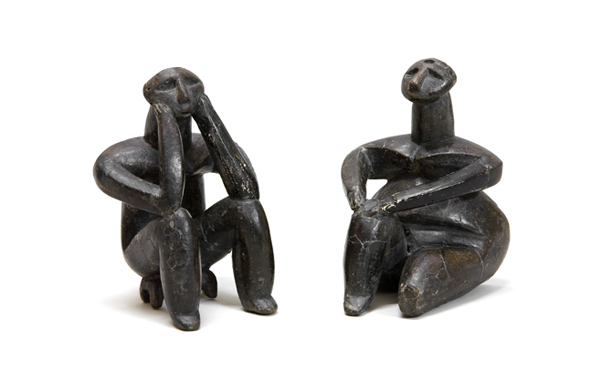
The Thinker
thinker.for_.main_.page_.jpg

http://isaw.nyu.edu/exhibitions/oldeurope/introduction.html
http://www.nytimes.com/2009/12/01/science/01arch.html

Then one of my favorite medievalists South-East Europe Florin Curta is likewise writing from United States,i have read in his articles that he is complaining that in Europe is hard to work whether archeology,history is subjected by some old ideas that are wrong,but are changing not talking about here IE'ans but medieval.
Balkan for some reason is avoided from many different studies despite the importance of this region in the Medieval times,downfall of Roman empire,emerging of new states etc and likewise as we see in much more ancient world.
 
I'd say that, inequality is rather a side effect of stratification, not a stand alone element which brings positive effect of stability. Stratification brings efficient organization and stability. Inequality brings dissatisfaction and in some degree instability, however stability and efficiency is much more precious to society than destructive inequality, that's why we put up with it. Of course, among other things, but it is irrelevant here.
In short, it seem that one ruler could do a better leading job than thousands of arguing citizens. Other words, making a timely decision, even not the best one, is better than no decision at all, especially in times of a crisis. Even modern democratic systems elect one ruler for this mentioned reason.

Agree that inequality is a side effect of stratification.
But also a certain degree of inequality itself is stable (self-reinforcing) in nature. The 80:20 figure is mentioned often In Pareto articles. I'm not saying that it is good, just that it is natural. Too much inequality again leads to instablilty of course (revolution).

Seems that I'm getting a quick backlash from South Europeans. :)
Hey, I never said that South Europe can't fight or be heroic. I'm just saying that it comes more naturally to Northern Europeans. They have more appetite for fighting, or liking it more. Along the line, that if you like what you do, you are going to do it more often. I'm hypothesising that it could be related to ANE or WHG of Steppe Warriors genes.
Just check the numbers how many people died in WW1 and 2 in south and north Europe.
There must be a reason why these steppe warriors conquered more populous and rich nations of the farming south, in Europe, Near East and India. They loved the war and trained from early age, like Mongols in recent history.

I have to disappoint you, I didn't agree with your WW2 hypothesis, that's why I didn't quote it. :) WW2 is no good example.
I only agree that it's possible that Indo-Europeans might have been more specialized on raids and mobility like Mongols, and farmers more specialized on defense (like Chinese?), or something similar. But to which degree this is inherited is not certain. For example Spain and Portugal were once the biggest empires in the world.
 
Back
Top