• Don't want to see ads? Install an adblocker like uBlock Origin or use a Europe-based privacy-friendly browser like Vivaldi or Mullvad.

Paleolithic DNA from the Caucasus

They're the same sample actually. Dzudzuana is the UP Caucasian.
Really? So Dzudzuana is simply sample NEO283 from Allentoft et al.?

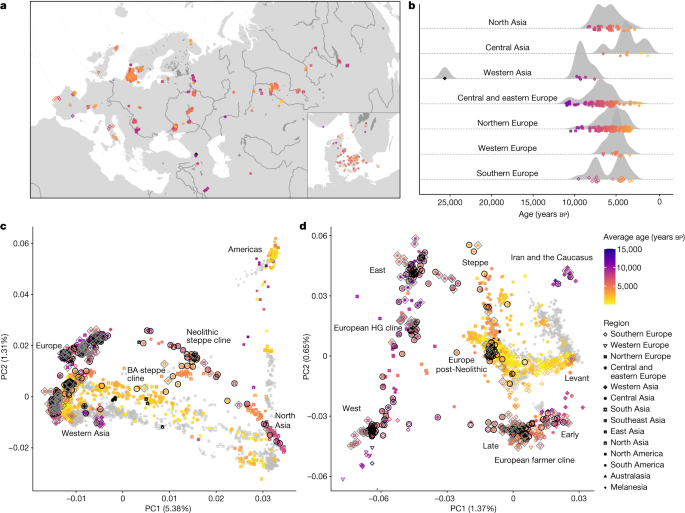
Among them, we report a 0.83X genome of an UP skeleton from Kotias Klde Cave in Georgia, Caucasus (NEO283), directly dated to 26,052 - 25,323 cal. BP (95%). In the PCA of all non-African individuals, it occupied a position distinct from other previously sequenced UP individuals, shifted towards west Eurasians along PC1 (Supplementary Note 3d).
https://www.biorxiv.org/content/10.1101/2022.05.04.490594v7.full
 
NEO283 Upper Paleolithic Caucasian from Kotias plots near Southern Italians:

qLF7TBI.png


kWFXsYc.png


nkBAA9Q.png


Thank you, Jovialis! I really appreciate the work you do.
 
M6OeM3n.png


Dzudzuana UP plots close to Anatolia_ChL

It's rather fascinating that they plot between southern Italians/Greek islanders and bronze age Anatolians. While these populations obviously were not formed from direct continuation of any UP Caucasian population, it does show that this intermediate position on the PCA has been shared by many incredibly archaic populations between the caucuses and north Mediterranean.

It also strongly implies that Caucasian populations received a significant ANE-like pull of ancestry either during or before the neolithic. Probably from the same source that drifted EHGs away from WHGs. The result of that ANE contribution since then has been lasting.

1736919402344.png
 
NEO283 Upper Paleolithic Caucasian from Kotias plots near Southern Italians:

qLF7TBI.png


kWFXsYc.png


nkBAA9Q.png


Jovialis:

Wow that is really interesting. I think of the WHG, EHG and CHG, the WHG and EHG plot outside the range of where modern Europeans plot. The CHG plotting where modern Southern Italians are is really interesting.

Thanks
 
1758297388443.png

1758297411573.png

1758297427034.png

"Most of the Dzudzuana population’s ancestry was deeply related to the post-glacial western European hunter-gatherers of the ‘Villabruna cluster’3, but it also had ancestry from a lineage that had separated from the great majority of non-African populations before they separated from each other, proving that such ‘Basal Eurasians’6,9 were present in West Eurasia twice as early as previously recorded5,6. We document major population turnover in the Near East after the time of Dzudzuana, showing that the highly differentiated Holocene populations of the region6 were formed by ‘Ancient North Eurasian’3,9,10 admixture into the Caucasus and Iran and North African11,12 admixture into the Natufians of the Levant. We finally show that the Dzudzuana population contributed the majority of the ancestry of post-Ice Age people in the Near East, North Africa, and even parts of Europe, thereby becoming the largest single contributor of ancestry of all present-day West Eurasians."-
Lazaridis et al. 2018 (Pre-print)
...

"Using distal sets of pre-LGM HGs as sources, we modelled western HGs as predominantly derived from a source related to the herein-reported Caucasus Upper Palaeolithic individual from Kotias Klde cave (Caucasus_25000BP), whereas eastern HGs showed varying amounts of ancestry related to a Siberian HG from Mal’ta (Malta_24000BP; Extended Data Fig. 4a and Supplementary Data 12). Using post-LGM sources, this divide is best represented by ancestry related to southern European (Italy_15000BP_9000BP) and Russian (RussiaNW_11000BP_8000BP) HGs, respectively, corresponding to the ‘WHG’ and ‘EHG’ labels commonly used in previous studies."-Allentoft et al. 2024
 
Back
Top