
• Don't want to see ads? Install an adblocker like uBlock Origin or use a Europe-based privacy-friendly browser like Vivaldi or Mullvad.

Genetic study Parent-of-origin effects on complex traits in up to 236,781 individuals

traveller

Regular Member
Messages
195
Reaction score
106
Points
43
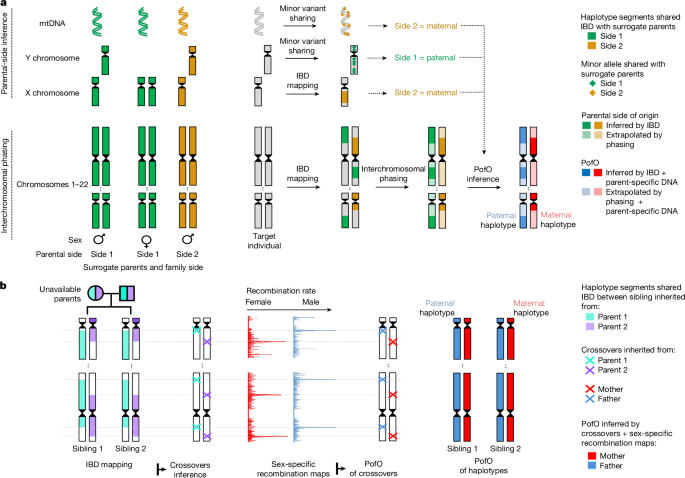
Parent-of-origin effects (POEs) occur when the effect of a genetic variant depends on its parental origin1. Traditionally linked to genomic imprinting, POEs are believed to occur due to parental conflict over resource allocation to offspring, resulting in opposing parental influences2. Despite their importance, POEs remain underexplored in complex traits, owing to the lack of parental genomes. Here we present an approach to infer the parent of origin of alleles without parental genomes, leveraging interchromosomal phasing, mitochondrial and X chromosome data, and sex-specific crossover in siblings. Applied to the UK Biobank, this enabled parent-of-origin inference for up to 109,385 individuals. Genome-wide association study scans for 59 complex traits and over 14,000 protein quantitative trait loci contrasting maternal and paternal effects identified over 30 POEs and confirmed more than 50% of known associations. More than one third of these showed opposite parental influences, especially for traits related to growth (for example, IGF1 and height) and metabolism (for example, type 2 diabetes and triglyceride levels). Replication in up to 85,050 individuals from the Estonian Biobank and 42,346 offspring from the Norwegian Mother, Father and Child Cohort Study (MoBa) validated 87% of testable associations. Overall, our findings highlight the contribution of POEs to complex traits and support the parental conflict hypothesis, providing compelling evidence for this understudied evolutionary phenomenon.
 
IMG_1729.jpeg
 
Here is the summary of the study by Perplexity.

Scientists Reveal Genetic Parent-of-Origin Effects

Scientists have revealed that genetic variants can produce dramatically different or even opposite effects depending on whether they're inherited from the mother or father, challenging fundamental assumptions about heredity and opening new avenues for personalized medicine. The research, published in Nature on August 6, 2025, analyzed genetic data from over 236,000 individuals across three major biobanks.

The study identified 34 parent-of-origin effects (POEs), with 19 showing "bipolar" patterns where the same genetic variant increases a trait when inherited from one parent but decreases it when inherited from the other. This phenomenon was previously invisible in standard genetic studies where opposing parental signals cancel each other out.


Dramatic Disease Risk Reversals Discovered

The most striking example involves a variant affecting type 2 diabetes risk:
  • When the rs10838787 gene variant is inherited from fathers, it increases diabetes risk by 14%, but when inherited from mothers, it actually decreases risk by 9%.
  • Similarly, another variant at the same genetic location shows a paternal allele increasing diabetes risk by approximately 25% compared to maternal inheritance.
The research team, led by Professor Zoltán Kutalik from the University of Lausanne, developed a novel computational method to determine parental origin of genetic variants without needing DNA from parents. By analyzing chromosome crossover patterns in siblings and using mitochondrial DNA markers, they achieved 97.94% accuracy in assigning parental origin.


Growth and Metabolism Genes Show Parent Conflict

All 19 bipolar effects involved growth and metabolism traits, including body mass index, blood lipid levels, height, and telomere length. Two genes affecting telomere length—molecular structures linked to aging—showed opposing patterns. The rs2293607 variant shortened telomeres more dramatically when inherited paternally, while rs11100479 lengthened telomeres specifically through paternal inheritance.

These findings support the "parental conflict hypothesis", an evolutionary theory suggesting paternal genes favor increased offspring growth to maximize reproductive success, while maternal genes limit growth to conserve resources for the mother's survival and future reproduction.

The researchers validated their findings across populations, with 87% of effects replicated in Estonian and Norwegian biobanks. The discovery could revolutionize genetic counseling and drug development by accounting for which parent contributed specific disease-associated variants, potentially leading to more precise treatment strategies tailored to individual genetic inheritance pat
terns.
 
Back
Top