• Don't want to see ads? Install an adblocker like uBlock Origin or use a Europe-based privacy-friendly browser like Vivaldi or Mullvad.

Proto-Indo-Europeans were the Highlanders, who lived near the sea.

I know. There're 3 categories of people who are denying these facts. First: ethnocentric racist insecure folks in denial full of hatred, be it from India or Europe. Second: really stupid, uneducated ignorant people. Third: people who are losing their reputation or business writers who like to write PIE fairytales for stupid ignorant people, who want to be misled. And those business writers make lots of money from misled people.

Sorry, please leave your unbased accusations and insults out of this thread.
 
Sorry, please leave your unbased accusations and insults out of this thread.
I'm sorry if I insulted anybody. It's my opinion. But ok, you're right, It's baseless and I don't want to insult goodfellas, so I'll adjust it by adding the 4th (fourth) option!
 
@Goga

Don't waste your time debating with fringe Steppe theories/ and or Eurocentrists. Nick Patterson, the senior computational biologist has already set the stage; further south.
http://news.harvard.edu/gazette/story/2014/12/the-surprising-origins-of-europeans/

There has already been some discussion of this article and why some of us think it doesn't make sense. Wheeled vehicles were in use long before 3500 years ago and in fact chariots were already in use before that date. The Bronze Age expansion to the east and west had already started, with the archeological evidence supporting the Samara area as the origin point. The Vedic invaders were already established in northwestern India 3500 years ago and Europe was by then undergoing a Bronze Age revolution. And the DNA evidence for Europe suggests that the Bronze Age invaders were probably a mixture of European hunter gatherers and some sort of Caucasian mixture of EEF and ANE.

I guess we'll have to wait for detailed results but this just sounds off to me. I still think a Maykop influenced Yamyana origin for IE seems more likely. And, as I said a couple of days ago, perhaps in another thread, if Corded Ware was an early IE horizon, IE couldn't have been from Maykop.
 
There has already been some discussion of this article and why some of us think it doesn't make sense. Wheeled vehicles were in use long before 3500 years ago and in fact chariots were already in use before that date. The Bronze Age expansion to the east and west had already started, with the archeological evidence supporting the Samara area as the origin point. The Vedic invaders were already established in northwestern India 3500 years ago and Europe was by then undergoing a Bronze Age revolution. And the DNA evidence for Europe suggests that the Bronze Age invaders were probably a mixture of European hunter gatherers and some sort of Caucasian mixture of EEF and ANE.

Yeah that article is crap.

Maykop influenced Yamyana origin for IE seems more likely.

This is most likely.

The Archaeological evidence also suggests some measure of continuity from Dneiper-Donets --->----> Yamna, and Dneiper-Donets appears, at least to me and countless others, to be a wedge with North West-->South East trajectory consistent with Baltic origins. The physical type in the burials are also consistent with these origins. This combined with the curious case of Lithuanian, and what appear to be PIE river names in the Baltic would strongly implicate some sort of early Baltic connection (origins of the Yamna component?). Baltic/Steppe ANE R1a and Iranian Plateau ANE R1b reuniting in Maykop seems the least problematic of homelands, which of course would explain the genetic evidence for the later Bronze age expansions, and the extensive agricultural lexicon within PIE.

But, the Corded Ware horizon cannot be detached from the IE-ization of Europe, and so we must conclude that Yamna enveloped Maykop.
 
I'm kind of a few pages back in this thread..

But Plains Indians and Eskimos definitely do have lighter pigmentation than Africans, you can't attribute this to Neanderthal admixture though because there are many other ethnic groups in the world containing this admixture who are equally as dark as Africans, for example Australian Aboriginals, Papuans, Sri Lankans, ect.
 
There has already been some discussion of this article and why some of us think it doesn't make sense. Wheeled vehicles were in use long before 3500 years ago and in fact chariots were already in use before that date. The Bronze Age expansion to the east and west had already started, with the archeological evidence supporting the Samara area as the origin point. The Vedic invaders were already established in northwestern India 3500 years ago and Europe was by then undergoing a Bronze Age revolution. And the DNA evidence for Europe suggests that the Bronze Age invaders were probably a mixture of European hunter gatherers and some sort of Caucasian mixture of EEF and ANE.

I guess we'll have to wait for detailed results but this just sounds off to me. I still think a Maykop influenced Yamyana origin for IE seems more likely. And, as I said a couple of days ago, perhaps in another thread, if Corded Ware was an early IE horizon, IE couldn't have been from Maykop.
Huh? Hahaha! Indians like it or not, the " J2a & Z93 " Aryans from BMAC invaded India around 1800 BC. Those Aryans came from the western side of the Iranian Plateau (Zagros Mountains) and before they invaded India, they settled down in BMAC. Those who stayed in BMAC became later known as the East Iranic people (like Bactrians, Sogdians and Scythians). Maykop does PREDATE Rigvedic tribes by at least 2000 years, lol!
Also, I don't feel the need to answer to other nonsense. I'm not even going to make an attempt to do it. It's ridiculing itself! Why? Because Yamnaya is the oldest of all Kurgan cultures in Europe, while Maykop is OLDER than Yamnaya. FACTS!

Early_Vedic_Culture_%281700-1100_BCE%29.png


http://en.wikipedia.org/wiki/Vedic_period
 
Huh? Hahaha! Indians like it or not, the Aryans from BMAC invaded India around 1800 BC. Those Aryans came from the western side of the Iranian Plateau (Zagros Mountains) and before they invaded India, they settled down in BMAC. Those who stayed in BMAC became later known as the East Iranic people (like Bactrians, Sogdians and Scythians). Maykop does PREDATE Rigvedic tribes by at least 2000 years, lol!
Also, I don't feel the need to answer to other nonsense. I'm not even going to make an attempt to do it. It's ridiculing itself! Why? Because Yamnaya is the oldest of all Kurgan cultures in Europe, while Maykop is OLDER than Yamnaya. FACTS!

Early_Vedic_Culture_%281700-1100_BCE%29.png


http://en.wikipedia.org/wiki/Vedic_period

It's funny that you call others ethnocentric.

IE is intrusive to the Iranian Plateau. This is a fact.
 
I feel like I'm a history schoolteacher, lol! But I don't really like it, because I'm getting tired to explain time after time some BASIC history. It is very time-consuming and actually getting annoying!
 
It's funny that you call others ethnocentric.

IE is intrusive to the Iranian Plateau. This is a fact.
LMAO, I'm just giving the FACTS and no assumptions. Like dates, Y-DNA migrations (like R1b) etc. Dates don't lie! Y-DNA R1b doesn't lie. It does exist. There're 2 possibilities about the (J2a & Z93) Aryan (Iranic) language. Proto-Aryan was a language with an ergative construction. FACT! Proto-Aryan is either native to Zagros Mountains or it came down from the Maykop Culture in the Caucasus. Even non-Aryan Indo-European languages in the Pontic-Caspian Sea had no ergative construction. Aryan (Iranic) is closely related to the Caucasian languages. Rigvedic tribes were from BMAC, but Iranic tribes in West Asia predate Rigvedic Invasion into India from BMAC by at least 1500 years.
 
I feel like I'm a history schoolteacher, lol! But I don't really like it, because I'm getting tired to explain time after time some BASIC history. It is very time-consuming and actually getting annoying!

OK you gotta be a troal. I wasn't sure at first. Well played.
 
OK you gotta be a troal. I wasn't sure at first. Well played.
Buddy, I do really like you. And I don't want to insult you at all. You are not my enemy. Islam, Muslims, Arabs, Turks are my enemies and I hope you're not one of them. I'm sorry, but after this I'm done with you. More important daily duties are waiting than playing childish games with you. Bye!
 
Goga has been banned for some time. He needed a breather to cool his nerves.
 
Goga has been banned for some time. He needed a breather to cool his nerves.

strange...........maybe I do not understand Y-Gen sensitivity
 
Last edited:
I know this may seem counter-intuitive to some, but I'm going to try applying logic to the ideas contained in the Harvard article. It states that Yamnaya has been ruled out as the source of IE because the Yamnaya population included hunter gatherer ancestry, which is stated to be absent from Armenian and Indian populations. So, let me pose these questions to those who know more than I do about the science of genetics.

1) Do you think R1a has anything to do with IE?

2) If we look at those countries that have the most R1a (Poland, Latvia, Lithuania, etc.), do they have significant amounts of hunter gatherer and, if so, do you think it's unrelated to R1a?

When I look at high R1a countries on Maciamo's admixture maps, I see lots of Northwest European and Eastern European but not much EEF and almost no Caucasian or Gedrosian. How does this fit with Maykop as the source of IE?
 
If proto-Kurgan Leyla-Tepe culture is PIE,
then PIE split in Anatolian language and Maykop?
If proto-Kurgan Leyla-Tepe culture is PIE, then we should consider these for Anatolians.


Anatolians << Novosvobodnaya(W.Caucasus) << Kurganized late TRB(Germany) << Globular Amphora(Poland) << North Pontic Kurgans(Not Yamna, but little befor Yamna) << Maikop(Caucasus) << Leila-Tepe

or if you want

Leila-Tepe >> Maikop(Caucasus) >> North Pontic Kurgans(Not Yamna, but little befor Yamna) >> Globular Amphora(Poland) >> Kurganized late TRB(Germany) >> Novosvobodnaya(W.Caucasus) >> Anatolians
 
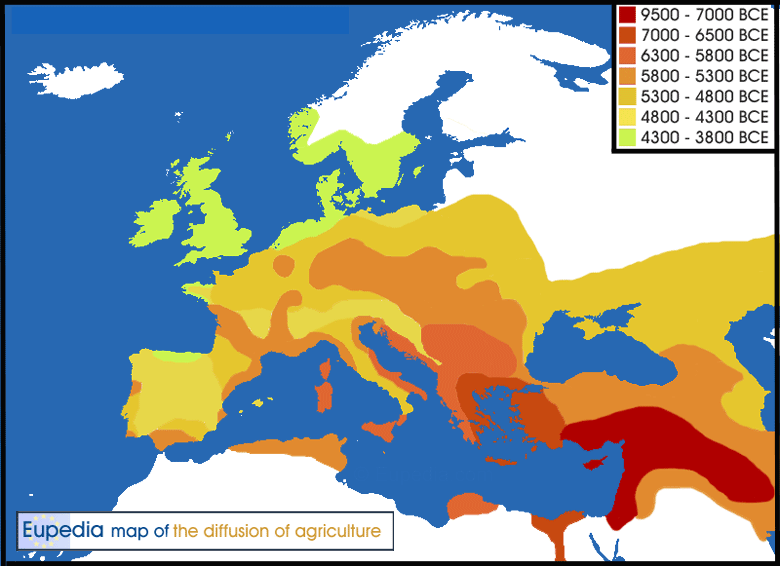
I would like to actually point out some thoughts regarding the Anatolian hypothesis, especially to visualize its glaring problems, as well as to tackle some of the misconceptions. In his original setup, Colin Renfrew argued that the Indo-European languages were spread with the original expansion of agriculture into Europe. If that was the case, then in the context of genetics, we must undoubtably identify Haplogroup G as the original dominant Indo-European Y-lineage, and not R1a, and certainly not R1b either - since unlike those, Haplogroup G2 was consistently found in Neolithic sites throughout Europe, including from the Linear Pottery Culture and the Cardium Pottery Culture, which must both be identified as early Indo-European cultures under the Anatolian hypothesis.


Haplogroup_G2a.gif

Europe-diffusion-farming.gif


From the genetics side, what I see as a glaring problem is that this fails to explain what ethnolinguistic groups the later introductions of R1a and R1b do represent, if they were not originally Proto-Indo-European?


On the linguistic side, another problem is, if the word for "wheel" or "wheeled vehicle" was not originally a Proto-Indo-European word, but is a later loanword, why is it that the word is subject to the respective sound laws of the daughter branches? If so, how could PIE have kept linguistic unity for thousands of years before the advent of the wheel? Another problem I always found that struck me is that the Anatolian model doesn't really explain the existence and spread of the Indo-Iranic and Tocharian languages.
 
I'm pissed. I typed out this huge post while sipping scotch last night and I lost it. I'll get back to this tonight.
 
I would like to actually point out some thoughts regarding the Anatolian hypothesis, especially to visualize its glaring problems, as well as to tackle some of the misconceptions. In his original setup, Colin Renfrew argued that the Indo-European languages were spread with the original expansion of agriculture into Europe. If that was the case, then in the context of genetics, we must undoubtably identify Haplogroup G as the original dominant Indo-European Y-lineage, and not R1a, and certainly not R1b either - since unlike those, Haplogroup G2 was consistently found in Neolithic sites throughout Europe, including from the Linear Pottery Culture and the Cardium Pottery Culture, which must both be identified as early Indo-European cultures under the Anatolian hypothesis.


Haplogroup_G2a.gif

Europe-diffusion-farming.gif


From the genetics side, what I see as a glaring problem is that this fails to explain what ethnolinguistic groups the later introductions of R1a and R1b do represent, if they were not originally Proto-Indo-European?


On the linguistic side, another problem is, if the word for "wheel" or "wheeled vehicle" was not originally a Proto-Indo-European word, but is a later loanword, why is it that the word is subject to the respective sound laws of the daughter branches? If so, how could PIE have kept linguistic unity for thousands of years before the advent of the wheel? Another problem I always found that struck me is that the Anatolian model doesn't really explain the existence and spread of the Indo-Iranic and Tocharian languages.


Well R1b would be associated with the Basque language very easily. R1a I dont know, maybe Uralic?
 
Well R1b would be associated with the Basque language very easily. R1a I dont know, maybe Uralic?

R1a? Indo-European, IMO. And I think that's another problem with the Anatolian hypothesis.
 
Back
Top