
• Don't want to see ads? Install an adblocker like uBlock Origin or use a Europe-based privacy-friendly browser like Vivaldi or Mullvad.

Proto-Indo-Europeans were the Highlanders, who lived near the sea.

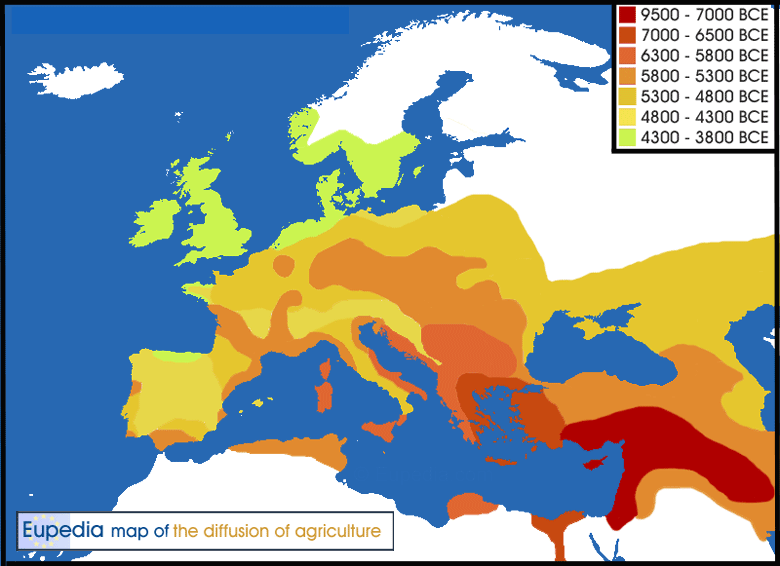
I would like to actually point out some thoughts regarding the Anatolian hypothesis, especially to visualize its glaring problems, as well as to tackle some of the misconceptions. In his original setup, Colin Renfrew argued that the Indo-European languages were spread with the original expansion of agriculture into Europe. If that was the case, then in the context of genetics, we must undoubtably identify Haplogroup G as the original dominant Indo-European Y-lineage, and not R1a, and certainly not R1b either - since unlike those, Haplogroup G2 was consistently found in Neolithic sites throughout Europe, including from the Linear Pottery Culture and the Cardium Pottery Culture, which must both be identified as early Indo-European cultures under the Anatolian hypothesis.

Haplogroup_G2a.gif

Europe-diffusion-farming.gif


From the genetics side, what I see as a glaring problem is that this fails to explain what ethnolinguistic groups the later introductions of R1a and R1b do represent, if they were not originally Proto-Indo-European?


On the linguistic side, another problem is, if the word for "wheel" or "wheeled vehicle" was not originally a Proto-Indo-European word, but is a later loanword, why is it that the word is subject to the respective sound laws of the daughter branches? If so, how could PIE have kept linguistic unity for thousands of years before the advent of the wheel? Another problem I always found that struck me is that the Anatolian model doesn't really explain the existence and spread of the Indo-Iranic and Tocharian languages.

did you read my post in #118...IIRC doctor Giacomo Benedetti might have covered it

But in regards to genetics....when man left africa, they created K haplogroup in the straits of Hormuz, while one K line went to South -East Asia creating along the way T and L on the indian border, then X and N an O in burma, then P in Thailand ( missed MP ) , then R and Q in malaysia................the other K from Hormuz went north along the persian gulf which was not a gulf at the time but a swampy river, in kuwait area and north of this to the kurds where created the following markers J, G, I and H ( was called F3 recently )all the bascially the same age.
basically if G2 went to europe , logic says J2 and I went with G2.........born basically the same age, same location
 
One of the many problems I have with the Harvard article is the claim that India doesn't have "hunter-gatherer" ancestry when Dodecad shows that Pakistanis have almost 30% European admixture. Also, I wonder how that "no hunter-gatherer" article fits with the findings about Ancient North Indian ancestry in "Reconstructing Indian Population History" by Reich et al (2009).

www.ncbi.nlm.nih.gov/pmc/articles/PMC2842210/
 
I would like to actually point out some thoughts regarding the Anatolian hypothesis, especially to visualize its glaring problems, as well as to tackle some of the misconceptions. In his original setup, Colin Renfrew argued that the Indo-European languages were spread with the original expansion of agriculture into Europe. If that was the case, then in the context of genetics, we must undoubtably identify Haplogroup G as the original dominant Indo-European Y-lineage, and not R1a, and certainly not R1b either - since unlike those, Haplogroup G2 was consistently found in Neolithic sites throughout Europe, including from the Linear Pottery Culture and the Cardium Pottery Culture, which must both be identified as early Indo-European cultures under the Anatolian hypothesis.


Haplogroup_G2a.gif

Europe-diffusion-farming.gif


From the genetics side, what I see as a glaring problem is that this fails to explain what ethnolinguistic groups the later introductions of R1a and R1b do represent, if they were not originally Proto-Indo-European?


On the linguistic side, another problem is, if the word for "wheel" or "wheeled vehicle" was not originally a Proto-Indo-European word, but is a later loanword, why is it that the word is subject to the respective sound laws of the daughter branches? If so, how could PIE have kept linguistic unity for thousands of years before the advent of the wheel? Another problem I always found that struck me is that the Anatolian model doesn't really explain the existence and spread of the Indo-Iranic and Tocharian languages.

good point!

I had nothing against a south-caucasian (géographicallyà origin of PIE - but what strikes me is the lack of written sources for a PIE at remote times (before the 3000 BC) in all those southern areas where we have a lot of languages (semitic, caucasianS, elamiitic...) which of they were not always written by their nautral speakers had been nevertheless written in traductions in some states-cities of N-mesopotamia - how a so powerful and metallurgist skilled espanding people could not have lost any trace after it in its origin country???
It's not to conclusive but it merits to be noticed I think - whay doesn't exclude a strong cultural imput of a better developped people upon the first I-Eans...
by the way I red (in Eurogenes Blog that new datations concluded the Yamnaya kurgans were AS OLD AS the Maykop kurgans - to relativize the possible direction of propagation - oidhche mhath -
 
There is a hypothetical and possibly IE language that was before the Sumerian in the Mesopotamia, linguists name it Euphratic
 
R1a? Indo-European, IMO. And I think that's another problem with the Anatolian hypothesis.

I don't doubt the R1a PIE connection but his proposition was what language groups R1b/a would belong to if not PIE. There is no law which states that the PIE speakers were a homogenous Y DNA group or that everywhere the PIE languages spread to accompanied a human migration. I don't think this was the most common means of the spread but I do believe that it is much more complex than a simple migration event from a singular homeland. After all, Jamaicans speak English but don't have English Y DNA, likewise Singapore.
 
2) If we look at those countries that have the most R1a (Poland, Latvia, Lithuania, etc.), do they have significant amounts of hunter gatherer and, if so, do you think it's unrelated to R1a?

There was huge turnover in the Baltic during the Iron age when Germanic tribes fled the Huns. I suspect that the Baltic has much more ANE than WHG, and that the current observable admixtures are a result of our lack of definition of ANE and small data set. This goes for all of Eastern Europe.
 
I don't doubt the R1a PIE connection but his proposition was what language groups R1b/a would belong to if not PIE. There is no law which states that the PIE speakers were a homogenous Y DNA group or that everywhere the PIE languages spread to accompanied a human migration. I don't think this was the most common means of the spread but I do believe that it is much more complex than a simple migration event from a singular homeland. After all, Jamaicans speak English but don't have English Y DNA, likewise Singapore.

Well, yes, I discussed this with someone else in another thread. The IE-ization of Europe happened as a result of several historical events; the Hallstatt and La Tene expansions that brought Celtic languages to much of western Europe and may also be responsible for the Latins in Italy, the long Greek colonization of southern Italy, the Roman empire, the Slavic expansion and the Germanic expansion. In other words, much of it happened during the Iron Age. And the only subclade of R1b that seems to me to be definitely tied to a Bronze Age expansion in Europe is the Italo-Celtic one, which I see as associated with Hallstatt.

I would bet on R1a and J2 being IE but I think it's possible that the Italo-Celtic subclade of R1b was originally not IE but lay on one of the routes of IE expansion and was one of the earliest European groups to become IE.
 
There was huge turnover in the Baltic during the Iron age when Germanic tribes fled the Huns. I suspect that the Baltic has much more ANE than WHG, and that the current observable admixtures are a result of our lack of definition of ANE and small data set. This goes for all of Eastern Europe.

And the Corded Ware R1a?
 
And the Corded Ware R1a?

The (Norweigan)Vikings are looking to be a good proxy for Corded Ware, who were about Mostyly R1a & I (picked up the r1b later). The Huns on the other hand look like R1a/N/ (and a tiny bit)Q, which is what we see in the Baltic today. Add a return dose of I with Viking settlement and it adds up.
 
Well, yes, I discussed this with someone else in another thread. The IE-ization of Europe happened as a result of several historical events; the Hallstatt and La Tene expansions that brought Celtic languages to much of western Europe and may also be responsible for the Latins in Italy, the long Greek colonization of southern Italy, the Roman empire, the Slavic expansion and the Germanic expansion. In other words, much of it happened during the Iron Age. And the only subclade of R1b that seems to me to be definitely tied to a Bronze Age expansion in Europe is the Italo-Celtic one, which I see as associated with Hallstatt.

I would bet on R1a and J2 being IE but I think it's possible that the Italo-Celtic subclade of R1b was originally not IE but lay on one of the routes of IE expansion and was one of the earliest European groups to become IE.

I disagree that Latin is descendant from Hallstatt. U152 looks like a perfect fit for Hallstatt & Gaulish, Latins look like R1b ht35 & J2.
 
On the linguistic side, another problem is, if the word for "wheel" or "wheeled vehicle" was not originally a Proto-Indo-European word, but is a later loanword, why is it that the word is subject to the respective sound laws of the daughter branches?.

Yes PCT doesn't make sense.

The PIE word for wheel, kWekWlo (Gveck-gvlo?), is very similar to that in Kartvelian, Sumerian, and Semitic, (something like gar-gar, gal-gal, Gr-gir whatever)which is really interesting that this was probably the original word for the wheel.

The PIE word grows out of "to twist", kWel, so this along with what you cite make it being a loan word unlikely.
 
Yes PCT doesn't make sense.

The PIE word for wheel, kWekWlo (Gveck-gvlo?), is very similar to that in Kartvelian, Sumerian, and Semitic, (something like gar-gar, gal-gal, Gr-gir whatever)which is really interesting that this was probably the original word for the wheel.

The PIE word grows out of "to twist", kWel, so this along with what you cite make it being a loan word unlikely.
Interesting. Though I don't have enough linguistic knowledge to comment on it, lol.
 
I think I address most of what has recently been posted.

What’s being said about R1b fails to explain R1a, which is associated with IE expansions into NE via the Corded Ware Horizon. Most would say that to detach the Corded Ware from the Indoeuropeanization of Europe is a complete denial of the evidence. Some even go so far as to say that we have no reason to exclude the Corded Ware Horizon from the PIE homeland. To render it non-indoeuropean would probably mean reinventing most of what it is that defines an IE speaking settlement/burial.

Near Eastern models always seem to invoke a farming catalyst that spread with the language, so why don’t we see R1b rather than G associated with the spread of farming into the Balkans?

The earliest evidence for incursions into the Farming communities of the Balkans is no doubt from the steppe, immediately following which we see all of the hallmarks of IE culture. The archaeological record of imposition from the steppe is undeniable, in fact the farming settlements appear to be fleeing to the West, which is a rare thing to actually see in the archaeological record.

The Near Eastern region being pegged (by Goga) for the PIE homeland is home to non-indoeuropean languages not only during the time frame for PIE, but immediately following PIE expansions. This not only doesn't make much sense intuitively, but is also inconsistent with other model linguistic homelands for obvious reasons.

The only model that can account for everything is Maykop being enveloped by Yamna, and R1b diversification and spread into Europe is actually supportive of this. I'm not quite sure on this, but I had thought that genetic evidence strongly supported a Steppe staging ground.

Domestic Horses were undoubtedly intrusive to the Ancient Near East. The earliest evidence for horse domestication occurs on the Pontic Steppe, and is probably the most definitive marker of IE peoples during the bronze age.

One needs to consider the power imparted by domestic horses, especially when your neighbors don’t have them. It was the only way to get around up until less than 100 years ago, and what we see in Yamna or their ancestors is this very epoch. Look at the random Indo aryan horse breeding lexicon in Mitanni. There’s a reason the Gods are depicted in chariots in the art of classical IEs.

I imagine it was a trade of domestic horses for Bronze at first until the horse breeders absorbed the smiths.
 
Yes PCT doesn't make sense.

The Paleolithic Continuity scenario is even worse, far worse, in this regard than the Anatolian hypothesis, because in addition for the word for 'wheel', you additionally have the entire agricultural and pastoralist terminology that is reconstructable for PIE that is supposed to be loanwords, like words for 'cow' and 'sheep' - the Anatolian hypothesis, for all its faults, is compatible with the farming vocabulary.

What I might note, on the other hand, is that the "Celtic from the West" scenario forwarded by O'Donell and Koch is actually compatible with the Anatolian hypothesis. One of the biggest problems that I always had with that scenario is that it basically reverses the direction of Indo-Europeanization (thereby lacking a mechanism by which Proto-Celtic is supposed to have planted itself in this western homeland in the first place), which totally makes no sense if the homeland of the Indo-Europeans was in the Pontic-Caspian steppe. If however Indo-European languages arrived in Europe with the start of the Neolithic, then it becomes possible to argument that the Megalithic-building communities of the Atlantic Neolithic were indeed early speakers of Celtic.

The PIE word for wheel, kWekWlo (Gveck-gvlo?), is very similar to that in Kartvelian, Sumerian, and Semitic, (something like gar-gar, gal-gal, Gr-gir whatever)which is really interesting that this was probably the original word for the wheel.

The word for 'wheel' definitely is not reconstructable for Proto-Semitic. This shouldn't be a surprise because Proto-Semitic clearly is far older than PIE. However, I would note that amongst the Central Semitic languages, Arabic "adʒala" and Hebrew "galgal" are reminiscient of the Indo-European *kwekelos. :)

Amongst the Mesopotamian languages, Sumerian has "ḫubum", and Akkadian has "ḫūpu".

The PIE word grows out of "to twist", kWel, so this along with what you cite make it being a loan word unlikely.

Indeed, the PIE word for wheel is reconstructed usually as *kwekwelos ('that which turns', approximately), and reflexes include English "wheel", Greek "kyklos" (κυκλος, whence English "cycle") and Hindi "chakra".

There's another Indo-European word for wheel German "rad", Irish "roth", Welsh "rod", Latin "rota", Lithuanian "ratas", as well as Hindi "ratha" ('chariot').

Well R1b would be associated with the Basque language very easily.

In that case, the Basques would be the newcomers... yet Basque is an isolate language, not closely related with any other language (other than Aquitanian, which was probably the same as Old Basque, and perhaps Iberian) which would be expected if it was a survivor of the pre-Indo-European languages. It might seem 'easy' but it really doesn't explain anything.

R1a I dont know, maybe Uralic?

So Corded Ware were speakers of Uralic... yet there's no evidence that Uralic speakers were in Central Europe prior to the (very late!) arrival of the Magyars in the Pannonian plain, which clearly occured in historic times.
 
[h=3]The Nordic Bronze Age culture evolved based on Corded Ware culture.[/h]Germanic have a substratum(substratum ~= basis).
So if Nordic Bronze age culture is proto-Germanic,
then the language of Corded Ware possibly was the substratum for Germanic (?).
 
The Paleolithic Continuity scenario is even worse, far worse, in this regard than the Anatolian hypothesis, because in addition for the word for 'wheel', you additionally have the entire agricultural and pastoralist terminology that is reconstructable for PIE that is supposed to be loanwords, like words for 'cow' and 'sheep' - the Anatolian hypothesis, for all its faults, is compatible with the farming vocabulary.

What I might note, on the other hand, is that the "Celtic from the West" scenario forwarded by O'Donell and Koch is actually compatible with the Anatolian hypothesis. One of the biggest problems that I always had with that scenario is that it basically reverses the direction of Indo-Europeanization (thereby lacking a mechanism by which Proto-Celtic is supposed to have planted itself in this western homeland in the first place), which totally makes no sense if the homeland of the Indo-Europeans was in the Pontic-Caspian steppe. If however Indo-European languages arrived in Europe with the start of the Neolithic, then it becomes possible to argument that the Megalithic-building communities of the Atlantic Neolithic were indeed early speakers of Celtic.


Yeah, it all just creates more problems. Too numerous to list here. A big one is time frame. That's a long ass time to be PIE, which I'm pretty sure is inconsistent with other known model homelands. And of course there the undeniable bronze age lexicon, which means the Proto-language needs to be cohesive until at the earliest 3500 BCish. At the very earliest. I'd say more like More like 2500-3000BCish.


There's another Indo-European word for wheel German "rad", Irish "roth", Welsh "rod", Latin "rota", Lithuanian "ratas", as well as Hindi "ratha" ('chariot').

Yes, this is interesting. But Kwekwlos rooted wheel is still attested in Germanic. My first assumption would be that this originally meant "wheeled vehicle", or something like that. I dunno.

So Corded Ware were speakers of Uralic... yet there's no evidence that Uralic speakers were in Central Europe prior to the (very late!) arrival of the Magyars in the Pannonian plain, which clearly occured in historic times.

Yes, inconsistent with the dirt and history/genetics.


The Nordic Bronze Ageculture evolved based on Corded Ware culture.

Germanic have a substratum(substratum ~= basis).
So if Nordic Bronze age culture is proto-Germanic,
then the language of Corded Ware possibly was the substratum for Germanic (?).


I always kinda figured TRB is a good candidate for the substratum culture. It makes sense, and would presumable be I dudes.
 
Professors from the University of Arizona have published an article in which they state that Yamnaya Culture is actually about 500 years older than has been assumed, so it began at the same time as the Maikop Culture.

https://journals.uair.Arizona.edu/index.php/radiocarbon/article/view/16087

If this is correct, I wonder where Yamnaya got its bronze technology from?
 
Well, yes, I discussed this with someone else in another thread. The IE-ization of Europe happened as a result of several historical events; the Hallstatt and La Tene expansions that brought Celtic languages to much of western Europe and may also be responsible for the Latins in Italy, the long Greek colonization of southern Italy, the Roman empire, the Slavic expansion and the Germanic expansion. In other words, much of it happened during the Iron Age. And the only subclade of R1b that seems to me to be definitely tied to a Bronze Age expansion in Europe is the Italo-Celtic one, which I see as associated with Hallstatt.

I would bet on R1a and J2 being IE but I think it's possible that the Italo-Celtic subclade of R1b was originally not IE but lay on one of the routes of IE expansion and was one of the earliest European groups to become IE.


I avow I'm still parlty confused about all that - but I'm almost sure celtic is older in Western Europe than Hallstatt-La Tène story - I already posted about this stuff - The first Tumuli Culture of Southern Germany- Western Bohemia was certainly celtic speaking (maybe for a long enough time) before iron Age and before Urnfields period - it would be very possible Hallstatt-La Tène send P-celtic in western Europe - and before already yet formed celtic (primary PIE P fallen down) there were I-Ean speaking population, maybe already settled in Portugal Spain France and Benelux (today namings) - the smoky concept of "Ligurian Empire", if false concerning politics, is surely very close to reality concerning languages ( lot of whom are I-E, archaic, and showing multiple links with either celtic, italic, germanic and lusitanian, ligurian, northwest european...
all that seems linked to a male elite of Y-R1b type powerful enough to squash the preceding males markers in a lot of lands of western Europe - It doesn't seem possible to link it too tightly to a neolithical episode, for me, nor to a BBs one - if late neolithical we have still to trace its way(S)... -
&: I would see easily enough Y-R1b-L21 linked with Qw- celtic (first wave? Bronze? or even Chalcolithic?) and R1b-U152 to P- celtic (second wave: Iron?)
the basque-R1b-gedrosia question is still in front of us but I think it could be linked to a peculiar episode of this (preogressive?) conquest, because 'gedrosia' is not so strong in Iberia apart Basques, and in other parts of Europe seems linked uniquely to Celts and Germans - I regret basque language is not associated with certitude to another language known by us.
so I think Y-R1a is for a long time associated with I-Ean and Y-R1b too what ever the most remote source of PIE... they were the bearers of the great migrations towards West and East (Tokharians for R1b?) so they were in the "hurricane eye" I think -
eatsern IEans, slavic, baltic, greek, seem more conservative concerning declinetions, for indo-iranian languages i've not enough knowledge but I supose they are still conservative enough too - has this a signification concerning substrata-superstrata? It merits deeper studies than a glance of profanes I think - sometimes it's the promotors of a language that make it evolve further on...
&&: Y-R1a and ANE: surely soe links with A CERTAIN PART of ANE and Y-R1b too (the ANE distribution of today in Europe is very too level to oppose two parts of Europe: by the way Basques have ANE more than have Sardinians...
I agree nevertheless, as Eurasiais big enough, that primarily a lot of Y-R1b beares if not all of them, could have been indo-uripeanized on the way, but surely early enough because R1b is still THE MASTER in western Europe- id it was only R1a which had send I-Ean, this haplogroup would have more weight as elite part in West and Southwest
 
Back
Top