• Don't want to see ads? Install an adblocker like uBlock Origin or use a Europe-based privacy-friendly browser like Vivaldi or Mullvad.

Proto-Indo-Europeans were the Highlanders, who lived near the sea.


the basque-R1b-gedrosia question is still in front of us but I think it could be linked to a peculiar episode of this (preogressive?) conquest, because 'gedrosia' is not so strong in Iberia apart Basques, and in other parts of Europe seems linked uniquely to Celts and Germans

Agree with everything you said. Regarding Basques I think their 'Gedrosia' signal from K12b in terms of the wider 'West-Asian' complex is much weaker than in other West Europeans because it almost disappears in other calculators while it remains present for other West Europeans. This is further supported by most PCA plots where Basques deviate towards Sardinians and away from other West Europeans. This is also compatible with Maciamo's R1b story about special way of R1b introgression in Basques. Basques received sort of incomplete or unique kind of 'West-Asian'/ANE/Gedrosian introgression compared to the rest of West Europe.
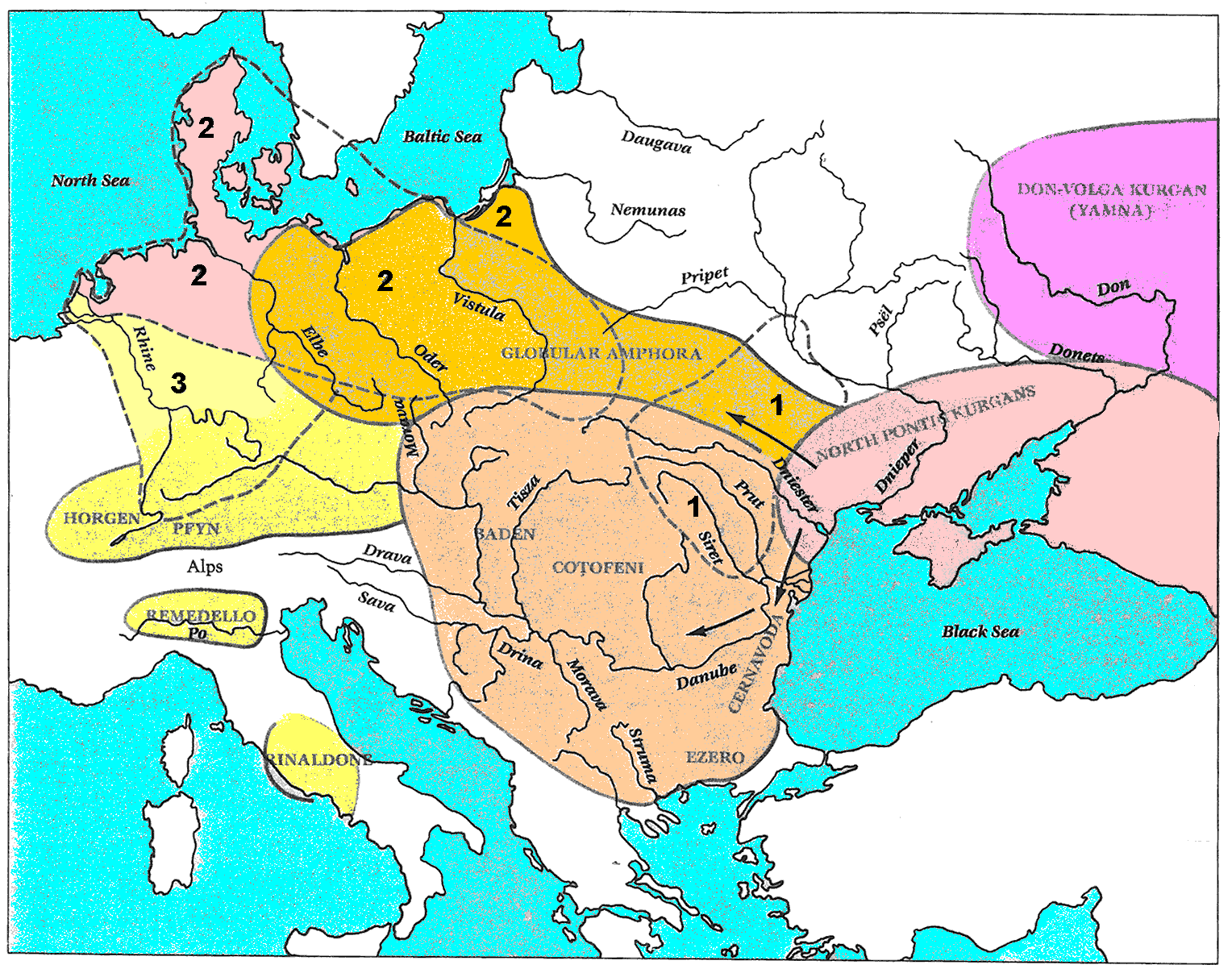
 
Yamna in the begining, is a late copper age culture
Also North Pontic Kurgan(Maikop) culture were in Ukraine befor the Yamna

http://s155239215.onlinehome.us/tur...fTheGoddess/BC3500GimbutasMKurganFig10-13.gif
BC3500GimbutasMKurganFig10-13.gif


The North Pontic Maikop Culture
The North Pontic culture is typified by hill forts and hundreds of Kurgan tumuli (grave mounds) with mortuary houses built of stones or wood.
Royal burials share a characteristic monumental style in which the tumuli are surrounded by orthostats (upright stone or slab) and stelae, then by an outermost ring of stones; within and below the kurgan is a stone- or wood-lined pit (mortuary house), covered with stone slabs and topped by a stone cupola. Models of wagons and daggers of hard metal accompany the males of the elite.
 
The (Norweigan)Vikings are looking to be a good proxy for Corded Ware, who were about Mostyly R1a & I (picked up the r1b later). The Huns on the other hand look like R1a/N/ (and a tiny bit)Q, which is what we see in the Baltic today. Add a return dose of I with Viking settlement and it adds up.
WHAT? :)
Are you saying we in Baltics are descendants of Huns? I have nothing against that to be honest, Huns were great warriors.

But Baltic N1C1 is very specific L550+, L1025+, M2782+. It peaks in Latvia and Lithuania (~40% of all hg, ~ 90% of N1C1) and declines from there. The other son lines of L1025+ (will call them M2782-) are very low in numbers, and are found around, mostly in North - Sweden, Finland, Petersburg region and in boyar sons from Kursk region, who could be resettled from North/Novgorod region or locals. Q on other hand in Latvia is represented by Jewish folk (at least in Latvia familytreedna project Q guys seem to have Jewish names and surnames).
Also Balt territories and Poland lacks East Asian component. You can find somewhere on eupedia admixture map with Latvia, Lithuania, Belarus and Poland having 0% of that.

So, trust me I tried to link Baltic N1C1 with Huns, but it does make very little sense :)
 
@Robert,
Wait, so is this an option - North Pontic Kurgan Culture (r1b rich) went to West (GAC) and Don-Volga Kurgan (r1a rich) culture went to Yamna place?
 
Thanks! So, no R1B yet found in GAC.
Btw, I suggest (not to you but as general suggestion) to maybe create a sticky thread for reference under Ancient DNA sections, where info on Y-dna found at different cultures would be collected.
Does anyone know where and how old was the earliest R1B found in/near Europe?
 
Thanks! So, no R1B yet found in GAC.
Btw, I suggest (not to you but as general suggestion) to maybe create a sticky thread for reference under Ancient DNA sections, where info on Y-dna found at different cultures would be collected.
Does anyone know where and how old was the earliest R1B found in/near Europe?

The earliest R1b samples found in Europe consist of two samples from a Bell Beaker site in Germany dated 2600-2500 BC. Since no Y DNA has ever been successfully tested from any other Bell Beaker site anywhere else in Europe, we don't know whether R1b is typical of Bell Beaker.

www.ancestraljourneys.org/ancientdna.shtml
 
Yamna in the begining, is a late copper age culture

Lots of cultures had a Copper Age, and it appears that copper may have been invented separately in many places, perhaps as a result of people trying to use copper ore to colour glazed pottery. And some of these cultures produced a small amount of bronze because of the impurities in the ore. However, proper bronze smelting is a very specialized process that may have one source in the Middle East, although some folks argue for a second origin point in the Balkans.
 
There are two samples from GAC the one is possibly G the other is J or I.
http://dienekes.blogspot.gr/2013/02/y-chromosomes-of-corded-ware-at-wroclaw.html

GAC is a mix of Maikop and TRB cultures.
Also GAC influenced culturally the Corded Ware culture

GAC and Maikop had Sati (practice)

Those samples are Corded Ware, not Global Amphora. They're also typical Neolithic Y DNA haplotypes. Later Corded Ware samples are R1a. I think it's unlikely that people from Maikop flew over or migrated around Yamnaya in order to directly influence European cultures. Has any academic suggested that? Other than the latest gossip from Harvard?
 
Also North Pontic Kurgan(Maikop) culture were in Ukraine befor the Yamna

http://s155239215.onlinehome.us/tur...fTheGoddess/BC3500GimbutasMKurganFig10-13.gif
BC3500GimbutasMKurganFig10-13.gif


The North Pontic Maikop Culture
The North Pontic culture is typified by hill forts and hundreds of Kurgan tumuli (grave mounds) with mortuary houses built of stones or wood.
Royal burials share a characteristic monumental style in which the tumuli are surrounded by orthostats (upright stone or slab) and stelae, then by an outermost ring of stones; within and below the kurgan is a stone- or wood-lined pit (mortuary house), covered with stone slabs and topped by a stone cupola. Models of wagons and daggers of hard metal accompany the males of the elite.

as usual people leave out Otzi and his culture.........Polada ......although his weapons where Remedello cultured ones

The Polada culture (22nd to 16th centuries BC) is the name for a culture of the ancient Bronze Age which spread primarily in the territory of modern-day Lombardy, Veneto and Trentino, characterized by settlements on pile-dwellings.
 
as usual people leave out Otzi and his culture.........Polada ......although his weapons where Remedello cultured ones

The Polada culture (22nd to 16th centuries BC) is the name for a culture of the ancient Bronze Age which spread primarily in the territory of modern-day Lombardy, Veneto and Trentino, characterized by settlements on pile-dwellings.

Otzi was 3300 B.C., early Copper Age, at the beginning of Remedello, when people used a combination of Neolithic and Copper Age technology. Polanda Culture was later.
 
Ancient genome database ordered by location and associated layer/culture would be would be awesome.
 
@Aberdeen,
Thanks for the link. Just noticed that there was Kromsdorf 2600-2500 BC with 2 samples R1B. Bell Beaker.
And then 1 hour drive in Eulau 2600 BC they have 2 samples R1A Corded Ware. Interesting, did not notice that.

1000 BC Urnfield has I2a2b, R1b and R1a (with question mark) in Lichtenstein Cave.
 
The (Norweigan)Vikings are looking to be a good proxy for Corded Ware, who were about Mostyly R1a & I (picked up the r1b later). The Huns on the other hand look like R1a/N/ (and a tiny bit)Q, which is what we see in the Baltic today. Add a return dose of I with Viking settlement and it adds up.

If Huns were R1a, wouldn't they have brought R1a-Z93 to Europe?
 
Those samples are Corded Ware, not Global Amphora. They're also typical Neolithic Y DNA haplotypes. Later Corded Ware samples are R1a. I think it's unlikely that people from Maikop flew over or migrated around Yamnaya in order to directly influence European cultures. Has any academic suggested that? Other than the latest gossip from Harvard?
Those samples were in the teritory of Globular Amphora in the time 2800 BC, so most possibly those are GAC.

Why should Maikop flew over Yamna, if Maikop culture(North Pontic Kurgan culture) were in Pontic Steppe before the Yamna?
 
If Huns were R1a, wouldn't they have brought R1a-Z93 to Europe?
[h=3]R1a1/U2e male in 2,000-year old Mongolian Xiongnu[/h]http://dienekes.blogspot.gr/2010/01/r1a1u2e-male-in-2000-year-old-mongolian.html

According to linguists the Chuvash language is descent from Xiongnu, but there is no Z93 among them, they have R1a-Z283 19,7% (or 31.6% another study)
 
Those samples were in the teritory of Globular Amphora in the time 2800 BC, so most possibly those are GAC.

Why should Maikop flew over Yamna, if Maikop culture(North Pontic Kurgan culture) were in Pontic Steppe before the Yamna?

It wasn't. Maikop was in the southern Caucasus.
 
@Aberdeen,
Thanks for the link. Just noticed that there was Kromsdorf 2600-2500 BC with 2 samples R1B. Bell Beaker.
And then 1 hour drive in Eulau 2600 BC they have 2 samples R1A Corded Ware. Interesting, did not notice that.

1000 BC Urnfield has I2a2b, R1b and R1a (with question mark) in Lichtenstein Cave.

If you look on this forum or do a Google for a map that shows Bell Beaker and Corded Ware, you can see where the assumed boundary between the two groups is. Based on various things I've read about it, my impression is that it was once thought that the two groups were quite separate but that is no longer necessarily thought to be the case. I do find it interesting that the earliest Y DNA for Corded Ware is typical Neolithic, with the R1a that I associate with the Russian steppes coming later. Too bad we don't have other results for Bell Beaker, particularly from Iberia, which is where it seems to have started from.
 
Back
Top