• Don't want to see ads? Install an adblocker like uBlock Origin or use a Europe-based privacy-friendly browser like Vivaldi or Mullvad.

(QUESTION) How to model central italians on qpadm

I think you’re still not fully grasping what I’m saying at a deeper level.

Deus is NOT ex machina, it is ZZ11.

ZZ11 is the ultimate reproductive predator in the entire history of the Mediterranean. This is not an opinion — currently, easily more than 180 million men descend from him.

Zeus is ZZ11* (Mycenaean)
Jupiter is ZZ11* (Roman)
Tinia is ZZ11* (Etruscan)
Habis is ZZ11* (Hispanic)

Three centuries later, resurrected Yisus is also ZZ11* (Christian).

What I am asserting is that the “Mycenaean Dorians” were ZZ11*.

Just like the Argeads and the Naqada. (Those samples had no contamination whatsoever.)

The tomb of Vergina is actually the closest thing we have to an elite Doric individual.

Both cases have been personally verified with manual BAM refinement and comparison of specific STRs, performed by multiple people arriving at the same conclusions.

The so-called U152> in those two cases is confusing because of now-extinct ZZ11* clades.

No one can claim direct descent from them.

The Vergina BAM stalls at L151*, and the STRs are incompatible with U106 or L21, only possible with ZZ11>.

Anyone who knows how to refine BAM files can verify this for themselves.

Contamination in the Y chromosome is not possible — only misclassifications caused by the ISSOG trees used. That’s why you need to certify with STRs which current populations are closest to know in which parts of the tree it “sticks.”

It’s also clear you haven’t read the full texts I write, because I’ve already talked about a “Mediterranean factor” rather than an “Eastern factor,” in which ZZ11> had far more influence than the Levant.

Around 20% of the Phoenicians analyzed were also ZZ11> (DF27> and U152>), and the gold craftsmanship of all these individuals is indistinguishable.

The Royal Mycenaeans of the Palace of Nestor had up to 30% Atlantic/Mediterranean ancestry.

If the Mycenaeans were what archaeologists and historians say they were, they shouldn’t have had 30% “Atlantic/Mediterranean,” which translates to “Southern Bell Beaker” (ZZ11).

Elite intermixing between PF7562*, PF7589*, P310*, and ZZ11* happened continuously from 3000 BC in the Mediterranean until the beginning of Rome.

If a U152* and a PF7562* had sat down to talk in 2000 BC, they would both perfectly know who M269* was (Dyeus Phter).

All of this is simply disruptive “darts” to make you understand that the Steppe migration narrative is completely unsustainable in 2026.

Until you get past that point, you cannot know the origin of all P312>*.

If you take the oldest empirically certified P312 sample*, EHUU002 from 2600 BC, and compare it with Samara L51 from 2800 BC* in STR regions, it becomes absolutely clear that these are divergent lineages more than 1000 years prior, not close relatives.

The Etruscans are direct descendants of the Bell Beakers, and they maintained virtually 100% genetic isolation for 2000 years until the beginning of Rome. The details I fill in with “Mycenaean elites” will only be fully understood when more precise refinement of current Y populations in that region is done, and more aDNA samples become available.

The “Mycenaeans” themselves were more a profession than an ethnicity.
:ROFLMAO::rolleyes:
 
I made that exact same face when you asked me for “G25” coordinates.

The problem you have is in your understanding of Y-chromosome phylogeny.

Everything you think you know about DNA, you’ve learned through circular reasoning on forums that are just that — nothing more than circular reasoning on forums.


All the anachronisms I used are simply to help locate you mentally; it’s not very clear to me whether you are 6-year-old kids or 70-year-old men.
 
I made that exact same face when you asked me for “G25” coordinates.

The problem you have is in your understanding of Y-chromosome phylogeny.

Everything you think you know about DNA, you’ve learned through circular reasoning on forums that are just that — nothing more than circular reasoning on forums.


All the anachronisms I used are simply to help locate you mentally; it’s not very clear to me whether you are 6-year-old kids or 70-year-old men.
At least G25 co-ordinates attempt to connect with reality.

What are you talking about?
You are mixing fact and fantasy.
I'd rather you were a troll.
Unfortunately you are worse than that.
You are a fantasist.
 
At least G25 co-ordinates attempt to connect with reality.

What are you talking about?
You are mixing fact and fantasy.
I'd rather you were a troll.
Unfortunately you are worse than that.
You are a fantasist.
No man, I’m not scientifically claiming that the deities existed; they’re just analogies to explain the high degree of endogamy among the Etruscans and all those populations of elitist origin.

Mythologies are overwhelmingly indicative, and only now are we starting to have tools that allow us to reinterpret how much truth they actually contained.

Did the deity Tinia exist?

Yes, on a practical level: for an ethnicity to have a mythological/real origin, it is necessary that all males share the same founder effect and that the rates exceed more than 50% of the male population so as not to fall into genetic drift. Without planned endogamy, PCA samples would keep shifting continuously and there would be no region that could delimit ethnic groups. It’s not that “Tinia” literally existed in 2600 BC; rather, a direct descendant of him who consolidated himself as king around 900 BC deified him, because they knew perfectly well that they descended from an uninterrupted foundational lineage lasting millennia.

What cannot be stated is whether “Tinia” was an L2, a Z36, or a Z56.

Those are anachronisms to try to uncover events that happened before writing.

On what date does the “endogamic knot” of all Italian U152* fall?

In 2600–2400 BC, not in 2200–2000 BC. In 400 years, “Tinia” filled central and northern Italy with U152* offspring. There were no massive migrations from anywhere, neither Steppe nor Central European — it was internal expansion. The intrusion of Celts beyond the Alps, Iberians, or Illyrians was at most around 5% and random.

Does that mean that “Tinia” was the father of all U152?

That would be an exaggeration; he would only be the father of about 60% of all U152.

Let’s take a hypothetical example where there is a version of an autosomal SNP related to the heart, common in 80% of U152, called HF257.

If 90% of Tinia’s children have HF257-23 and you find that same mutation in an Australian from 1600 BC, by brute statistical force an Etruscan years earlier must have taken a boat and ended up in Australia, and it cannot be the result of a Germanic Celtic arrival because U152>L2>Z49 have HF257-65.

That’s how autosomal calculators theoretically work with thousands of similar preselected mutations, but the errors come from missing spatiotemporal pieces: two months later it turns out that HF257-23 is also detected in a Gallic population, and in the end that mutation was not original to “Tinia” but to the inbred Gallic cousin of Tinia’s son who had the most children.

As a result, HF257-23 reached Australia through a Gallic cousin who intermarried with Tinia’s line, but it did not arrive directly through any male lineage.

That’s why this kind of migrational reasoning can only be done with Y chromosome SNPs and STRs.

Not with poorly calibrated autosomal mixtures.

It’s because of this kind of bullshit that my fellow Spaniards make a one-hour documentary about Columbus’s DNA and have the sheer nerve not to even mention the Y lineage, because they are basing it on SCHIZOPHRENIA.

That’s why calculators fed with 10,000 ancient DNA samples can change radically by adding another 100 or even just one single ancient sample. What really clarifies the “paths” is Y phylogeny.

All this about “deities” are lines of reasoning we would never have believed possible years ago. The endogamy practiced by all M269> groups, especially P312>, is absolutely brutal.

Back around 2016, when people said there was a very strong founder effect around 3000 BC, I firmly claimed (among biologist colleagues) that this would eventually resolve into many bottlenecks going back to 10,000 BC or earlier.

The “many” part was true, but almost all the knots are between 2800–2400 BC. That is not normal at all.

More than 10 years ago people talked about Genghis Khan causing a founder effect of over 10 million descendants, which seemed insane. Today we know we can’t be sure it was Genghis Khan himself, but it was done by someone of his ethnicity.

There are thousands of Y-SNP clades with several million descendants, but having more than 50 million within just 5,000 years is totally disproportionate.

P312> can easily exceed 200 million. R1a-Z94 I’ve never estimated, but rough calculation also puts it near 200 million.

These are absurd numbers that far exceed any fantasized deity.

We’re not talking about supernatural fantasy, just genealogy distorted by fanatic religious cults and isolation.

The statistical norm of having 6 U152 great-great-grandfathers in the Iron Age among Etruscans no longer exists; that population is extinct today. The closest thing are populations that patrilineally descend from them in the same area and still have 3 or 4 U152 great-great-grandfathers today.

Basques in the Iron Age had on average 7 out of 8 great-great-grandfathers as P312>, and today they still have 7 out of 8 grandfathers as P312, and are therefore the ethnicity with the greatest continuity of total SNPs. They haven’t shifted in PCA in more than 4,000 years, whereas all Italic populations did after Rome. Basques are the strangest ethnicity on the planet.

So this isn’t bullshit or fantasy — it’s extreme endogamy. Only in the Iron Age could you systematically find genetic profiles with extreme homozygosity, especially in male lineages.

According to your profile, Vallicanus, you are U152 and show a very high match with the Picenes.

But you are not an inbred Iron Age Picene, right?

The matches those calculators give are preselected SNPs, so it comes out the same whether both ancient and modern samples have 5% or 40% coverage.

Because what they measure are SNPs resulting from extremely, extremely endogamic knots.

Mythological deities are simply genealogical distortions that really did exist; those degrees of endogamy don’t arise or persist by themselves.

What we don’t really know is which specific SNP was which deity, but any SNP that consolidated more than 10 different branches within 100 years, whether we like it or not, deserves the title of “deity”.

Foundational branches are not about sleeping with everyone, having 100 children and letting chance do its thing.

Foundational branches are about having 20 children and educating them so that they also have 20 children, so that in the future 10 branches consolidate.

There is the case of a guy called Jonathan Jacob Meijer who illegally donated sperm and today has more than 1,000 children.

Will that guy have a foundational SNP 200 years later?

NO. He’s a nutcase, and the women who resort to anonymous fertilization aren’t exactly mentally stable either (and they got fertilized by a nutcase). Those kids won’t know their biological father and in three generations most will be extinct, or there will be fewer than 1,000 people with that Y-SNP. If “Tinia” had done it, in 200 years there would be 30,000.

Immediate SNP branches do not represent sons, they represent consolidated descendants.

I’ve often read the claim that the Y chromosome only contributes 2% of the genome.

What happens if there is an SNP like P312 with a pedigree collapse of a number followed by 60 zeros, when a million only has 6 zeros?

The result is that P312 easily contributed more than 40% of all autosomes in Western Europe.


In summary:

People who claim you can model a central Italian as 80% Etruscan samples, 12.5% Bronze Age Germanic, and 7.5% Levantine Canaanite…

1 have a strong ideological bias.
2 suffer from biological illiteracy.
3 or a mix of both.

The 12.5% “Germanic” is actually P312> clades (proto-Celts) expanding from south to north between 2600–2200 with the Bell Beakers, and the 7.5% Levantine “Canaanite” belongs to Aegeans (G2, J1, J2, T, E, R1B) who invaded the Levant with the Sea Peoples (Mycenaeans – Proto-Phoenicians).

Models with acceptable results can be obtained in either direction because autosomes don’t tell you the order — only phylogeny does.

 
I'm not following the discussion very closely, or what is being debated in terms of ancestry of Greeks or Etruscans.

But G25 is a suboptimal means of ancestry analysis vs academic tools from which it is derived. There is no question about it. It is mere 25 dimensions flatting complex genetic information into coordinates. It measures PCA-distance based on those coordinates which are totally dependent on Davidiski's 25 references he picked years ago now, not actual polymorphic SNP information from the samples the way qpadm does. We do not know what those 25 dimensions even are. Why would that be sufficient when we already have more sophisticated tools for free that are gold-standard?

Moreover, there aren't any guardrails to determine statistical robustness. One or two spurious results in G25 mean little to nothing, in terms of modeling.

Real genetic modeling involve picking the right outgroups to hone the appropriate asymmetrical sources so the results are not bias. There's no way to do that, since it is entirely dependent on the 25 dimensions. Thus you are always forced to you a single methodology, which is severely limiting in terms of scope and accuracy. That is an extreme price to pay for simple convenance of use.

Furthermore, what it actually is, a PCA, is 2nd to what it is derivative to, which is smartpca.

Probably, the reason why he doesn't publish white papers for it, is because more technically minded people would be able to replicate it from re-creating it with eigensoft, scrutinize it, and cut off using it as a business.

All of that being said, even outputs from qpAdm can lead to spurious conclusions. Which is why the results must follow archeological information, and/or historical data. While being further verified by other sophisticated tools.
 
Last edited:
I'm not following the discussion very closely, or what is being debated in terms of ancestry of Greeks or Etruscans.

But G25 is a suboptimal means of ancestry analysis vs academic tools from which it is derived. There is no question about it. It is mere 25 dimensions flatting complex genetic information into coordinates. It measures PCA-distance based on those coordinates which are totally dependent on Davidiski's 25 references he picked years ago now, not actual polymorphic SNP information from the samples the way qpadm does. We do not know what those 25 dimensions even are. Why would that be sufficient when we already have more sophisticated tools for free that are gold-standard?

Moreover, there aren't any guardrails to determine statistical robustness. One or two spurious results in G25 mean little to nothing, in terms of modeling.

Real genetic modeling involve picking the right outgroups to hone the appropriate asymmetrical sources so the results are not bias. There's no way to do that, since it is entirely dependent on the 25 dimensions. Thus you are always forced to you a single methodology, which is severely limiting in terms of scope and accuracy. That is an extreme price to pay for simple convenance of use.

Furthermore, what it actually is, a PCA, is 2nd to what it is derivative to, which is smartpca.

Probably, the reason why he doesn't publish white papers for it, is because more technically minded people would be able to replicate it from re-creating it with eigensoft, scrutinize it, and cut off using it as a business.

All of that being said, even outputs from qpAdm can lead to spurious conclusions. Which is why the results must follow archeological information, and/or historical data. While being further verified by other sophisticated tools.
I don't advocate that G25 is the best tool for modelling ancestry, however I would say that it does correlate reasonably well what we see as far as PCA modelling in studies. That doesn't mean that Davidski's 25 dimensional flattening is absolutely sound with reality, but it does show some consistency. I mainly use it because I haven't had the time/patience to get into qpadm which appears to be it's own involved process. The time and energy I have to devote to the world of ancient DNA modelling is less these days. Hats off to you for figuring it out.

Out of curiosity do the results I posted between our IA_Picenes and Imperial aged C. Italians look much different in qpadm?

I agree with your last statement. If one's ancestry modelling doesn't agree with what we know from history/archaeology it should be subject to extreme skepticism. I think until we get better sampling from northern/southern Italy and more sampling from ancient Greece we will be missing much of the direct picture, but I would also say we know enough to make some inferences with reasonable confidence - particularly in regards to Central Italy.
 
I'm not following the discussion very closely, or what is being debated in terms of ancestry of Greeks or Etruscans.

But G25 is a suboptimal means of ancestry analysis vs academic tools from which it is derived. There is no question about it. It is mere 25 dimensions flatting complex genetic information into coordinates. It measures PCA-distance based on those coordinates which are totally dependent on Davidiski's 25 references he picked years ago now, not actual polymorphic SNP information from the samples the way qpadm does. We do not know what those 25 dimensions even are. Why would that be sufficient when we already have more sophisticated tools for free that are gold-standard?

Moreover, there aren't any guardrails to determine statistical robustness. One or two spurious results in G25 mean little to nothing, in terms of modeling.

Real genetic modeling involve picking the right outgroups to hone the appropriate asymmetrical sources so the results are not bias. There's no way to do that, since it is entirely dependent on the 25 dimensions. Thus you are always forced to you a single methodology, which is severely limiting in terms of scope and accuracy. That is an extreme price to pay for simple convenance of use.

Furthermore, what it actually is, a PCA, is 2nd to what it is derivative to, which is smartpca.

Probably, the reason why he doesn't publish white papers for it, is because more technically minded people would be able to replicate it from re-creating it with eigensoft, scrutinize it, and cut off using it as a business.

All of that being said, even outputs from qpAdm can lead to spurious conclusions. Which is why the results must follow archeological information, and/or historical data. While being further verified by other sophisticated tools.

Why do all the current admixture and PCA calculators have errors?

Between 8000–4000 BC there are four major mixes:
  1. Anatolian Neolithic Farmer
  2. Western Hunter-Gatherer
  3. Eastern Hunter-Gatherer
  4. Eastern Early Farmer
These four mixes are poorly calibrated because the ratio of all the people who existed at that time is not proportional to the number of samples we have.
END.


In practical terms, this is like starting to build the Egyptian pyramids without plans, wanting to finish them in 20 years, taking 50 years instead, and then saying that the Egyptians were lying because they took 20.

Therefore, there are many “jumps” and fillers with statistical mathematics.

That’s why the percentages in these calculators always fluctuate between all these labels with a 10–20% error depending on the calculator, and the best approach is to take an “average” between several calculators and supplement them with:
  1. Phylogeny
  2. STRs of uniparental markers, both Y and mtDNA
EEF are a mixture of ANF + WHG + (EHG + CHG)
That is a major problem.

As a result, the mixture outputs of all these Neolithic markers usually end up being “bread-with-bread sandwiches”.

The Steppe theory eliminates EEF and replaces it with EHG-Steppe.

EHG-Steppe is a schizophrenic mixture based on only two or three samples from the Samara region and wild extrapolations claiming that this autosomal mixture dominated the planet.

People in the southern Bronze Age have 0% real EHG-Steppe.

What they do have is about 10% EHG, which comes from EEF.

One group with high EEF were the Balkans, near the Vinča region, a pioneering site for copper use on the planet. All G2, H2, I2, and V88 carriers with high EEF were most likely from this area.

In summary, there is a lot of noise between what was Balkan EEF, the Cardial culture, and EHG-Steppe, and there is a very high possibility that the so-called EHG-Steppe is actually derived from Balkan EEF re-mixed with CHG.

But due to the lack of concrete Y-lineage samples between 6000–4500 BC in this region, this cannot be confirmed.

G25 is a fanatic of EHG-Steppe and inflates it in a completely disproportionate way; it overestimates some of these “axes” by 10–15%, which is why nobody who has spent hours trying to build a coherent calculator likes it.

It appeals to amateurs for being the “consensus” calculator, but in science, consensus cannot exist. Personally, I consider myself a data hitman.

G25 is orientative, but it is not the holy grail of calculators, even if people think it is.

If the Yamnaya had turned out to be what was estimated around 2018, all these calculators would be fine.

But since the Yamnaya STRs had absolutely nothing to do with:

PF7562*, PF7589*, P310*, L151*, P312*, U106*, L21*, ZZ11*

The result is schizophrenia and statistical noise.

All of that block has absolutely nothing to do with Z2103* from the Steppe.

At the Y-STR level, any European is more closely related to the 18th Dynasty of Egypt than to the Samara population.

The Y-STRs filtered years ago from Tutankhamun, which previously gave M269> in STR calculators, now give L151>.

All real Egyptians analyzed to date are rare clades P310*, L151*, and ZZ11*, not documented today in modern populations.

In a PCA, they would appear Brazilian.

And I am not saying that all L151> are necessarily close to the 18th Dynasty Egyptians; at the autosomal level, we are very far away, I am pointing out how far we are from the Yamnaya.

I find it funny that people certify two populations as related just because they are close in the G25 PCA, and at the same time overlook that Yamnaya, on the scale species>race>ethnicity in the same graph, only reach the “similar species” level, fail the race filter via SNPs, fail the ethnicity filter via Y-STRs, and are in an extreme outlier position compared to the rest of the populations.

All current southern ZZ11> are on average 200–400 years older than ZZ11> from the north, Austria, Czech Republic, and Unetice.

Among all L151>:
  • The oldest ZZ11>DF27 today are in Hispania.
  • The oldest ZZ11>U152 today are in Italy.
  • The oldest L21* are in Galicia, French Brittany, Belgium, and then the British Isles.
U106 is totally irrelevant in the Bell Beaker period and the ethnogenesis of Europe until after Rome.

The Steppe theory has been dead since around 2022; you will soon smell it.

That is why when you upload your raw data to different commercial calculators, the results always fluctuate 10–20%.
 
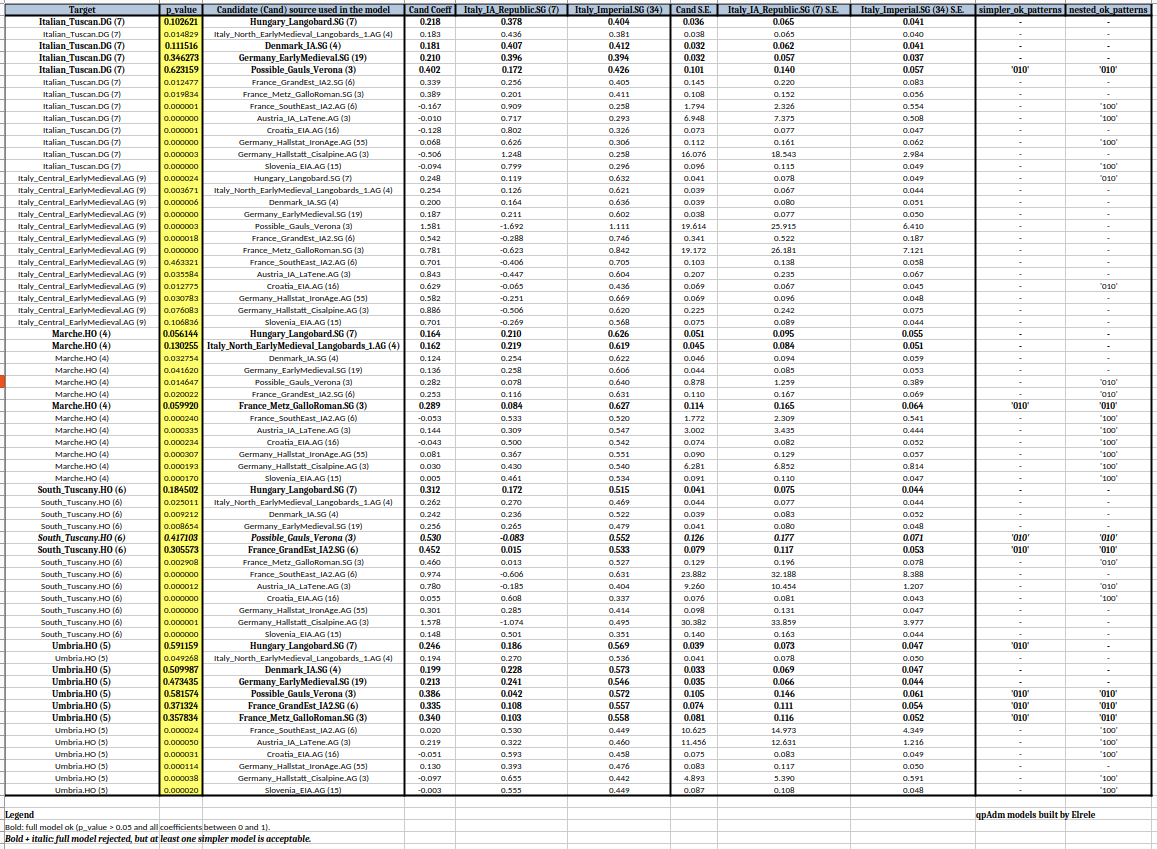
I have tried to model Central Italians in qpAdm. I have done similar models for North Italians, in a thread already posted at this blog: https://genarchivist.net/showthread.php?tid=2117 , where I also detailed my methodology.
I did not use Picenes, because I did not have time to convert the Picenes data to .geno files compatible with the .HO dataset, but I plan to do this in the future. However, I used Balkan IA populations (Slovenia_EIA.AG and Croatia_EIA.AG) which possibly would fit the models well if Picenes played a significant role in shaping modern Central Italians. Balkan IA sources do not fit the models as well as other candidate sources. Maybe Picenes will fit the data better. If I manage to use Picenes in the models, I plan to post the results here.

I focused on evaluating which models qpAdm accepts or rejects, which is the standard criterion in academia to rule in favor of a specific model. Models with a p-value > 0.05 and all source coefficients between 0 and 1 are accepted, others are rejected. However, it's important to use some common sense when interpreting the results (e.g., a p-value of 0.06 is not much stronger than 0.04). This was done to see which sources fit Central Italian models the best. I am also an amateur, so critiques are welcome, but I have done some studies in the topic, and I hope that at least my core idea is valid. So, my approach was to try to model Central Italians as 3-way models, with:
- Italy_IA_Republic.SG (7) (to account for IA Central Italy);
- Italy_Imperial.SG (34) (to account for East-Med related admixture);
- Candidate sources to capture a more Northern admixture. This source can be non-Germanic or Germanic (the goal is to compare which one fits the data best). From many PCAs, and many other modeling attempts, it has already been speculated that it is unlikely for Central Italians to be solely: Italy_IA_Republic.SG + Italy_Imperial.SG.

These were the candidate sources:
- Germanic sources used:
Hungary_Langobard.SG (N = 7), Italy_North_EarlyMedieval_Langobards_1.AG (N = 4), Denmark_IA.SG (N = 4), and Germany_EarlyMedieval.SG (N = 19).
- Non-Germanic sources used:
Austria_IA_LaTene.AG (N = 3), Croatia_EIA.AG (N = 16), Germany_Hallstat_IronAge.AG (N = 55), Germany_Hallstat_Cisalpine.AG (N = 3),
Slovenia_EIA.AG (N = 15), France_SouthEast_IA2.AG (N = 6), France_GrandEst_IA2.SG (N = 6), France_Metz_GalloRoman.SG (N = 3), and Possible_Gauls_Verona (N = 3).

Possible_Gauls_Verona are 3 outliers of the Verona_LIA Cenomani sample, so they are likely Gauls (though it's not 100% clear their origin).


Here are the results:
Screenshot%20from%202026-01-23%2019-35-01.png


As can be seen, both Germanic and Gaulish-related sources can explain most current Central Italian samples, but other sources usually cannot. Between Gaulish and Germanic, there is no decisive evidence on either side. I am not saying this is a definitive proof of Central Italian origins, but an attempt to understand their origins better. Also, it's important to note that qpAdm outcomes are highly sensitive to the chosen set of right populations. I showed my right-set of pops and explained why I chose those populations on the GitHub link and in the previous post of the North Italian models.

Models are detailed on github: https://github.com/elrele/Central_I...e/main/Italy_Central--IA_Republic_IA_Imperial. I plan to redo them with Italy_Tuscany_Grosseto_Etruscan.AG and Italy_Central_Imperial.AG soon.

Also, if anyone already has a .geno file of Picenes (or other Italian-related samples) compatible with the .HO dataset and is willing to share, I would be thankful! I have .geno data of Verona LIA and Torino EMA, which I can also share (maybe, there are faster ways to do it, but it took more than I expected to fully convert some samples).
 
Last edited:
I have tried to model Central Italians in qpAdm. I have done similar models for North Italians, in a thread already posted at this blog: https://genarchivist.net/showthread.php?tid=2117 , where I also detailed my methodology.
I did not use Picenes, because I did not have time to convert the Picenes data to .geno files compatible with the .HO dataset, but I plan to do this in the future. However, I used Balkan IA populations (Slovenia_EIA.AG and Croatia_EIA.AG) which possibly would fit the models well if Picenes played a significant role in shaping modern Central Italians. Balkan IA sources do not fit the models as well as other candidate sources. Maybe Picenes will fit the data better. If I manage to use Picenes in the models, I plan to post the results here.

I focused on evaluating which models qpAdm accepts or rejects, which is the standard criterion in academia to rule in favor of a specific model. Models with a p-value > 0.05 and all source coefficients between 0 and 1 are accepted, others are rejected. However, it's important to use some common sense when interpreting the results (e.g., a p-value of 0.06 is not much stronger than 0.04). This was done to see which sources fit Central Italian models the best. I am also an amateur, so critiques are welcome, but I have done some studies in the topic, and I hope that at least my core idea is valid. So, my approach was to try to model Central Italians as 3-way models, with:
- Italy_IA_Republic.SG (7) (to account for IA Central Italy);
- Italy_Imperial.SG (34) (to account for East-Med related admixture);
- Candidate sources to capture a more Northern admixture. This source can be non-Germanic or Germanic (the goal is to compare which one fits the data best). From many PCAs, and many other modeling attempts, it has already been speculated that it is unlikely for Central Italians to be solely: Italy_IA_Republic.SG + Italy_Imperial.SG.

These were the candidate sources:
- Germanic sources used:
Hungary_Langobard.SG (N = 7), Italy_North_EarlyMedieval_Langobards_1.AG (N = 4), Denmark_IA.SG (N = 4), and Germany_EarlyMedieval.SG (N = 19).
- Non-Germanic sources used:
Austria_IA_LaTene.AG (N = 3), Croatia_EIA.AG (N = 16), Germany_Hallstat_IronAge.AG (N = 55), Germany_Hallstat_Cisalpine.AG (N = 3),
Slovenia_EIA.AG (N = 15), France_SouthEast_IA2.AG (N = 6), France_GrandEst_IA2.SG (N = 6), France_Metz_GalloRoman.SG (N = 3), and Possible_Gauls_Verona (N = 3).

Possible_Gauls_Verona are 3 outliers of the Verona_LIA Cenomani sample, so they are likely Gauls (though it's not 100% clear their origin).


Here are the results:
Screenshot%20from%202026-01-23%2019-35-01.png


As can be seen, both Germanic and Gaulish-related sources can explain most current Central Italian samples, but other sources usually cannot. Between Gaulish and Germanic, there is no decisive evidence on either side. I am not saying this is a definitive proof of Central Italian origins, but an attempt to understand their origins better. Also, it's important to note that qpAdm outcomes are highly sensitive to the chosen set of right populations. I showed my right-set of pops and explained why I chose those populations on the GitHub link and in the previous post of the North Italian models.

Models are detailed on github: https://github.com/elrele/Central_I...e/main/Italy_Central--IA_Republic_IA_Imperial. I plan to redo them with Italy_Tuscany_Grosseto_Etruscan.AG and Italy_Central_Imperial.AG soon.

Also, if anyone already has a .geno file of Picenes (or other Italian-related samples) compatible with the .HO dataset and is willing to share, I would be thankful! I have .geno data of Verona LIA and Torino EMA, which I can also share (maybe, there are faster ways to do it, but it took more than I expected to fully convert some samples).
I've had this conversation already too many times, but I'll reiterate; the idea of Germanic sources being a source for contribution to the central Italian genepool after the imperial era directly contradicts aDNA we do have from Roman late antiquity for central Italy. The bulk Northerly contributions for Central Italy instead appear to stem from the Northern Italian portion of the PCA - not what would be found in Germanic Europe - precisely the same area which the IA picenes and EMA bardonecchia occupied. The idea of Germanic repopulation of the Italian peninsula also does not coincide with historic demography as it is estimated by classical demographers that the invading Lombards represented at best 2-3% of the population of Italy. Their contributions would've been extremely minor. You may also notice central Italians on the PCA pull further towards EEF heavy populations instead of where Germans presently lie, indicating an alternate direction of major ancestry contribution. I also contest Gallic sources, which similarly lack too much EEF to be a good fit.

1769288062184.png
 
Last edited:
Not purporting this to be true in a literal sense. But perhaps in a broad sense some of the "Langobard" could be North of Alps ancestry that could have arrived at any given time.

I ran f4(Target, Source; Rightk, Rightl) (which I got the kinks out of the code, and will post later) across all right pairs for the outgroups.


1769425805630.png


I actually can be modeled similarly but with a weaker single against the Langobards, but passable:
1769425951859.png


The model fails for North Italians however, making it less plausible overall in my eyes:

1769425988779.png
 
Last edited:
Nor
Not purporting this to be true in a literal sense. But perhaps in a broad sense some of the "Langobard" could be North of Alps ancestry that could have arrived at any given time.

I ran f4(Target, Source; Rightk, Rightl) (which I got the kinks out of the code, and will post later) across all right pairs for the outgroups.


View attachment 19124

I actually can be modeled similarly but with a weaker single against the Langobards, but passable:
View attachment 19125

The model fails for North Italians however, making it less plausible overall in my eyes:

View attachment 19126
"North of Alps" ancestry, not necessarily Langobard Germanic...Illyrian-like or Gallic-like in your opinion?
 
Nor

"North of Alps" ancestry, not necessarily Langobard Germanic...Illyrian-like or Gallic-like in your opinion?
Something in that direction, qpAdm shouldn't be taken too literally, especially in a simple 2-way using broad Lefts. But also, it is a single run that works. It hasn't gone under more rigorous verification by other tools.
 
Not purporting this to be true in a literal sense. But perhaps in a broad sense some of the "Langobard" could be North of Alps ancestry that could have arrived at any given time.

I ran f4(Target, Source; Rightk, Rightl) (which I got the kinks out of the code, and will post later) across all right pairs for the outgroups.


View attachment 19124

I actually can be modeled similarly but with a weaker single against the Langobards, but passable:
View attachment 19125

The model fails for North Italians however, making it less plausible overall in my eyes:

View attachment 19126
Of course it fails: as i pointed out multiple times, north italians are not the product of 30% Germanic+ an Italian/Central med source but are descended from local populations+roman imperial and minor Germanic. Such 2 way mix also can't produce the frequency and quality(in term of subclades) of U152 we observe. A low amount of germanic in Italy(and even slavic via byzantines) is suggested by the ibd mixture modelling from the "Tracing the spread of Germanic languages using ancient genomics" paper(see supplementary data, i will post later the figures, now i don't have access to my pc).
 
Last edited:
Nor

"North of Alps" ancestry, not necessarily Langobard Germanic...Illyrian-like or Gallic-like in your opinion?
Something in that direction, qpAdm shouldn't be taken to literally, especially in a simple 2-way.
Of course it fails: as i pointed out multiple times, north italians are not the product of 30% Germanic+ an Italian/Central med source but are descended from local populations+roman imperial and minor Germanic. Such 2 way mix also can't produce the frequency and quality(in term of subclades) of U152 we observe. A low amount of germanic in Italy(and even slavic via byzantines) is suggested by the ibd mixture modelling from the "Tracing the spread of Germanic languages using ancient genomics" paper(see supplementary data, i will post later the figures, now i don't have access to my pc).
I argree with you, but you should know Lazaridis recently said he thinks it is likely that Italians are Imperial Romans, (Anatolian-enriched) and Langobard/Gothic admixture enrichment.
 
Something in that direction, qpAdm shouldn't be taken to literally, especially in a simple 2-way.

I argree with you, but you should know Lazaridis recently said he thinks it is likely that Italians are Imperial Romans, (Anatolian-enriched) and Langobard/Gothic admixture enrichment.
It's unbelievable from a professional scholar.
 
Something in that direction, qpAdm shouldn't be taken to literally, especially in a simple 2-way.

I argree with you, but you should know Lazaridis recently said he thinks it is likely that Italians are Imperial Romans, (Anatolian-enriched) and Langobard/Gothic admixture enrichment.
Perhaps he was referring to central/southern Italians, that statement is more true for them, while i still don't agree with such an oversimplification.
I think that in various areas of Italy there is some degree of continuity. The Balkan shift is still noticeable in Adriatic Italy, Umbria is too EEF shifted to be derived from Imperial Roman+Germanic, Southern Italy tend to lack the proper late IA sources ecc...
The Aegean influx before the imperial roman period and the later Byzantine contribution(which i think is underestimated in Southern Italy where it even left the Greek language spoken to this day, once more widespread) are surely part of the shift which can't be attributed solely to Imperial Anatolian/Mesopotamian.
But i think we agree on this, since you were one of the first to point this out.
I also suspect that if appenninic inland and remote villages are analyzed, instead of big cities and coastal areas, we will see more conservative profiles, with greater native contribution, richer in EEF and lower in Anatolia_BA.

Here are the figures from the study:
Immagine 2026-01-26 202151 - Copia.jpg


page_53.png


We can see that, aside from the outliers, the germanic is present albeit in low amount, and also a bit of Baltic_BA likely derived from Slavs, mediated by Byzantines and/or picked up by Langobards/Goths.
It is interesting to note some amount of this pink component (EstoniaBA) in the Medieval Foggia samples.
 
Perhaps he was referring to central/southern Italians, that statement is more true for them, while i still don't agree with such an oversimplification.
I think that in various areas of Italy there is some degree of continuity. The Balkan shift is still noticeable in Adriatic Italy, Umbria is too EEF shifted to be derived from Imperial Roman+Germanic, Southern Italy tend to lack the proper late IA sources ecc...
The Aegean influx before the imperial roman period and the later Byzantine contribution(which i think is underestimated in Southern Italy where it even left the Greek language spoken to this day, once more widespread) are surely part of the shift which can't be attributed solely to Imperial Anatolian/Mesopotamian.
But i think we agree on this, since you were one of the first to point this out.
I also suspect that if appenninic inland and remote villages are analyzed, instead of big cities and coastal areas, we will see more conservative profiles, with greater native contribution, richer in EEF and lower in Anatolia_BA.

Here are the figures from the study:
View attachment 19127

View attachment 19128


We can see that, aside from the outliers, the germanic is present albeit in low amount, and also a bit of Baltic_BA likely derived from Slavs, mediated by Byzantines and/or picked up by Langobards/Goths.
It is interesting to note some amount of this pink component (EstoniaBA) in the Medieval Foggia samples.
While I think the Imperial immigrants are likely from Anatolia. I think C6 represents a native group, or a confluence of various Italic-like people and Greek colonists. That being said, I think academics should consider the fact that the haplotypes from that study compel a closer more nuanced analysis. Not to mention the demographic dynamics of the post-Western Roman period. At any rate, you guys know my opinion on the matter.
 
Just as an aside, Italy_Bivio_Roman.SG is essentially the AADR "official version" of C6.

It is also Central Italian, it comes from Umbria I believe. It is not the other Bivio near the Swiss boarder.

1769465879233.png


1769466130467.png

1769466139739.png
 
Back
Top