Nobody1
Regular Member
- Messages
- 1,033
- Reaction score
- 259
- Points
- 0
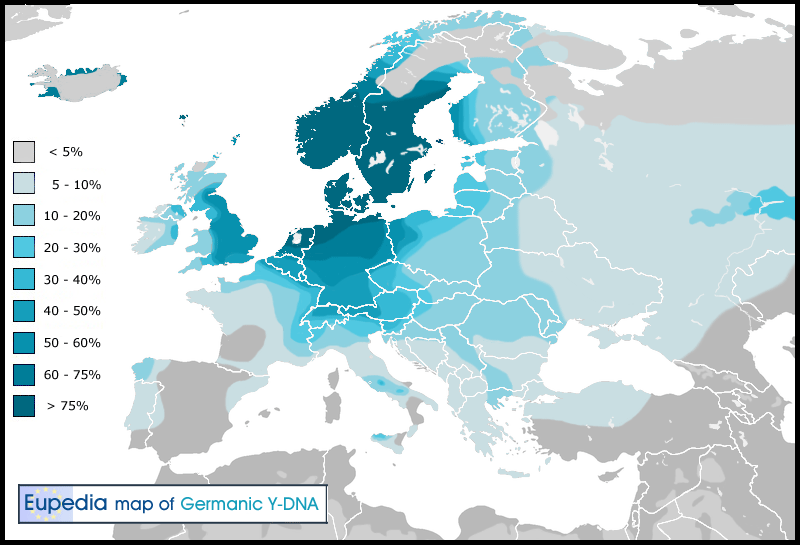
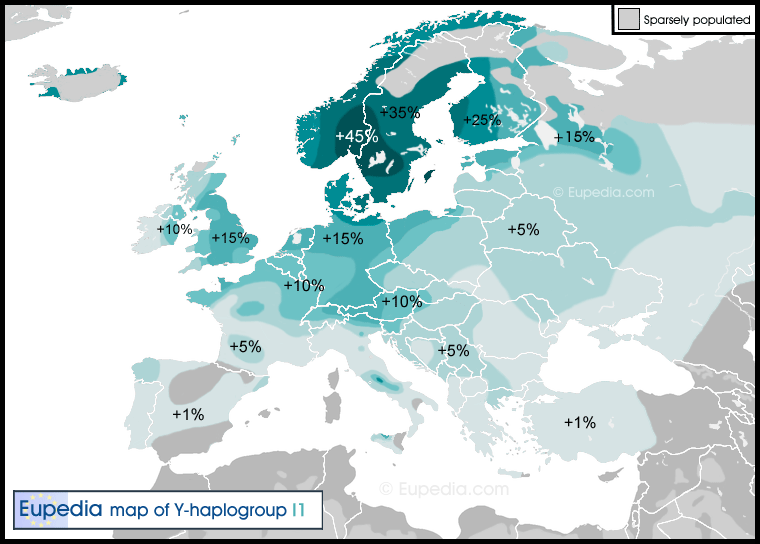
Since location of Proto-Germanic is highly related to I1a, it is most interesting to find out how and when did they got hold of IE language?
Are you implying that the proto-Germanics and the subsequent Germanic peoples were not Indo-Europeans?
And its all a big mystery as to why they speak an Indo-European language?
Lets take a look
First im not really sure why you think that proto-Germanic is related to I1a;
Eulau (Corded-Ware culture/Indo-European) which is West of the Elbe north of the Danube was Y-DNA R1a 3x [mtDNA X2/K1b/H/U]; Lichtenstein cave (Urnfield culture/Indo-European) Harz area north of the Danube was Y-DNA I-M170(L-38) 3x, R1a 1x and R1b-U106 1x [mtDNA H/U/J/T];
Haak et al 2008 - Eulau
http://www.pnas.org/content/105/47/18226.long
Lichtenstein - Göttingen Uni. / D. Schweizer
http://www.genebaze.cz/res/LC/LC.pdf
http://dirkschweitzer.net/LichtensteinCaveAnalysis0804DS.pdf
The proto-Germanic and Germanic peoples were Indo-Europeans that emerged out of the Indo-European waves and cultures of Globular Amphora, Corded-Ware, (Nordic)/Urnfield, Jastorf, Lusatian, Przworsk etc.
The Germanic language (which is Indo-European) contains like all other Indo-European languages non-Indo-European elements which is due to the inter-mixing and subjugating of the pre-Indo-European pops. in the varies areas; The Germanic people were equated with the Indo-European Kelts and even to be of the same stock as the Kelts (a broader Indo-European stock) - though the GERMANI were seen as purer (not as mixed as the Kelts) than the Kelts;
Strabo - Book VII/I
Now the parts beyond the Rhenus, immediately after the country of the Celti, slope towards the east and are occupied by the Germans, who, though they vary slightly from the Celtic stock in that they are wilder, taller, and have yellower hair, are in all other respects similar, for in build, habits, and modes of life they are such as I have said the Celti are. And I also think that it was for this reason that the Romans assigned to them the name 'Germani', as though they wished to indicate thereby that they were 'genuine' Galatae, for in the language of the Romans 'germani' means 'genuine'.
Many more pasages like that are found in the Germania of Tacitus;
The Germanic language is fundamental for the Grimms-law which might be first recorded at the Negau helmet; Which raises the question: Who were the Tauriski?