• Don't want to see ads? Install an adblocker like uBlock Origin or use a Europe-based privacy-friendly browser like Vivaldi or Mullvad.

Genetic study Slavic Expansion

Tomenable

Well-known member
Messages
5,991
Reaction score
1,714
Points
113
Location
Poland
Ethnic group
Polish
Y-DNA haplogroup
R1b-L617
mtDNA haplogroup
W6a
This article was just published today so I thought that we can start a fresh thread about the Slavic Expansion.

Link:

Abstract

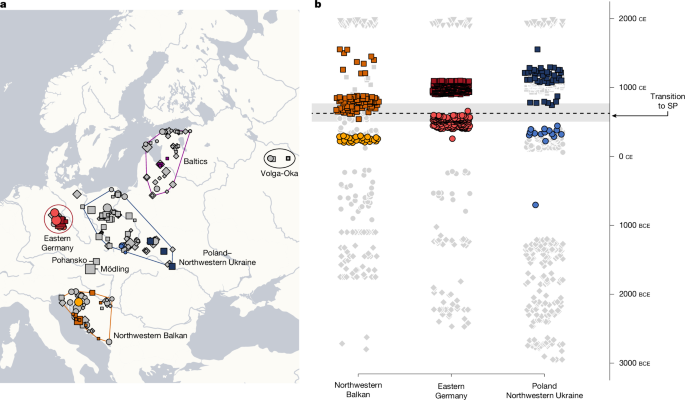
The second half of the first millennium CE in Central and Eastern Europe was accompanied by fundamental cultural and political transformations. This period of change is commonly associated with the appearance of the Slavs, which is supported by textual evidence1,2 and coincides with the emergence of similar archaeological horizons3,4,5,6. However, so far there has been no consensus on whether this archaeological horizon spread by migration, Slavicisation or a combination of both. Genetic data remain sparse, especially owing to the widespread practice of cremation in the early phase of the Slavic settlement. Here we present genome-wide data from 555 ancient individuals, including 359 samples from Slavic contexts from as early as the seventh century CE. Our data demonstrate large-scale population movement from Eastern Europe during the sixth to eighth centuries, replacing more than 80% of the local gene pool in Eastern Germany, Poland and Croatia. Yet, we also show substantial regional heterogeneity as well as a lack of sex-biased admixture, indicating varying degrees of cultural assimilation of the autochthonous populations. Comparing archaeological and genetic evidence, we find that the change in ancestry in Eastern Germany coincided with a change in social organization, characterized by an intensification of inter- and intra-site genetic relatedness and patrilocality. On the European scale, it appears plausible that the changes in material culture and language between the sixth and eighth centuries were connected to these large-scale population movements.

=====

And another paper also published today:

Abstract

Background
The Slavs are a major ethnolinguistic group of Europe, yet the process that led to their formation remains disputed. As of the sixth century CE, people supposedly belonging to the Slavs populated the space between the Avar Khaganate in the Carpathian Basin, the Merovingian Frankish Empire to the West and the Balkan Peninsula to the South. Proposed theories to explain those events are, however, conceptually incompatible, as some invoke major population movements while others stress the continuity of locals.

Results
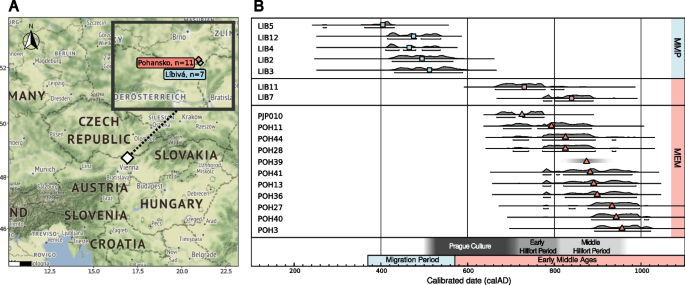
We report high-quality genomic data of 18 individuals from two nearby burial sites in South Moravia that span from the fifth to the tenth century CE, during which the region became the core of the ninth century Slavic principality. In contrast to existing data, the individuals reported here can be directly connected to an Early-Slavic-associated culture and include the earliest known inhumation associated with any such culture.

Conclusions
The data indicates a strong genetic shift incompatible with local continuity between the fifth and seventh century, supporting the notion that the Slavic expansion in South Moravia was driven by population movement.
 
And here an interesting video about the subject:

 
From the first paper (MP - Migration Period, SP - Slavic Period):

Across Central Europe, we show that during the Roman Iron Age and subsequent MP genetic diversity increased not only within the empire, but also outside it. Southeastern Europe experienced an influx from the Eastern Mediterranean, whereas large parts of East-Central Europe were inhabited by people mainly related to modern inhabitants of Northern and Northwestern Europe. We also show a fifth and sixth century admixture of Mediterranean ancestry in Eastern Germany, prevalently but not exclusively through females. They and their offspring became well-integrated in the regional societies, and their burials show no signs of inferior status or cultural differences, a finding very different from those at early medieval cemeteries in Hungary, Italy and England with respect to incoming Northern versus local, Southern and Western European ancestry. Yet, after the fall of the Thuringian kingdom this diverse population gradually disappeared, and the SP began.

We were able to connect the fundamental transformations of culture in large parts of Eastern Europe to a substantial movement of people most plausibly from regions between the Eastern Baltics and the Northwestern Pontic region. This genetically inferred area agrees well with archaeological hypotheses for the origins of Slavic material culture east of the Vistula River, for instance, in the Kyivan culture (second or third to fifth centuries CE)
 
From the supplement to the first paper:

the results of the present paper make it hard to deny substantial movements from a region between the Baltic countries and the northeastern foreland of the Carpathians towards the Elbe, the Adriatic and the Upper Volga. However, this does not mean that the traditional narrative of an expansion of “the” Slavs has now received confirmation. In the vast region from where the ancestry of the Slavs came according to the archaeogenetic results, we have no indication that a people called “Slavs” existed. Furthermore, as Florin Curta has emphasized, they did not transfer from any homeland a distinct “Slavic culture” as defined by archaeologists in post-6th century East-Central Europe. Neither can we be sure who exactly in the region of origin spoke the common Slavic language that can be reconstructed from much later written evidence. “The Slavs” were the result, not the precondition of the movements from the northeast.
 
It seems a "southern" (rather Balkanic + light Germanic) input concerned the alleged region for the Slavs possible craddle. I think it would be very interesting to search for Y-I2a1b specific subclades involved in the Slavs genesis. It could have been the cause of the definitive break between Slavs and Balts? Some Y-I2+ emerged from a Peri-Carpathian small region?
 
It seems a "southern" (rather Balkanic + light Germanic) input concerned the alleged region for the Slavs possible craddle. I think it would be very interesting to search for Y-I2a1b specific subclades involved in the Slavs genesis. It could have been the cause of the definitive break between Slavs and Balts? Some Y-I2+ emerged from a Peri-Carpathian small region?

R1a-M458 and R1a-M558 are named as characteristically Slavic.

On the Baltic-Slavic split:

in contrast to the Bronze Age Baltic samples, we note that SP individuals from all study regions exhibit substantially less Western hunter-gatherer (WHG) and more early European farmer (EEF) ancestry (Supplementary Figs. 41 and 42a and Supplementary Note 4.4.2). This suggests that the SP groups in Central Europe were already admixed, most probably between a WHG and Steppe ancestry-enriched Baltic Bronze Age-related source from the sub-Neolithic forest zone and at least one EEF-enriched source from the south. Using qpAdm, we identify various groups in Southeastern and East-Central Europe that constitute working proxies for such an EEF-enriched donor, yet we are not able to precisely identify the most likely representative (Supplementary Fig. 43). Across all fitting two-way models (P > 0.01) (and most non-fitting), the admixture proportions are highly similar, with the Eastern German and Polish-Northwestern Ukrainian SP samples receiving around 71% Baltic (95% confidence interval: 66.5%–76%) and around 29% (95% confidence interval: 24%–33.5%) EEF-enriched ancestry (Supplementary Fig. 43b and Supplementary Table 34). However, we highlight that the demographic trajectories that led to the formation of the SP gene pool were potentially more complex than a simple two-way admixture event.
 
It seems a "southern" (rather Balkanic + light Germanic) input concerned the alleged region for the Slavs possible craddle. I think it would be very interesting to search for Y-I2a1b specific subclades involved in the Slavs genesis. It could have been the cause of the definitive break between Slavs and Balts? Some Y-I2+ emerged from a Peri-Carpathian small region?

I also share the same opinion, Y-DNA I2a is a solid candidate for the more Southern-like shift of Proto-Slavs. Some population just north of Carpathians perhaps?
 
You might want to dive into the supplemental information of the first article, it has extensive chapters on uniparental markers, admixture and IBD clustering. The broad summary is that R1a and I2 proportions increased hugely with the slavic migration, but each analysed site has its own nuances.

The authors note that there were some Slavic-like people in the Balkans already in the Roman period and that proto-Slavs must have had a lot of contact to SE Europe:

our IBD results might recapitulate a network of long-term, recurrent genetic exchange between Pannonia/the Northern Balkans and the ancestors of the SP population in Eastern Europe (Fig. S32b)
 
I made an average for nine Przeworsk samples in Eurogenes K36 calculator:

Samples included in the average:

Przeworsk_PC1001 (Boczne cave, 200-400 AD)
Przeworsk_PC1004 (Zarska cave, 200-500 AD)
Przeworsk_PC1005 (Zarska cave, 200-500 AD)
Przeworsk_PC1008 (Koziarnia cave, 258-530 AD)
Przeworsk_PC1009 (Koziarnia cave, 246-404 AD)
Przeworsk_PC1016 (Koziarnia cave, 200-500 AD)
Przeworsk_PCA0011 (Gaski, 200 BC - 100 AD)
Przeworsk_PCA0012 (Gaski, 200 BC - 100 AD)
Przeworsk_czu001 (Czulice, 395–418 AD)

This average has such distances to modern regional European populations:

Przeworsk_N9

[1] "1. CLOSEST SINGLE ITEM DISTANCE%"
Europe_NL_Zuid-Holland
0.3009950
Europe_NL_Gelderland
0.3898654
Europe_DE_Nordrhein-Westfalen
0.3927225
Europe_NL_Noord-Holland
0.3953593
Europe_GB_East-of-England
0.4364905
Europe_NL_Utrecht
0.4456624
Europe_DK_Denmark
0.4486000
(...)

And K36 Mixed Mode for this Przeworsk average (reduced to 5 populations):

Target: Przeworsk_N9
Distance: 0.87696597 | R5P
32.2 Europe_DK_Denmark
27.0 Europe_NL_Friesland
20.6 Europe_NL_Utrecht
14.8 Europe_FR_Nord-Pas-de-Calais
5.4 Europe_FR_Picardy

And here Similitude Map based on these averaged K36 results for Przeworsk:

TgNc55H.png
 
For comparison the only Lusatian sample from this paper:


PC2001 (Zbojecka cave, 776-634 BC)

Sample PC2001_Lusatian
Amerindian 0.14
Arabian 0
Armenian 0.22
Basque 0.34
Central African 0
Central Euro 8.47
East African 0
East Asian 0.92
East Balkan 8.3
East Central Asian 0
East Central Euro 19.17
East Med 0
Eastern Euro 8.55
Fennoscandian 2.67
French 6.25
Iberian 3.64
Indo-Chinese 0
Italian 2.8
Malayan 0
Near Eastern 0
North African 0
North Atlantic 14.81
North Caucasian 0
North Sea 14.3
Northeast African 0
Oceanian 0
Omotic 0
Pygmy 0
Siberian 0
South Asian 0
South Central Asian 0
South Chinese 0
Volga-Ural 1.01
West African 0
West Caucasian 0
West Med 8.42

UebjbAK.png
 
And Y-DNA haplogroups of Przeworsk samples:

czu001 (Czulice) - I1-FGC21611
PC1004 (Zarska cave) - I1-CTS11950,Z2880
PC1005 (Zarska cave) - I1-FGC7747
PC1008 (Koziarnia cave) - I2a1b1-CTS7391
PC1001 (Boczne cave) - J2b2a1a1a1a1a1a-Z639 (also J-Z631)
PC1009 (Koziarnia cave) - E1b1b1a1b1-CTS10084,PF2245,Z1058
PC1016 (Koziarnia cave) - woman
PCA0011 (Gaski) - woman
PCA0012 (Gaski) - woman

And also the Poprad prince who is suspected of being Przeworsk:

DA119 (Poprad-Matejovce) - R1b1a1b1a1a1c2b1b4b-S6915

These two haplogroup tools are very useful:

HRAS - https://hras.yseq.net/?dna_type=y&map_type=alpha

SNP Tracker - https://scaledinnovation.com/gg/snpTracker.html
 
Comparison of Grodek_Tribal and Grodek_Medieval averages using my K36 averages:

Grodek_Tribal includes these samples:

GRK004 - dated to 772 - 973 CE
GRK008 - dated to 677 - 877 CE
GRK010 - dated to 670 - 821 CE
GRK011 - dated to 682 - 880 CE
GRK013 - dated to 676 - 876 CE
GRK014 - dated to 705 - 884 CE
GRK015 - dated to 704 - 884 CE

Distance to: Grodek_Tribal
3.18240475 Europe_UA_Lviv-Oblast
3.69383270 Europe_SK_Zemplin-Rusyns
4.66173787 Europe_SK_Slovakia
4.76123933 Europe_UA_Zakarpattia-Oblast
4.92020325 Europe_PL_Malopolskie
5.20370061 Europe_SK_Slovakia-Presov
5.40671804 Europe_PL_Podkarpackie
5.62751277 Europe_PL_Upper-Silesia
5.67713836 Europe_UA_Poltava-Oblast
5.86718842 Europe_UA_Vinnytsia-Oblast

Grodek_Medieval includes these samples:

GRK001 - dated to 1036 - 1164 CE
GRK002 - dated to 1032 - 1159 CE
GRK005 - dated to 1039 - 1185 CE
GRK006 - dated to 1039 - 1162 CE
GRK007 - dated to 995 - 1154 CE
GRK009 - dated to 1024 - 1157 CE
GRK012 - dated to 1032 - 1159 CE

Distance to: Grodek_Medieval
2.94068019 Europe_PL_Podlaskie
3.10436789 Europe_PL_Mazowieckie
3.67675128 Europe_PL_Central-Poland
3.82745346 Europe_BY_Grodno-Region
4.03220783 Europe_PL_Lubelskie
4.33591974 Europe_PL_Zachodniopomorskie:Medieval
4.62135262 Europe_UA_Sumy-Oblast
4.68984008 Europe_UA_Zhytomyr-Oblast
4.78677344 Europe_PL_Podkarpackie
4.90176499 Europe_UA_Rivne-Oblast

Interesting, don't you think? Weren't Grodek_Tribal the Ledzianie tribe?:

 
Maybe it shows that the Balkan-like admixture did not come with Vlachs but was already present in the Tribal Period (Early Middle Ages).

=====

Edit:

After removing outlier GRK002 from the Medieval average it looks like this:

(maybe the garrison of the stronghold came from Medieval Wielkopolska?)

Distance to: Grodek_Medieval
3.07475202 Europe_PL_Podlaskie
3.22035712 Europe_BY_Grodno-Region
3.55671196 Europe_PL_Wielkopolskie:Medieval
3.72808262 Europe_PL_Mazowieckie
3.99911240 Europe_UA_Kiev-Oblast
4.01248053 Europe_UA_Sumy-Oblast
4.26609892 Europe_BY_Minsk-Region
4.26626300 Russia_RUS_Smolensk
4.27031615 Europe_PL_Central-Poland
4.36467639 Europe_BY_Homyel-Region

PCA of Grodek_Tribal and Grodek_Medieval compared to modern countries:

xyORsBw.png
 
Last edited:
There is also one Slavic-like ancient sample from Grodek, dated to 245 - 402 AD:

Distance to: GRK023
11.26423544 Europe_PL_Pomorskie-Kluki:Slovincians
11.74814028 Europe_PL_Warmia-Masuria
12.01737492 Europe_BY_Brest-Region
12.23638836 Europe_PL_Central-Poland
12.29588142 Europe_BY_Mogilev-Region
12.56791550 Europe_PL_Wielkopolskie:Medieval
12.70014173 Europe_EE_Parnu-County
12.70910697 Europe_PL_Kujawsko-Pomorskie
12.89168724 Europe_PL_Mazowieckie
12.94686835 Europe_PL_Pomorskie-Kashubia

Sample GRK023
Amerindian 0
Arabian 0
Armenian 0
Basque 1.56
Central African 0
Central Euro 0
East African 0
East Asian 0
East Balkan 5.9
East Central Asian 0
East Central Euro 24.88
East Med 0
Eastern Euro 16.4
Fennoscandian 16.37
French 5.68
Iberian 1.1
Indo-Chinese 0
Italian 0
Malayan 0
Near Eastern 0
North African 0
North Atlantic 13.99
North Caucasian 0
North Sea 12.72
Northeast African 0
Oceanian 0
Omotic 0
Pygmy 0
Siberian 0
South Asian 0
South Central Asian 0
South Chinese 0
Volga-Ural 1.39
West African 0
West Caucasian 0
West Med 0

Maybe it is a Gothic-Baltic mixed person?
 
Last edited:
Now a comparison using G25 and Europe1 PCA:

As can be seen Grodek_Tribal is more Balkan-shifted and Grodek_Medieval more Baltic-shifted:


Code:
Grodek_Medieval:GRK001,0.132035,0.128972,0.069013,0.056848,0.042162,0.019801,0.011986,0.007846,-0.005318,-0.021322,-0.004384,-0.009442,0.022596,0.026699,-0.008686,0.002254,0.008345,-0.006208,-0.004399,0.004252,-0.004866,-0.009892,0.010846,-0.007591,-0.006945
Grodek_Medieval:GRK005,0.138864,0.123895,0.07731,0.076874,0.043393,0.032909,0.011751,0.014999,0.004704,-0.0277,-0.002111,-0.009891,0.02334,0.023121,-0.016829,-0.002784,0.010952,-0.005194,0.00817,0.004502,-0.002745,-0.008408,0.00912,-0.015183,0.00455
Grodek_Medieval:GRK006,0.127482,0.12491,0.071653,0.068153,0.048009,0.025658,0.008225,0.009461,-0.001841,-0.026789,-0.007795,-0.013338,0.016501,0.017065,-0.009093,0.000928,0.006128,-0.00038,0.006536,0.01038,-0.002371,-0.003833,0.000246,-0.009399,0.00012
Grodek_Medieval:GRK007,0.126344,0.126941,0.058077,0.042636,0.042777,0.012829,0.012456,0.014999,-0.003681,-0.010387,-0.001624,-0.002997,0.015312,0.017203,-0.006243,0.008353,0.008475,0.003927,0.007416,-0.003502,-0.004991,-0.005564,0.001725,-0.009278,-0.00946
Grodek_Medieval:GRK009,0.130897,0.121864,0.072784,0.069122,0.040007,0.018128,0.012221,0.015692,-0.001432,-0.024237,-0.005034,-0.000599,0.021258,0.026836,-0.015744,-0.012861,-0.00678,-0.002787,0.004274,0.001626,-0.010107,-0.00136,0.0053,-0.007832,-0.000958
Grodek_Medieval:GRK012,0.129758,0.123895,0.059585,0.059109,0.045239,0.013945,0.01034,0.01223,-0.001432,-0.024602,0.001461,-0.01094,0.022894,0.020781,-0.013572,0.012198,0.02047,-0.005701,-0.004777,0.006628,-0.006738,-0.009274,0.011832,-0.008073,-0.00491
Grodek_Tribal:GRK004,0.132035,0.128972,0.066373,0.048127,0.048624,0.010877,0.011751,0.010153,0.003068,-0.013485,-0.008119,-0.005695,0.005203,0.021332,-0.010722,-0.000133,0.005215,0.00114,0.005531,0.008379,-0.005865,0.00779,0.008134,-0.007471,0.007544
Grodek_Tribal:GRK008,0.140002,0.12491,0.06675,0.054587,0.038161,0.018407,0.008225,0.004154,0.003272,-0.026424,-0.005359,-0.001499,0.011744,0.015551,-0.012758,0.01538,0.022035,-0.007728,-0.002765,0.003502,0,-0.004946,0.008751,-0.007471,-0.002155
Grodek_Tribal:GRK010,0.136588,0.13405,0.059208,0.040698,0.043085,0.01757,0.00893,0.008538,-0.002863,-0.015672,-0.004872,-0.008093,0.006095,0.019405,-0.010722,0.003447,0.010952,-0.001014,0.013324,-0.000375,0.00287,0.001607,0.003944,-0.009399,-0.000359
Grodek_Tribal:GRK011,0.134311,0.118817,0.056191,0.053941,0.030159,0.020917,0.00705,0.011538,0.001023,-0.021322,0.00747,-0.005845,0.014717,0.019818,-0.011536,0.000796,0.00339,0.00114,-0.001131,-0.000875,-0.009733,-0.005812,0.008134,-0.005181,-0.000958
Grodek_Tribal:GRK013,0.136588,0.125926,0.069013,0.057817,0.0437,0.016176,0.011751,0.015922,-0.002863,-0.019317,0.002111,-0.006894,0.015015,0.01913,-0.0095,-0.005436,-0.007041,0.003294,0.007416,-0.001376,-0.005989,-0.008656,0.008258,-0.012291,0.002395
Grodek_Tribal:GRK014,0.12862,0.132019,0.054305,0.03553,0.038161,0.006972,0.003995,0,-0.003272,-0.005649,-0.001949,0.002398,0.001338,0.016102,-0.008822,0.001458,0.011083,0.007728,0.014707,0.004877,-0.00262,0.004575,0.006162,0.001325,0.006945
Grodek_Tribal:GRK015,0.125205,0.11577,0.059962,0.042313,0.031698,0.018407,0.00423,0.008769,0.000409,-0.01385,0.001786,-0.003147,0.00669,0.010459,-0.003529,0.013259,0.015255,-0.004561,0.000628,0.002501,-0.003494,-0.003586,0.010599,-0.000723,-0.001317

CnfnVGO.png
 
So we have these samples from Przeworsk in G25:

(I'm not sure why but in Ajeje's spreadsheet PCA0011 and PCA0012 have a bit different coordinates)

Code:
Przeworsk_Gaski_PCA0011,0.127482,0.128972,0.060716,0.057494,0.036622,0.015339,0.007285,-0.003923,0.000614,0.001276,-0.004872,-0.001349,-0.015758,-0.009221,0.020358,0.005701,-0.00339,0.001647,0.003394,0.008629,0.003119,0.011252,0.012325,0.013134,-0.002754
Przeworsk_Gaski_PCA0012,0.134311,0.145221,0.054682,0.030685,0.050163,0.007809,-0.00141,0.006,0.013908,0.01877,-0.003085,0.01154,-0.01115,-0.007982,0.013843,0.011138,0.005215,0.006588,0.006536,-0.001626,-0.001373,0.001731,-0.000616,-0.001446,-0.00012
Przeworsk_Czulice_czu001,0.121791,0.133034,0.075801,0.070737,0.042469,0.017012,0.00188,0.011307,0.006749,-0.002369,-0.005196,0.004946,-0.013379,-0.013762,0.021444,0.025722,0.004433,-0.003294,-0.002891,0.008754,0.013102,0.000618,-0.002095,0.019882,-0.001197
Przeworsk_Boczne_PC1001,0.135449,0.131003,0.060716,0.046189,0.035391,0.022869,-0.00188,0.003,-0.000818,0.005832,-0.009256,0.012739,-0.012339,-0.011147,0.009229,0.018165,0.011865,0.007855,0.010433,0.000625,0.001248,0.010881,-0.003451,0.009519,-0.011975
Przeworsk_Zarska_PC1004,0.140002,0.142174,0.060339,0.052326,0.038161,0.027331,0.014101,0.004615,-0.006545,0.000364,-0.001624,0.001349,-0.0055,-0.02202,0.002986,0.016441,0.007823,-0.003674,0.002514,0.01138,-0.000125,0.011129,0.000986,0.017593,-0.014969
Przeworsk_Zarska_PC1005,0.135449,0.146236,0.060716,0.054587,0.048624,0.019801,0.006345,0.007615,-0.005522,0.001822,0.000974,0.006145,-0.009514,-0.011836,0.019544,0.008221,0.014473,-0.000507,0.007416,0.008254,0.002496,0.000371,0.003081,0.017593,-0.012574
Przeworsk_Koziarnia_PC1009,0.142279,0.126941,0.059208,0.038114,0.041238,0.018128,0.000705,0.009923,-0.012067,0.010387,0.002598,0.004946,0.000743,-0.006331,0.002714,0.001326,0.005607,0.003674,0.004022,-0.002376,0.007237,0.009274,0.003697,0.012652,-0.001317
Przeworsk_Koziarnia_PC1016,0.132035,0.141159,0.061094,0.027132,0.049855,0.005857,0.00235,0.02723,0.013294,0.012939,0.006171,0.028025,-0.003717,-0.012386,0.03678,0.027446,0.009257,0.010135,0.004399,0.013381,0.004492,0.003957,-0.002465,0.006145,0.012454

Average:

Code:
Przeworsk_N8,0.1335998,0.1368425,0.061659,0.047158,0.0428154,0.0167682,0.003672,0.0082209,0.0012016,0.0061276,-0.0017862,0.0085426,-0.0088268,-0.0118356,0.0158622,0.01427,0.0069104,0.002803,0.0044779,0.0058776,0.0037745,0.0061516,0.0014328,0.011884,-0.0040565

The average for these 8 Przeworsk culture samples lies exactly along the cline connecting Gauls with Germanics:

MTZRe0k.png


^^^
I used populations from my "World 6th century BC" calculator:

 
There is an upcoming study about Polish Y-DNA haplogroups by my friend who is a geneticist. It will be published in "Human Genetics" journal. According to this upcoming study 60% of Polish males belong to as few as 23 lineages (including 16 lineages within haplogroup R1a) all of which are younger than 2750 years (so they emerged in the Iron Age because the end of the Bronze Age in East-Central Europe is dated to the middle of the 8th century BCE). I already have the manuscript of this study and I would share excerpts and graphs with you, but I promised not to publicize it before official publication. This study will support the idea of an Iron Age origin of Slavs from a relatively small founder population.
 
You might want to dive into the supplemental information of the first article, it has extensive chapters on uniparental markers, admixture and IBD clustering. The broad summary is that R1a and I2 proportions increased hugely with the slavic migration, but each analysed site has its own nuances.

The authors note that there were some Slavic-like people in the Balkans already in the Roman period and that proto-Slavs must have had a lot of contact to SE Europe:
Yes, if we consider Croatia is in southeatsern Europe.
 
Back
Top