I'm quite intrigued by it; Montenegro, or at least the southeastern portion of it, is a hotspot for E-V13, considering that we know that a lot of it transmitted during the Middle Ages, I'm curious whether any will be discovered during the Iron Age.
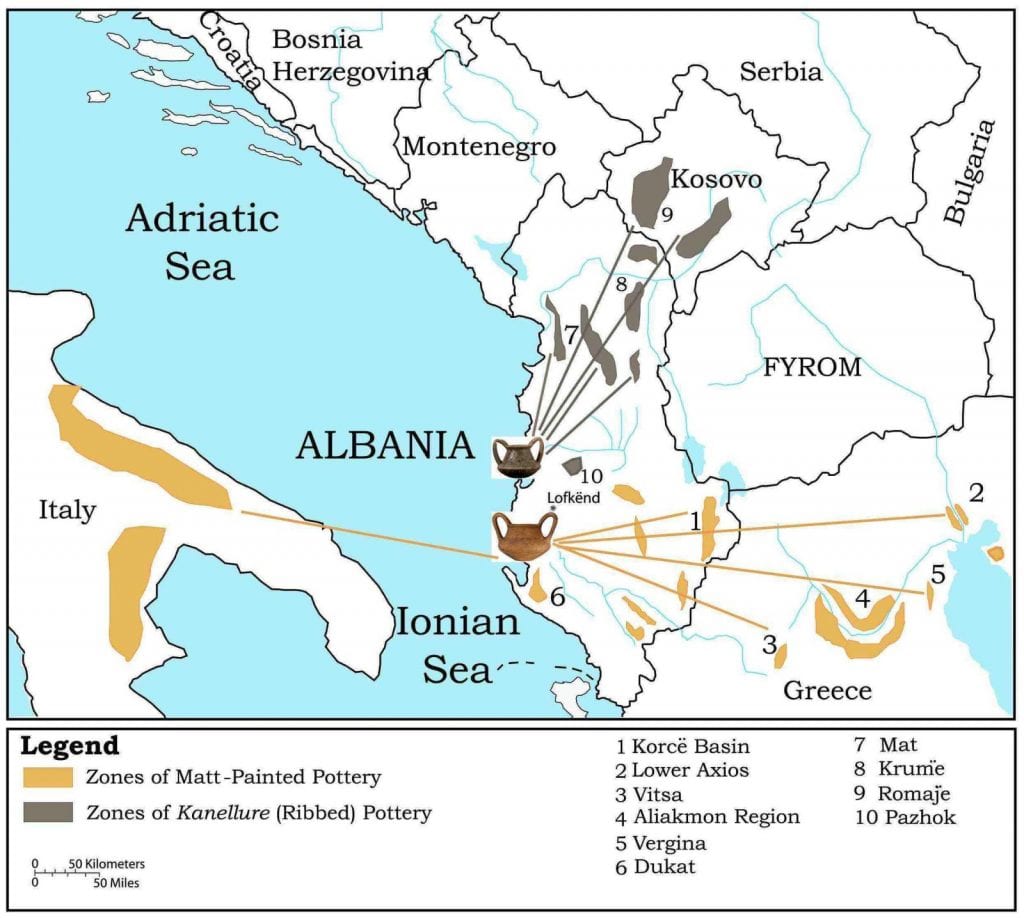
That's a good question, but I think a higher portion of E-V13 is more likely for Kosovo and the North of Albania than for Montenegro, which was more protected from the earlier movements. But Macedonia should have it in the Iron Age, most definitely. It was heavily affected by both Channelled Ware and Psenichevo-Basarabi, much more so than Bosnia, Montenegro or Albania, that was replacement level in much of its territory. Same is true for Serbia, for Croatia it depends on the area, the North East/Slavonia was most affected.
Compare with the signature finds from Channelled Ware, especially the South Western Belegis II-G?va group:
https://www.eupedia.com/forum/threa...kan-case/page9?p=634651&viewfull=1#post634651
If you compare those with the latest samples of E-V13, you could as well overlap the hoard/flame shaped casted spearheads with higher concentrations of E-V13 in Pannonia up to the Avars. Could be a coincidence, but rather not.
In most these maps, Albania got affected too, but there is a core region of the Southern Adriatic they just seem to have forewent, presumably because the locals blocked them (Illyrian core). In other Adriatic and even Albanian regions there were at least produced finds, most important are of course hoards and production for the Reutlingen swords, flame shaped, casted spearheads, burnished black pottery with fluting etc. in combination with hoards and cremation burials.
If they find E1b1b anywhere, context and dating is key, as is the exact subclade, in a best case scenario terminal clade, of the sample.
To just get "some E1b1b" might be not that helpful after all, because we need to know:
- To which branch they belong, how they can be placed in the larger distribution and phylogeny
- Whether they are part of "the founding fathers" from the LBA-EIA transition or just a negligible side branch which probably didn't even survive, like some of the Michelsberger presumably.
That was a major shortcoming of the British paper and much better in the Avar-Pannonian one.