• Don't want to see ads? Install an adblocker like uBlock Origin or use a Europe-based privacy-friendly browser like Vivaldi or Mullvad.

The genetic history of Ice Age Europe

Darn straight, Epoch. That's exactly what I did. :) If I may be so blunt, if I need medical advice for a serious issue I don't rely on some jamoke on the internet who doesn't post under his real name and whose qualifications I can't check, and who might also be somebody with an undisclosed and unsavory bias.

As one of the jamokes I can assure you you can trust me. I have many, many undisclosed and unsavory biases. But since most of them firmly contradict each other the end result is zero.

I do an exhaustive search of a professional's education and other qualifications. If it's a doctor I find out how many malpractice suits have been filed against him or her. Not that I then just rely on them. I ultimately don't blindly trust anyone. It must be genetic. :) Just as I do here I do my own research and ask tough questions and challenge what they're saying until I'm satisfied I'm getting the best possible advice. It may not make me the ideal patient from their point of view, but that's too damn bad for them; if they don't like the color of my money I can go elsewhere. Of course, every once in a while there is an amateur who surprises everyone, including me...i.e. Gioiello! :)

Really, you can blindly trust me. Have I ever lied to you?

A bald statement that "We also find no evidence for the suggestion that the Mal'ta lineage contributed to Upper Paleolithic Europeans..." doesn't sound like they're waffling to me. It sounds pretty darn definite. However, maybe you're correct and it is because they are being cautious because AG3 is so low coverage. By the same token, if it's so low coverage that scientists are unwilling to use it, then should anyone be drawing such vast conclusions based on it? Has anyone thought to contact the lead author and ask about it? The few times I've done that they've been remarkably forthcoming.


Good idea.

Maybe it is as simple as AG3 indeed being too low coverage. At least we'd know. Also, has it been checked whether the relationship between AG3 and Upper Paleolithic Europeans is necessarily because of shared ANE? Could it be AG3s other ancestry that is shared?

David thinks this disproves that, as Mal'ta did not show any signal in UP Europeans.

Davidski said:
So if we want to see if Villabruna has admixture from AG3 that Vestonice lacks, or at least has a lot less of, we do the same...

Chimp AfontovaGora3 Villabruna Vestonice -5.792

Yes, it does. And we can also check if AG3 has admixture from Villabruna that MA1 lacks.

Chimp Villabruna AfontovaGora3 MA1 -0.484

I just don't understand all this certainty when these experiments have so often led to wrong conclusions. I get even more skeptical when I read posts which make it clear there's still uncertainty about which populations should even be plugged into these programs.

Skeptical of what exactly? We are all just bumming around with ideas, data and what not. I, for one, am amusing myself to no end. I don't consider any of this as definitive.

Look, don't get me wrong. All I said is that I'm taking a wait and see attitude. Maybe some of these internet speculations will be proved to be correct, in which case mazel to everyone who picked up on it. I just think that we're not going to get clarity without ancient genomes from the Balkans, Anatolia, the Levant, and the areas around the Caucasus, genomes which the people at these labs may have already examined at least on a cursory level. The lead author here says she's been working on the genomes that are the subject of the paper for a few years.

I think that we aren't at all disagreeing with her. The SI already suggested in section 12 something Mal'ta like in Satsurbia, but mention they can't find a signal for Mal'ta sensu stricto in UP Europeans.
 
my conclusions so far :


the paleolithic European C1a2 is extinct, what is left in Europe today is neolithic C1a2 with origins in the Levant (C-V86)
I seems to have partly dissapeared during neolitisation but expanded again at the onset of the bronze age, while C1a2 remained marginal

PS : Aurignacian C1a2 had higher Neanderthal admixture than I who arrived in Europe 35 ka

Sorry I'm late - What makes you think rare today Y-C1a2 are not descendants from the paleo C1a2; naive question maybe.
 
Sorry I'm late - What makes you think rare today Y-C1a2 are not descendants from the paleo C1a2; naive question maybe.

we have C1a2 from just 3 paleo/meso sites : Goyet,Vestonice and LaBrana, LaBrana did not have C-V86, Vestonice & Goyet, we don't know
we also have a lot of paleo/meso IJ and I in Europe, which seems to have replaced C1a2
we also have Hungarian neolithic C1a2, these have C-V86, as do have - afaik - C1a2 European today
split between LaBrana and V86 is some 43 ka (see YFull)
 
:grin::grin::grin: Good one! Sometimes they still use stickies on the bulletin boards, with magic marker lines going every which way...it's a you know what nightmare!

When there's no other scale that's exactly what looking at 50 Dstats is. You'd think with all the computing power we'd be able to generate better graphical models. They all either seem too simple, or I'm just jumping between stats. But maybe I'm just a comp bio noob.
 
Look what happens when you place Vestonice16(30ky Central Europe), Villabruna, Kostinki14, Anatolia_Neolithic, CHG, and Afontova Gora3(Younger version of MA1) in a tree with East Asians and Africans and allow there to be 4 or 5 admixture events.

4 admixture events
5 admixture events.

4admixture events:
Mixed populations.
PC4Basal EurasianBasal WHGBasal ANEEast Asian
CHG
EEF/Anatolia Neolithic
Villabruna
Dai/Han

[TD="align: right"]33[/TD]
[TD="align: right"]0[/TD]
[TD="align: right"]67[/TD]
[TD="align: right"]0[/TD]

[TD="align: right"]64[/TD]
[TD="align: right"]46[/TD]
[TD="align: right"]0[/TD]
[TD="align: right"]0[/TD]

[TD="align: right"]0[/TD]
[TD="align: right"]66[/TD]
[TD="align: right"]44[/TD]
[TD="align: right"]0[/TD]

[TD="align: right"]0[/TD]
[TD="align: right"]0[/TD]
[TD="align: right"]11[/TD]
[TD="align: right"]89[/TD]

5 admixture events
PC5Basal West EurasianBasal WHGBasal ANEEast AsianBasal Kostinki
CHG
EEF/Anatolia Neolithic
Villabruna
Dai/Han
Ust ishim

[TD="align: right"]56[/TD]
[TD="align: right"]0[/TD]
[TD="align: right"]44[/TD]
[TD="align: right"]0[/TD]
[TD="align: right"]0[/TD]

[TD="align: right"]72[/TD]
[TD="align: right"]28[/TD]
[TD="align: right"]0[/TD]
[TD="align: right"]0[/TD]
[TD="align: right"]0[/TD]

[TD="align: right"]0[/TD]
[TD="align: right"]57[/TD]
[TD="align: right"]43[/TD]
[TD="align: right"]0[/TD]
[TD="align: right"]0[/TD]

[TD="align: right"]0[/TD]
[TD="align: right"]0[/TD]
[TD="align: right"]37[/TD]
[TD="align: right"]63[/TD]
[TD="align: right"]0[/TD]

[TD="align: right"]0[/TD]
[TD="align: right"]0[/TD]
[TD="align: right"]0[/TD]
[TD="align: right"]75[/TD]
[TD="align: right"]25[/TD]

5 admixture events with MA1 included.
PC6Basal West EurasianBasal WHGVery Basal ANEBasal ANEEast AsianBasal CHG
CHG
EEF/Anatolia Neolithic
Villabruna
Dai/Han

[TD="align: right"]87[/TD]
[TD="align: right"]0[/TD]
[TD="align: right"]0[/TD]
[TD="align: right"]13[/TD]
[TD="align: right"]0[/TD]
[TD="align: right"]0[/TD]

[TD="align: right"]73[/TD]
[TD="align: right"]27[/TD]
[TD="align: right"]0[/TD]
[TD="align: right"]0[/TD]
[TD="align: right"]0[/TD]
[TD="align: right"]0[/TD]

[TD="align: right"]0[/TD]
[TD="align: right"]62[/TD]
[TD="align: right"]38[/TD]
[TD="align: right"]0[/TD]
[TD="align: right"]0[/TD]
[TD="align: right"]5[/TD]

[TD="align: right"]0[/TD]
[TD="align: right"]0[/TD]
[TD="align: right"]0[/TD]
[TD="align: right"]12[/TD]
[TD="align: right"]88[/TD]
[TD="align: right"]0[/TD]

So Ust Ishim is showing up in Kostenki now?
 
epoch;480017]As one of the jamokes I can assure you you can trust me. I have many, many undisclosed and unsavory biases. But since most of them firmly contradict each other the end result is zero.

Says you. :) Fwiw I wasn't including you in the "jamoke" or "idiot-jerk" category. You haven't given any such indications as of yet, but time will tell.

Really, you can blindly trust me. Have I ever lied to you?

How could I possibly know? I'm the trust but verify type, and I can't verify in this situation.

“Those friends thou hast, and their adoption tried,
Grapple them to thy soul with hoops of steel;
But do not dull thy palm with entertainment
Of each new-hatch'd, unfledg'd comrade.”
Hamlet

On the other hand, even with friends who have been "tried", fidarsi e' bene, non fidarsi e' meglio, or to trust is good, not to trust is better.

Of course, there are some people whose lack of integrity is so obvious that, as Mary McCarthy said of Lillian Hellman, the prudent stance is to assume that everything they say is a lie, and that includes "a" and "the".

Good idea.

Yes, I generally find it's a good idea to ask for directions when I'm lost. I do realize men have more of an issue with this. :)

We are all just bumming around with ideas, data and what not. I, for one, am amusing myself to no end. I don't consider any of this as definitive.

I'm glad to hear it. Again, I wasn't including you in my little mini rant.

As far as the substance goes, given the conclusions of the paper and the evidence available, I don't see any proof that there is Mal'ta in Villabruna, or that AG3 admixed into Villabruna. I still think, if anyone is interested in such speculations, as I did a few days ago, that there is probably some West Eurasian group similar to or perhaps parallel to the non-Basal part of Kotias that may have admixed into Villabruna, or created Villabruna. I don't know whether they were centered in the Balkans-Italy, or Anatolia, or near the Black Sea. Any back migration later into Anatolia is another issue.
 

Those friends thou hast, and their adoption tried,
Grapple them to thy soul with hoops of steel;
But do not dull thy palm with entertainment
Of each new-hatch'd, unfledg'd comrade.”
Hamlet


The opposite of that can be found in Jackson Browne's "Cocaine (Rehab version)":

Sittin' here thinking 'bout back when
Everybody I knew, was my best friend

As far as the substance goes, given the conclusions of the paper and the evidence available, I don't see any proof that there is Mal'ta in Villabruna, or that AG3 admixed into Villabruna. I still think, if anyone is interested in such speculations, as I did a few days ago, that there is probably some West Eurasian group similar to or perhaps parallel to the non-Basal part of Kotias that may have admixed into Villabruna, or created Villabruna. I don't know whether they were centered in the Balkans-Italy, or Anatolia, or near the Black Sea. Any back migration later into Anatolia is another issue.

The biggest thing that causes me to think that the origin of WHG can't really be situated very far east is that a clear WHG signal is found in the Red Lady of El Miron and she lived before the ice retreated, i.e. during LGM. She is modeled as one third WHG, verily not a small amount, so that must have been in the neighbourhood at the time. That, in my humble vision, basically excludes massive migrations for far away, especially as the Alps were essentially an ice cap.

And if that is the case, then the growing affinity with others (Han, American, perhaps even Middle Eastern) must have been brought by admixture. And since the paper clearly state they modeled WHG as a three admixture population I tend to think of the one population can bring such divers affinity: ANE.

(EDIT: If three populations admixted to WHG, and one is related to a Belgian Aurignacian, and we would consider another from around Italy, the only good option for the rising admixture is that it all comes from one population. The best candidate would be something that came from the mammoth steppe, as that provides cause and opportunity.)

Apart from that, this whole ancient DNA thing showed one thing. Despite half a century of archaeological rethinking it turns out that cultures actually are migrations, and the Epigravettian seriously looks like an Italian culture.

My guess the first WHG is paglicci71 (mtDNA U5b2b). Bloody shame they only got 4000 SNP's.
 
Last edited:
we have C1a2 from just 3 paleo/meso sites : Goyet,Vestonice and LaBrana, LaBrana did not have C-V86, Vestonice & Goyet, we don't know
we also have a lot of paleo/meso IJ and I in Europe, which seems to have replaced C1a2
we also have Hungarian neolithic C1a2, these have C-V86, as do have - afaik - C1a2 European today
split between LaBrana and V86 is some 43 ka (see YFull)


Thanks for kind answer
Your reasoning has some solidity but as you say we don't know concerningVestonice and Goyet. All the way 3 Y-DNA is a bit scarce. And a "dead" branch does not prove the kind of population which had it has disappeared, concerning auDNA. in a clan someones with upstream or different downstream (compared to the root) Y-haplo's can live a long time side by side in the same population.
But I agree with you that this look like a dead end in the case of La Brana
 
I 've no merit here but i copy & paste some thoughts of "For what they were we are". Surely some words could have some value?


MAJU


I must also mention that previous studies found mostly I2 in Epipaleolithic samples, excepted La Braña, which carried C* (maybe some sort of C1 but unconfirmed). R1a1* was found in Karelia as well.


Synthesis: I and R1b1, the most common lineages of Europe West of the Elbe, only show up after the Last Glacial Maximum, at least as far as we know. I probably coalesced in the subcontinent, the issue of where R1b, the most common modern patrlineage of Western Europe, coalesced and how it expanded remains open but the Villabruna data point defines a terminus ante quem for this haplogroup, which MUST be older than 14,000 years necessarily, discarding some of the most outrageous recentist chronologies altogether. The great initial diversity of CT-derived lineages suffered bottlenecks with the LGM and probably also later, pruning most of them (although rare instances of some of those lines such as F* or C1 are still found among modern Europeans).


Mitochondrial DNA


Lots of interesting stuff in this issue of the matrilineages, but also some strange issues in the data that do raise eyebrows quite a bit. The full dataset is in the supplemental materials section 2.


However they do not provide clear data on how the tests were performed, just a generic listing. This is very problematic, notably when they state that El Mirón is U5b, when Hervella (with more clear methodology) classified her as H just a year ago. Another similar issue is the apparent H7 (H7a1?) in Vestonice 14, which is first classified as "damaged" (based apparently on X-chr contamination, the CI for H7 is 0.9-1) and then listed as "U" in the extended table 1, with no reasoning whatsoever for the change.
Rumor is already around about a mysterious H-hater "black hand" being at play here. I can't neither confirm nor reject it but I do think that the authors should explain themselves more clearly on this most important matter, which is beginning to be more than just annoying, fueling conspiracy theories and what-not.


Another interesting issue is a possible U6 in Muierii (Gravettian Romania, CI 0.88-0.97), labeled as "damaged" again and refurbished as mere amorphous "U". This is a very important issue and is directly related with the presence of mtDNA H in Paleolithic Europe and the origin of these lineages in North Africa.


Northwestern Africa (not counting Cyrenaica) did not experience any sort of Upper Paleolithic (UP) until c. 22 Ka BP, when a new culture of very likely Iberian Solutrean affinity, the Iberomaurusian or Oranian expanded from Taforalt (Arif, North Morocco). In my understanding this is the most likely origin of mtDNA H (H*, H1, H3, H4 and H7) in North Africa and maybe also of mtDNA V, and also should be related to the bicontinental distribution of mtDNA U6 (in North Africa but also and quite diversely in Iberia) and the surely related distribution of Y-DNA E1b-M81.


While it's easy to imagine mtDNA H (and maybe also V) migrating from Europe to North Africa in this context, less clear has been so far the issue of U6 origins: as U-derived lineage it must ultimately derive from the early UP populations of West Asia but then again the first UP in the region must have arrived from SW Europe in the Last Glacial Maximum (LGM) period. So something I've been wondering all this time, particularly since the crucial, rare and basal, U6c lineage was discovered to exist not just in Morocco but also in Andalusia, is if U6 actually arrived to NW Africa from Europe and not, as is often assumed, vice-versa.
So you will understand how this issue of properly identifying ancient mtDNA H and U6 lineages is important not only for the understanding of the roots of Europeans but also for those of North Africans. There are interests at play here because many geneticists have made a personal issue of "molecular clock" age estimates (whose actual scientific, empirical, value is often close to zero but are "sold" as "scientific" instead) and also of exaggerating the West Asian Neolithic influence in Europe beyond reason, leading to true quasi-ideological "DNA wars" that are totally out of place.


Please, let's be serious: there is no room for childish games on these matters, you guys and gals are grown ups with a PhD!


Otherwise a lot of U (as usual: U*, U5, U2), notable is U8c (CI 0.91-1 but declared "damaged" in spite of extremely low X-chr contamination), which, if confirmed, could offer clues about the origins of the rare Italo-Jordanian U8c (and indirectly about Basque U8a and the quite common but surely Neolithic haplogroup K). Also discarded are several samples that initially produced lineages under macro-haplogroup M, however Goyet Q116-1 was labeled as "pass" with this lineage. So there is Paleoeuropean M, or at least there was once upon a time, this one beyond any doubt.
So you will understand how this issue of properly identifying ancient mtDNA H and U6 lineages is important not only for the understanding of the roots of Europeans but also for those of North Africans. There are interests at play here because many geneticists have made a personal issue of "molecular clock" age estimates (whose actual scientific, empirical, value is often close to zero but are "sold" as "scientific" instead) and also of exaggerating the West Asian Neolithic influence in Europe beyond reason, leading to true quasi-ideological "DNA wars" that are totally out of place.


Please, let's be serious: there is no room for childish games on these matters, you guys and gals are grown ups with a PhD!


Otherwise a lot of U (as usual: U*, U5, U2), notable is U8c (CI 0.91-1 but declared "damaged" in spite of extremely low X-chr contamination), which, if confirmed, could offer clues about the origins of the rare Italo-Jordanian U8c (and indirectly about Basque U8a and the quite common but surely Neolithic haplogroup K). Also discarded are several samples that initially produced lineages under macro-haplogroup M, however Goyet Q116-1 was labeled as "pass" with this lineage. So there is Paleoeuropean M, or at least there was once upon a time, this one beyond any doubt.

So you will understand how this issue of properly identifying ancient mtDNA H and U6 lineages is important not only for the understanding of the roots of Europeans but also for those of North Africans. There are interests at play here because many geneticists have made a personal issue of "molecular clock" age estimates (whose actual scientific, empirical, value is often close to zero but are "sold" as "scientific" instead) and also of exaggerating the West Asian Neolithic influence in Europe beyond reason, leading to true quasi-ideological "DNA wars" that are totally out of place.


Please, let's be serious: there is no room for childish games on these matters, you guys and gals are grown ups with a PhD!


Otherwise a lot of U (as usual: U*, U5, U2), notable is U8c (CI 0.91-1 but declared "damaged" in spite of extremely low X-chr contamination), which, if confirmed, could offer clues about the origins of the rare Italo-Jordanian U8c (and indirectly about Basque U8a and the quite common but surely Neolithic haplogroup K). Also discarded are several samples that initially produced lineages under macro-haplogroup M, however Goyet Q116-1 was labeled as "pass" with this lineage. So there is Paleoeuropean M, or at least there was once upon a time, this one beyond any doubt.

;;; AUdna
First of all it is clear that all or most Paleoeuropeans form a unique macro-cluster (orange shaded) to the exclusion of the Mal'ta and Satsurbilia clusters and also of Early Neolithic Stuttgart (~3/4 West Asian). This macro-cluster is comparable in affinity to that of Han-Dai-Karitiana, so even the word "race" can be used. Some people have argued that "there was no Europe" back then, because the Bosporus was an isthmus, but from the genetic data it seems clear that Europe was more distinctive then than it is now, after the Neolithic massive admixture event that spanned from Europe to India with West Asian centrality.


Then we see an older "Gravettian" or blue or Vestonice cluster, that is clearly pre-LGM and that does not include however peripheral Gravettians such as Mal'ta, Kostenki or Goyet Q53-1.


But the most interesting feature is that two different populations existed at the end of the Paleolithic period: thegreen one (El Mirón) is strictly Magdalenian and vanishes with the Epipaleolithic (at least for this sample, which has mayor gaps), instead the red one (Villabruna or WHG) was initially less common in Magdalenian and spans beyond its cultural borders into Epigravettian Italy too, however it becomes the only thing around in the Epipaleolithic, suggesting the expansion of a single population in that late period, maybe with the geometric microlithism which precedes in most areas the arrival of Neolithic and may well have expanded from France.


I must also mention that previous studies found mostly I2 in Epipaleolithic samples, excepted La Braña, which carried C* (maybe some sort of C1 but unconfirmed). R1a1* was found in Karelia as well.


Synthesis: I and R1b1, the most common lineages of Europe West of the Elbe, only show up after the Last Glacial Maximum, at least as far as we know. I probably coalesced in the subcontinent, the issue of where R1b, the most common modern patrlineage of Western Europe, coalesced and how it expanded remains open but the Villabruna data point defines a terminus ante quem for this haplogroup, which MUST be older than 14,000 years necessarily, discarding some of the most outrageous recentist chronologies altogether. The great initial diversity of CT-derived lineages suffered bottlenecks with the LGM and probably also later, pruning most of them (although rare instances of some of those lines such as F* or C1 are still found among modern Europeans).


Mitochondrial DNA


Lots of interesting stuff in this issue of the matrilineages, but also some strange issues in the data that do raise eyebrows quite a bit. The full dataset is in the supplemental materials section 2.


However they do not provide clear data on how the tests were performed, just a generic listing. This is very problematic, notably when they state that El Mirón is U5b, when Hervella (with more clear methodology) classified her as H just a year ago. Another similar issue is the apparent H7 (H7a1?) in Vestonice 14, which is first classified as "damaged" (based apparently on X-chr contamination, the CI for H7 is 0.9-1) and then listed as "U" in the extended table 1, with no reasoning whatsoever for the change.
 
I 've no merit here but i copy & paste some thoughts of "For what they were we are". Surely some words could have some value?


MAJU said:
Synthesis: I and R1b1, the most common lineages of Europe West of the Elbe, only show up after the Last Glacial Maximum, at least as far as we know.

Paglicci133, 34.500-31.000 years old, is Y-DNA I, according to the paper.
 
Epoch:The biggest thing that causes me to think that the origin of WHG can't really be situated very far east is that a clear WHG signal is found in the Red Lady of El Miron and she lived before the ice retreated, i.e. during LGM. She is modeled as one third WHG, verily not a small amount, so that must have been in the neighbourhood at the time. That, in my humble vision, basically excludes massive migrations for far away, especially as the Alps were essentially an ice cap.


WHG being in El Miron so early would definitely be important in trying to piece together what happened. I'm not quite sure I understand what you're getting at when you say the source population couldn't have been very far to the east or about the Alps being in the way. Do you mean it couldn't have been as far as the Ukraine? Or it couldn't have been as far to the southeast as Anatolia? Or do you mean the center of gravity for this "old" El Miron age WHG population was north of the Alps in central Europe?

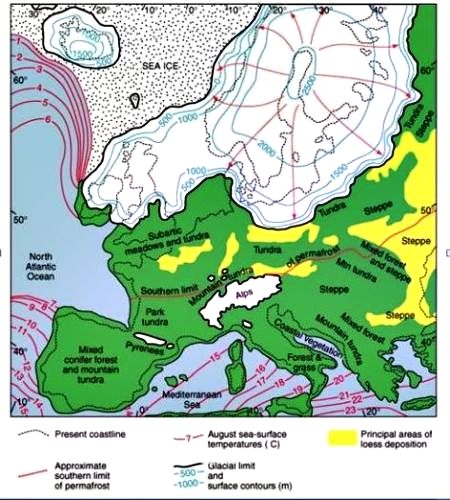
Paleolithic Europe has never been my forte, so excuse any ignorance here. If Villabruna people admixed into El Miron, couldn't the Villabruna people or their ancestors have been in Italy from before that time, which was during, as you say, the LGM, and couldn't they have followed the coast route west? Is the following map accurate to your knowledge?
1483p.jpg


One of the biggest Paleolithic sites in Italy is at Arene Candide not far from me on the Ligurian coast. The way I recall it being described to me is that there may well have been a passage from Italy to France along the sea, but that rising sea levels may have hidden all traces of it and of other sites.

This is Arena Candide:
https://en.wikipedia.org/wiki/Arene_Candide

I wonder if the bones of the 23,500 year old "Il Principe" (they could just as well call him figlio di papa') are too contaminated by all the handling to be suitable for testing. The culture is described as Gravettian.

This is information on the site and the diet (about 25% of protein from the Mediterranean).
http://www.uio.no/studier/emner/hf/...The Gravettian burial known as the Prince.pdf

This is a whole list of papers on the remains and the artifacts, here labeled Epigravettian.
http://www.academia.edu/Documents/in/Arene_Candide

I've never understood why there's no interest in it in the Anglosphere.

And if that is the case, then the growing affinity with others (Han, American, perhaps even Middle Eastern) must have been brought by admixture. And since the paper clearly state they modeled WHG as a three admixture population I tend to think of the one population can bring such divers affinity: ANE. (EDIT: If three populations admixed to WHG, and one is related to a Belgian Aurignacian, and we would consider another from around Italy, the only good option for the rising admixture is that it all comes from one population. The best candidate would be something that came from the mammoth steppe, as that provides cause and opportunity.)

WHG weren't mammoth hunters, though, to the best of my recollection. Weren't they small game hunters and fishermen? Isn't that what all their tool assemblages show? Some of them were quite sedentary, as they were at the Danube Gates. Or are you saying that during the LGM a group followed the mammoth into Italy and when the climate changed and the mammoth died out they turned to other game and technology? Did the mammoths get all the way down to northern Italy, though? Was there unbroken suitable terrain all the way from beyond the Urals to Italy? I thought that north eastern area now covered by the Adriatic was marsh and swamp then, or is that later? Was it different during the LGM? The map above says grasslands and forest for southern Italy, so small game hunters and fishermen make sense, but doesn't show anything about that northern area. Maybe someone else knows.

Apart from that, this whole ancient DNA thing showed one thing. Despite half a century of archaeological rethinking it turns out that cultures actually are migrations, and the Epigravettian seriously looks like an Italian culture.

I hate to always be quibbling, but yes and no. According to the authors there's "Gravettian" cultural influence to some extent in Mal'ta (I think they pointed to the female figurines), but they maintain population movement didn't bring it. Then there's always pesky Remedello to explain and even Baden didn't show too much steppe genetic intrusion did it, or have I lost track of that discussion?

My guess the first WHG is paglicci71 (mtDNA U5b2b). Bloody shame they only got 4000 SNP's.
Seems like a good bet.
 
[/B]

WHG weren't mammoth hunters, though, to the best of my recollection. Weren't they small game hunters and fishermen? Isn't that what all their tool assemblages show? Some of them were quite sedentary, as they were at the Danube Gates. Or are you saying that during the LGM a group followed the mammoth into Italy and when the climate changed and the mammoth died out they turned to other game and technology? Did the mammoths get all the way down to northern Italy, though? Was there unbroken suitable terrain all the way from beyond the Urals to Italy? I thought that north eastern area now covered by the Adriatic was marsh and swamp then, or is that later? Was it different during the LGM? The map above says grasslands and forest for southern Italy, so small game hunters and fishermen make sense, but doesn't show anything about that northern area. Maybe someone else knows.
I think you are right, and I also subscribe to notion that WHG was more of sedentary kind of HGs. After LGM and into warming phase, Europe is getting more forested and filling other kind of game animals, notably deer and boar. They didn't need to follow herds of animals like it happened in the steppe or tundra scenario. Instead they could stay put hunting local fauna and fishing too.
Looking at the map, one of refugium could have been Sicily, not mentioning coast of Africa so close by. So many places to hide and survive. Who knows, maybe the wondered to Anatolia relatively late?
 
Angela

WHG weren't mammoth hunters, though, to the best of my recollection. Weren't they small game hunters and fishermen? Isn't that what all their tool assemblages show? Some of them were quite sedentary, as they were at the Danube Gates.

I think your points about WHG are all correct. The question for me is if there was a north-south split between WHG and mammoth dudes (ANE?) what would the mammoth dudes (or at least some of them) do *after* their mammoth went extinct?

One possibility would be drift south and merge with WHG and this *might* explain Villabruna.

No doubt there are other possible explanations.

#

edit:

This is Arena Candide:


cool link
 
Angela


I think your points about WHG are all correct. The question for me is if there was a north-south split between WHG and mammoth dudes (ANE?) what would the mammoth dudes (or at least some of them) do *after* their mammoth went extinct?

One possibility would be drift south and merge with WHG and this *might* explain Villabruna.

No doubt there are other possible explanations.

#

edit:


[/B]cool link
If I may. North hunters went mostly extinct with their pray. That's why WHG is mostly distinct with only some admixtures from previous and older HGs.
 
always copy and paste

EUROGENES here (no time to discuss today): could make some sense?

[h=2]Thursday, May 12, 2016[/h][h=3]Following the mammoth herds?[/h]


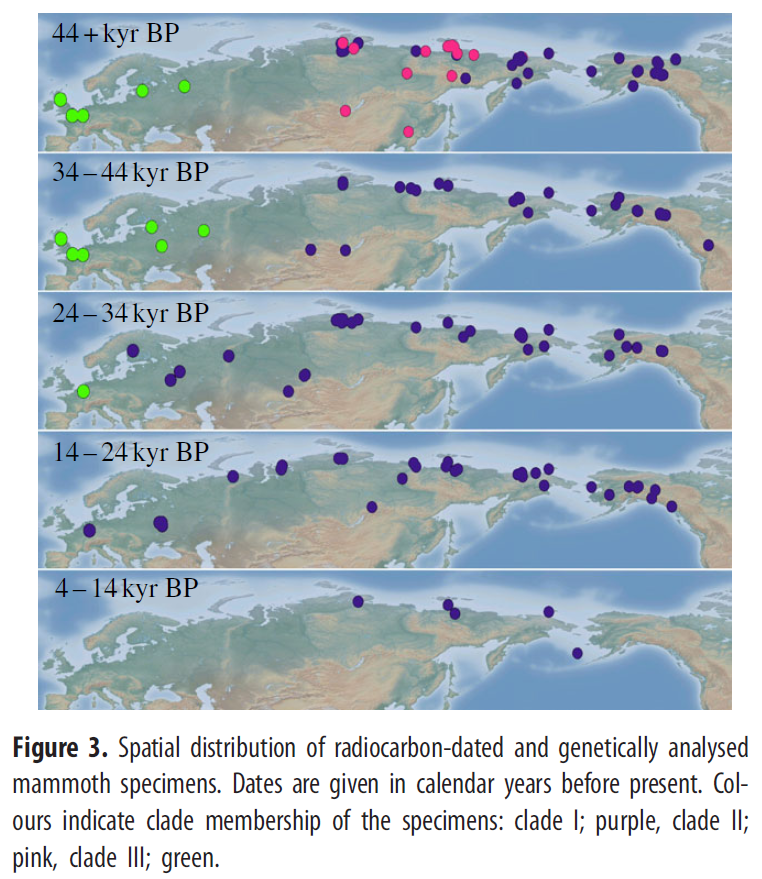
The recent Qiaomei Fu et al. paper on the population genomics of Ice Age Europe was a fascinating read, but its sampling strategy left a big blind spot: Eastern Europe 24-34 kyr BP. Check out what happens to the maternal lineages of Eastern European mammoths at this time.


Basically, they're replaced by lineages native to North America. During the 14-24 kyr BP period, the rest of the European mammoth population is also affected.

Of course, this is also precisely the period when the so called Villabruna hunter-gatherer cluster appears in Central Europe, probably as a result of mixture between the remnants of post-Ice Age Europeans and a population relatively closely related to Caucasus and Siberian hunter-gatherers (see post and discussion here). Perhaps mammoth hunters?

No wonder then, that this is also the time when we see the first appearance of Y-chromosome haplogroup R1 in Europe; more precisely R1b1, in the ~14 kyr cal BP genome from Villabruna, northeast Italy, that defines the Villabruna cluster. After all, R is the sister clade of Q, the dominant Y-chromosome haplogroup in many parts of North Asia and the Americas.


WHG being in El Miron so early would definitely be important in trying to piece together what happened. I'm not quite sure I understand what you're getting at when you say the source population couldn't have been very far to the east or about the Alps being in the way. Do you mean it couldn't have been as far as the Ukraine? Or it couldn't have been as far to the southeast as Anatolia? Or do you mean the center of gravity for this "old" El Miron age WHG population was north of the Alps in central Europe?

As Gravettian-Danubian points out: It hardly impossible to be anything Anatolian:


http://www.anthrogenica.com/showthr...s-and-opinions&p=155609&viewfull=1#post155609

Paleolithic Europe has never been my forte, so excuse any ignorance here. If Villabruna people admixed into El Miron, couldn't the Villabruna people or their ancestors have been in Italy from before that time, which was during, as you say, the LGM, and couldn't they have followed the coast route west? Is the following map accurate to your knowledge?
1483p.jpg

Combine that map with this, and you'll get the idea of what routes are suitable. The Vestonice and Pavlov samples all come from the so called Moravian Corridor.

http://abload.de/img/a1nspa6.jpg

One of the biggest Paleolithic sites in Italy is at Arene Candide not far from me on the Ligurian coast. The way I recall it being described to me is that there may well have been a passage from Italy to France along the sea, but that rising sea levels may have hidden all traces of it and of other sites.

This is Arena Candide:
https://en.wikipedia.org/wiki/Arene_Candide

I wonder if the bones of the 23,500 year old "Il Principe" (they could just as well call him figlio di papa') are too contaminated by all the handling to be suitable for testing. The culture is described as Gravettian.

This is information on the site and the diet (about 25% of protein from the Mediterranean).
http://www.uio.no/studier/emner/hf/...The Gravettian burial known as the Prince.pdf

This is a whole list of papers on the remains and the artifacts, here labeled Epigravettian.
http://www.academia.edu/Documents/in/Arene_Candide

I've never understood why there's no interest in it in the Anglosphere.

Well, this paper certainly will change that. And yes, that looks like a very interesting site.

WHG weren't mammoth hunters, though, to the best of my recollection. Weren't they small game hunters and fishermen? Isn't that what all their tool assemblages show?

Yes. Way into the Neolithic these peoples, that lived alongside the LBK cultures, remained fishermen.


Some of them were quite sedentary, as they were at the Danube Gates. Or are you saying that during the LGM a group followed the mammoth into Italy and when the climate changed and the mammoth died out they turned to other game and technology?

I don't know. The Han affinity/Y-DNA R1b/mtDNA R3 could have come that way as well.

Did the mammoths get all the way down to northern Italy, though?

Certainly not. David has a post up on Mammoths that is quite interesting and has maps. Furthermore, see the link above: Italy probably was unreachable

http://eurogenes.blogspot.com/2016/05/following-mammoth-herds.html

Was there unbroken suitable terrain all the way from beyond the Urals to Italy?

No, but there was at one point, before LGM, unbroken suitable terrain for mammoths from France all the way to Alaska.

I thought that north eastern area now covered by the Adriatic was marsh and swamp then, or is that later? Was it different during the LGM? The map above says grasslands and forest for southern Italy, so small game hunters and fishermen make sense, but doesn't show anything about that northern area. Maybe someone else knows.

Gravettian-Danubian said similar things. I think it is exactly why mesolithic HGs were so attached to fishing and shellfish. There are quite a number of mesolithic shell middens in Europe.


I hate to always be quibbling, but yes and no. According to the authors there's "Gravettian" cultural influence to some extent in Mal'ta (I think they pointed to the female figurines), but they maintain population movement didn't bring it. Then there's always pesky Remedello to explain and even Baden didn't show too much steppe genetic intrusion did it, or have I lost track of that discussion?

There are almost no absolutes in human history. But the utter and complete rehabilitation of the culture-means-people idea can hardly be denied. You are right though that this still doesn't mean it to be always the case.

The majority of Mal'ta figurines don't exactly look like European Venus-figurines, even if some are quite alike. Some actually look slightly more like Ket dolls, but that is just me. (Ket are one of the Siberian groups with the highest ANE. You are almost inclined to believe in continuity here, even if it is 24.000 year)

http://donsmaps.com/malta.html
https://www.uaf.edu/files/anlc/2011ketlandscape.pdf
https://upload.wikimedia.org/wikipedia/en/1/10/Dolls_of_the_Ket_people.jpg
 
Last edited:
If I may. North hunters went mostly extinct with their pray. That's why WHG is mostly distinct with only some admixtures from previous and older HGs.

We are talking about a very, very small amount of people. It could very well have been that they didn't expand the same way Magdalenians did. There is a pocket of U8a in Southwest France, where the IBD map of Vestonice also seems to have a minor hotspot.

http://bmcgenomics.biomedcentral.com/articles/10.1186/1471-2164-7-124 <- Check the Var region


01c9b6539c74.png
 
I hate to always be quibbling, but yes and no. According to the authors there's "Gravettian" cultural influence to some extent in Mal'ta (I think they pointed to the female figurines), but they maintain population movement didn't bring it. Then there's always pesky Remedello to explain and even Baden didn't show too much steppe genetic intrusion did it, or have I lost track of that discussion?

Malta's guy himself is a hybrid.
Mammoths hunters were there, where were mammoths.
So they could travell (as nomads) so it should be expected
that R1 can be find everywhere between Galicia and Manjuria
in paleolithic times. That means also, that they could have contacts
with Gravettians during their migrations across Eurasia.

1-s2.0-S1040618215002086-gr1ad.jpg


I think you are right, and I also subscribe to notion that WHG was more of sedentary kind of HGs.

Can you dicribed which populations were mammoth's hunters and which were not, and why?

No wonder then, that this is also the time when we see the first appearance of Y-chromosome haplogroup R1 in Europe; more precisely R1b1, in the ~14 kyr cal BP genome from Villabruna, northeast Italy, that defines the Villabruna cluster. After all, R is the sister clade of Q, the dominant Y-chromosome haplogroup in many parts of North Asia and the Americas.

:smile:

 
Malta's guy himself is a hybrid.
Mammoths hunters were there, where were mammoths.
So they could travell (as nomads) so it should be expected
that R1 can be find everywhere between Galicia and Manjuria
in paleolithic times. That means also, that they could have contacts
with Gravettians during their migrations across Eurasia.

1-s2.0-S1040618215002086-gr1ad.jpg


Can you dicribed which populations were mammoth's hunters and which were not, and why?


:smile:


there is very little - not to say none - archeological evidence of human presence in western Siberia before LGM
the Usht-Ishim bone found is an exception
I doubt there was any exchange of human DNA between the Altaï area and Europe before LGM
this study now seems to confirm that
from earlier studies we know there was exchange during mesolithic
during LGM travelling across western Siberia was impossible for humans and I suspect even for Mammoths, while south of the icecaps there was permafrost not allowing any plants to grow on which mammoths could feed
there was a corridor though along the northern mountain slopes between the Hindu Kush and the Altaï Mountains which was frequently used by paleolithic men

in western Europe mammoths went extinct allread during early Magdalenean, when the first huters started turining north
 
We are talking about a very, very small amount of people. It could very well have been that they didn't expand the same way Magdalenians did. There is a pocket of U8a in Southwest France, where the IBD map of Vestonice also seems to have a minor hotspot.
Certainly a higher population ratio of WHG to pre LGM populations HGs could explain the final "product". Also, genetic game of genomic adaptation and selection can do this job too. WHG genome could have been positively selected as more suitable to post glacial scenario, even if initial mixing events were 50/50. Same way Neanderthal genome seems to be weeded out with time passing by.
 
Back
Top