
Drac II
Banned
- Messages
- 713
- Reaction score
- 95
- Points
- 0
I don't know whose posts you've been reading, but they certainly weren't mine...
So you did not write post #10 in this thread? Who posted it then? It seems to have been posted from your account.

I don't know whose posts you've been reading, but they certainly weren't mine...
The Romans were able to make the trip because they built huge ships and powered them with slaves. Even then, there was a particular route they needed to follow in order to make the trip. I think it would have been a very difficult journey in small vessels that relied solely on sail and couldn't tack against the wind. And yet the DNA evidence may suggest some spread of peoples around the Mediterranean during the Neolithic. I personally think at this point it's still a bit of an unsolved puzzle but that if we're going to get clearer answers to how people spread into southern Europe during the Neolithic we may need to look at the potential for crossings from Libya to Sicily and from Morocco to Spain.
Although of course some of the people who arrived in Europe during the Neolithic got there by skirting the Adriatic.

There are other, detailed maps available. Both of the studies I have linked to have done extensive mapping (623 sites covered by the second study), and applied a finer time scale (500 years per colour), which allows to better trace development. Can't link the maps here, you need to look them up in the studies yourself. Another map (University of Dublin) is this one:The trail also seems to go up into the Balkans from Greece.
I think this map is generally correct in terms of chronology. I should point out, however, that I haven't checked the date of each site. I think there's also a pretty good correlation with the conclusions of this paper. This is the link so that you can decide for yourself the reliability you want to assign to it.
http://www.markbwilson.com/album/1-...a-Neolithic Agricultural Revolution Sites.jpg

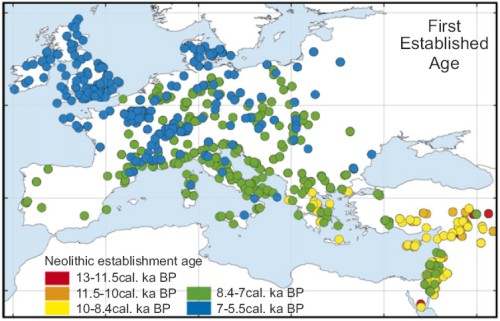


Since it is a very nice map, I have copied the map of agricultural expansion from the Cronenburg 2009 essay (my first link in post #56). For the colouring, see the bottom line of the climate diagrams in the upper left corner. In central France, the map appears to apply colour overlays to indicate the convergence of the Mediterranean and the Danube routes.
View attachment 6495
Have you checked to see (under Settings) whether you have used up all your attachment space? I frequently run into this type of problem, and then have to delete older stored data.Somehow the map doesn't show up as thumbnail. Could an admin please help?Have you
This is another map by Carsten Lemmen. (World distribution of land cover changes during Pre-and Protohistoric Times and estimation of induced carbon releases) This time, instead of using the Pinhasi 2005 data set, he used the Turney and Brown data set. The map is on the internet, so it's easier to post.

@FrankN,
I read the papers in question with great interest. Thank you for the links. Here is the map from the Carsten Lemmen paper:
View attachment 6496
From what I see, this reinforces the map I provided above, and the findings of this Paschou paper, that the Neolithic moved from the Levant to Cyprus, Crete, then presumably the Aegean and even the Adriatic and Sicily before it moved to even central Anatolia, much less northwestern Anatolia. So, I think it unlikely that the spread north onto the continent (i.e. broadly the Balkans and then via the Danube into central and eastern Europe) came by way of northwestern Anatolia over the Bosphorous.
Do you have other archaeological data to indicate that there was a definite, direct connection between the Neolithic of the Northwest and that of Thessaly? I believe that Maju, on his blogs has questioned such a connection.
There is a long list of Romanian sources enclosed - maybe one of the Romanian forum members can provide a few more details.The Early Neolithic (c. 6600 – 5500 BC) consists of two cultural layers: genetically linked and with similar physiognomies. The first (layer Gura Baciului - Cârcea/Precriş) is the exclusive result of the migration of a Neolithic population from the South Balkan area, while the second (the Starčevo-Criş culture) reflects the process of adjusting to local conditions by a South Balkan community, possibly a synthesis with the local Tardenoisian groups.
Layer Gura Baciului – Cârcea, also called the Precriş culture, is a spin-off of a Protosesklo culture group that advanced north and reached the North Danubian region where it founded the first culture of painted pottery in Romania. The small number of sites attributable to this early cultural time has not allowed the route followed by the group, to penetrate the Inter-Carpathian area, to be firmly established, yet in all likelihood, it was the Oltului Valley.
I do not know what this issue is of a rome to alexandria sea voyage is about.
If the Phoenicians where traveling by ship across all of the Mediterranean as early as the late bronze-age then what is the issue with a Rome to Alexandria trip?
The Phoenicians (from Tyre, in southern Lebanon) were amongst the greatest Mediterranean traders from approximately 1,500 to 600 BC. Tradition has it that they founded the city of Gadir/ Cádiz in south west Spain in 1100 to exploit the natural resources in the area. There is, however, no hard evidence to substantiate such an early date. Based on archaeological remains, the consensus now is that colonisation began around 800, when settlements were founded along the south coast of the peninsula. The most important besides Gadir, were Malacca (Málaga), Sexi (Almuñecar) and Toscanos (Vélez Málaga, in the province of Málaga).
Under the protection of their powerful, military neighbours, the Assyrians, the Phoenicians expanded throughout the Mediterranean and beyond in search of raw materials and metals for the Middle East market. Although their voyages took them as far as Cornwall (southern England) in pursuit of tin, they found an ample supply of gold, silver, copper and iron in southern Spain. Silver was particularly important to the Assyrians since their currency was largely based on it, and the Phoenicians were expected to provide it. This is why the Río Tinto mines north of Huelva were so important to the Phoenicians; the area contained large deposits of silver. While excavations show that mining in this area goes back to the early Bronze Age, the Phoenicians exploited the deposits of silver more efficiently than ever before.
A relation that is still well traceable in German: Wald (woods, forests, also mountain ranges as in "Schwarzwald"= Black Forest) <> Wild (game for hunting) <> wild <> gewaltig (violent, mighty).I think people should also consider wild life with predators like bears, lions, wolves being quite prevalent as there was a lot of forested land. There are ancient lion statues found in Anatolia. People would have avoided forests and hills till they began domesticating animals. Hills and mountains were scary places for ancient people. For instance Switzerland's high peaks were avoided till recent times as they thought the gods and spirits inhabited them. (Does Mt. Sinai in the Bible come to mind?) With shepherding mountains became the place to pasture goats and sheep.
ROFL? An American triracial mulatto talking about Egyptian slaves in Italy?
First of all, the Italian peninsula was already heavily urbanized and satured well before Rome expanded in the East. It was not like Brazil or Alabama which were completely empty and needed hordes of slaves.
Better watch for your Iberian masters who were active in the shipping of African slaves in the last 1.500 years with their Moorish and Jewish buddies, with all the obvious mixing.
Too bad that it's actually American and European (even some Italian ones) historians who keep pointing out the large numbers of Asiatic and African slaves and free citizens in Roman Italy, and not just the "American triracial mulattoes" of your racist rants, "Joey". BTW, weren't you already banned before? What are you doing here again?
Too bad that it's actually American and European (even some Italian ones) historians who keep pointing out the large numbers of Asiatic and African slaves and free citizens in Roman Italy, and not just the "American triracial mulattoes" of your racist rants, "Joey". BTW, weren't you already banned before? What are you doing here again?

Egypt has direct connections to Crete (also known from Minoan civilization records), but surprisingly to Sicily too. I know Egypt was producing lots of food for Rome. Perhaps Sicily was a shipping hub?
Equally surprising are the extensive connections from Palestine to Europe. It might be indication for the whole Near East. I would gladly want to see connections from Lebanon (old Phoenician), but they missed this important spot, and also Varna and Cucuteni cultures, coastal Bulgaria and Romania. A bit disappointing in sight selection.
Glad to see somebody bringing this thread back to topic.East Rumelia, the land above Rodope mountains from Pontos sea to Aimos Mountains, Varna is included.
part of today Turkey and Bulgaria the antique Odrysse Thrace
