• Don't want to see ads? Install an adblocker like uBlock Origin or use a Europe-based privacy-friendly browser like Vivaldi or Mullvad.

Uniparental analysis of Deep Maniot Greeks reveals genetic continuity from the pre-Medieval era

Tautalus

Regular Member
Messages
545
Reaction score
1,379
Points
93
Ethnic group
Portuguese
Y-DNA haplogroup
I2-M223 / I-FTB15368
mtDNA haplogroup
H6a1b2y
Abstract

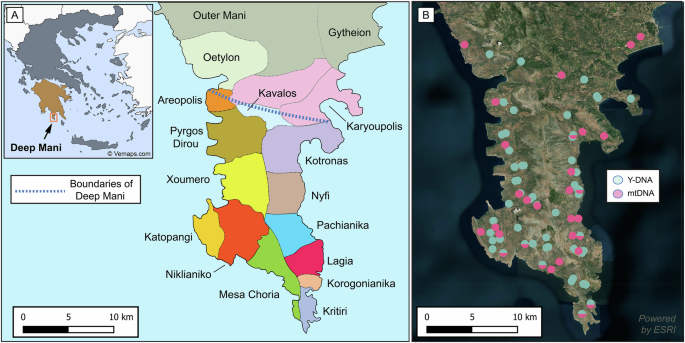
The Deep Maniots, an isolated population at the southernmost tip of mainland Greece, have drawn scholarly interest for their unique dialect, culture, and patrilineal clan structure. Geographically shielded by the Mani Peninsula, they are thought to have been minimally affected by 6th-century CE migrations that transformed Balkan demography. To investigate their genetic origins, we analysed Y-DNA and mtDNA from 102 Deep Maniots using next-generation sequencing. Paternally, Deep Maniots exhibit an exceptional prevalence (~80%) of West Asian haplogroup J-M172 (J2a), with subclade J-L930 accounting for ~50% of lineages. We identify Bronze Age Greek ancestry in Y-haplogroups nearly absent elsewhere, highlighting their longstanding genetic isolation. The absence of northeast European-related paternal lineages, common in other mainland Greeks, suggests preservation of southern Greece’s pre-Medieval genetic landscape. Y-haplogroup phylogeny reveals strong founder effects dated to ~380–670 CE, while the emergence of clan-based social structure is estimated around 1350 CE, centuries earlier than previously thought. In contrast, maternal lineages display greater heterogeneity, primarily originating from ancient Balkan, Levantine, and West Eurasian sources. These results align with historical and anthropological accounts, showcasing Deep Maniots as a genetic snapshot of pre-Medieval southern Greece, offering new perspectives on population continuity and mobility in the Late Antique eastern Mediterranean.

w5e0WJK.jpg
 
It is surprising the low frequency of E-V13 among Deep Maniots.
From the paper : “Remarkably, Y-haplogroup E-V13, the dominant paternal lineage of present-day mainland Greeks (20%; Fig. 2B), is found in very low frequencies in Deep Mani (1%). Although E-V13 was previously thought to have been transmitted by archaic Greeks, it is so far entirely absent in ancient samples from Bronze and Iron Age central and southern Greece (Supplementary Data 3), with its earliest record in the Hellenistic era. A recent study has suggested the large-scale dissemination of this haplogroup occurred in at least three major pulses: one in the Iron Age and Roman Period with populations located north of present-day Greece, such as the ancient Daco-Thracians, one with Aromanians and another with Albanians in the Middle Ages. The disparities in the frequencies of major haplogroups between mainland Greeks and Deep Maniots demonstrate that the latter were minimally affected by demographic events that shaped the paternal genetic landscape of Balkan populations during the Migration and Medieval Periods.”​
 
E-V13 is more Daco-Thracian than ancient Greek.

The most surprising in this study is that the Maniot Greeks plot between the Chechens and the Ingush, meaning that they are not autosomally Greek, but Dagestani. Even the high percentage of J2a (although a different clade) is mirrored in the Chechen population. How did that happen?
 
The Deep Maniot sample also lacks Y-haplogroups associated with the Central-Northern European (R1b-U152, R1b-L2, R1b-U106)71,72 and Albanian expansions (e.g. R1b-BY611)73 into Greece in the Middle Ages. Remarkably, Y-haplogroup E-V13, the dominant paternal lineage of present-day mainland Greeks (20%; Fig. 2B), is found in very low frequencies in Deep Mani (1%). Although E-V13 was previously thought to have been transmitted by archaic Greeks74, it is so far entirely absent in ancient samples from Bronze and Iron Age central and southern Greece (Supplementary Data 3), with its earliest record in the Hellenistic era75. A recent study has suggested the large-scale dissemination of this haplogroup occurred in at least three major pulses: one in the Iron Age and Roman Period with populations located north of present-day Greece, such as the ancient Daco-Thracians, one with Aromanians and another with Albanians in the Middle Ages73. The disparities in the frequencies of major haplogroups between mainland Greeks and Deep Maniots demonstrate that the latter were minimally affected by demographic events that shaped the paternal genetic landscape of Balkan populations during the Migration and Medieval Periods.
The principal haplogroup of Outer Maniots is E-V13>E-Z16659 (46%), in contrast to Deep Maniots, where E-V13 is remarkably rare (1%). Remarkably, one sequenced Messenian Maniot belongs to subclade E-V13>E-Z16659>E-Y3183>E-S2972>E-PH3589>E-S2978>E-BY5285>E-BY116895>E-FTF92003, which is different to the Deep Maniot E-V13 lineage (E-V13>E-BY3880>E-Y16729>E-BY202063>E-FT64983*).

https://discover.familytreedna.com/y-dna/E-FT64983/tree is a South Thracian lineage - and quite typically, South Thracian branches have more often ancient DNA samples from Dalmatia, while North Thracian samples are common in the Carpathian basin record.

The Outer Maniot big Greek founder lineage is from a central to Northern branch (E-S2972): https://discover.familytreedna.com/y-dna/E-FTF92003/tree

I consider this branch being Dacian, generally speaking. They write about it:

The Messenian Maniot forms a subclade with a man from Trifylia, in western coastal Messenia, dated to ca. 620 CE, while upstream lineage E-BY202063 (dated to 480 CE), is found in an individual from the Evrotas valley in Laconia, 80 km to the north of Messenian Mani95. The distribution and TMRCA of this lineage suggest a presence of this subclade in the broader southern Peloponnese at least since the Late Roman period. All other lineages found in Outer Mani (e.g. E-M34, G-PF3146, Ι-Μ223, J-S18579; Supplementary Data 13) are not present in our extensive dataset of Deep Maniots, even at the macro-haplogroup level. We also found two lineages associated with the Migration Period (R1a-Z282>R-YP372, I-M423>I-CTS10228; Supplementary Data 13), which account for 15% of the patrilines in Messenian Mani.

Late Roman period is beyond doubt. Earlier is not.

Based on the above preliminary results, the Outer Maniots represent a population that experienced different influences on paternal ancestry from their southern kin, the Deep Maniots. Considering the autosomal relatedness (based on IBD-sharing) and the similarities in social organisation and dialect of the two populations11,12,31, it is likely that complex demographic and genetic processes may have led to a transfer of the Deep Maniot cultural package to Outer Mani, uniting the two areas into a common zone of influence and interaction, leading to shared features in their identity.

My guess is that a Daco-Roman group was resettled to the area from say around Oltenia or the Danube and assimilated into the Greek Maniot neighbourhood.

Source: https://www.nature.com/articles/s42003-026-09597-9
 
E-V13 is more Daco-Thracian than ancient Greek.

The most surprising in this study is that the Maniot
IMG_0532.jpeg
IMG_0531.jpeg
Greeks plot between the Chechens and the Ingush, meaning that they are not autosomally Greek, but Dagestani. Even the high percentage of J2a (although a different clade) is mirrored in the Chechen population. How did that happen?
This is Y-STR distances. Autosomally deep mani is a cluster that is aligned with Neolithic Aegean, and Taygetos plus southern-shifted Italians are just above it, the cutoff point of migrant entry possibly. Above that is the main Peloponnese cluster, then central Greece and northward.
 
E-V13 is more Daco-Thracian than ancient Greek.

The most surprising in this study is that the Maniot Greeks plot between the Chechens and the Ingush, meaning that they are not autosomally Greek, but Dagestani. Even the high percentage of J2a (although a different clade) is mirrored in the Chechen population. How did that happen?

It’s not that they aren’t autosomally Greek; rather, they represent the segment of J2>L26 that migrated from the Caucasus region (Maikop, Kura-Araxes, or nearby) to the Aegean between 4000–2000 BC and did not mix with other populations high in EEF, unlike the rest of the Greeks. By retaining over 50–80% of their original J2-L26> haplogroup, instead of shifting in the PCA, they effectively drew other populations toward their cline, placing them close to modern Caucasians.

In fact, if you take the point corresponding to the Maniots and mix it with Balkan EEF or a modern Sardinian, the resulting position would be intermediate—essentially where modern Greeks are located.

I chose this PCA as an example because the one used in the study is heavily distorted, with populations inverted relative to the positions we usually observe in PCA plots:
IMG_5949.jpeg


Although they would mix with other populations, applying successive endogamy focused solely on the male lineage would return them to their original position.

If we could observe their entire ethnogenesis step by step in an interactive PCA, it might look like this:

Phase 1: They arrive from the Caucasus, mix with EEF populations, and settle near the position of modern Greeks.

Phase 2: They intermarry with endogamous Caucasian cousins, shifting to a position between Greeks and Caucasians.

Phase 3: Another round of intermarriage with their Caucasian cousins returns them to their original PCA position.

Phase 4: Further intermarriage pushes them beyond the original Caucasian cluster, ending near present-day Chechens, though slightly offset due to guided genetic drift.

An alternative scenario is that they remained largely “exclusive,” mixing no more than 10–20%, and thus maintaining their initial PCA position for 5,000 years.

The reality is likely a combination of both scenarios, varying over time—5,000 years is long enough for both patterns to occur.

This “anomaly” essentially reveals the source of J2 in Greece.

E-V13, besides appearing among Dacians and Thracians, may still surprise us; it seems to have been present in the Aegean well before the Mycenaean period. While it currently appears more Danubian than Aegean, Greece and Italy, if I recall correctly, have high frequencies of E-V13*, which cannot be explained solely by Daco-Thracian migrations.

The Maniots do not seem to represent the broader population of the period; rather, they reflect the isolation of a specific branch of Greek ethnogenesis, rather than ancient Greeks in general.
 
Interesting to find J2-L70 among Maniots as well, as it is found on may other Greek regions, specially on the islands. Although is only a 2%, under J-Z2117. Still waiting for new ancient samples under this clade, the oldest one we have published until now, was found on a roman early Imperial grave close the Limes Germanicus ( Valkenburg-Netherlands).
 
It seems clear that Deep Mani has a widespread and old, albeit highly diluted, autosomal relationship to its Peloponnese neighbors. The Taygetos zone seems like a migrant cutoff type place, where Deep Mani shares far more DNA than the rest of the peninsula. Y STR placement outside of Chechen appears to be a textbook example of why autosomal dna is superior to uniparental for determining overall ancestry.
IMG_0533.jpeg
 
Last edited:
E-V13, besides appearing among Dacians and Thracians, may still surprise us; it seems to have been present in the Aegean well before the Mycenaean period. While it currently appears more Danubian than Aegean, Greece and Italy, if I recall correctly, have high frequencies of E-V13*, which cannot be explained solely by Daco-Thracian migrations.

E-V13 being relatively big because it expanded with Proto-Thracians and later Daco-Thracian groups. You can see that some E-L618 branches are old Mycenaean Greek and might have been present in Proto-Greeks already. Look at the proven presence of E-L618 in the wider Aegean-Greek world, it is a regular encounter. Yet look at the frequency of E-V13 vs. E-L618 in total, already in the Bronze Age based on phylogenetic patterns. E-V13 is just so much bigger, already in the Early Bronze Age, than all E-L618 combined, yet we find E-L618 branches in Mycenaean Greeks, not E-V13.
This is a very, very strong indication as to why E-V13 won't be present before the Thracian migrations on any significant level, but will pop up afterwards (earliest LBA) in all Thracian-Greek borderzones.
 
Last edited:
E-V13 being low to non existent is kind of expected, we know that the Dorian migration included assimilation of the local Achaean Greeks and as much as the Maniots try and place themselves as Spartans they are Helots descendants as the Spartans were a small aristocratic caste. Even if the Dorians that migrated into the region had E-V13 we would not see it here or it will be low. Although I myself hold that Thracians brought it in the greek dark ages with a later vlach influx.

The haplogroup J I find interested would this imply they atleast partly come from Roman-era anatolians or that there was a bronze age migration of anatolians into the region? I haven't read the whole paper yet but it implies something anatolia from the bronze ages not the initial farmer migration as an origin population. edit:currently re reading the paper, this idea is wrong I misread the discussion when it comes to the origins of J-L930.

What I find more interesting is that it shows us the bottleneck caused by the Justianian plague due to their isolation. The only reason we do not see the same level of regional bottlenecks in the rest of Greece is I believe because people moved, especially during the late byzantine and early Ottoman period, hiding regional bottlenecks that had occured.
 
Last edited:
In the case of J2 it always depends on the exact branch in question. Some branches are Mycenaean Greek and Minoan, others are Anatolian, Caucasian and again others (mainly J-L283) are Illyrian or Pannonian in origin. J2 is just too broad and old to be put into just one bucket.
 
E-V13 is more Daco-Thracian than ancient Greek.

The most surprising in this study is that the Maniot Greeks plot between the Chechens and the Ingush, meaning that they are not autosomally Greek, but Dagestani. Even the high percentage of J2a (although a different clade) is mirrored in the Chechen population. How did that happen?
But did they have many other subclades of E1b1b in the Mycenaeans and Illyrians?

I wonder if fact that ancient Greeks were primarily made up of the three lineages E1b1b, R1, and J2 is the real life origin that inspired the three big gods Zeus, Poseidon, and Hades brothers in the Greek pantheon, with each of the three brothers representing a major lineage of their population.
 
E-V13 being relatively big because it expanded with Proto-Thracians and later Daco-Thracian groups. You can see that some E-L618 branches are old Mycenaean Greek and might have been present in Proto-Greeks already. Look at the proven presence of E-L618 in the wider Aegean-Greek world, it is a regular encounter. Yet look at the frequency of E-V13 vs. E-L618 in total, already in the Bronze Age based on phylogenetic patterns. E-V13 is just so much bigger, already in the Early Bronze Age, than all E-L618 combined, yet we find E-L618 branches in Mycenaean Greeks, not E-V13.
This is a very, very strong indication as to why E-V13 won't be present before the Thracian migrations on any significant level, but will pop up afterwards (earliest LBA) in all Thracian-Greek borderzones.

E-V13 appears to be very large, even more than what we have seen so far. Based on FTDNA data, more than half of the samples are currently classified as V13>BY3880, but one-third of Greek V13 and half of the total Italian V13 are not >BY3880.

BY3880 consolidated 15 branches from around 2200 BC, close to the proto-Thracian and proto-Mycenaean period.

In present-day Bulgarians, 80% of V13 are BY3880>, but they do not carry all 15 varieties.

In my opinion, the Thracians were not the origin of V13, nor of BY3880, but rather one of its most successful clans.

Within BY3880, only two branches seem to be dominant: BY3880>Z5017 and BY3880>Z5018.

V13 lineages were likely among the first groups in the area to handle horses and bronze, which allowed them to appear in any place and culture, both geographically and in autosomal PCA. Their familiarity with the Danube, the Black Sea, the Aegean, and the Mediterranean allowed them to form thousands of distinct clans. Since we do not have full refinement of all E-V13> branches, the actual origin could be as far back as 4500–3500 BC. The issue with aDNA samples is not that they lack resolution beyond L618>; it’s that unclassified V13 branches—and V13 being only a single mutation with a large “birth window”—cannot reveal the subsequent mutations that remain undetected in modern populations.

I would be very surprised if L618* lineages survived 6,000 years only to go completely extinct, given that all modern Greeks are V13>.

Most likely, more than half of the L618* in ancient Bronze Age samples are indeed +V13, but FTDNA has not refined them using the updated tree.

For me, a “Mycenaean” is not an ethnicity or a lineage. It refers to a military elite based on horses, ships, weapons, bronze helmets, and stone fortifications. Proto-Thracians fall into the proto-Mycenaean sphere, and through the domino effect of Classical Greeks, even if the Thracians did not want to be Greek.

V13 in some ways reminds me of the P297>M269 jump, due to the curious fact that it has only one distinctive SNP across thousands of years.

The L618>CTS1975>V13 sequence, seen with each generation representing an X every 25 years, would look like this:

L618>x>x>x>x>x>x>x>x>x>x>x>x>x>x>x>x>CTS1975>x>x>x>x>x>x>x>x>x>x>x>x>x>x>x>x>x>x>x>x>x>x>x>x>x>x>x>x>x>x>x>x>x>x>x>x>x>x>x>x>x>x>x>x>x>x>x>x>x>x>x>x>x>x>x>x>x>x>x>x>x>x>x>x>x>x>x>x>x>x>x>x>x>x>x>x>x>x>x>x>>x>x>x>x>x>x>x>x>x>x>x>x>x>x>x>x>x>x>x>x>x>x>x>x>x>x>x>x>x>x>x>x>x>x>x>x>x>x>x>x>x>x>x>x>x>x>x>x>x>x>x>x>x>x>x>x>x>x>x>x>x>x>x>x>x>x>x>x>x>x>x>x>x>x>x>x>x>x>x>x>V13.

The true position of V13 could be anywhere among all the Xs before CTS1975, meaning that during all that time it was in a “phase of extinction.”

Between CTS1975>V13 there are roughly 4,000 years, while between P297>M269 there are 10,000.

For J2-L26>, we see the opposite: thousands of lines exist, but no detectable founder effect in the West comparable to V13.


P.S.: RiverMan, I’ve seen that you’ve researched V13 extensively. This opinion is simply meant to provide you with something new.
 
E-V13 being low to non existent is kind of expected, we know that the Dorian migration included assimilation of the local Achaean Greeks and as much as the Maniots try and place themselves as Spartans they are Helots descendants as the Spartans were a small aristocratic caste. Even if the Dorians that migrated into the region had E-V13 we would not see it here or it will be low. Although I myself hold that Thracians brought it in the greek dark ages with a later vlach influx.

The haplogroup J I find interested would this imply they atleast partly come from Roman-era anatolians or that there was a bronze age migration of anatolians into the region? I haven't read the whole paper yet but it implies something anatolia from the bronze ages not the initial farmer migration as an origin population. edit:currently re reading the paper, this idea is wrong I misread the discussion when it comes to the origins of J-L930.

What I find more interesting is that it shows us the bottleneck caused by the Justianian plague due to their isolation. The only reason we do not see the same level of regional bottlenecks in the rest of Greece is I believe because people moved, especially during the late byzantine and early Ottoman period, hiding regional bottlenecks that had occured.
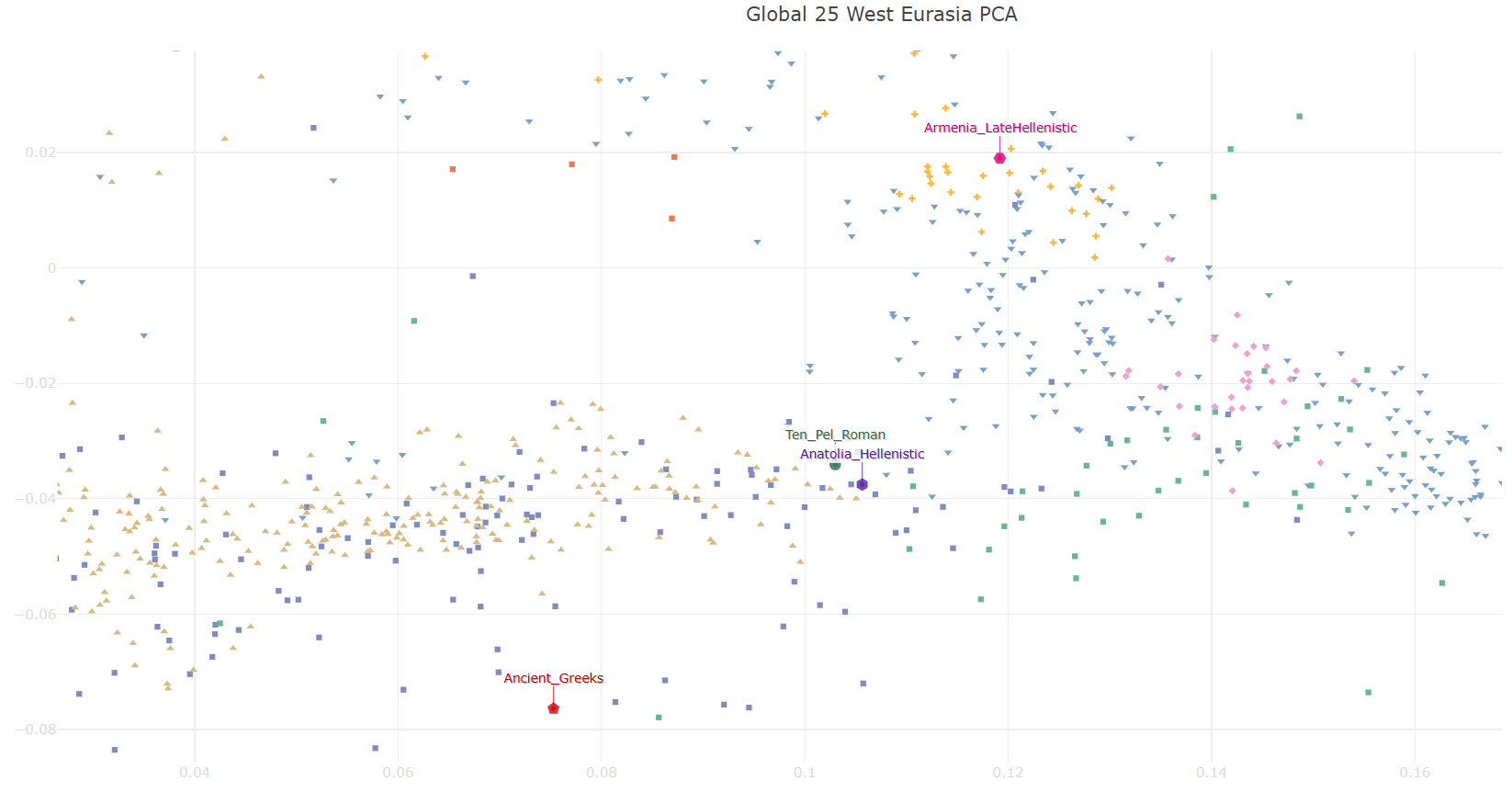
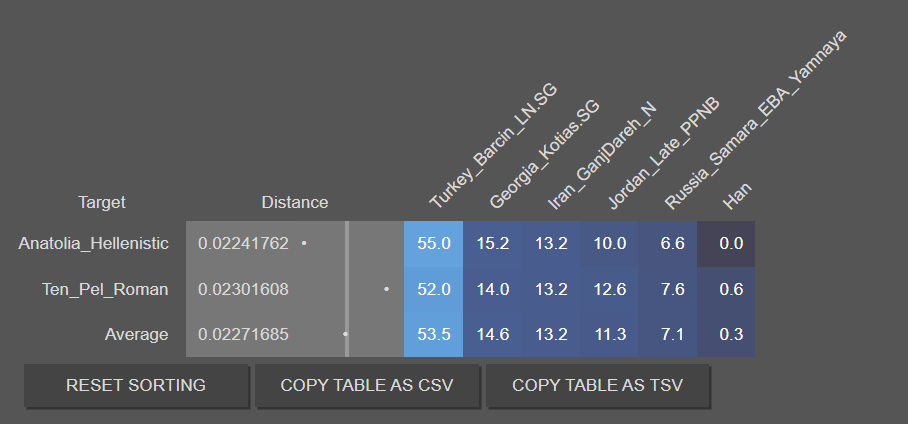
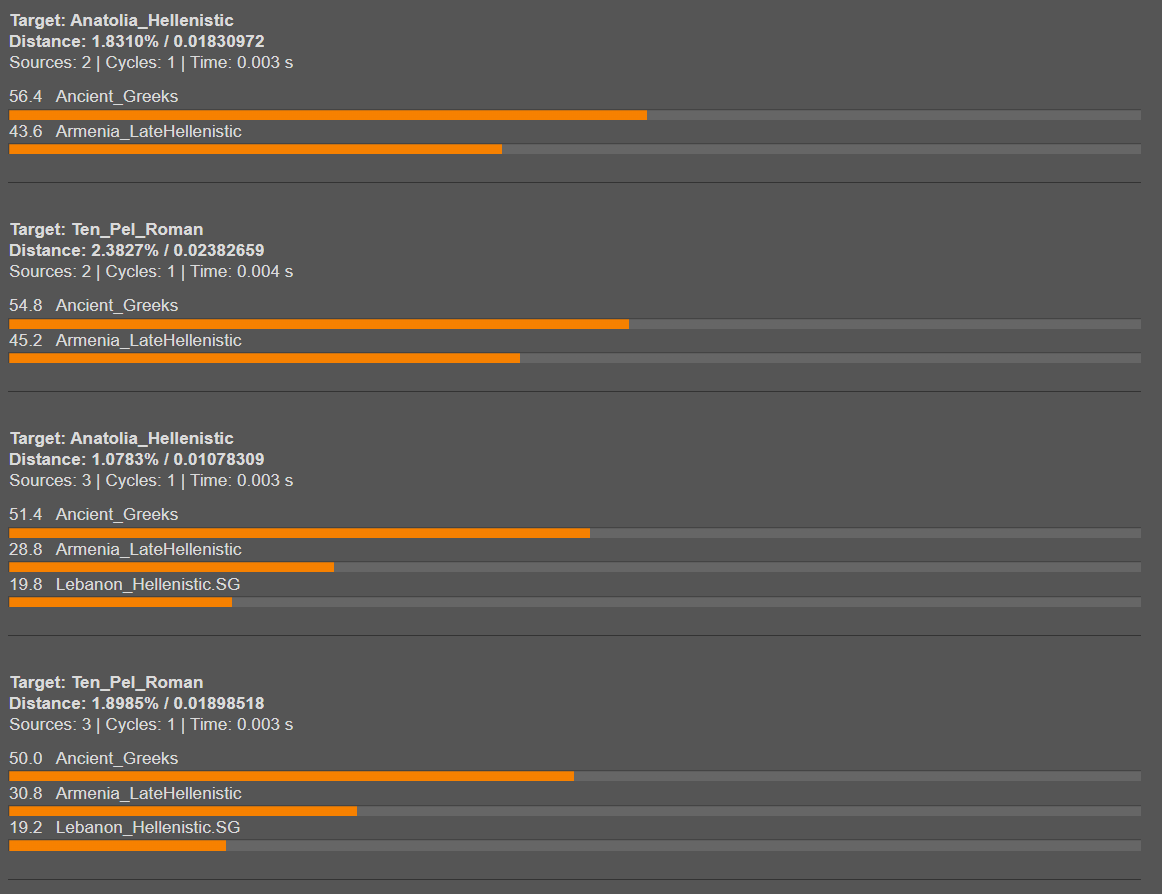
It's becoming well understood that Greece has been under steady but constant genetic overturn from Anatolian migrations from the Neolithic through the Roman era. By the Roman era Tenea was identical to Anatolian proper populations. Most of this was likely mediated from the long since Hellenized Anatolians of Turkey's western coastline. The same process was indeed taking place throughout the full extent of the bronze age as well.
 
Abstract

The Deep Maniots, an isolated population at the southernmost tip of mainland Greece, have drawn scholarly interest for their unique dialect, culture, and patrilineal clan structure. Geographically shielded by the Mani Peninsula, they are thought to have been minimally affected by 6th-century CE migrations that transformed Balkan demography. To investigate their genetic origins, we analysed Y-DNA and mtDNA from 102 Deep Maniots using next-generation sequencing. Paternally, Deep Maniots exhibit an exceptional prevalence (~80%) of West Asian haplogroup J-M172 (J2a), with subclade J-L930 accounting for ~50% of lineages. We identify Bronze Age Greek ancestry in Y-haplogroups nearly absent elsewhere, highlighting their longstanding genetic isolation. The absence of northeast European-related paternal lineages, common in other mainland Greeks, suggests preservation of southern Greece’s pre-Medieval genetic landscape. Y-haplogroup phylogeny reveals strong founder effects dated to ~380–670 CE, while the emergence of clan-based social structure is estimated around 1350 CE, centuries earlier than previously thought. In contrast, maternal lineages display greater heterogeneity, primarily originating from ancient Balkan, Levantine, and West Eurasian sources. These results align with historical and anthropological accounts, showcasing Deep Maniots as a genetic snapshot of pre-Medieval southern Greece, offering new perspectives on population continuity and mobility in the Late Antique eastern Mediterranean.


w5e0WJK.jpg
This Y-STR based PCA is a perfect example as to why haplogroups should never be used to infer autosomal ancestry. It's an absolute mess and many of these populations which cluster next to one another have little to nothing to do with one another both ethnically and autosomally. The genetic data point being looked at is so small that it's functionally useless outside of pure patrilineal tracing. It quantifies exactly 0.5% of one's genetic expression.

It seems clear that Deep Mani has a widespread and old, albeit highly diluted, autosomal relationship to its Peloponnese neighbors. The Taygetos zone seems like a migrant cutoff type place, where Deep Mani shares far more DNA than the rest of the peninsula. Y STR placement outside of Chechen appears to be a textbook example of why autosomal dna is superior to uniparental for determining overall ancestry.View attachment 19183

I fully agree. People do not take into account how severe a founder effect may affect Y chromosome ratios and also Y carriers which happen to produce a biased ratio of sons compared to daughters. People like this will always exist in any population and time will multiply their representation many times over in the Y haplogroup record.
 
Last edited:
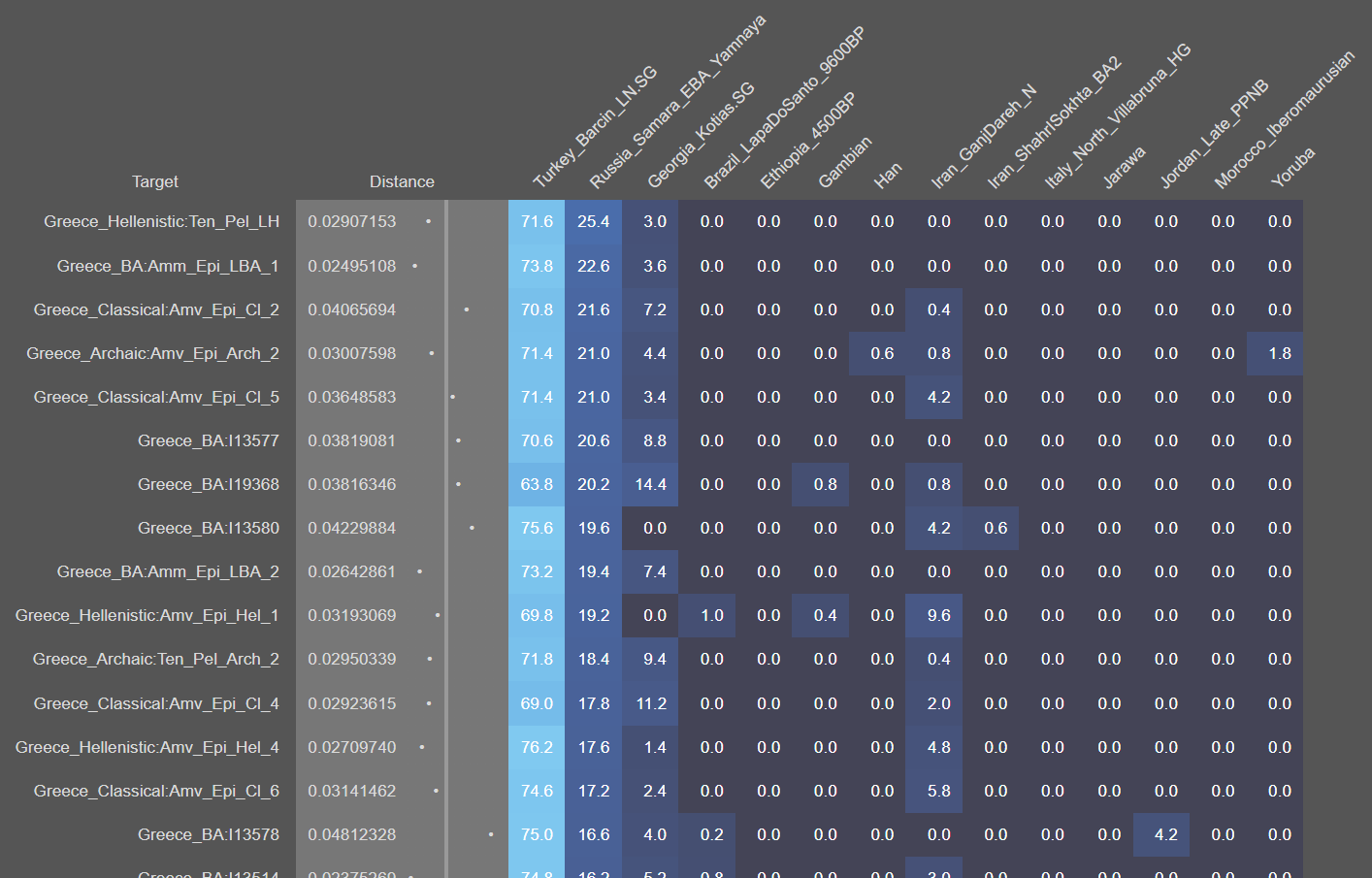
By the Roman era Tenea was identical to Anatolian proper populations.

Probably because they are Anatolians? They plot like Anatolians; they have the same genetic makeup as Anatolians. What else could they be? Greeks Islanders? They certainly aren't mainland Greeks, which would suggest a complete population replacement between 30 BC and 476 CE as the bulk of the Hellenistic samples plot with their predecessors. This contradicts the findings of an unreleased paper. Or they need heavy Caucasian admixture to plot where they do, but Caucasian profiles in the Greek mainland are so far non-existent. Imagine archaeologists from 2000 years in the future discovering the family graves of Pontic Greeks in Thessaloniki from the 20th century and proclaiming they were representative of the genetic profile of mainland Greeks. Lastly, the late Hellenistic sample is also supportive of the findings of the unleased paper that Greece began experiencing increased Steppe inflow from the Hellenistic to Roman transition.


image.png


image.png


image.png


image.png


study.png
 
Last edited:
E-V13 appears to be very large, even more than what we have seen so far. Based on FTDNA data, more than half of the samples are currently classified as V13>BY3880, but one-third of Greek V13 and half of the total Italian V13 are not >BY3880.

Italians need to be divided especially into North Western vs. Southern Italians. The Southern Italians have more South Thracian branches (like E-BY5022), whereas in North Western Italians, especially around Genua, there is a lot of North Thracian E-FGC11451.

However, the vast majority of both Greeks and Italians is most definitely E-BY3880. The main non-E-BY3880 South Thracian/Southern branch is E-PH1246 and while important, it is not that important. The true reason for so many Italians and Greeks being non-E-BY3880 seems to be me that they weren't tested further downstream. Greeks have no such bad STR testing level, but their BigY-testing level is very bad. I made a comparison for various groups once, and Greeks are notorious for not testing any further, probably more than any other group. That means most of the downstream positions comes from the FamilyFinder assignment, whereas WGS/BigY tests are even more rare. This is a serious issue, since e.g. for evaluating the North Thracian branches in Greeks, we can't be sure whether they are old, Albanian, Vlach or Slavic etc. derived, because so few ethnic Greeks did a BigY/other WGS.
That's making this paper so interesting, because they could compare the STR data to known BigY/WGS testers, which is not ideal but helps to narrow results down in many instances.

In present-day Bulgarians, 80% of V13 are BY3880>, but they do not carry all 15 varieties.

In present-day Bulgarians the Vlach founder lineage downstream of E-CTS9320 is particularly noticeable. There are, going by FTDNA data extrapolated, hundreds of thousands of Bulgarians downstream of the main Vlach founder lineage - if E-CTS9320 -> BY4380 is the "royal Dacian" lineage apparently, which likely dominated Basarabi, E-FT181830 is the "royal Vlach" lineage. Literally so, because the Hunyadis belonged to it as well. And that lineage alone is super-widespread in Bulgarians.

In my opinion, the Thracians were not the origin of V13, nor of BY3880, but rather one of its most successful clans.

The Pre-Thracians emerged from the fusion of Salcuta IV with steppe groups (Suvorovo? Cernavoda? Usatovo? Yamnaya? Corded Ware?) in the area of Banat-Oltenia-Transylvania in the Cotofeni horizon and the main source group for both Bronze Age Proto-Thracians and E-V13, the most likely candidate to be more careful, is Gornea-Orlești-Foeni group/Besenstrich/broom stroke horizon.

Gornea-Orlești ended right when E-BY3880 split (2300-2200 BC) and it is at least one of the main sources for all the following Carpatho-Danubian cremating Bronze Age groups: Otomani, Wietenberg, Balta Sarata, Vatin, Verbicoara, Tei.

This explains perfectly why E-V13 had this massive surge (they spread with the Gornea-Foeni clans which spread more advanced bronze technology, new forms of settlement and hierarchical social organisation) in that time frame and could spread both Thracian tongue and E-V13 so wide and so far already in the Early Bronze Age.

The only really important non-E-BY3880 branch is, like mentioned before, E-PH1246. And E-PH1246 was also found in Iron Age Thracians and it also has a timing compatible with Gornea-Foeni. Also, the starting point of E-V13 aligns perfectly with the Cotofeni (around 3000 BC) ethnogenesis and we already know that Cotofeni must have been very ANF-rich, because Salcuta was so too, which is the main ancestral component.

Within BY3880, only two branches seem to be dominant: BY3880>Z5017 and BY3880>Z5018.

That is very misleading, because it only looks at moderns. In moderns these two branches are dominant because North Thracian/Dacian branches are in moderns so dominant. However, back in the Bronze Age, E-Z5018 was nothing, compared to many of the South Thracian branches. That is, quite likely, due to the area of Wietenberg-Otomani going through a serious bottleneck for the local Thracian population, with the attack from both sides (Füzesabony first, then Tumulus culture in the West, Noua-Sabatinovka in the East). In that period (2000-1600 BC) the South Thracian branches were way more important and widespread. But with the resurgence of the locals in the North, E-Z5018 had the biggest growth, especially its main LBA-EIA branches of E-FGC11451, E-L241 and E-S2972. This was likely due to Gáva-related Channelled Ware (Gáva-Holigrady, Belegis II-Gáva, Vartop-Gáva).
It is only then, by around 1300-1000 BC, that E-Z5018 becomes more important than the stable growing South Thracian branches. The South Thracians were later much more decimated due to Greek, Roman and Slavic conquest, whereas the Dacian branches could still grow with a downtime mainly between 200-500 AD.

V13 lineages were likely among the first groups in the area to handle horses and bronze, which allowed them to appear in any place and culture, both geographically and in autosomal PCA.

Bronze - copper mining and bronze production is crucial especially for Gornea-Foeni and all successors onwards, with the Apuseni mountains being a key production centre. There can be no doubt, at this point, that the spread of E-BY3880 was due to more advanced-competitive bronze metallurgy and social organisation, because the timing for that correlates 100 %. Gornea-Foeni is the main vector from which the Carpatho-Danubian cremating Bronze Age cultures can be derived from.

Most likely, more than half of the L618* in ancient Bronze Age samples are indeed +V13, but FTDNA has not refined them using the updated tree.

No they are not. There were a couple of downstream assignments and they were all E-L618. E-L618 was likely present in BSK/Salcuta and "bled into" neighbouring Gumelnita-Karanovo-Varna and Tiszapolgar-Bodrogkeresztur among other groups. It was also present in Varna and Tripolye-Cucuteni, so we can't exclude E-V13 being already in the steppe newcomers which mixed with Salcuta to produce Cotofeni, but more likely they were in Salcuta IMHO.

The E-L618 in Mycenaean Greek-related samples is no accident, it is an actual relevant finding. One of the downstream assigned Greek samples is from Crete (Mycenean period and profile for the island) and he ended up downstream of E-BY6630, a rare E-L618 branch.

The Thracian migrations (potentially Brnjica and Zimnicea-Plovdiv-Cerkovna, for sure Belegis II-Gáva and Knobbed Ware) did reach Greece and they even invaded Greece. This can be seen by the appearance of "coarse Barbarian ware" (Brnjica) and later Channelled Ware in Greece, together with cremation burials. Cremation burials were not as common in Mycenaean Greece (though they appeared), but became more frequent afterwards, especially in Attica. Similarly some weapons (like Carpathian Naue II/Reutlingen slashing swords) spread during the Bronze Age collapse period too.

So we see that Thracian influences did reach Greece, but it looks like the local Greeks, while adopting some technology and customs selectively, did push the Thracians back. Like in some instances it really looks like Thracians invaded, did influence locals, were pushed back to the Balkans or moved on to Anatolia, Greek ethnic dominance persisted.

This process is impossible to evaluate genetically, without proper sampling. Like we need samples from Attica, from groups which adopted cremation during the LBA-EIA period, to see whether they acquired Thracian autosomal and uniparental (E-V13) genetics. I think the impact was very limited by this point, but we really don't know without testing them.

Concerning Greeks and haplogroups: Well, J2 was widely spread already before the Aegean became Greek, we see it with Minoan lineages for example. E-L618 on the other hand appared only with ethnolinguistic Greeks, so did R-Z2103. Therefore I think that most of E-L618 was brought from the Western steppe and Balkan zone, where it was found before (Tripolye-Cucuteni, BSK, Gumlnita-Karanovo-Varna, Usatovo) by the Proto-Greeks which marched through those areas.

Greeks have more IBD sharing with Western steppe groups than Thracians do. This means the Thracian steppe component is older, the Greek one is younger, due to a more recent immigration of a steppe group. This is a crucial difference and points to the old formation of Thracians with Cotofeni/Gornea-Foeni vs. the much younger formation of Greeks on the basis of local Aegean groups.
And E-L618 branches were likely picked up in the Western steppe and Balkans, by those steppe groups moving in. That happened in a time frame when the Thracians already existed and E-V13 was already growing, post-Cotofeni, post-Gornea Foeni.

The Thracian expansion is one of clan people, tribal people, with respective founder and replacement events. The Greeks on the other hand were formed by elite dominance. Elites from the steppe took over an already proto-state oriented society. That's why old Greeks have much fewer and much weaker founder events - the second reason is that those founder events which existed were diminished by later demographic failures and contractions, which includes the mass migrations from Anatolia and apparent lack of growth and founder events.

Especially the North Thracians/Dacians were still tribal clans people when the Greeks were in full decline (200 BC-300 AD). And patrilinear founder events are more often than not connected to clans and tribes expanding.

 
Last edited:
It's becoming well understood that Greece has been under steady but constant genetic overturn from Anatolian migrations from the Neolithic through the Roman era. By the Roman era Tenea was identical to Anatolian proper populations. Most of this was likely mediated from the long since Hellenized Anatolians of Turkey's western coastline. The same process was indeed taking place throughout the full extent of the bronze age as well.
I was more talking about the chronology of the split between the J-L930, I know about the influx, although I do not see much evidence to call it constant before the Hellenistic era. I had misread the part where the paper discussed the related haplogroups to it and misunderstood it as chronologically as spliting with the caucasus branches in the late bronze age when all the paper says it that it has related branches in the bronze ages but probably originates in the neolithic. If it had migrated out of anatolia in the late bronze age it would put a variable on the slight increase of steppe ancestry during the Greek dark ages found in Skourtanioti 2023 and would imply a bigger influx of steppe admixed individuals than initially thought by the increase.
 
This plot is not a Principal Component Analysis (PCA), it is a Non-Metric Multidimensional Scaling (NMDS) used for measure genetic distances from Y-chromosome STR markers. It is designed as a descriptive, exploratory visualization tool for patrilineal similarity and structure, and not as a measure of population ancestry, ethnicity, or autosomal relatedness. Is useful for studying male demographic history, and completely inappropriate for inferring autosomal ancestry or population affinity.
This plot is a distance metric originally designed for allele frequency differences, when applied to Y-STRs, it quantifies how different male lineages are, it does not model admixture. Is useful for exploring patrilineal structure, detecting clusters of related Y lineages, identifying founder effects or clan expansions and seeing whether certain male lines are shared across regions.
We can answer several questions like: are two populations sharing many Y-STR lineages, are they dominated by one or two paternal founders, is there high or low patrilineal diversity?
It’s a map of male-lineage similarity, distorted by mutation rate, drift, and sampling, useful for spotting patterns, but meaningless for measuring ancestry. We cannot say in a plot like this that if “Population A clusters with Population B they’re closely related genetically”, this is incorrect for this type of plot. The correct statement would be, “Some paternal lineages found in Population A resemble those in Population B.” Researchers still use it because when used properly, it can reveal hidden founder events and explain Y-haplogroup frequencies. It’s not a replacement to autosomal PCA / ADMIXTURE.
KEEKxG6.png
 
Last edited:
Back
Top