• Don't want to see ads? Install an adblocker like uBlock Origin or use a Europe-based privacy-friendly browser like Vivaldi or Mullvad.

What was the ethnicity(ies) of Bronze Age Lusatian culture?

В статье поставлен вопрос можно ли на основании имеющихся данных по мутациям в Y-хромосоме ДНК выявить современных потомков исторических венетов и венедов, описанных в античной литературе. Для ответа на вопрос были идентифицированы северо-евразийские, балтийские и карпатские ветви гаплогруппы R1a на основании имеющихся результатов геномного анализа (по снипам Y-хромосомы) и определения базовых (предковых) гаплотипов, проведено их географическое отнесение, и показано, что во всех балтийских, северных, карпатских ветвях гаплогруппы R1a преобладают поляки и русские, в меньшей степени немцы, еще в меньшей степени украинцы и белорусы. Полученные данные показывают, что древние венеты могли иметь гаплогруппу R1a, источниками ее могли быть балканская Адриатика, Малая Азия, Троя, гаплогруппа R1a могла попасть туда в ходе миграций с северной части восточной Европы с венедами или их предками, и наиболее вероятные потомки венетов и венедов имеют северо-европейское, балтийское или карпатское происхождение.


КиберЛенинка: https://cyberleninka.ru/article/n/venety-i-venedy-po-dannym-dnk-genealogii
 
В статье поставлен вопрос можно ли на основании имеющихся данных по мутациям в Y-хромосоме ДНК выявить современных потомков исторических венетов и венедов, описанных в античной литературе. Для ответа на вопрос были идентифицированы северо-евразийские, балтийские и карпатские ветви гаплогруппы R1a на основании имеющихся результатов геномного анализа (по снипам Y-хромосомы) и определения базовых (предковых) гаплотипов, проведено их географическое отнесение, и показано, что во всех балтийских, северных, карпатских ветвях гаплогруппы R1a преобладают поляки и русские, в меньшей степени немцы, еще в меньшей степени украинцы и белорусы. Полученные данные показывают, что древние венеты могли иметь гаплогруппу R1a, источниками ее могли быть балканская Адриатика, Малая Азия, Троя, гаплогруппа R1a могла попасть туда в ходе миграций с северной части восточной Европы с венедами или их предками, и наиболее вероятные потомки венетов и венедов имеют северо-европейское, балтийское или карпатское происхождение.


КиберЛенинка: https://cyberleninka.ru/article/n/venety-i-venedy-po-dannym-dnk-genealogii

I think only Pan-Slavic Pseudo Historians try to ascribe Venets, Veneds, and Veneths of all Europe to North-East origin. In the face of actual evidence one can reassess the situation. However, I do not see how historical Venetians of antiquity or the early middle ages are related to Proto-Slavs or even Balto-Slavs. Anything is possible of course. It seems a stretch though, especially the mention of Troy lol. Granted I used google translate so I am uncertain if the translation was butchered or not.

The discovery of M458 would show that the lineage could have spread much earlier than the Slavic tribes of the migration era(which could represent a later migration of the same stock). Slav/Sklaveni/Proto-Slav/Balto-Slav are merely new descriptions for peoples that may have gone by other names. Personally(given only Goth elite remains showed Germanic nature) I think that Balto-Slavs/Proto-Slavs were more widespread in antiquity than history would give credit.

As far as historical populations, I am of the mind that Proto-Slavs possibly draw origin/or at least relation from the Getae, whom were considered a tribe of Dacians, but not much evidence to suggest they were Dacian. Even Theophylact Simokatta believed the Sklavenoi were actually called Getae(a Greek designation) in antiquity. Though theres no way of him verifying this but it was mentioned nonetheless. Considering some Slavic archaeological finds showed similarities to Celtic, it stands to reason that Lusatians were a Balto Slavic/Proto-Slavic peoples considering influence of the Urnfield culture. Perhaps the expanding Germanic dominance in antiquity pushed Balto-Slavic/Proto-Slavs further East and South-East before the migration era. This could explain the supposed "eastern shift" that was found in a Suebi sample. Or as some theorize the Goths may have been Proto-Slavs that had a Germanic Elite.

I suppose time will tell. I very much hope they begin testing those rich samples from the battle of Tolense.
 
Question of the ethnic quality of Lusacian Culture :
I lack recent works about it but it seems the old scientists had ?ad hoc? theories, placing Lusacians of the shifting between Bronze and Iron ages among proto-Germans, proto-Slavs, Thracians, Carps (Carpo-Daces), Illyrians? broad choice !
It ?s hard to descriminate ethnies among cultures : ethnies change culture, cultures changes ethny?
To me it seems the Lusacian culture rather than the prototype of the Urnfields aspects is one aspect of the Urnfields, Urnfields born around Hungary/Austria, mixing diverse streams of culture, but with incineration which seems a recurrent trait of Late Neolithic cultures under southeastern influences. But I don?t believe in important cultures changes without some demic imput ; and more than one scholar mentions an encrease in demography : the problem is how to weight this demic input. Center Europe has been a crossroad of so numerous tribes in past ! (and to date too). But it?s not to say there has been always a complete melting of these tribes at the basic social level (even swords, tradable, showed typical geographical distribution for some time, and even when they were found almost all of them in Hungary, a central point).
Linguistically, I have pain to forget completely some phenomenons, even if some proximities can be discarded by peer examenation : the supposed devoicing and hard spiration of consonants in Rhaetian, Etruscan, Germanic, modern Hungarian compared to Finno-Ugric roots (in this late case I don?t know if these phenomenos did not occur before reaching Europe, I avow). What is maybe of some weight is some proximity in Venetic of basic words (pronouns) with Germanic and some phonologic similarities with Rhaetian. So I?m tempted to think that some linguistic phenomenons took their origin in Central Europe, for the most around Hungary, a crossroad, around the very Late Bronze/Early Iron and Hallstatt and I would discard coincidences. Spite the new mutations in High Germanic dialects compared to Low Germanic and ancient Germanic are similar but not identical, I still wonder if they would not be linked to an ancient pop of Tyrol surroundings, linked to something Etruscan-like.
So, maybe a population or Hungary or surroundings could be at the origin of the spread of a religion implying cremation, but it seems it had the support of some trade or partial colonisation, based on aspects considered then as a (material) progress ; the demography in more than a place confirms it. It is not sure this newcoming pop imposed everywhere its language, IE or not. The change has been either brutal and complete or progressive or incomplete (sometime crossed : old artefacts new burying, new artefacts, old burying ; look at Baviera : first cremations only for wives : exchanges ?), according to regions ; this last aspect discards the solution of an uniquely religious phenomenon, IMO. In Lusace territory, I think a new ethny took foot by South in S-W but it could not be a Slavic one, nor I think it was Celtic spite I believe Celts or some kind of Italics could have been the tumuli first intruders fromS-W Czechia, before Urnfields. After first change in Lusacian world (urnfields), I think the mode extended unevenly to other regions of Poland or Germany to other ethnies (and in other Europe regions the same mode). In Poland I think that in East we could have found some (proto-)satem langage from previous CWC, on the way to maybe Baltic-Slavic, not Slavic yet, whatever the tribes names. In West, I guess some proto-Germanics, and pan-Italics (Germanics show more grammatical ties with Balto-Slavic, and more deep ties too with Italics than with Celts, according to someones). Only bets before writings, if ever someones came to light.
 
What about recent ancient autosomal DNA evidence from Tollense?

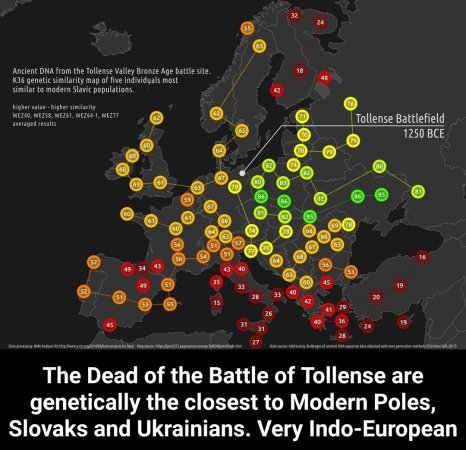
Some of the Tollense warriors share a lot of genetic drift with Slavs.

We have not just skulls, but also autosomal DNA samples of several warriors who died in the battle of Tollense in 1250 BC.

Of course warriors were from opposing armies, we don't know which warrior fought for which side, but we have their DNA.

Results indicate that some warriors were related to Balto-Slavs, some to Germanics, and some to "Southerners" (maybe from Pannonia). The battle was fought in Tollense River Valley (Tollensetal), at that time borderland between Nordic Bronze Age and Lusatian cultures:

EyHgjzZ.png


Lusatian culture was Pre-Proto-Slavic according to late Polish archaeologist - prof. Kostrzewski - who discovered Biskupin:


Kossinna was to some extent right when he linked archaeological cultures with ethnicities, as aDNA studies have proven.

Kostrzewski disagreed with that assumption that one prehistoric material culture = one prehistoric ethnicity.

But Kossinna was wrong when he attributed the Lusatian culture to Germanic tribes, perhaps Kostrzewski was right here.

Based on their preliminary autosomal results, it is not impossible that those eastern-shifted Tollense warriors were Proto-Slavs, or at least some kind of Balto-Slavs (Gimbutas could be right as well about prehistoric Balts extending as far west as the Oder). But we also need Y-DNA to confirm this. For example if none of them was R1a-M458, then in my opinion they could not be ancestors of Slavs because R1a-M458 almost certainly had to be present among Proto-Slavs.

If they find R1a-M458 among Tollense warriors, it will be certain that they were ancestors of Slavs.

Remember that so far the number of known ancient R1a-M458 samples is exactly ZERO.

Tollense warriors were mostly i2 which are most frequently found in Slavs with a diversity peak in Ukrainians
 
Tollense warriors were mostly i2 which are most frequently found in Slavs with a diversity peak in Ukrainians

But they had a different subclade. I2 has a very wide range and the I2 in Slavs, which is even more important, is the result of a very recent founder event. It does look like the original Baltoslavs were all R-Z283, which is also what the Mierzanowice Epi-Corded Ware groups and related fromations (like Nitra, Kostany and Füzesabony) were.
 
But they had a different subclade. I2 has a very wide range and the I2 in Slavs, which is even more important, is the result of a very recent founder event. It does look like the original Baltoslavs were all R-Z283, which is also what the Mierzanowice Epi-Corded Ware groups and related fromations (like Nitra, Kostany and Füzesabony) were.

The I2 subclade that expanded later with the Slavs in the middle ages no doubt was part of central European Urnfield culture and explains why Slavs also have highest levels of WHG ancestry. We know the Tollense warriors were carrying 30%+ WHG autosomal and match closest with Polish and Ukrainians today.

Otherwise what is your proposal for the origin of I2 in Slavs?
 
Last edited:
ATW the fact that todate Slavs have a lot of Y-I2 descending of ancient clades present among Lusace culture doesn't signify that these ancient Lusacians were already something like the Slavs or even like the Balto-Slavs...
 
ATW the fact that todate Slavs have a lot of Y-I2 descending of ancient clades present among Lusace culture doesn't signify that these ancient Lusacians were already something like the Slavs or even like the Balto-Slavs...

The Tollense warriors which were probably Lusatians match closest with Poles and Ukrainians of today, these 2 countries are considered to be the proto Slavic region. Of course they don't match exactly 100% with these bronze age people but close enough to make a case to being ancestral, will be clarified with more ancient DNA
 
The Tollense warriors which were probably Lusatians match closest with Poles and Ukrainians of today, these 2 countries are considered to be the proto Slavic region. Of course they don't match exactly 100% with these bronze age people but close enough to make a case to being ancestral, will be clarified with more ancient DNA
They were rather heterogenous concerning autoDNA - If a rely on an PA mentioned or made by Eurogenes, I find (20):
1 = Irish
1 = Southern (Iberia?)
5 = German
6 = German-Slav
3 = Central-Western Europe
3 = Slav
1 = Balto-Slav
We are far from a proxi for Slavs - This fact had been spoken about on Eurogenes and Eupedia, longly: I don't know where was positioned the earers of Y-I2a1b on this PCA...
The Tollense warriors which were probably Lusatians match closest with Poles and Ukrainians of today, these 2 countries are considered to be the proto Slavic region. Of course they don't match exactly 100% with these bronze age people but close enough to make a case to being ancestral, will be clarified with more ancient DNA
I keep on:
"the earers": no, the bearers - sorry - surely, two ethnies at first, with maybe, mercenaries ?
 
They were rather heterogenous concerning autoDNA - If a rely on an PA mentioned or made by Eurogenes, I find (20):
1 = Irish
1 = Southern (Iberia?)
5 = German
6 = German-Slav
3 = Central-Western Europe
3 = Slav
1 = Balto-Slav
We are far from a proxi for Slavs - This fact had been spoken about on Eurogenes and Eupedia, longly: I don't know where was positioned the earers of Y-I2a1b on this PCA...

I keep on:
"the earers": no, the bearers - sorry - surely, two ethnies at first, with maybe, mercenaries ?

Lusatians wouldn't have been exactly like modern Slavs, they were proto Slavs or ancestral to the Slavs. This is who the majority of Tollense warriors matched with and you can read this article to understand why Western Europe doesn't care much about researching this more - https://www.scirp.org/journal/paperinformation?paperid=123370

You can see there that Balts aren't related to these ancient samples like the Slavs are which means Balts are mixed, and we see a lot of Uralic N1 yDNA in modern Balts which didn't show up in Tollense
 

Attachments

  • 8a45fc43dcd6741bbe88b0b128516248e7612d5ae9bef3c151eccef6b54f3386_1~2.jpg
    8a45fc43dcd6741bbe88b0b128516248e7612d5ae9bef3c151eccef6b54f3386_1~2.jpg
    184.9 KB · Views: 300
Last edited:
Lusatians wouldn't have been exactly like modern Slavs, they were proto Slavs or ancestral to the Slavs. This is who the majority of Tollense warriors matched with and you can read this article to understand why Western Europe doesn't care much about researching this more - https://www.scirp.org/journal/paperinformation?paperid=123370

You can see there that Balts aren't related to these ancient samples like the Slavs are which means Balts are mixed, and we see a lot of Uralic N1 yDNA in modern Balts which didn't show up in Tollense
Thanks for the paper -
We have to consider several things:
- the total expansion of the Lusacian culture until North Poland is not the feflect of the cultural and the human forces that created the first Lusacian culture.
- This map of comparisons between ancient pops and modern ones don't show the distances between them (only the relative ones here) and are based, I suppose, on averaged pop, which is very mistaking. It doesn't reflect the heterogeneity which is real. I doubt today Eastern German are exactly Pols even if they are neatly closer to them than the Western Germans. What signifies that today Poles are not very closer for this artificial average of auDNA. Another interpretation was that this battle took place between two different people, one from North and another from Central Europe, with some outlayers in every party. First Lusacians were a mix where dominated central Europeans (Celts or even pan-Italics of the North, Unetice and maybe other. They were not, at least at the beginning, in a situation to give way to some kind of proto-Slavs. A part of these people took part effectively but later into the Slavs genesis. It's my religion todate, before I 'll put my nose deeper in this question.
 
The fact that modern Ukrainians fall very far of this average shows it was far enough from modern Poles mean since this last one todate is very close to the Ukraine one.
 
Thanks for the paper -
We have to consider several things:
- the total expansion of the Lusacian culture until North Poland is not the feflect of the cultural and the human forces that created the first Lusacian culture.
- This map of comparisons between ancient pops and modern ones don't show the distances between them (only the relative ones here) and are based, I suppose, on averaged pop, which is very mistaking. It doesn't reflect the heterogeneity which is real. I doubt today Eastern German are exactly Pols even if they are neatly closer to them than the Western Germans. What signifies that today Poles are not very closer for this artificial average of auDNA. Another interpretation was that this battle took place between two different people, one from North and another from Central Europe, with some outlayers in every party. First Lusacians were a mix where dominated central Europeans (Celts or even pan-Italics of the North, Unetice and maybe other. They were not, at least at the beginning, in a situation to give way to some kind of proto-Slavs. A part of these people took part effectively but later into the Slavs genesis. It's my religion todate, before I 'll put my nose deeper in this question.

Lusatians have nothing to do with Celts as the study and Tollense sampled showed, it literally shows that proto Slavs are related to Lusatians
 
The fact that modern Ukrainians fall very far of this average shows it was far enough from modern Poles mean since this last one todate is very close to the Ukraine one.

What are you on about? It says that Poles and Ukrainians are closest to the Tollense Lusatians with 86/85 similarities. It tells us that Poles and Ukrainians are the "purest" Slavs
 
Lusatians have nothing to do with Celts as the study and Tollense sampled showed, it literally shows that proto Slavs are related to Lusatians
Even if Wiki is not the Bible:

Reconstructed Biskupin (Poland)

Reconstructed fortifications and longhouses at Biskupin
The Lusatian culture developed as the preceding Trzciniec culture experienced influences from the Tumulus culture of the Middle Bronze Age, essentially incorporating the local communities into the socio-political network of Iron Age Europe.[3] It formed part of the Urnfield systems, origin of the Celts and Romans,[4][5][6][7] found from eastern France, southern Germany and Austria to Hungary and the Nordic Bronze Age in northwestern Germany and Scandinavia. It was followed by the Billendorf culture of the Early Iron Age in the West. In Poland, the Lusatian culture is taken have spanned part of the Iron Age as well (there is only a terminological difference) and was succeeded in Montelius VIIbc in the northern ranges around the mouth of Vistula by the Pomeranian culture spreading south.
'Lusatian-type' burials were first described by the German pathologist and archaeologist Rudolf Virchow (1821–1902). The name refers to the Lusatia area in eastern Germany (Brandenburg and Saxony) and western Poland. Virchow identified the pottery artifacts as 'pre-Germanic' but refused to speculate on the ethnic identity of their makers.[citation needed] The Polish archeologist Józef Kostrzewski, who started in 1934 to conduct extensive excavations of a Lusatian settlement of Biskupin, hypothesised that the Lusatian culture was a predecessor of later cultures that belonged to the early Slavs.[8] Modern archeologists, such as both K. Godłowski and P. Kaczanowski, hold the view that the ethnic geography of Bronze Age Central Europe then included peoples whose languages and ethnic identity are simply unknown....]
Sure their view on Urnfields as only Celtic-Italic is simplistic, but it shows that the dominant influences that gave birth to the Lusatian culturehad been central European at first -
And please, don't consider all the people fallen in the Tollense as parts of the same human group... seemignly the most drifted towards N-E had a majority of Y-R1a when the others, more "central", were Y-R1b and Y-I2? if what I read is true.
 
Don't worry about any of that, after Tollense samples Western Europeans have given up on linking Celts with Urnfield/Lusatians as they are closest to Poles and Ukrainians and very far from French, British etc. The Polish archeologists seemed to be correct all along to link Lusatians to proto Slavs.

The Tollense samples were mostly I2 and had 30-45% WHG autosomal ancestry (which also peaks in Slavs today), there was some R1b and less R1a though a couple of the R1b samples were related to French/Celts. These would have been recruits from the west while the majority of the force had deep roots in Poland
 
Last edited:
Don't worry about any of that, after Tollense samples Western Europeans have given up on linking Celts with Urnfield/Lusatians as they are closest to Poles and Ukrainians and very far from French, British etc. The Polish archeologists seemed to be correct all along to link Lusatians to proto Slavs.

The Tollense samples were mostly I2 and had 30-45% WHG autosomal ancestry (which also peaks in Slavs today), there was some R1b and less R1a though a couple of the R1b samples were related to French/Celts. These would have been recruits from the west while the majority of the force had deep roots in Poland

I'm sure you're well aware of the long established fact that haplogroups and autosomal ancestry don't have to correspond, for which there are many examples. However, I agree that the high presence of I2a among proto-Slavs does correspond to substantial WHG ancestry. But to make a case in point for what I wrote at the beginning of this post, take the South Slavs as an example, especially the Bosniaks of Bosnia-Herzegovina and the Croats. If one derives an estimate from all available sources, I2a may comprise as much as 50% of Bosniak Y-DNA, clearly the consequence of founder effects. Through Paleo-Balkanic admixture, South Slavs now have significantly more EEF than WHG ancestry.

The Baltic case also provokes confusion. More than 40% of their Y-DNA is the Uralic haplogroup N1a, which is owed to a bottleneck event, yet in terms of autosomal ancestry, the Uralic component is hardly detectable. It's higher among Swedes, for example, who have far less N1a (under 10%). WHG ancestry is especially high among the Balts. All this begs the question if our understanding and focus on haplogroups may be faulty and misguided. There are other such extreme cases, one of them being the Arabian peninsula with the highest Natufian ancestry in the Middle East. Yet the male lines are dominated by the Caucasian haplogroup J1, most likely mediated by pastoralists from Iran and the descendants of the Kura-Araxes culture, even though the latter had a much bigger genetic impact on the Semitic-speaking peoples of Mesopotamia, while the Arabian peninsula would have been more exposed to the incursion of Iranian pastoralists.

E-V13 may be a European haplogroup but it is still the mutation of E-M78 which came from the Middle East. It is the dominant haplogroup among Albanians (also the result of founder effects) but if you consider the Albanians' autosomal profile, their dominant Y-haplogroup should be G2a because their autosomal ancestry is predominantly EEF-related. The Sardinians belong mostly to I2a, yet they are the best genetic example of an EEF-related ethnic group, the other such group being the Basque who are predominantly R1b. The oddities are confusing and it remains to be seen if and how much the interpretation of raw data has been susceptible to error and perhaps even political manipulation. By political I don't necessarily mean ideological. Internal politics in academia has become a major obstacle to progress, not just in genetics and archeogenetics but other scientific disciplines as well. This overinflation of published papers is doing great damage to the credibility of this science. Along with increased politicisation, researchers are under pressure to publish in order to secure funds, not just for their own departments but their universities. So there's an interdepartmental pressure to appease other interests and expectations, too.

Just recently I read an article about the Anglo-Saxon and Norse invasions of Britain. The archeologists cited in the text claim that it was a peaceful transition, a clearly politicised statement which can and must be classified as BS. So here we have the problem of not only erroneous claims and conclusions but also of intellectual dishonesty at best and willful deception at worst, to fit a politically correct narrative. It doesn't surprise me that amateur genetics "enthusiasts" take everything for granted they find in a paper just because it's, well, a paper. Nobody seems to consider the wider picture of political, institutional and personal interests, financial pressure and a hyperinflated bureaucratisation of academic activities. All this creates an environment and a culture where securing a position with the prospect of a nice pension is more important than scientific truth. Eternally searching is the objective, not discovering, just like treating is more important than curing, if you look at it from the perspective of Big Pharma executives. And what is almost always overlooked, even ignored, is the most fundamental scientific question of all: the question of the right epistemology. It goes back to the Greek and has not been satisfyingly resolved due to the ever-presence of political and economic special interests. This has had catastrophic consequences for science in the last decades, most notably physics where mathematical fantasies have taken over and where it is expected that overly expensive particle accelerators and their dismantling of matter into its fundamental constituents will unlock all the secrets to reality, as if a brick equals a house. By the way, you will find the employment of a similar tool that may be described as mathematical fantasy in genetics. It's called PCA.

I'm sorry for this overlong comment but it's my final on a "scientific" field that is more entertaining than educating.
 
Last edited:
Celtic did not develop from the Urnfield complex, it predates Urnfield (according to recent linguistic publications). It seems that ethnogenesis and expansion of the Celts took place already in the Bronze Age (not during the Iron Age as thought previously). This is in line with ancieng DNA findings too.

One user on Polish history forum cited recent linguistic publications which push back the age of Celtic languages:

http://www.historycy.org/index.php?showtopic=152158&st=675&p=1749127&#entry1749127


^^^
"The first phase of Indo-Europeization of the Iberian Peninsula, represented by Lusitanian inscriptions, has to be dated back to the Early Bronze Age."


^^^
"Ancestors of Celtiberians, according to linguists, split from the rest of Celts already before the emergence of the Western Group of Urnfield Culture."

And here something in English, "The Language of the Ancient Lusitanians":

https://www.academia.edu/9563554/The_Language_and_the_Religion_of_the_Ancient_Lusitanians

Recent research on the chronology of Celtic expansion:

"(...) Chapter 9 gives a short description of the problem of the western expansions of the Indo-European tribes. The chronology of the Celtic invasions into the Hispanic Peninsula is reviewed. The present author accepts the hypothesis that the migration) of the Proto-Lusitanian tribes preceded all the Celtic invasions. He suggests (after Jan G. P. Best’s earlier proposal) that the proto-Lusitanian tribes were representatives of the so called Beaker culture, dating to 2600-1900 BC. This archaeological culture is found intermittently across Western Europe, from Ireland east to Hungary, and from Denmark south to Sicily (see map 20). According to James P. Mallory, the Beaker culture “has often been associated with the Indo- Europeans since there are good reasons to derive it from the area of the earlier Corded Ware culture (The Netherlands / Rhineland region is probably the most widely accepted), which is frequently regarded as early Indo-European. [...] Beakers are also sometimes linked with the spread of the domestic horse (in Ireland and parts of Iberia, for example), solar symbolism, weaponry, and the introduction of early metallurgy - all seen as Indo-European traits”. The findings of the Beaker culture in ancient Lusitania are abundant, so the hypothesis seems to be correct. What is more, the distribution of the late phase of the Beaker culture in the Hispanic Peninsula agrees with the distribution of the Indo-European place-names ending with -briga 'hill, castle (in the hill), town, city’ (see map 22), whereas the Iberian culture called El Argar connects with the distribution of the non-Indo-European place names beginning with Ili-, Ilti-. It is possible to suggest that the proto-Lusitanian tribes originated from the Netherlands and the Rhineland region. There are many lexical and phonological similarities between the onomastics of the Gallia Belgica, which was inhabited by the Belgians (i.e. an unknown Indo-European nation located “zwischen Germanen und Kelten”) and that of the Lusitania. The Proto-Belgians and the Proto-Lusitanians had to represent two branches of a Pre-Celtic population of Indo-European origin. (...)"

In other words, Iberia and Britain could already be Celtic-speaking during the Bronze Age.

Hallstatt and La Tene were not Proto-Celtic cultures and were not ancestral to all of Celts.

==========

Celtiberians and Lepontic-speakers according to linguists split from the rest of Celts around the middle of the 2nd millennium BCE, during the disintegration of the Tumuli Cultures, and came to Iberia and Italy during the Middle Bronze Age.

Celts in Italy:

"Diffusion of Canegrate culture
The Canegrate culture was a civilization of Prehistoric Italy who developed from the recent Bronze Age (13th century BC) until the Iron Age, in the areas of what are now western Lombardy, eastern Piedmont, and Ticino. Canegrate represented a completely new cultural dynamic to the area expressed in pottery and bronzework making it a typical example of the western Hallstatt culture.

The name comes from the locality of Canegrate in Lombardy, south of Legnano and 25 km north of Milan, where Guido Sutermeister discovered important archaeological finds (approximately 50 tombs with ceramics and metallic objects). The site was first excavated in 1926 in the area of Rione Santa Colomba, and systematic excavation occurred between March 1953 and autumn 1956, which led to the discovery of a necropolis of 165 tomb. It is one of the richer archeological sites of Northern Italy.

The necropolis found in Canegrate is very similar to those realized in the same period in the north of Alps. It represents the first migratory wave of the proto-Celtic population from the northwest part of the Alps that, through the Alpine passes, had already penetrated and settled in the western Po valley between Lake Maggiore and Lake Como (Scamozzina culture). They brought a new funerary practice—cremation—which supplanted inhumation."

Due to some problems of mine with the Last interface, unknown for me, my response was duplicated, the correct response is in the post below.
 
Last edited:
Very interesting article. I've been thinking for over a decade that Celtic culture originated from Western cultures, such as the Lusitanian-vettones, Cogotas culture, Atlantic Bronze Age, the Bell Beaker, megalithic, and even from the Neolithic, or older. On the other hand, I find the relationship with the Neanderthals a bit controversial.

IMO The celtic populations migration from Central Europe into the Iberian Peninsula around 5th and 4th centuries and many other, BC was due to a slow circular migration, with roots in the Iberian Peninsula, from mixed cultures of native Iberians and migrants from the Eastern European steppe, bringing with them genetics belonging to haplogroup R1b.
Greetings from Madrid.
 
Last edited:
Back
Top