
Kardu
Banned
- Messages
- 874
- Reaction score
- 80
- Points
- 0
- Ethnic group
- Georgian

The two big families Jumblat (derives from Kurdish Canpolat) and Arsalan (not sure about Arsalan) are of Kurdish origin.Ethnic origins
The Druze faith extended to many areas in the Middle East, but most of the surviving modern Druze can trace their origin to the Wadi al-Taymour in South Lebanon, which is named after an Arab tribe Taymour-Allah (formerly Taymour-Allat) which, according to Islamic historian, al-Tabari, first came from Arabia into the valley of the Euphrates where they were Christianized prior to their migration into the Lebanon. Many of the Druze feudal families whose genealogies have been preserved by the two modern Syrian chroniclers Haydar al-Shihabi and al-Shidyaq seem also to point in the direction of this origin. Arabian tribes emigrated via the Persian Gulf and stopped in Iraq on the route that was later to lead them to Syria. The first feudal Druze family, the Tanukh family, which made for itself a name in fighting the Crusaders, was, according to Haydar al-Shihabi, an Arab tribe from Mesopotamia where it occupied the position of a ruling family and apparently was Christianized.[28][page needed]
The Tanukhs must have left Arabia as early as the second or third century A.D. The Ma'an tribe, which superseded the Tanukhs and produced the greatest Druze hero in history, Fakhr-al-Din, had the same traditional origin. The Talhuq family and 'Abd-al-Malik, who supplied the later Druze leadership, have the same record as the Tanukhs. The Imad family is named for al-Imadiyyah — the Kurdish town of Amadiya, northeast of Mosul inside Kurdistan, and, like the Jumblatts, is thought to be of Kurdish origin. The Arsalan family claims descent from the Hirah Arab kings, but the name Arsalan (Persian and Turkish for lion) suggests Persian influence, if not origin.[28][page needed]
According to Jewish contemporary literature, the Druze, who were visited by Benjamin of Tudela, were described as descendants of the Itureans — an Ismaelite Arab tribe, which used to reside in the northern parts of the Golan plateau through Hellenistic and Roman periods.
Nevertheless, many scholars formed their own hypotheses: for example, Lamartine (1835) discovered in the modern Druzes the remnants of the Samaritans;[53] Earl of Carnarvon (1860), those of the Cuthites whom Esarhaddon transplanted into Palestine;[54] Professor Felix von Luschan (1911), according to his conclusions from anthropometric measurements, makes the Druze, Maronites, and Alawites of Syria, together with the Bektashis, 'Ali-Ilahis, and Yezidis of Asia Minor and Persia, the modern representatives of the ancient Hittites.[55]
During the 18th century, there were two branches of Druze living in Lebanon: the Yemeni Druze, headed by the Hamdan and Al-Atrash families; and the Kaysi Druze, headed by the Jumblat and Arsalan families.

igin of the Jumblatt family is the Kurdish Janpoulad family coming from Shamel Janpoulad and dating back to Janboulad Ibn Kassem al Kirdi al Kaisari, known as Ibn Arabou (1530–1580), and governor of Aleppo. Walid Jumblatt is the son of Kamal Jumblatt, the founder of the PSP, the party which Walid Jumblatt currently leads. He is the maternal grandson of Prince Shakib Arslan.[2] His first wife was Gervette "Gigi," a Jordanian woman of Circassian origin who is the mother of his child Timour. His current wife is the Syrian Nora Sharabati, the daughter of the former Syrian Minister of Defense Ahmed Al-Sharabati. Walid Jumblatt graduated from the American University of Beirut in Political Science.
"The picture of the little boy with the blue eyes and dark skin probably represents Ocular Albinism or Nettleship-Falls albinism, or Juvenile uveitis. Both conditions cause the pigment of the iris to be less dense"
The boys eyes look pretty normal to me, Albinism is relative imo and it depends on your own definition of it. I am not trying to be rude but in some kind of way you could say the North Europeans "suffer" also from a sort of "Albinism".

No, blue eyes in Europeans are due to a specific, inheritable genetic mutation.
Ocular albinism on the other hand is a medical condition...
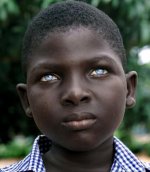
A quick trace of the flurry of hits revealed the picture before you. It is, perhaps, the best example of a black African, non-mulatto, non-albino, with blue eyes. Also, the boy in the picture does not appear to have Waardenberg Syndrome, also a source of blue eyes in blacks. This leaves the strong possibility of a rare mutation of a key eye color gene.

ok let it be so, still the boy does not look like he suffers from albinism, his skin color is normal, and his eyes too. Blue eyes of Albinos have a reddish touch.
the description says it is most probably

Is it make him sick? Is he going to die?Ocular albinism on the other hand is a medical condition...
Ocular albinism is a form of albinism which, in contrast tooculocutaneous albinism, presents primarily in the eyes.[1]There are multiple forms of ocular albinism, which are clinically similar.[2]:865
Both known genes are on the X chromosome.
https://en.wikipedia.org/wiki/Ocular_albinism
What's your point, LeBrok?
Does what you say challenge the claim that blue eyes among Europeans is due to a single mutation which occurred about 8000 years ago?
If what professor says is right, then Ocular Albinism cannot be a medical condition. Blue eyes won't make you sick even if you're African.The mutation of brown eyes to blue represents neither a positive nor a negative mutation. It is one of several mutations such as hair colour, baldness, freckles and beauty spots, which neither increases nor reduces a human’s chance of survival. As Professor Eiberg says, “it simply shows that nature is constantly shuffling the human genome, creating a genetic cocktail of human chromosomes and trying out different changes as it does so.”
Not so fastNot at all, I was challenging your understanding of relation between mutation and medical condition.
To add, here is a fragment of this article you posted.
If what professor says is right, then Ocular Albinism cannot be a medical condition. Blue eyes won't make you sick even if you're African.
Most likely the difference is that Blue eye Europeans got this OCA2 mutation in whole body, at least skin and eyes (as side effect of one of mutations of making skin whiter), where the African boy got this mutation in eyes only.
Is Ocular Albinism among Africans heritable like blue eye mutation among Europeans?
Yes, if it is a mutation that happened in early cell divisions. If this mutation happened only in eyes cells then no, sperm or egg won't carry it to next generation.
)

Thanks for this study. Every study on Kurds is GOLD for me. Shows me that the Medes and other ancient 'Umman Manda' in Kurdistan were mostly J2a folks.Y-chromosome variation in Tajiks and Iranians
http://informahealthcare.com/doi/abs/10.3109/03014460.2012.747628
https://fbcdn-sphotos-c-a.akamaihd.net/hphotos-ak-snc7/424863_3823408110088_1311194968_n.jpg
It's interesting to observe that in Persian sample R1a1 is 20.8%, in Tajiks - 30% while among Kurds - 0%
but you're way off topic now. I started this topic about totally other subject. Nothing to do with this. And what are you trying to say? That Kurds are not Iranic?
Well, if Kurds are not Iranic, Indians are not Indic, French are not Celtic, Germans are not Germanic, Italians are not Italic/Roman, modernGreeks are not Hellenic etc. This doesn't make any sense.