• Don't want to see ads? Install an adblocker like uBlock Origin or use a Europe-based privacy-friendly browser like Vivaldi or Mullvad.

Theory: I1 originally from Paloithic Cro magnon central Europe not Scandinavia

As far as curlyhair goes, I don't think it's true. We have a lot of andamese with straight hair. We really don't know where nappy hair comes from yet.

3 posts to go before you can link.

patience has its rewards:cool-v:
 
What percentage of old/ancient royal lines dominated the servicing of Women........something along the lines of Shaka and the Zulus?

If I1 was central european, then it was either pannonian, noric, illyrian, venetic or dacian ( earliest known tribal societies). later would have been celtic/gallic.
Then again Herodotus states, that after the Indians, the most populous people are the Thracians.
 
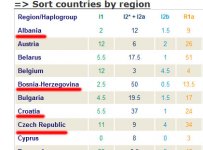
Maybe I1 originated in the Balkans in the paleolithic, who knows, but sometime in mid neolithic I1 almost went extinct and in the Bronze age it started expanding from germanic/nordic lands. The I1 that you see in the Balkans today is remnants from the -Illyrians/Thracians. I know because the percentage peaks with Albanians.

I1 does not peak in Albanians. It is more or less evenly distributed throughout the Balkans.
I1 distribution differs from all other haplogroups in that region because it neither fits in pre migration period haplogroups (like E-V13, J2, R1b-L23 or G2a) nor it fits in migration period haplogroups (I2a-Din and R1a which most likely came with the Slavs).

The first thing that comes to mind is that I1 was there before Slavs came, but came after pre migration period haplogroups. One logical conclusion is that it came with the Goths.

But when you go deeper you see that this kind of thinking is not enough. Reason for that are I1 clades found in the Balkans. As I wrote on another topic, predominant I1 clades seem to be Z63 and P109 (there is also some Z58 in Romania and Bulgaria). At this moment it is not possible to assume distribution pattern for these two clades in the Balkans. For example, if one of those clades peaks among Gheg Albanians and drops in frequency among Slavic nations it would be clear that it is not of Germanic origin and that it has been in the Balkans for thousands of years.

So the way I see it, we have to wait and see some more thorough research which would provide us the needed I1 clades data. At this moment at least one of these two clades does appear to had come in Balkans with Germanic tribes, and that is for the simple reason mentioned in the first paragraph - I1 does not geographically fit neither with pre-Slavic nor with Slavic haplogroups.
 
What percentage of old/ancient royal lines dominated the servicing of Women........something along the lines of Shaka and the Zulus?
All the celt and proto celt tribes were centered around women and that's why even today europe is more liberal in the true sense than anywhere else on earth. The patriarchal stuff came with the monarchies which came later from the east. Many of the royal lines are G which were the more eastern farmers who settled france and probably were related to the etruscans.
 
Norman... a few things. 1. Of course you aren't Spencer Wells, that was a joke. Your literal interpretation of my comment (F.H. made the same mistake) illustrates that I may have to be more careful with my audience. Not everyone shares my cunning wit I guess. 2. About the only thing I agree with you on is that all haplogroups are the same age. Even the ones that peeled off from the main trunk didn't stop evolving. 3. Celts have been breeding for negative blood type for YEARS. You wouldn't believe how easy it is to determine clotting factor, and their horse breeding/animal husbandry culture surely gave them a head-start here. I do think negative blood type came from Neanderthal and that the Norse had more of it initially. We didn't concern ourselves with this trait though, unlike the Druids.
 
I like you Norman. You charge into an I1 thread as a newbie, loudly and fearlessly proclaiming your ideas without letting fact and evidence slow you down. That shows massive cajones. I might make you an honorary Viking! Seriously, I look forward to our coming battles. You put it all out there, without parsing words... which is greatly appreciated. There are others on this site that hold your views, but won't announce their positions with such gusto. Nice to see this honesty. But please be warned, I am undefeated on these threads. A virtual master-debater. P.S. F.H. how do you have R1b conquering Southern Scandinavia? I have a decent chunk of R1b in Scandinavia brought in as slaves.
 
Last edited:
I said I know everyone knows I'm not spencer wells, but if I ignored the comment someone might think I am trying to pretend I am.

Interesting theory that there was conscious selection on negative blood type, had no idea it affected clotting. Even if so it should have led to other neanderthal genes hitchhiking, and ultimately unless you are trying hard to paint europeans as genocidal maniacs by birth you realize that natural selection does exist and that has to be how so many neanderthal characteristics have been kept (before homo sapiens came to europe they had very low numbers due to some massive climate change, otherwise they'd have failed to penetrate their territory as they had previously).

There's also a strong selection against negative blood type when in a postive blood type society. So probably there's less in I haplogroup because they didn't go as far west and they had to deal with more incursion from the east. I figure probably they were the pre-classic greeks so there had to have been outside influence.

Things like morton's toe are very doubtful to be selected on and exist in maybe 10-20% of europeans. Unfortunately we don't have any detailed info on it like we do with blood type.
 
I apologize for my multiple response format-- keep getting timed out and my edit feature is on strike. Yes Noman, it's true that Celts (R1b) do hold their women in higher status when compared to other cultures, but this was learned from the neighboring Norse. Is there a "tribe" that treats their ladies better than the Swedes or the Norwegians? Plus any archeologist worth his student loans will tell you that the Venus carvings associated with Gravettian (Lespuge, Hohle Fels) indicate paleolithic peoples of Europe have always held females in elevated esteem.
 
Touching on the Sentinelese Islanders (this is one of my favorite fields of study-- uncontacted tribes) they only appear to be of sub-Saharan extraction at first glance. Their facial features and body type are quite unique. Could they have the most Denisovan admixture of living peoples? I don't know, but this is a fascinating subject that could probably use it's own thread.
 
Maybe I1 originated in the Balkans in the paleolithic, who knows, but sometime in mid neolithic I1 almost went extinct and in the Bronze age it started expanding from germanic/nordic lands. The I1 that you see in the Balkans today is remnants from the -Illyrians/Thracians. I know because the percentage peaks with Albanians.

How do you know?What does I1 have to do with Albany? All I are less than 10 % there. How have you connected something that peaks in Albania with Illyrians or Thracians? Why have you grouped Illyrians and Thracians together anyway?
 
The funniest thing is the Schizophrenia;
On one hand there is NO such thing as an Indo-European lineage or even a substantial Indo-European migration
and on the other hand I1 is constantly connected to Indo-Europeans;
I have read (on this thread) about Balts, Thracians, Illyrians, Noricans, Pannonian, Venetic, Dacian and also Gallic/Keltic;

Also looks like an Archaeological wonderland;
Just randomly picking out Cultures without any sense behind it;

History has a documented time-line;
sticking to it wouldnt be a bad idea;
 
The funniest thing is the Schizophrenia;
On one hand there is NO such thing as an Indo-European lineage or even a substantial Indo-European migration
and on the other hand I1 is constantly connected to Indo-Europeans;
I have read (on this thread) about Balts, Thracians, Illyrians, Noricans, Pannonian, Venetic, Dacian and also Gallic/Keltic;

Also looks like an Archaeological wonderland;
Just randomly picking out Cultures without any sense behind it;

History has a documented time-line;
sticking to it wouldnt be a bad idea;
True that! I say let R1b and R1a fight that one out, they can have it. What I find interesting is that someone with Noman's viewpoint and myself are arguing about who has the closer tie to Neanderthal. This indicates a sea-change in Neanderthal acceptance/status.
 
How do you know?What does I1 have to do with Albany? All I are less than 10 % there. How have you connected something that peaks in Albania with Illyrians or Thracians? Why have you grouped Illyrians and Thracians together anyway?

In the Pericic study about ex-Jugoslavian countries, I1 peaks with Kosovar Albanians at about 5%. I have collected some data about South-Albanians and they have even more, at about 9%. That can't be the Goths, it's not paleolithic, not slavic, not roman. The most logical explanation is that is was the Illyrians or Thracians, or both.
 
wow this forum has went from the Baltics all the way down to Albania,well the only thing I know is i1 in the north france all the way to Denmark and Scandinavia area is Germanic,it just makes sense,also with r1b-u1o6 being three.i don't know where it started but I believe before the r1 groups came along the where the most northern of european haplogroups,bascically still is.what u think nordicquarrler?i respect your sparkey and macimo opinion
 
Is this a contest to see how many bad theories we can pack into one thread?


  • I1 is not likely to be over 10,000 years old in terms of TMRCA. Even if we add a Zhivotovsky-type "evolutionary" fudge factor to the date estimates to bring I1 to ~13,500 years old, we end up with it still being definitely younger that other haplogroups like I2, which end up being absurdly old (60,000+). So regardless of Fire Haired's theories, I1 very likely has a ~5,000 year TMRCA.


  • Western Finland has high I1, but it is a child branch amidst an otherwise quite Germanic group. It's also quite young. So no matter who introduced it, it must owe its present distribution to a founder effect. As a result, regardless of whether or not Germanic peoples introduced it to Finland originally, it says nothing about the origins of I1 as a whole.


  • Even if I1 originated in the Baltic, it was not likely spread by Balts. There is a temporal separation there. Balts could have *gasp* moved into, or formed within, the Pomeranian and Old Prussian region after I1 started to spread! We're talking 5000 years ago, after all, long before "Balts" were ever recorded. One of the most obvious differences between Germanic and Baltic populations is the I1:N1c ratio, which is much, much larger in Germanic populations.


  • R1b is not likely to be the Ice Age remnant of Western Europe. Even if you ignore STR and SNP dating as many seem to do nowadays, you have to contend with the fact that this is the question most clearly answered by the few ancient European Y-DNA samples we currently have. The earliest R1b we have is a Beaker sample.

I'm pretty sure I've answered these all before in different threads. But thanks for the compendium, everybody.
 
What I find interesting is that someone with Noman's viewpoint and myself are arguing about who has the closer tie to Neanderthal. This indicates a sea-change in Neanderthal acceptance/status.

LoL. When you look at the Neanderthals from out point of view they seem primitive and disgusting, but once you consider how we looked and behaved back then, they seem like a cultural, civilized and empathic beings :) I predict Stormfront soon be renamed into "Neanderthal supremacy board". It would work on so many levels :)
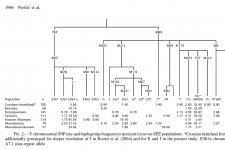


In the Pericic study about ex-Jugoslavian countries, I1 peaks with Kosovar Albanians at about 5%. I have collected some data about South-Albanians and they have even more, at about 9%. That can't be the Goths, it's not paleolithic, not slavic, not roman. The most logical explanation is that is was the Illyrians or Thracians, or both.

I don't see it peaking in Albanians. Anyway, Pericic didn't even get any samples from Albania, but only from Kosovo and Macedonia. Her results show ~ 5% of I1 in Kosovo, Macedonia, Serbia and Herzegovina, and we could relate this to Kosovar Albanians recent spread, but it doesn't necessarily mean we can connect it with any of the alleged tribes. We don't even know if those tribes existed, and who they were. And those I1 could easily be remnants of one Norman crusader who fell sick and abandoned his mission.

I1p.jpg


Other sources show rise of I1 as you go away from Albania:

I1.jpg
 
Back
Top